







Electric Hanging Orbit Crane For Power Plant
Products Description
The Electric Hanging Orbit Crane for power plants is an advanced, high-performance lifting solution designed specifically for handling heavy loads within power plant environments. It combines efficiency, safety, and versatility, making it ideal for maintenance, construction, and operational tasks in power stations, including thermal, hydro, and nuclear plants.
The crane operates on electric power, offering high reliability, low operational costs, and energy efficiency. It ensures smooth lifting and precise control, which is essential for the safety and efficiency of plant operations.The crane features a unique hanging orbit design, allowing it to travel along a fixed path within a defined area. This design ensures optimized space utilization, better load handling, and precise positioning, even in constrained environments.It is designed to handle a wide range of heavy components such as turbines, generators, transformers, and other large equipment found in power plants. It can support substantial lifting capacities, ranging from several tons to hundreds of tons, depending on the specific needs of the plant.
The crane's design ensures it can lift equipment to significant heights, which is particularly important in power plants for assembly, installation, and repair of large machinery at elevated positions. The crane is equipped with advanced electric control systems, ensuring precise and smooth movement of the load. It integrates intelligent control systems that provide real-time diagnostics, remote monitoring, and fault detection, ensuring minimal downtime.The crane includes multiple safety mechanisms, such as overload protection, limit switches, emergency stop systems, and automatic brake systems. These features minimize risks associated with heavy lifting operations in critical power plant environments.
The Electric Hanging Orbit Crane for power plants is built to withstand the harsh conditions of power plants, the crane is constructed with high-strength materials, ensuring long-lasting performance even in challenging environments such as high humidity, extreme temperatures, and heavy-duty operation.
The Electric Hanging Orbit Crane can be customized to fit a wide range of applications within power plants, whether it's used for lifting large equipment, handling materials, or aiding in plant construction and decommissioning projects.The crane supports remote operation, allowing for precise control from a safe distance. This feature is particularly important for reducing the risks to personnel working in potentially hazardous areas of the plant.The electric motor and advanced design offer energy-efficient performance, helping power plants reduce operational costs and lower their carbon footprint.
Core Components :PLC, Engine, Bearing
Place of Origin :Henan, China
Warranty :12 months
Weight (KG): 1000 kg
Video outgoing-inspection : Provided
Machinery Test Report :Provided
Control Method :Pendant Control+Wireless Control
Application : Workshop & warehouse, outdoor, etc.
Working Duty: A3-A5
Working Temperature: -25-+40℃
Power Source :3 Phase 380V 50hz Or Accord Your Requirements
Color :Red, Yellow, Blue Or Your Requests
Keyword :Overhead Crane
After Warranty Service :Online support

Pictures & Components
1.Main beam
The main beam of an electric hanging orbit crane, especially for a power plant application, is a critical structural component designed to support and carry the loads during lifting operations. The specifications and design considerations of the main beam vary depending on the type of crane and its specific use.
It is typically made of high-strength steel (e.g., Q345B, Q235, or alloy steel) to ensure durability and resistance to heavy loads.The main beam is often an I-beam or box-shaped structure, designed to distribute the load evenly across its span.The main beam must be able to withstand both vertical and lateral forces. It will usually have reinforcements in high-stress areas to avoid deformation during operation.
Power plant cranes typically handle large, heavy loads, often involving heavy machinery, large transformers, or power plant components. Therefore, the main beam is designed with a high load-bearing capacity, which can range from several tons to hundreds of tons, depending on the crane's intended use.The crane may have additional safety factors built in, such as overload limiters, to prevent accidents.
The span of the main beam is typically designed to cover the full width of the area to be serviced by the crane, which could be anywhere from a few meters to over 100 meters in large industrial applications like power plants.For high ceiling clearance and maximum lifting height, the design of the beam will allow for proper clearance without interference with the structure above.
The beam is typically supported by end trucks or wheels that run along a fixed rail track or gantry. These tracks are designed to support the weight of the crane, its load, and any additional forces encountered during operation.
Traveling Mechanism: The beam is usually equipped with electric motors that control the horizontal (lateral) movement along the track. The motors are carefully chosen based on the load capacity and operational speed required.
Lifting System
The lifting system of an electric hanging orbit crane for a power plant is designed to handle heavy loads and work in demanding industrial environments like power plants.
Girder (Bridge): The main structural element that spans the work area. It typically consists of a horizontal beam, supported by end trucks or wheels.
End Trucks: The units at both ends of the crane that move along the rail or track, allowing the crane to move horizontally across the work area.
Motorized Hoist: A key component that raises and lowers loads. The hoist is typically powered by an electric motor, which drives a chain, rope, or cable drum.
Lifting Mechanism: Usually consists of a drum or a chain block, around which the lifting medium (cable, chain, etc.) winds. The hoist is designed to support the weight of the load and operate reliably in heavy-duty environments.
Load Capacity: Lifting systems in power plants often have large load capacities (up to hundreds of tons), depending on the application (e.g., turbine assembly, maintenance, etc.).
Track System: The crane moves along a circular or linear track system, often mounted overhead on the plant's structure. For an "electric hanging orbit crane," this track would allow the crane to move in a defined orbit or path around a specific area, providing flexible movement over large workspaces.
Rail System: Rails are mounted on the overhead structure or on the ground. The crane travels along these rails using wheel assemblies, which are powered by electric motors. In some cases, the crane may move along a custom-designed track to follow a path suited for a specific operational process.

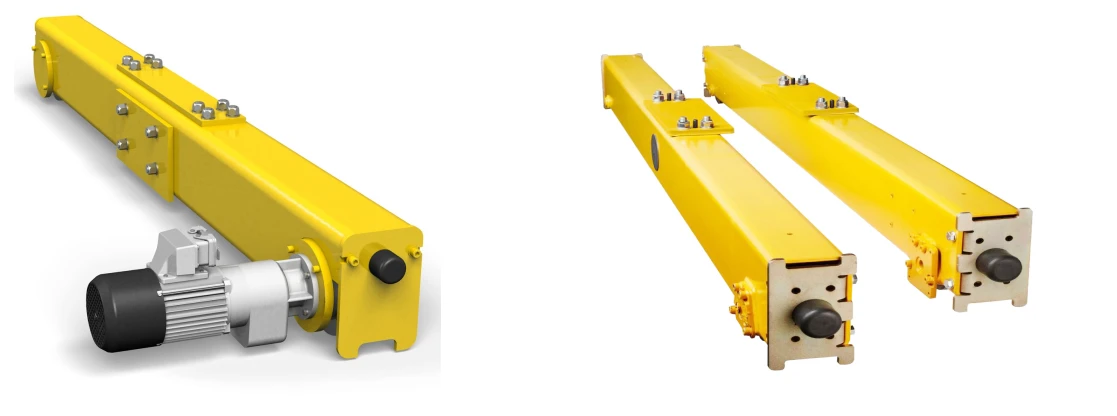
3.End carriage
The end carriage of an electric hanging orbit crane for a power plant is a critical component responsible for supporting and guiding the movement of the crane along the tracks or rails. It typically houses the wheels, drive mechanism, and support structure that allow the crane to move horizontally along the crane runway.
Function of End Carriage:
Movement Support: The end carriage ensures the crane can travel along the overhead track or runway. It supports the load and maintains the stability of the crane during operations.
Structural Support: It connects the bridge structure (which holds the hoist and other lifting equipment) to the rail system, ensuring the bridge can move freely along the tracks.
Guiding the Crane: The end carriage houses the drive mechanism (usually a motor and reducer) to propel the crane across the runway. It also includes wheels that run on the tracks.
Key Components of End Carriage:
Wheels: The wheels are designed to handle the weight of the crane, the load, and any dynamic forces during movement. They are typically made of high-strength materials like steel and are designed to operate on specific rail profiles.
Drive Mechanism: This can consist of an electric motor, gear reducer, and coupling system. The motor drives the wheels, allowing the crane to move horizontally.
Frame/Support Structure: The frame of the end carriage is designed to support the crane bridge, the hoist, and the load. It is typically made of welded steel to ensure strength and durability.
Bearings: High-quality bearings are used to reduce friction between the wheels and tracks and to allow smooth movement.
Electrical System: Includes electrical connections for powering the motor, and in some cases, safety and control systems for overload protection, speed control, and emergency stop mechanisms.
Braking System: A braking system is incorporated to stop the crane safely when needed. This can be either a mechanical brake, electromagnetic brake, or regenerative braking system.
4.Crane travelling mechanism
1) Working principle
The crane receives electrical power through cables or an overhead conductor system. The electrical power is fed to the motors, which drive the crane's movement.The crane operator uses a joystick, pendant, or remote control to send commands to the control system. These commands activate the motors that drive the wheels or trolleys, enabling the crane bridge to move along the tracks.The speed at which the crane moves is typically adjustable. It is controlled through the motor speed or variable-frequency drives (VFDs), allowing precise control.As the crane moves horizontally, it can be used to transport heavy loads across the power plant. The hoist mechanism (often with a trolley) allows for vertical lifting and lowering of loads, while the traveling mechanism enables horizontal movement.The crane's traveling mechanism includes a braking system that ensures controlled stopping and safety during operations.
2) Functions of the crane operating mechanism
The crane traveling mechanism of an electric hanging orbit crane, particularly in a power plant, plays a crucial role in ensuring the efficient and safe movement of heavy loads across a wide area. Here are the key functions of the crane's traveling mechanism:
Movement of the Crane Along the Track:The primary function of the traveling mechanism is to move the entire crane structure horizontally along the rail or track system installed on the crane's supporting structure.The mechanism uses wheels or trolleys that are driven by motors to move the crane horizontally, typically in a longitudinal direction (across the plant or work area).
Horizontal Load Transport:The traveling mechanism enables the crane to move heavy loads (such as equipment, materials, and tools) horizontally across the plant, allowing for precise placement or transport between various sections of the facility.This helps in tasks like transferring coal, raw materials, equipment, or even assembling power plant machinery in the designated areas.
Power Supply and Control:The traveling mechanism is powered by electric motors that are connected to a power supply. These motors are responsible for controlling the speed, direction, and movement of the crane.The crane operator controls the mechanism through a control panel or remote system, ensuring safe operation.
Precision and Safety:The traveling mechanism is designed to operate with high precision, which is vital in a power plant where load positioning is critical, such as during equipment maintenance or installation.It also includes safety features like overload protection, anti-collision sensors, and emergency stop systems to ensure safe operation within the plant environment.
Coordination with Other Crane Movements:The traveling mechanism works in tandem with other crane movements, such as hoisting (vertical movement) and trolley movements (horizontal load shifting).This coordinated operation allows the crane to perform tasks like lifting, transporting, and placing heavy equipment accurately within tight spaces, such as around turbine halls, reactor buildings, or transformer stations.
5.Trolley travelling mechanism
1) Structural composition
The trolley traveling mechanism of an electric hanging orbit crane (often referred to as an electric overhead crane or EOT crane) in a power plant typically consists of several key structural components that work together to allow for the precise movement of the crane along its track or runway.
Trolley Frame: The trolley frame is the main structural component that supports the crane's load and various mechanical systems. It is designed to be rigid and durable to bear the dynamic loads during operation. Usually fabricated from steel or welded sections to ensure strength and stability.It provides a platform for other components like the hoist and motor and allows movement along the runway.
Motors and Gearboxes: These are the driving force behind the trolley's movement along the track. They are typically AC motors that provide the necessary torque for travel.A reduction gearbox is used to step down the motor's high-speed output to the lower speed required for the trolley's travel motion.To drive the trolley along the runway track at a controlled speed.
Travel Wheels and Axles: These are mounted on the trolley and are in direct contact with the overhead crane's track. They are designed to withstand heavy loads and dynamic forces. Typically made of high-strength steel or cast iron.These are mounted on the trolley frame and carry the travel wheels. They ensure proper alignment and smooth movement.To allow the trolley to travel along the track (overhead crane runway) smoothly and with minimal friction.
End Trucks: End trucks are structural units located at both ends of the trolley frame. These trucks house the motors, wheels, and other components needed to guide the trolley along its path.End trucks allow the transfer of the trolley's load from the fixed runway structure to the mobile trolley, supporting movement across the track.
Braking Mechanism: The trolley's electric traveling motor is usually equipped with electric brakes to stop the movement of the trolley. They help prevent uncontrolled movement and provide smooth deceleration.Sometimes, mechanical disc or drum brakes are included for additional safety and control.To control the speed of the trolley and stop it safely during operation.
2) Function of the trolley operating mechanism
Horizontal Movement of the Load:The primary function of the trolley mechanism is to move the crane hook (or lifting device) horizontally along the beam (also known as the crane girder or runway) of the overhead crane system. This movement allows the crane to place the load at different positions across the entire working area, such as above equipment, machinery, or other structures in a power plant.
Load Positioning:The trolley mechanism ensures precise positioning of the load, which is crucial in power plant settings where heavy equipment or materials need to be moved safely and efficiently. Accurate positioning is essential for tasks such as assembling machinery, lifting and placing heavy components, and carrying out maintenance tasks.
Motorized Drive and Control:The trolley is typically powered by an electric motor, which drives the wheels of the trolley along the crane runway. The speed and direction of the trolley's movement are controlled via an electrical system, providing flexibility and precision in positioning the load. The motor may be operated with variable speeds, allowing for careful handling of sensitive or heavy loads.
Structural Support:The trolley is mounted on the crane girder and is designed to bear the weight of both the load and the lifting mechanism (hook, hoist, etc.). It needs to be sturdy enough to handle the forces generated by lifting and moving heavy loads, often in challenging industrial environments like power plants.
Safety and Load Control:The traveling mechanism is designed with safety features to ensure stable movement. It includes limit switches, braking systems, and overload protection devices to prevent accidents or mechanical failure during operation. In a power plant, where there might be a need to handle critical or hazardous equipment, these safety features are crucial to avoid accidents or damage to equipment.
6.Crane wheel
The crane wheel for an electric hanging orbit crane used in a power plant plays a crucial role in the overall functioning and safety of the crane system. These cranes are typically employed for lifting heavy loads, such as equipment and materials, within power plant facilities. The wheels are part of the crane's running gear and allow the crane to travel along the bridge or rail system.
Crane wheels are usually made of high-strength steel or alloy to withstand the heavy loads and stresses they encounter.Given the constant movement and load-bearing requirements, the wheels must be able to withstand wear and tear over time. Some materials may be treated to increase their hardness and resistance to wear.The tread of the wheel (the part in contact with the track) is often designed for optimal grip and smooth operation. A crowned tread or a tapered wheel profile can help distribute the load evenly and reduce wear on both the wheels and the rail.The diameter of the crane wheels is important for load distribution and stability. Larger wheels may be used for heavier cranes or when high-speed travel is required.
Functionality:
Support: Crane wheels support the weight of the crane's structure, including the load it's carrying, and ensure smooth movement along the track.
Movement: The wheels facilitate horizontal movement of the crane along the gantry, ensuring that the crane can reach different areas of the plant. They are often connected to a drive mechanism (typically electric motors) that powers the crane's movement.
Stability: The crane wheel system ensures the stability of the entire crane, preventing tipping and ensuring smooth and accurate motion along the track or rail system.
Wheel Types:
Single Flanged Wheels: These are commonly used on cranes that run on rails and offer stability in the lateral direction.
Double Flanged Wheels: These have a flange on both sides of the wheel, which can offer additional stability and help prevent derailing, especially in high-speed applications.

Crane Hook
A crane hook in the context of a trussed-type electric hoist gantry crane is a critical component designed for lifting and transporting loads.
Function
Lift and lower loads by attaching to the load's lifting points.
Hold the load securely while it's being moved across the crane's travel span.
Allow for quick attachment and detachment from loads, depending on the specific operation.
Types of Crane Hooks
Single Hook: The most common type, used for lifting loads with a single point of contact.
Double Hook: Used when extra stability is required, often for heavy or unevenly distributed loads.
Specialty Hooks: These can be customized for unique applications, such as magnetic or grab hooks for specific industries.

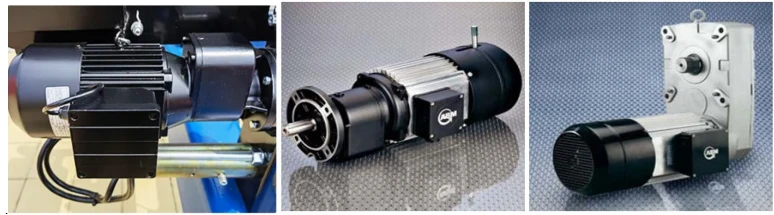
Motor
The motor for an electric hanging orbit crane in a power plant is a critical component that drives the crane's movement, including hoisting, traversing, and possibly rotating operations. For such an industrial application, the motor needs to be robust, reliable, and capable of operating under heavy load conditions.
Motor Type:
AC Motors (Alternating Current): These are commonly used for electric cranes due to their efficiency, durability, and ease of maintenance. Specifically, squirrel cage induction motors are often preferred for their robustness and cost-effectiveness.
DC Motors: Less common today but may still be used for precision control in applications requiring variable speeds and high starting torque.
Synchronous Motors: Used in applications where precise speed control and constant speed under varying loads are important.
The motor's power rating should be sufficient to handle the maximum load that the crane will carry. This includes not just the weight of the load itself but also factors like friction, wind load (in open areas), and the nature of the movements (hoisting, traveling, or rotating).The typical power range can vary from a few kW for light-duty cranes to hundreds of kW for heavy-duty applications in power plants.

.
Sound and light alarm system & limit switch
1) Sound and light alarm system
The sound and light alarm system for an electric hanging orbit crane in a power plant is crucial for ensuring safety, operational efficiency, and alerting personnel to any issues during crane operation. Here's an outline of how such a system typically works and the key components:
Sound Alarm:The sound alarm is usually a loud, attention-grabbing sound, like a siren or buzzer, activated in case of an emergency or abnormal condition.It helps in alerting workers in and around the crane's operation area, especially in noisy industrial environments like power plants.The sound can vary in pitch or volume depending on the severity of the situation (e.g., a slow tone for warnings and a rapid, high-pitched tone for critical conditions).
Light Alarm:The light component of the alarm system typically consists of flashing or steady lights.These are often color-coded for different types of alerts (e.g., red for emergency, yellow for caution, green for normal operation).The lights can be mounted on the crane structure, control panels, or nearby equipment, providing a visual warning to operators and personnel working in the vicinity.
2) Limit switch
A limit switch in an electric hanging orbit crane for a power plant is an essential safety and control component. It is designed to detect the position of the crane's hoist, trolley, or other moving parts to ensure they do not exceed their intended travel limits.
Purpose of the Limit Switch
Prevents Over-travel: The primary function is to limit the movement of the crane, preventing the hoist or trolley from moving beyond predefined positions (e.g., the end of the track or maximum height).
Safety: Protects the crane and its components from damage caused by over-travel or collisions. It also protects workers and other equipment from accidents.
Operational Control: Provides feedback to the crane's control system, ensuring the crane operates within safe and defined parameters.
Types of Limit Switches Used
Mechanical Limit Switches: These are commonly used in cranes. A mechanical arm or lever is activated when a moving part reaches a certain point. The switch either opens or closes a circuit to stop further motion.
Proximity Limit Switches: These sensors detect the presence or absence of an object without physical contact. These are useful in environments where mechanical wear could be a concern or where more precise control is needed.
Rotary Limit Switches: These can be used to detect rotation of the crane's hoist or trolley wheels and set rotational limits to prevent the equipment from going too far.

10.Safety Devices
1. Overload Protection Device: Prevents the crane from lifting loads beyond its rated capacity.Often includes a weight sensor or load cell, which triggers an alarm or automatically cuts power to the lifting mechanism if an overload condition occurs.Protects both the crane structure and the lifted load from potential damage.
2. Limit Switches: Prevents the crane from traveling beyond its designed travel limits (both horizontal and vertical). Used to prevent the trolley or hoist from going past the track's end. Prevents the hook from traveling too high.Ensures the crane operates within safe boundaries to avoid mechanical damage or accidents.
3. Emergency Stop Button: Instantly cuts power to the crane in the event of an emergency.Typically located at easily accessible points, such as the crane operator's station and along the crane path.Provides a quick response to halt crane movement if an unsafe situation arises.
4. Anti-Sway Control: Reduces the swinging motion of the load during lifting and movement.Helps ensure the load remains stable, reducing the risk of accidents or damage due to load instability.
5. Crane Monitoring Systems: Continuously monitors and displays various crane performance metrics, such as load weight, operating speed, and movement.Includes Allows operators to quickly detect potential issues and avoid unsafe operating conditions.
6. Brake Systems: Stops the crane in a controlled manner when required.
Motor brakes: Commonly used to stop the movement of the motorized components.
Dynamic brakes: Convert the kinetic energy of the moving crane into electrical energy, providing smoother stopping.
Importance: Ensures precise control over the crane's stopping actions, reducing the risk of accidents.
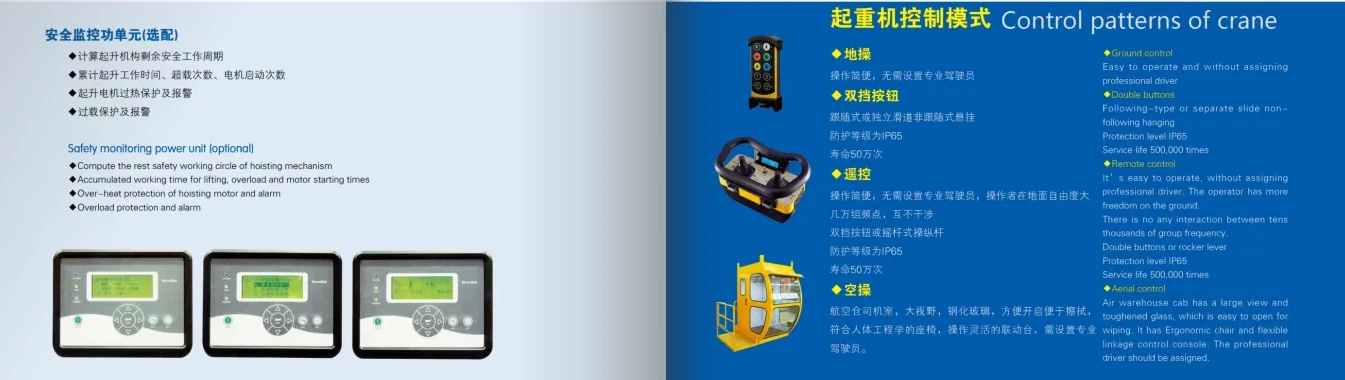
11.Control Mode
1. Manual Control Mode:
Joystick Control: The operator uses a joystick or button-based control system to manually guide the crane in all directions (horizontal and vertical movement, hoisting, etc.).
Manual Overrides: The operator has the option to control individual motions such as the hoist, trolley, and bridge independently.
Common in Smaller or Less Complex Operations: Suitable for situations where precise control is needed or where automation isn't feasible.
2. Semi-Automatic Control Mode:
Automated Movement: The operator can set certain movements, such as travel along the tracks or hoisting/lowering loads, and the crane will perform those movements automatically.
Manual Intervention for Precision: If the operator needs more precision for a particular task, manual control can be taken over for fine-tuning.
Load Positioning: The crane may have a built-in system for automatically positioning the load within certain predefined parameters (such as set travel paths or specific drop points).
3. Fully Automatic Control Mode:
Pre-programmed Routes: The crane can follow a set route, usually defined by programmed paths and points on the track. These are commonly used for repetitive or routine tasks like moving materials between fixed points in the power plant.
Sensors and Feedback Systems: Equipped with sensors and a PLC (Programmable Logic Controller) to monitor the position, speed, and load to ensure safe operation. This mode is typically used in more sophisticated power plants.
Automatic Load Positioning and Lifting: The system can automatically lift and place heavy loads based on pre-determined operational sequences, reducing the need for manual input.
4. Remote Control Mode:
Wireless Control: Operators use wireless devices (remote controls or tablets) to control the crane from a distance. This is useful for enhancing safety (operator is not in the immediate danger zone) or for more flexible operation.
Short Range or Long Range: Some systems are designed for short-range operation within the plant, while others may allow for longer-range operation from a central control room.
12.Sketch
Main technical

Advantages
Enhanced Operational Efficiency
High Lifting Capacity: They can handle heavy loads, such as turbines, generators, and other large equipment, making them suitable for power plant operations.
Precision Control: Advanced electric motors and control systems allow for smooth and precise movement, reducing the risk of accidents and improving work efficiency.
Space Optimization
Hanging Design: The overhead installation leaves the ground space free for other activities, optimizing the available workspace in the power plant.
Compact Design: It fits well into the limited space of a power plant without obstructing ongoing operations.
Safety Features
Automation: Automated systems reduce the need for manual operation, lowering the risk of human error.
Safety Mechanisms: Modern cranes come equipped with overload protection, emergency stop systems, and anti-collision technology to enhance safety.
Cost-Effectiveness
Reduced Labor Costs: Automation and mechanization reduce reliance on manual labor for heavy lifting.
Durability: These cranes are designed for long-term use, minimizing maintenance and replacement costs over time.
Customizability
Tailored Designs: They can be customized to meet specific requirements, such as lifting capacity, height, and movement range, ensuring they are perfectly suited for various tasks within the power plant.
Multi-functional Applications: They can be adapted for material handling, equipment assembly, and maintenance operations.
Improved Productivity
Faster Operations: The electric motors ensure quick and efficient movement of materials, minimizing downtime and enhancing productivity.
Continuous Operation: Capable of 24/7 operations without performance degradation, which is crucial for high-demand environments like power plants.
Environmental Friendliness
Electric Power Source: These cranes use electricity, reducing carbon emissions compared to diesel-powered alternatives, aligning with green energy initiatives in power plants.
Reduced Equipment Wear
Gentle Handling: Precision controls and advanced braking systems reduce stress on both the crane and the lifted objects, prolonging the lifespan of the equipment being handled.
Application:
1. Handling of Heavy Equipment
Turbine and Generator Installation: In thermal, hydro, and nuclear power plants, turbines and generators are heavy and require specialized lifting equipment for installation. Electric hanging orbit cranes can lift and position these components accurately in confined or restricted spaces.
Transformers and Switchgear: These large electrical components often need to be moved within the plant for maintenance or during installation. The cranes can be used for lifting, shifting, and positioning transformers and switchgear units.
Boiler and Pressure Vessel Assembly: Boilers and pressure vessels are essential parts of power plants, and the crane system can assist with their installation and maintenance by positioning them in tight spaces.
2. Maintenance and Overhaul
Routine Maintenance: Regular inspection and maintenance of plant equipment require moving parts such as motors, pumps, and large valves. An electric hanging orbit crane provides the flexibility to transport these parts safely and efficiently to maintenance areas.
Repairs and Component Replacement: Power plants often need to replace worn-out or damaged components like heat exchangers, fans, or piping systems. The crane can be used to lift and replace such parts.
Removal of Scrap and Waste: During overhauls or repairs, debris, scrap metal, or other waste materials need to be removed from the site. Cranes can efficiently clear away waste materials without causing damage to the plant's infrastructure.
3. Precise Handling in Restricted Areas
Power plants often have limited space, and the design of electric hanging orbit cranes makes them ideal for precise handling of materials in these confined spaces. The crane can be easily maneuvered along the tracks to access difficult-to-reach areas, making it suitable for the complex layouts of many power plants.
4. Safety and Efficiency
Load Positioning: The ability of electric hanging orbit cranes to move loads slowly and with high precision helps ensure that heavy equipment is positioned safely without risking damage.
Automation and Control: Many modern electric hanging orbit cranes are automated, providing greater control and safety. Operators can control the crane from a distance, minimizing the risk of accidents and improving operational efficiency.
5. Construction and Expansion Projects
During the construction phase or plant expansion, the cranes are essential for lifting structural components, piping, and mechanical systems into place. They can also be used for assembling plant infrastructure, such as platforms and staircases, that require heavy lifting.
Crane production procedure
1. Design & Engineering: Understanding the specific lifting requirements, load capacities, and working conditions of the power plant.Designing individual components of the crane such as the crane girder, hoist, trolley, electric motor, and control systems.Ensure the crane is robust enough to handle the environmental conditions of a power plant, including factors like temperature variations, high humidity, and potential exposure to harsh chemicals.Perform structural and mechanical calculations to ensure the crane can lift the required loads with the proper safety margin.Detailed 3D models of the crane system, including the girder, hoist, trolley, and electrical control systems.
2. Material Procurement: High-strength steel for the main crane structure, as well as steel plates, beams, and profiles for the girder and frame.Motors, controllers, electrical wiring, sensors, and safety systems.Bearings, gearboxes, brakes, wheels, and safety devices like limit switches, overload protectors, etc.
3. Fabrication: Cutting steel plates and profiles according to the design specifications for the crane girder, trolley frame, and other structural components.Assembling the crane components using welding techniques to ensure the frame is strong and precise.Milling and turning operations to create precise components like the trolley wheels, axles, and bearings.Assembling the hoist, trolley, and end trucks (which move along the crane track).
4. Hoist and Trolley System Assembly: This includes the electric motor, gearbox, drum or chain system, and lifting hook or load block. The hoist should be capable of lifting loads safely and efficiently.This part includes the frame and wheels that allow the hoist to move along the crane's girder. The trolley is powered by motors and ensures smooth horizontal movement of the hoist.
5. Electrical and Control System Installation: Installing wiring for the crane's power supply, motor controllers, and safety mechanisms.A central control panel is designed and assembled to allow operators to control crane movement, including speed and load lifting.Integration of safety systems such as limit switches, overload protectors, emergency stop buttons, and anti-collision sensors.
6. Assembly of the Crane Structure: The crane girders (the main horizontal beams) are assembled first, followed by the attachment of the end trucks, which house the motors and wheels that move along the runway rails.The crane's wheels are fitted onto the rails on the runway structure, ensuring smooth movement.
7. Testing & Commissioning: Test the crane's ability to handle static loads that are near or at its rated capacity.Conduct dynamic testing, including lifting and lowering the load while checking for any vibrations, misalignments, or instability in the system.Testing the crane's safety features, such as limit switches, overload sensors, and emergency stop functions. Full operational testing, ensuring the crane moves along both the horizontal and vertical axes smoothly, accurately, and without undue noise or vibration.
8. Final Inspection & Quality Control: Ensure all components meet the required standards and specifications. This includes visual checks, dimensional inspections, and weld quality checks.Certification of the crane based on international standards (e.g., ISO 9001, EN, or IEC standards).
9. Delivery and Installation: After all tests are complete, the crane may be disassembled and packed for transport to the power plant site.Preparing the site where the crane will be installed, including the setup of runway rails, power supply connections, and installation of safety barriers.The crane is then reassembled and installed at the power plant. This includes connecting the electrical system and ensuring the crane runs smoothly.

Workshop view:
The company has installed an intelligent equipment management platform, and has installed 310 sets (sets) of handling and welding robots. After the completion of the plan, there will be more than 500 sets (sets), and the equipment networking rate will reach 95%. 32 welding lines have been put into use, 50 are planned to be installed, and the automation rate of the entire product line has reached 85%.


Hot Tags: electric hanging orbit crane for power plant, China electric hanging orbit crane for power plant manufacturers, suppliers, factory, Bridge Crane, Double Girder Bridge Crane with Electric Hoist
Previous
Homemade Bridge CraneYou Might Also Like



Send Inquiry