








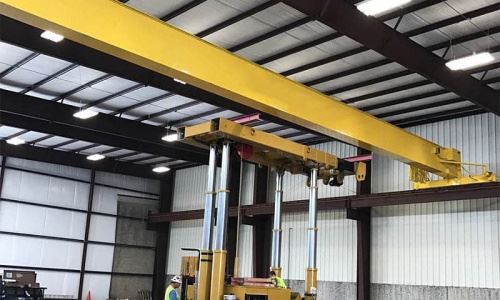


Homemade Bridge Crane
Products Introduction
Products Description
Key Features:
Compact Design: Optimized for space-saving installation, with a low headroom profile to maximize working area.
High Performance: Capable of handling loads ranging from 1 ton to 20 tons, ensuring reliable operation for diverse tasks.
Durable Construction: Made with high-quality steel and precision engineering to guarantee long-term durability and safety.
Smooth Operation: Equipped with advanced hoisting mechanisms for precise and efficient load handling.
Customizable Options: Available in various configurations, including manual, electric, and motorized models, tailored to your specific requirements.
Place of Origin:Henan, China
Warranty:1 Year
Weight (KG):30000 kg
Video outgoing-inspection:Provided
Machinery Test Report:Provided
Lifting mechanism:Heady Duty Trolley
Control method:Ground Control+Remote Control
Application:Lifting Goods
Crane feature:High Efficiency
Color;Customized Color Acceptable
Power Source:3 Phase 380V 50hz
Work Duty:A6

Pictures & Components
1.Main beam
Design and Structure:
1)Single Girder Configuration:
The homemade bridge crane's main beam is composed of a single horizontal girder, providing a simpler and lighter structure compared to double girder cranes.
2)Material:
Made from high-strength steel (e.g., Q235 or Q345), ensuring durability and resistance to deformation under load.
3)Cross-Section Types:
I-Beam (Rolled Steel Girder): Lightweight and cost-effective, suitable for lower lifting capacities.
Box Girder: More robust, used for higher load capacities or longer spans, offering enhanced stability and rigidity.
4)Span:
Customizable span lengths, typically ranging from 6m to 30m, depending on application requirements.

2.Lifting System
1)Electric Hoist:
The electric hoist is the primary lifting device mounted on the single girder.
Types:
Wire Rope Hoist: Ideal for higher lifting capacities and precision.
Chain Hoist: Compact and economical, suitable for lighter loads.
Features:
High lifting capacity (commonly 1–20 tons).
Smooth and precise lifting with speed control options.
Equipped with brakes for load safety during lifting and holding.
2)Trolley:
The trolley supports the hoist and allows horizontal movement along the main beam.
Types:
Monorail Trolley: Moves along the bottom flange of the girder.
Low Headroom Trolley: Optimized for spaces with limited vertical clearance.
Operation:
Manual or motorized, depending on the homemade bridge crane's design and application.
3)Motor and Gearbox:
The hoist and trolley are powered by electric motors coupled with gearboxes.
Provides efficient power transmission for smooth and precise movements.
4)Hook or Lifting Attachment:
A hook or specialized lifting device (e.g., magnet or grab) is attached to the hoist for holding the load.
Features high-grade alloy steel construction for strength and durability.
Control System:
Includes pendant control, wireless remote control, or a cabin for operating the homemade bridge crane.
Features overload protection and emergency stop mechanisms for safety.

3.End carriage
Design and Structure:
1)Steel Construction:
Made from high-strength steel, the end carriage is designed to withstand dynamic loads and provide durability.
2)Lightweight Design:
Optimized for reducing the overall weight of the homemade bridge crane while maintaining structural integrity.
3)Welded or Bolted Construction:
Precision-engineered and assembled with welding or bolted connections to ensure stability and ease of installation.

4.Crane travelling mechanism
Key Features:
1)Smooth Travel:
Precision-engineered wheels and drive components ensure vibration-free movement.
2)Variable Speed Control:
Some systems feature frequency inverters, allowing operators to adjust the travel speed for precise positioning.
3)Compact Design:
The traveling mechanism is integrated into the homemade bridge crane's end carriages, minimizing space requirements.
4)Safety Systems:
Overload protection to prevent excessive strain.
Emergency stop functions for quick shutdown during emergencies.
5.Trolley travelling mechanism
Types of Trolley Mechanisms:
1)Manual Trolley:
Operated by pulling or pushing the trolley manually.
Suitable for light-duty applications.
2)Electric Trolley:
Powered by an electric motor for smooth and efficient movement.
Ideal for medium to heavy-duty operations.
3)Low Headroom Trolley:
Specifically designed for environments with limited vertical clearance.
Allows maximum lifting height.
6.Crane wheel
1)Material:
Made from high-strength forged steel or cast steel, ensuring durability and resistance to wear and deformation.Heat-treated for enhanced hardness and longevity.
2)Types of Wheels:
Double-Flanged Wheels:
These wheels have flanges on both sides to keep the homemade bridge crane aligned on the rails, preventing derailment.
Flat Wheels:
Used in systems with external rail guides; suitable for specific applications requiring free lateral movement.
3)Load-Bearing Capacity:
Designed to handle both static and dynamic loads from the homemade bridge crane's structure and its operational weight.
4)Precision Engineering:
Manufactured with high dimensional accuracy to ensure smooth rolling and minimal vibration.Balanced to prevent uneven wear and tear.

7.Crane Hook
1)Material:
The crane hook is typically made from high-quality forged steel or alloy steel, which ensures high strength and resistance to deformation under heavy loads.The steel is usually heat-treated to enhance hardness and fatigue resistance.
2)Shape:
Single Hook: Commonly used in single girder cranes, the hook features a simple yet effective design to lift materials efficiently. The hook is usually designed with a curved or trapezoidal shape for maximum strength and load-bearing capacity.
3)Load-Bearing Capacity:
Crane hooks are designed to handle a range of load capacities, typically from 1 ton to 20 tons or more, depending on the crane's specifications.The hook must be strong enough to safely support both static and dynamic loads, including shock loads.

8.Motor
Key Types of Motors:
1)Hoist Motor:
Drives the hoisting mechanism to lift and lower loads.
Typically a squirrel-cage induction motor or DC motor depending on the design, load capacity, and speed requirements.
2)Travel Motor:
Powers the movement of the crane along the runway beams (horizontal movement).
Can be either a DC motor (for smooth control) or an AC motor (for larger, high-speed cranes).
3)Trolley Motor:
Operates the trolley traveling mechanism, allowing for lateral movement of the hoist along the main beam.
Similar to the travel motor, it can be an AC or DC motor depending on the design and specific operational needs.


9.Sound and light alarm system & limit switch
1)Sound and Light Alarm System
The sound and light alarm system is designed to signal when the crane is operating in a manner that could potentially lead to dangerous conditions or when specific operational limits are approached or exceeded. This system is crucial in preventing accidents and ensuring that the crane is being used within safe parameters.
2)Limit Switch
A limit switch is a mechanical or electronic device that stops the crane's movement once it has reached a predefined position or limit. Limit switches help protect both the crane and its operators by preventing damage to the crane, load, or surrounding infrastructure.

10.Safety Devices
1)Overload Protection
Prevents the crane from lifting loads that exceed its rated capacity, reducing the risk of structural damage or failure.The overload protection device monitors the load being lifted and will trigger an automatic shutdown or alarm if the load exceeds the crane's capacity.It may also include a load limiter or a weight sensor that measures the actual load in real-time.
2)Limit Switches
Stops crane movement once it reaches a predefined limit, preventing the crane from moving beyond its safe operating range.
3)Sound and Light Alarm System
Alerts the operator and surrounding personnel about abnormal crane movements or dangerous conditions.The system activates a horn or buzzer (sound alarm) and flashing lights (light alarm) in response to unsafe conditions like overload, excessive speed, or the crane approaching its operational limits.
4)Emergency Stop Button
Provides the operator with the ability to stop the crane immediately in case of an emergency.The emergency stop button is located within easy reach of the operator and immediately halts all crane movement when pressed, regardless of the crane's operational state.
5)Crane Brakes (Hoist and Travel Brakes)
Prevents unwanted movement, especially when the crane is in motion or when the load is lifted.Hoist brakes stop the lifting mechanism and prevent the load from drifting downward when the motor is stopped or power is cut.Travel brakes prevent the crane from unintended horizontal motion when the crane is not in use or when the trolley is stopped.
6)Safety Latch on Crane Hook
Prevents the accidental detachment of the load from the crane hook during operation.The crane hook is equipped with a safety latch or locking mechanism that securely holds the lifting sling or hook attachment in place. This reduces the risk of the load slipping off the hook during movement.
11.Control Mode
1)Pendant Control Mode
In this mode, the crane operator uses a pendant control (a handheld device connected to the crane via a cable) to control the crane's movement.
2)Radio Remote Control Mode
This mode allows the operator to control the crane using a wireless radio remote control. The crane can be controlled from a distance, allowing for more flexibility in operation.
3)Cabin Control Mode
In this mode, the crane operator controls the crane from a control cabin located on the crane itself, usually at the top or within the bridge structure.
4)Joystick Control Mode
The crane is controlled via a joystick (or multiple joysticks) that manage the various movements (hoisting, traveling, and trolley) of the crane.
5)Automatic Control Mode
The crane can operate in automatic mode, where it follows pre-programmed instructions for repetitive lifting tasks or movement patterns.

12.Sketch

Main Technical

Advantages
1. Cost-Effective
Lower Initial Investment:
homemade bridge cranes require fewer materials for construction, making them more affordable than double girder cranes.
The hoist is mounted directly on the girder, reducing the need for additional supporting structures.
2. Lightweight Design
Less Structural Load:
The crane's lightweight design places less stress on the building's structure or runway beams.
Optimized Space Utilization:
Single girder cranes have a low headroom design, allowing for better use of vertical space.They are suitable for facilities with limited ceiling height.
4. Versatility
Wide Range of Applications:
Can be used in various industries, including manufacturing, logistics, warehousing, and construction.Suitable for lifting light to medium loads, typically ranging from 1 ton to 20 tons.
5. Energy Efficiency
Lower Power Consumption:
The crane's lightweight design requires less energy to operate, resulting in reduced electricity costs.
Efficient Motors:
Equipped with energy-efficient motors that enhance performance while minimizing energy usage.
Application
1. Manufacturing Industry
Usage:Transporting raw materials, semi-finished products, and finished goods within production facilities.Assisting in assembly lines, machining operations, and fabrication processes.
Industries:Automotive, electronics, textiles, machinery, and more.
2. Warehousing and Logistics
Usage:Loading and unloading goods from trucks or storage racks.Moving heavy items efficiently within warehouses or distribution centers.
Industries:Retail, e-commerce, logistics hubs, and inventory storage facilities.
3. Construction Industry
Usage:Lifting and positioning construction materials such as steel beams, concrete blocks, and prefabricated components.Supporting maintenance and repair tasks at construction sites.
Industries:Building construction, bridge construction, and infrastructure development.
4. Maintenance and Repair Workshops
Usage:Lifting heavy machinery or equipment for inspection, repair, and maintenance.Supporting installation or dismantling of large components.
Industries:Automotive repair shops, industrial equipment maintenance, and machinery service centers.
5. Steel and Metal Fabrication
Usage:Handling heavy sheets, plates, pipes, and other metal components in fabrication facilities.Assisting in welding, cutting, bending, and assembly processes.
Industries:Steel mills, metal fabrication shops, and foundries.
6. Power Plants
Usage:Handling equipment and materials used in the maintenance and operation of power generation systems.Lifting heavy components like turbines, transformers, and generators.
Industries:Thermal, hydroelectric, nuclear, and renewable energy power plants.
Crane Production Procedure
1. Design and Engineering
Collect specifications from the customer, such as load capacity, span, lifting height, application environment, and operational requirements.Engineers use specialized software (e.g., AutoCAD, SolidWorks) to create detailed designs for the crane's structure and components.Perform simulations and structural analysis to ensure the design meets safety and performance standards.Finalize the design after customer approval and regulatory compliance checks.
2. Material Selection and Procurement
Material Specification:Source high-quality raw materials like structural steel, electrical components, and mechanical parts.
Vendor Selection:Choose reliable suppliers for hoists, motors, wheels, control systems, and other critical components.
3. Fabrication of Main Components
A. Main Beam (Girder)
Steel Cutting:Cut steel plates and sections using CNC machines, laser cutters, or plasma cutters.
Welding:Weld the steel components to form the main girder, ensuring strength and precision. Automatic welding machines are often used for consistency.
Non-Destructive Testing (NDT):Perform ultrasonic or X-ray testing to ensure weld quality and detect any defects.
B. End Carriages
Machining:Fabricate and machine end carriage components, including wheel assemblies and connection plates.
Assembly:Assemble the wheels, bearings, and frames of the end carriages.
C. Trolley and Hoist
Hoist Assembly:Assemble the lifting mechanism, including the motor, gearbox, drum, wire rope, and hook.
Trolley Frame:Fabricate and assemble the trolley frame, ensuring it matches the main girder's specifications.
D. Electrical Components
Panel Assembly:Prepare the electrical control panels, including contactors, relays, inverters, and overload protection systems.
Wiring:Wire the electrical components for seamless integration into the crane.
4. Machining and Surface Treatment
Precision Machining:Machine critical components, such as wheel bores, bearing housings, and motor mounts, to ensure precise fit and alignment.
Surface Preparation:Perform sandblasting or shot blasting to remove rust, scale, and impurities from steel surfaces.
Painting and Coating:Apply anti-corrosion primer and a final topcoat of paint to protect the crane from environmental conditions and wear.
5. Assembly
Component Integration:Assemble the main girder, end carriages, hoist, and trolley into a complete structure.
Bolt Tightening:Securely fasten all components using high-strength bolts and locking mechanisms.
Alignment Check:Ensure proper alignment of the girder, end carriages, and trolley to facilitate smooth operation.
6. Quality Inspection
Dimensional Inspection:Measure and verify that all dimensions match the design specifications.
Load Testing:Perform static and dynamic load tests to ensure the crane can safely lift and move its rated capacity.
Function Testing:Test all electrical and mechanical systems, including hoisting, trolley movement, crane travel, and safety devices.
Regulatory Compliance:Ensure the crane meets industry standards such as ISO, FEM, or OSHA requirements.
7. Packaging and Delivery
Disassembly for Transport:Disassemble large components (e.g., main girder and end carriages) for easy transportation.
Packaging:Use protective materials to prevent damage during transit, such as wooden crates, bubble wrap, or steel framing.
Logistics:Arrange shipping to the customer's site via truck, ship, or rail, depending on the destination.
8. Installation and Commissioning
Site Preparation:Inspect and prepare the installation site, ensuring the runway beams or supporting structures are ready.
Crane Installation:Assemble the crane components at the site, aligning the girder, end carriages, and trolley.
Wiring and Connection:Connect electrical systems and perform a final wiring check.
Commissioning:Conduct final load tests and system checks to ensure the crane operates as designed.
9. Operator Training and Handover
Training:Provide operational and safety training for the customer's staff.
Documentation:Deliver manuals, certificates, and inspection reports to the customer.
Handover:Officially hand over the crane to the customer, ensuring satisfaction with the installation and performance.

Workshop View
The company has installed an intelligent equipment management platform, and has installed 310 sets (sets) of handling and welding robots. After the completion of the plan, there will be more than 500 sets (sets), and the equipment networking rate will reach 95%. 32 welding lines have been put into use, 50 are planned to be installed, and the automation rate of the entire product line has reached 85%.


Hot Tags: homemade bridge crane, China homemade bridge crane manufacturers, suppliers, factory, Bridge Crane, Double Girder Bridge Crane with Electric Hoist
You Might Also Like


Send Inquiry