












Bridge Crane Specialist
Products Description
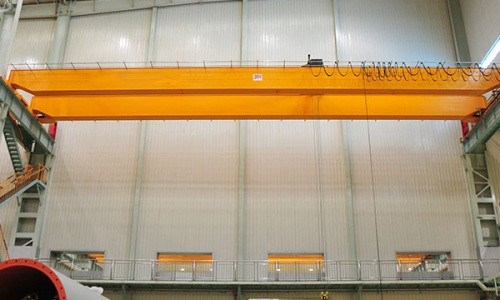
A bridge crane specialist (also known as an Overhead Crane) is a type of lifting equipment used primarily in industrial settings for the movement of heavy loads. It consists of a hoist that moves along a horizontal bridge or beam, which is supported by two parallel runways. These bridge crane specialists are commonly used in warehouses, factories, docks, and construction sites where there is a need to transport large or heavy materials or products over short distances.
2.Product Features:
Capacity: Bridge cranes come in various load capacities, often ranging from 1 ton to several hundred tons, making them suitable for different industrial applications.
Control Options: Cranes are typically operated via remote control, pendant control, or a cabin with manual or automatic control systems.
Customizable Designs: Bridge cranes can be customized for specific tasks, including modifications for unique lifting needs, reach, height, and environmental conditions (e.g., harsh weather or extreme temperatures).
Safety Features: Common safety features include overload protection, anti-collision systems, limit switches, and emergency stop functions to ensure safe operation.
3.Bridge crane specialists require careful installation by trained professionals to ensure that they meet safety standards and operate efficiently. Regular maintenance is crucial for ensuring their longevity and reliable performance.
Core Components:Bearing, Gearbox, Motor, Pressure vessel, Gear, Pump
Place of Origin:Henan Province China
Warranty:1 Year
Weight (KG):11000 kg
Video outgoing-inspection:Provided
Machinery Test Report:Provided
Product name:Double girder Bridge crane
Control mode:Remote control/customization
Lifting speed:0.8~8 m/min - Customized
Lifting mechanism:Electric hoist trolley
Lifting height:0- 30m/customized
Span:0-35m/Customized
Power Source:380V 50HZ 3P or customized
Material:Steel
Control Model:remote control

Pictures & Components
1.Main beam
1). Greater Load Handling Capability: The double girder design is ideal for handling heavier and more complex loads, making it suitable for manufacturing, steel mills, warehouses, and large-scale industrial applications.
2).Better Stability: With two girders, the bridge crane specialist is more stable, reducing the risk of structural failure under heavy loads.
3).Improved Durability: The double girder design provides increased longevity due to the distributed load, reducing wear and tear on individual components.
4).Higher Hoist Capacity: The additional girder allows for the use of more powerful hoists capable of handling greater weights.
5).Longer Spans: bridge crane specialist can span greater distances without compromising their structural integrity. This is ideal for large facilities where the crane must cover wide areas.

Lifting System
1)Benefits of bridge crane specialist Lifting Systems:
Increased Lifting Capacity: The ability to use two girders for load distribution allows for much higher lifting capacities, which makes these cranes ideal for heavy-duty lifting in industrial and manufacturing environments.
Stability and Safety: The two-girder system provides enhanced stability and reduces the risk of crane tipping, especially when lifting extremely heavy or oversized loads.
2)Maintenance Considerations for the Lifting System:
Hoist Inspection: Regular inspection of the hoist mechanism for wear on the drum, sheaves, and lifting chains or ropes is essential. Damaged components must be replaced to prevent failure during operation.
Motor and Gear Maintenance: Check the hoist and trolley motors for wear and lubrication to ensure smooth operation. This includes verifying the brake systems and ensuring that they function properly.
End Truck and Track Alignment: The end trucks must be kept properly aligned with the runway rails to ensure smooth movement across the span.
Safety Features: Periodically check the bridge crane specialist's safety systems, including overload protection, limit switches, and emergency stop functions to ensure the lifting system operates safely.

|

3.End carriage
1)Horizontal Movement:
The end beams house the end trucks, which allow the bridge crane specialist to move along the runway system. The movement is typically powered by electric motors that drive the wheels on the end trucks.
2)Load Distribution:
The end beam is responsible for distributing the load from the bridge crane specialist's bridge (main girders) onto the runway tracks. The proper load distribution is essential for preventing damage to the crane components and ensuring safe operation.
3)Structural Stability:
The end beams, in combination with the end trucks and wheels, provide structural stability for the entire crane system. They ensure that the crane moves in a controlled, stable manner and help to prevent the crane from tipping, even when lifting heavy loads.
4)Safety:
The end beam plays an important role in the bridge crane specialist's safety features. Safety mechanisms such as limit switches (to prevent over-travel), emergency brakes, and overload protection are often integrated into the end beam or end truck assembly to ensure the crane operates safely.
 |
 |
4.Crane travelling mechanism
1)End Trucks:
The end trucks are located at each end of the crane bridge and are responsible for carrying the entire weight of the crane and the load.
2)Wheels and Track System:
The wheels are mounted on the end trucks and travel along the rails of the runway system. The wheels are typically made of steel and designed to handle the crane's weight and load while ensuring smooth travel.
The track system (or rail system) consists of parallel rails mounted on the floor or ceiling (depending on the crane design). The rails are designed to carry the full weight of the crane and its load, and their alignment is crucial to ensure smooth, stable operation.
3)Motors and Drives:
Electric Motors: The crane's traveling movement is typically powered by electric motors that drive the wheels on the end trucks. These motors are designed to provide enough torque to move the crane smoothly and efficiently.
The drive system includes gears, clutches, and couplings that connect the motor to the wheels. This system ensures that the motor's rotational force is transferred efficiently to the wheels, allowing the crane to move across the tracks.
4)Control Mechanism:
The control system may include safety features such as limit switches, which prevent the crane from over-traveling past a designated point.
5)Braking System:
The braking system on the crane's traveling mechanism is designed to slow down, stop, and hold the crane in position. This is essential for controlling the crane's movement and preventing unwanted motion during operation.
6)Track and Alignment:
The alignment of the runway rails is essential for smooth operation. If the rails are misaligned or distorted, the crane can experience difficulty in movement, increased wear on the wheels, and even safety issues.
7)End Beam and Frame:
The end beam (or end truck beam) connects the crane's main girders to the end trucks. The end beam houses the wheels and connects the entire crane structure to the runway.
The frame of the end beam supports the components of the crane traveling mechanism, including the motor, wheels, brakes, and any additional components like drive shafts or gearboxes.
5.Trolley travelling mechanism
How the Trolley Traveling Mechanism Works:
1)Trolley Movement:
The trolley moves along the main girders of the crane bridge, powered by the electric motor. The motor drives the wheels mounted on the trolley, and as the wheels rotate, the trolley moves horizontally along the bridge span.
The trolley can be moved in both directions (left and right) along the length of the bridge, allowing the operator to position the hoist directly over the load or area where lifting is needed.
2)Speed Control:
The trolley's travel speed is controlled by the motor's variable frequency drive (VFD) or a similar speed control mechanism. This allows the operator to adjust the trolley's speed, which is critical for precise load placement.
Some cranes allow for smooth acceleration and deceleration, minimizing jolts and ensuring safe operation when handling delicate or heavy loads.
3)Load Handling:
The trolley moves the hoist across the crane bridge to position the hook or lifting attachment directly above the load. Once the load is picked up by the hoist, the trolley moves the load horizontally to the desired location.
As the trolley moves, it ensures that the hoist is accurately positioned to lift, move, and lower the load in a controlled manner.
4)Precision and Safety:
The operator controls the horizontal movement of the trolley using the control system, ensuring that the load is moved precisely across the span.
The trolley system typically includes limit switches to prevent the trolley from moving beyond the ends of the bridge. Emergency stop buttons are also included in the control systems to stop the trolley in case of a malfunction or safety hazard.
6.Crane wheel
1)Wheel Material:
Crane wheels are typically made from high-strength steel, which is capable of supporting heavy loads and enduring the mechanical stresses experienced during operation.
The wheel material needs to be durable to withstand constant friction, pressure, and wear from the contact with the runway rails. Some crane wheels may be hardened or treated to improve their wear resistance and extend their service life.
2)Wheel Design:
Flanged Wheels: Most crane wheels are flanged, meaning they have a raised edge (flange) around the outside of the wheel to keep the wheel on track. This flange helps prevent the wheel from slipping off the rail, maintaining smooth, stable travel.
The diameter and width of the wheel are carefully selected based on the load capacity and operating conditions of the crane. Larger wheels are typically used for higher-load capacity cranes, while smaller wheels may be used for lighter-duty applications.
The wheels are mounted on the end trucks of the crane, where they are designed to rotate on bearings and allow the crane to move horizontally along the runway.

7.Crane Hook
1)Attaching the Load:
The crane hook is typically used in conjunction with a lifting sling, chain, or wire rope to attach to the load. The operator lowers the hook to the load, and then either the latch or the hook's shape secures the load in place.
The crane hook must hold the load securely while the crane's hoisting mechanism (typically a drum, winch, or motorized system) raises the hook and load to the desired height.
2)Lifting:
Once the load is attached, the hoisting motor or other lifting mechanism begins to move the load vertically. The crane hook must be able to withstand the stresses from the weight of the load during lifting, and it must maintain a stable connection to prevent the load from slipping or detaching.
In some cases, the hook may have a swivel that allows it to rotate freely, preventing the load from twisting or becoming unbalanced.
3)Moving and Lowering:
The crane hook and attached load can be moved horizontally using the crane's traveling mechanism. The hook must be capable of withstanding lateral stresses during movement.
Once the load is moved to the desired location, the hook will be lowered carefully, using the hoist mechanism to control the descent. The safety latch, if present, will remain closed until the load is safely lowered to the ground.
4)Unloading:
After the load has been safely lowered, the hook is detached from the lifting sling, chain, or other attachment devices. The hook is then moved back to its original position to prepare for the next lifting operation.

Motor
Motor maintenance and care
1) Regular inspection:
It is necessary to check the motor's operating status regularly to ensure that there is no abnormal noise, vibration or overheating. Regularly check the motor's electrical connections, grounding, terminals and insulation.
2) Cleaning and lubrication:
Regularly clean the dust and dirt on the outside of the motor, especially the fan and vents, to ensure that the motor dissipates heat effectively. For motors with bearings, lubricate the motor's bearings and gears in time to reduce friction and extend service life.
3) Temperature monitoring:
The motor generates a certain amount of heat during operation, and long-term high-temperature operation may cause damage to the motor. Therefore, temperature monitoring and cooling system inspection are crucial. Install a temperature sensor and check the motor temperature regularly to avoid failures caused by overheating.
4) Check brushes and commutator (for DC motors):
If a DC motor is used, it is very important to check the brushes and commutator. Regularly check the brush wear and replace the brushes when necessary to avoid poor contact or unstable current.


Sound and light alarm system & limit switch
1) Sound and light alarm system
Function and role
Warning role: When the crane is in operation or approaches a dangerous area, the sound and light alarm system will issue an audible warning (usually a beep) and/or a flashing light signal (such as a flashing warning light). This allows the operator and other staff to promptly detect the movement of the crane, load changes or equipment status, thereby avoiding potential dangers.
Load reminder: For example, when the load of the crane is close to the maximum rated load, the system will issue a specific sound and light alarm to remind the operator not to overload.
Position reminder: When the operation of the crane reaches a certain area or limit, the sound and light alarm system will remind the operator in advance to prevent the crane or load from entering the dangerous area.
Emergency warning: In the event of a fault, emergency stop, overspeed, stop, etc., the sound and light alarm system can issue a rapid alarm sound and a strong flash, causing the operator to be highly alert and take safety measures immediately.
2) Limit switch
Function and role
Prevent overtravel: The limit switch is used to prevent the main bridge or trolley of the crane from moving beyond the specified range. It monitors the crane's moving position. Once it reaches the limit position, the limit switch automatically disconnects the circuit or sends a signal to stop the crane from moving further.
Protecting equipment: The limit switch reduces the risk of equipment damage by limiting the crane's range of motion, preventing mechanical collisions and overuse.
Ensuring operational safety: The limit switch helps ensure that the crane does not accidentally collide or come into contact with surrounding structures during operation, protecting the operator's safety.

10.Safety Devices
1. Limit switch (limit device)
The limit switch is a basic safety device in double-beam bridge cranes. It is mainly used to limit the range of motion of the crane in the horizontal and vertical directions to prevent damage or safety accidents caused by excessive movement of the equipment.
Prevent collision: The limit switch can prevent different parts of the crane from colliding with each other and protect the equipment from damage.
2. Overload protection device
The overload protection device is a key safety device to prevent crane overload. When the load of the crane exceeds its rated load capacity, the overload protection device will immediately issue a warning and automatically stop the operation to prevent equipment failure or accidents caused by overload.
3. Emergency stop device
The emergency stop device is used to quickly stop and protect the safety of equipment and personnel in the event of an emergency. When a system failure, equipment loss of control or other emergency conditions occur, the emergency stop device can immediately disconnect the power supply or stop all moving parts.
4. Anti-collision device
The anti-collision device is used to prevent the crane from colliding with other equipment, obstacles or parts of the crane itself, especially in an environment where multiple cranes are operating in parallel.
5. Electrical protection device
The electrical protection device is used to protect the electrical system from short circuit, overload and other electrical faults. The electrical protection device can ensure that the electrical equipment and motor of the crane are not damaged and improve the safety of operation.
6. Crane anti-tilt device
The anti-tilt device is used to prevent the crane from tilting due to uneven load or other reasons during operation, ensuring the stability of the equipment.
11.Control Mode
1) Manual control
Manual control is the most traditional and direct way to control a crane, and is suitable for situations where the operator needs to directly participate in the control. In this control mode, all operations (such as bridge movement, trolley travel, hook lifting, etc.) are completed by the operator through buttons, switches and joysticks on the control panel.
2) Remote control
Remote control is a way to control the movement of a crane through radio waves or wired connections, and is suitable for situations where the operator needs to control the equipment within a certain distance from the crane. Remote control systems usually include handheld controllers or fixed control consoles.
3) Automatic control
Automatic control is the automatic control of the various moving parts of the crane through a control system, usually based on control devices such as PLC (programmable logic controller) and SCADA (supervisory control and data acquisition system). The automatic control system can automatically adjust and manage the various operations of the crane according to the set program, and is widely used in situations where high operating accuracy is required or a large number of repetitive operations are required.
4) Variable frequency speed control
Variable frequency speed control (VFD control) is a modern motor control technology that is widely used in double-beam bridge cranes. The frequency converter adjusts the operating frequency and voltage of the motor to achieve precise control of the crane's movement speed.
5) Integrated control system
The integrated control system integrates multiple control methods such as PLC control, variable frequency speed regulation, and remote control on a unified control platform, so as to flexibly select the operation mode in different operating environments. This type of system is suitable for large and complex crane operations and can achieve all-round control through data collection, intelligent analysis and remote monitoring.

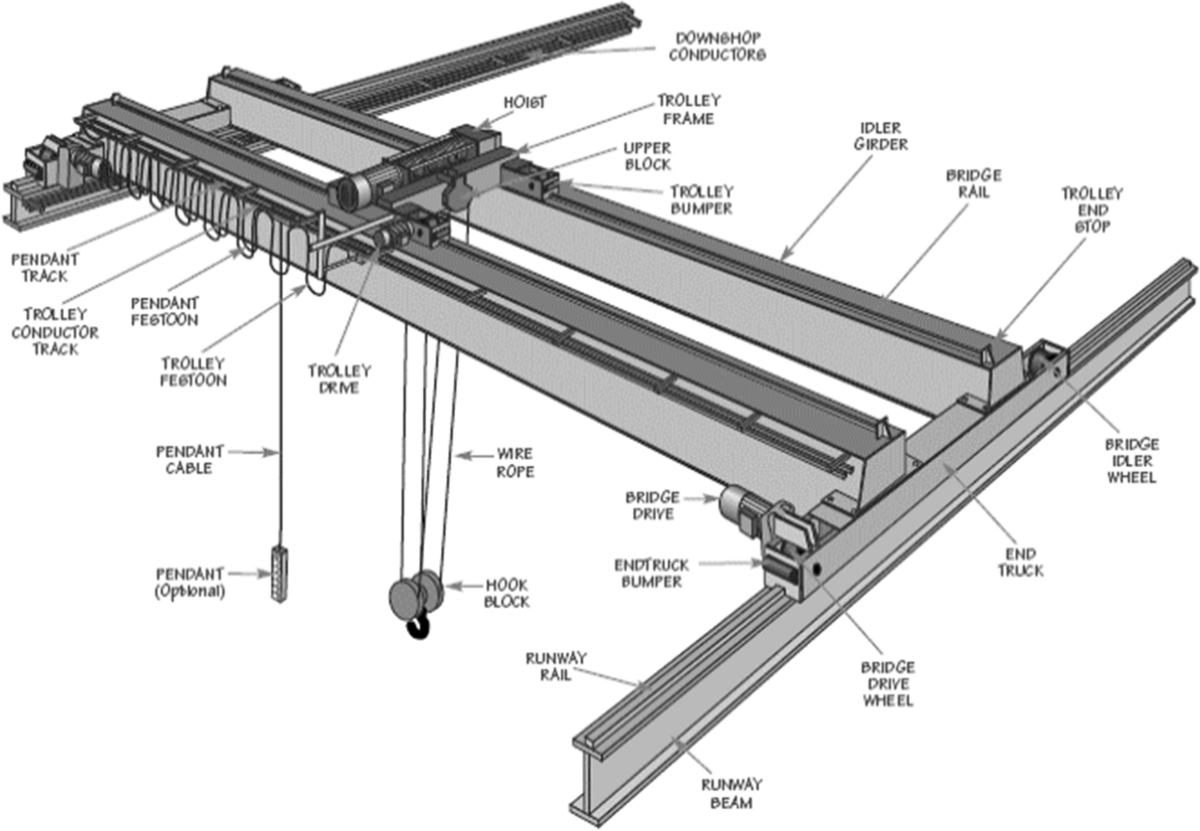
12.Sketch
Main technical

Advantages
1. High load capacity
Suitable for heavy load operations: can carry heavier items (such as heavy equipment, steel, large machinery, etc.).
Stronger load-bearing capacity: the double-beam design makes the pressure on the bridge part evenly distributed, can carry more weight, and ensure safety within the working load range.
2. Larger span and height
Wide span operation: suitable for working environments that need to span large spaces, such as workshops, warehouses, yards, etc.
Large lifting height: can provide a higher lifting height to meet the needs of high-altitude operations.
3. Higher stability and safety
Uniform load-bearing: the two main beams share the load together, which improves the overall structural stability.
Strong anti-tilting: even under extreme loads, the structure of the double-beam bridge crane can effectively prevent tilting and improve safety during operation.
4. High-precision control and smooth operation
Precise lifting positioning: the high-precision control system allows the load to be accurately lifted, lowered and transferred, especially suitable for the lifting of precision equipment.
Smooth start and stop: the use of variable frequency speed regulation technology can start and stop smoothly, reducing mechanical shock and equipment wear.
5. Flexible operation mode
Multiple control modes: manual, remote control or automatic control mode can be selected to adapt to different working environments.
Adapt to complex working environment: can perform hoisting operations in limited space, dangerous areas or high temperature and high pressure environments.
6. Save space and improve work efficiency
Due to the double-beam design of the double-beam bridge crane, it can more flexibly utilize the height and width of the plant, so that the vertical and horizontal space can be better used. Therefore, more operations can be performed in a limited space, improving work efficiency.
Application:
1. Metallurgical Industry
Double-beam bridge cranes are widely used in heavy industrial environments such as steel mills, aluminum plants, and metallurgical workshops, responsible for lifting and moving large tonnage of steel, iron ore, electric furnace materials, etc.
2. Manufacturing and mechanical processing
In mechanical manufacturing, heavy machinery assembly and processing workshops, double-beam bridge cranes are used for lifting and moving
3. Building and construction
In the field of building and construction, double-beam bridge cranes are widely used in high-rise buildings, bridge construction, infrastructure and other engineering projects, responsible for the lifting and transportation of heavy materials.
4. Ports and docks
In ports and docks, double-beam bridge cranes are mainly used for container loading and unloading, cargo handling, and ship cargo hold operations.
Container lifting: It is used for container handling, lifting, stacking and disassembly.
Large cargo loading and unloading: It is used to lift large tonnage cargo such as steel, wood, bulk cargo, etc.
Ship loading and unloading: Through the movement of the bridge crane, the material transportation between the ship cargo hold and the dock is completed.
5. Energy and power industry
Double-beam bridge cranes are used in the power industry to install, overhaul and maintain large equipment, especially in the construction and operation of thermal power, nuclear power, wind power and other facilities.
6. Warehousing and logistics
In the field of modern warehousing and logistics, double-girder bridge cranes are used for the handling, stacking and sorting of materials in large warehouses, especially in the handling of heavy goods and large items.
7. Shipbuilding and maritime engineering
Double-girder bridge cranes are widely used in shipyards, ship repairs and maritime engineering, mainly for the lifting and transportation of hull parts.
Crane production procedure
1. Design stage
Requirement analysis: Determine the main parameters of the crane according to the customer's needs (lifting capacity, span, lifting height, use environment, etc.).
Scheme design: Including structural design, electrical system design, control system design, etc., to ensure that the various parts of the crane work in coordination.
CAD drawing: Draw detailed design drawings through computer-aided design (CAD) to clarify the size, material and assembly method of each component.
Structural calculation: Perform mechanical analysis on the bridge, main beam, lifting mechanism, etc. to ensure that the designed structure is safe and stable under actual load.
2. Material procurement and pretreatment
The main components of a double-beam bridge crane include steel, electrical components, hooks, wheels, rails, drive devices, etc. The first step in the production process is material procurement and pretreatment.
3. Manufacturing and processing
Machining of main beams and sub-beams: The main beams and sub-beams are usually welded from steel plates. First, the steel is cut, formed, drilled, etc., and then welded. After welding is completed, inspection and quality inspection are required to ensure welding strength.
Trolley frame and lifting mechanism: The lifting mechanism includes motor, reducer, brake, wire rope, lifting trolley, etc. All parts will be processed and assembled in detail.
Manufacturing of drive wheels and wheel rails: The drive wheels, guide wheels and wheel rails need to be precisely processed to ensure the smooth operation of the crane. The wheel rails need to be accurately debugged and tested before installation.
Electrical system and control device: The electrical system includes motors, inverters, control cabinets, cables, sensors, etc. All electrical components need to be installed and wired according to the design drawings.
4. Component assembly
Main beam assembly: When the main beam is connected to the auxiliary beam, it is necessary to ensure that the welding is firm and the various connecting parts are accurately connected. The accuracy of the beam frame determines the overall operating stability of the crane.
Trolley assembly: Combine the trolley frame with the drive system, lifting mechanism, wire rope, etc. to ensure that the trolley can run smoothly.
Electrical control system assembly: The installation of the electrical control system needs to be very precise. All cables and wiring need to be fixed and insulated according to the standards to ensure the stability and safety of the system.
Hook and wire rope installation: Install hooks, wire ropes and other equipment according to the lifting requirements to ensure that they are closely matched with the lifting mechanism and are safe and reliable.
5. Debugging and testing
After the various parts of the crane are installed, comprehensive debugging and testing are carried out to ensure that the equipment can operate normally in all aspects.
6. Quality inspection and acceptance
After the crane passes the initial debugging, it will enter the final quality inspection stage. This step will ensure that the equipment meets the design and quality standards.
7. Final acceptance before delivery
Final quality acceptance: The customer or a third-party quality inspection agency conducts a comprehensive acceptance of the equipment to ensure that its various performances meet the requirements.
User training: Provide customers with operation manuals and maintenance manuals, and conduct on-site operation training when necessary to ensure that operators can master the operation methods and safety requirements of the crane.
Delivery and delivery: After the equipment has been finally inspected and confirmed to be correct, it will be packaged and transported and sent to the customer's site.
8. Installation and commissioning
After the crane is delivered to the site, it will be installed and commissioned. It is necessary to ensure that the various components of the crane are accurately installed and that the running tracks and power systems on site can be connected normally. After the installation is completed, on-site debugging is carried out, and load tests, driving performance tests, safety performance tests, etc. are carried out to ensure that the crane can adapt to the on-site working environment.
9. After-sales service
Regular maintenance: According to the use environment and frequency, regular maintenance and overhaul services are provided to ensure the safe operation of the crane.
Technical support: Provide operation guidance, technical support and problem-solving services to ensure that customers can get help in time when they encounter problems during use.
Spare parts supply: Provide customers with wearing parts and spare parts to ensure that the equipment can be repaired quickly.

Workshop view:
The company has installed an intelligent equipment management platform, and has installed 310 sets (sets) of handling and welding robots. After the completion of the plan, there will be more than 500 sets (sets), and the equipment networking rate will reach 95%. 32 welding lines have been put into use, 50 are planned to be installed, and the automation rate of the entire product line has reached 85%.




Hot Tags: bridge crane specialist, China bridge crane specialist manufacturers, suppliers, factory, Crane Parts, Single Girder Gantry Crane, Explosion Proof Overhead Crane, Bridge Crane, Steel Factory Overhead Crane, Single Girder Eot Crane
Previous
Under Running Bridge CraneYou Might Also Like



Send Inquiry