










Single Girder Bridge Crane
Products Description
1. Single Girder Bridge Crane is a common type of bridge crane, usually used for material handling and lifting in workshops, warehouses, factories and other places.
2. Single Girder Bridge Crane mainly consists of a horizontal bridge (single beam) and two supporting legs. The bridge of the crane spans the working area of the factory workshop, and the supporting legs on both sides are supported on the track to ensure the stability of the crane in the lateral direction.
3. The bridge of the single girder bridge crane is equipped with one or more crane trolleys, which are responsible for lifting and lifting goods. The trolley moves along the bridge in the length direction of the factory, and the crane on the trolley can be raised and lowered in the width direction of the bridge.
4. The load capacity of single girder bridge crane is generally small, suitable for light and medium load handling. Its load capacity is usually between 1 and 20 tons, but the specific specifications will vary according to the design of different manufacturers.
5. Single girder bridge crane is widely used in production workshops, warehouses, logistics centers, steel mills and other places, especially in environments with limited space, it can effectively use vertical space for material handling.
Max. Lifting Height:6~30m
Warranty:1 Year
Weight (KG):1500 kg
Max. Lifting Load:32 Ton
Span:7.5-31.5m or customized
Working Class:A3/A4/A5
Lifting Capacity:3,5,10,16,20,25,32 ton
Power:3P 220--440 V/50HZ 60HZ
Working Temperature:-20-40℃

Pictures & Components
1.Main beam
1.The main beam of a single-girder bridge crane is its core structural part, which mainly bears the load of the crane and supports the operation of the crane.
2.The main beam of a single-girder bridge crane usually adopts a box beam or an I-beam structure, both of which can effectively bear lateral loads. Box beams have higher rigidity and stability, while I-beams are lighter and suitable for occasions with smaller loads.
3.The main beam of a single-girder bridge crane is usually made of high-strength steel to ensure that it has sufficient load-bearing capacity and durability. The selection and processing of steel are crucial to the safety and performance of the crane.
4.The main beam of a single-girder bridge crane needs to be regularly inspected and maintained during use to ensure its structural integrity and normal functioning. This includes checking the corrosion of the steel, the integrity of the welding points, and the wear of the connection parts.

Lifting System
The lifting system of a single-girder bridge crane is its key component, which is used to actually complete the lifting and handling of materials.
2.The lifting system is mainly composed of the following components: hoist (crane), wire rope or chain, motor, brake system, control system, pulley and guide device.
3.Overall, the lifting system of a single-girder bridge crane achieves efficient and safe material handling through the coordinated work of these components.


End Beam
1. The end beam of a single-beam bridge crane is an important part of the crane structure, which is mainly responsible for supporting the main beam and fixing it on the support legs or tracks.
2. The end beams of a single-beam bridge crane are located at both ends of the main beam, usually in a horizontal or slightly inclined structure. The two sides of the end beam are connected to the support legs, which are fixed on the tracks of the workshop or factory. The main function of the end beam is to bear the weight of the main beam and evenly distribute the load of the main beam to the support legs or tracks. It ensures the stability of the crane during operation. Wheels or tracks are installed on the end beam, which move along the tracks of the workshop or factory, allowing the entire crane system to move laterally within a specified range. The end beam is usually made of high-strength steel to provide sufficient strength and durability. The selection and processing technology of steel are crucial to the performance of the end beam.
3. In general, the end beam plays an important role in supporting and carrying in a single-beam bridge crane, and its design and maintenance directly affect the operating stability and safety of the crane.

Crane travelling mechanism
1. The Crane travelling mechanism of a single-girder bridge crane is one of the key components of the crane, used to enable the crane to run along a horizontal track on the main beam. The main function of this mechanism is to achieve lateral movement on the main beam, so that the crane can cover a larger range in the working area.
2. The operation of the Crane of a single-girder bridge crane is usually controlled by a control panel or operating lever, through which the operator can start, stop, accelerate or decelerate the movement of the Crane . In some modern single-girder bridge cranes, a remote control system may be equipped, and the operator can remotely control the movement of the Crane , providing greater operational flexibility and safety.
3. In general, the design and maintenance of the Crane travelling mechanism are crucial to the performance and safety of single-girder bridge cranes. Through precise design and effective maintenance, it can ensure that the trolley moves smoothly and efficiently on the main beam, thereby improving the operating efficiency and reliability of the crane.
Trolley travelling mechanism
1. The trolley running mechanism of a single-girder bridge crane is an important part of the crane, responsible for moving the trolley along the width direction of the main beam. This mechanism enables the crane to cover a wider working area on the main beam.
2. The trolley of a single-girder bridge crane usually consists of a car body, a drive device and a support wheel. The car body is equipped with a bracket for mounting the crane's sling or winch. The main function of the trolley is to move along the width direction of the main beam to achieve the lifting and transfer of the load.
3. The wheels of the trolley roll along the track on the main beam, which can be a guide rail or a steel rail on the main beam. The design of the wheel and the flatness of the track directly affect the smooth operation of the trolley. In order to ensure the stable operation of the trolley on the main beam, the design usually includes guide devices, which help the trolley stay on the correct track and avoid deviation or jamming.
4. The movement and operation of the trolley are usually controlled by a control panel or a lever, through which the operator can start, stop, accelerate or decelerate the trolley. In some modern single-girder bridge cranes, a remote control system may be equipped, which enables the operator to remotely control the movement of the trolley, providing greater operational flexibility and safety.
The design and maintenance of the trolley operating mechanism are crucial to the overall performance of the single-girder bridge crane. Through precise design and regular maintenance, the smooth and efficient operation of the trolley on the main beam can be ensured, thereby improving the working efficiency and safety of the crane.
6.Crane wheel
1. The wheels of a single-girder bridge crane are a key component of its operating mechanism, responsible for transferring the load of the main beam to the supporting rails and allowing the crane to move smoothly on the main beam.
2. The wheels of a single-girder bridge crane are usually made of high-strength steel to withstand loads and wear. Steel wheels can withstand high loads and harsh working environments. Wheels can come in different forms, such as solid wheels or hub wheels with inner holes. The edges of the wheels usually have rims to allow for smooth rolling on the rails.
3. The wheels of a single-girder bridge crane roll along the tracks or rails on the main beam. The tracks can be either steel rails mounted on the main beam or specially designed guide rails. The tracks need to be regularly inspected and maintained to ensure that their surfaces are smooth and free of deformation to avoid wear and uneven operation of the wheels.
The wheels are an important component for the stable operation of a single-girder bridge crane. Through precise design and maintenance, the smooth movement of the wheels on the main beam is ensured, thereby improving the overall performance and work efficiency of the crane.
 |
 |
 |
Crane hook
1. The hook of a single-beam bridge crane is one of the key components in its lifting system, which is directly used to suspend and move the load. The design and function of the hook are very important and directly affect the working efficiency and safety of the crane.
2. The structure of the hook:
Hook body: The main part of the hook, usually curved, so that it can firmly hang the load. The design of the hook body must meet the requirements of strength and stability.
Hook tip: The hook tip is the part that contacts the load and is usually designed to be sharper to better grasp the material or accessories.
Hook hole or hook: The hook usually has one or more hook holes for connecting chains, wire ropes or other slings.
Material and manufacturing:
Material: The hook is usually made of high-strength alloy steel to ensure its strength and durability under high loads. The selection of steel and the heat treatment process are crucial to the performance of the hook.
Manufacturing process: The hook manufacturing process includes processes such as forging, heat treatment and surface treatment to ensure that it has sufficient strength and wear resistance.
Load capacity:
Rated load: The rated load of the hook must meet or exceed the maximum load capacity of the crane. The design and manufacture of the hook must take into account the maximum value of the working load to ensure safety.
Safety factor: The design of the hook should include a certain safety factor to cope with overload or unexpected situations.
3.In short, as an important component of the single-beam bridge crane, the design, manufacture and maintenance of the hook need to strictly follow safety standards and technical requirements to ensure that the crane can carry out material handling operations efficiently and safely.
 |
 |
 |
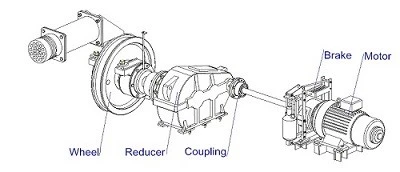
Motor
1. The motor of a single-girder bridge crane is the core power source for the operation and control of the crane. The main function of the motor is to drive various parts of the crane, including the trolley, the carriage and the lifting system of the crane itself.
2. The following is detailed information about the motor of a single-girder bridge crane:
Types of motors:
AC motors: Most single-girder bridge cranes use AC motors because of their simple structure, low maintenance cost and reliable operation. AC motors are suitable for applications that require continuous operation.
DC motors: Some applications may use DC motors, especially in applications that require more precise speed control and higher starting torque.
Functions of the motor:
Driving the trolley: The motor drives the trolley through the reducer and transmission system to move it along the width of the main beam.
Driving the carriage: The motor can also drive the carriage to move it along the length of the main beam, thereby achieving lateral movement of the crane in the working area.
Driving the lifting system: The motor drives the lifting system through a winch or chain to complete the lifting and lowering of the load.
Control system:
Frequency converter: Some modern cranes are equipped with frequency converters, which can adjust the speed and torque of the motor to achieve more precise control and higher energy efficiency.
Electrical control system: The operation of the motor is usually managed by an electronic control system, including functions such as starting, stopping, accelerating and decelerating. The electronic control system can be a manual operation panel, push button switches or a modern touch screen interface.
3.In general, the electric motor plays a vital role in the single girder bridge crane, and its performance and maintenance directly affect the efficiency and safety of the crane. By properly selecting and carefully maintaining the electric motor, the stable operation and long-term use of the crane can be ensured.
. 

Sound and light alarm system & limit switch
1.The audible and visual alarm system and limit switch of a single-girder bridge crane are important components to ensure the safe operation of the crane. These systems help monitor and control the operation of the crane to prevent overloading, misoperation and other possible safety hazards.
Sound and light alarm system of the single-girder bridge crane
The sound and light alarm system warns the operator or surrounding personnel through a combination of sound and light to remind the operator or surrounding personnel of potential dangers or abnormal status of the equipment. It is usually used to issue warnings such as equipment start-up, stop, overload, failure, etc. to ensure that the operator can take timely measures. The sound and light alarm system is usually installed in a conspicuous position on the crane to ensure that the operator and surrounding personnel can clearly hear and see the alarm signal. Adjust the intensity of sound and light according to the working environment and needs to ensure that the alarm system can effectively transmit warnings.
3.Limit switch of the single-girder bridge crane
The limit switch is used to monitor the position of each moving part of the crane to prevent it from exceeding the predetermined working range. This helps to protect the equipment from damage and ensure safe operation. When a part of the crane approaches or reaches the position set by the limit switch, the limit switch will automatically trigger to stop further movement of the equipment. Limit switches are usually installed at key positions of the main beam, trolley, carriage and other moving parts. The installation position needs to be determined according to specific design and work requirements.
Debugging: After installation, the limit switch needs to be debugged to ensure that it can accurately detect the predetermined position and trigger the corresponding protection measures when necessary. Limit switches are usually installed at key positions of the main beam, trolley, carriage and other moving parts. The installation position needs to be determined according to the specific design and work requirements. After installation, the limit switch needs to be debugged to ensure that it can accurately detect the predetermined position and trigger the corresponding protection measures when necessary.
4.Generally speaking, audible and visual alarm systems and limit switches play a vital safety role in single-girder overhead cranes, ensuring that the crane can operate safely and efficiently during operation. By properly designing, installing and maintaining these systems, crane safety and reliability can be significantly improved.

Safety Devices
1. The safety equipment of single-girder bridge cranes is an important part of ensuring the safe and efficient operation of the crane during operation. These devices are used to prevent accidents and protect the safety of equipment and personnel.
2. The following are common safety equipment and functions of the single-girder bridge cranes
Electrical control system
Function: Manage the motor and other electrical equipment of the crane, provide precise control and protection functions.
Composition: electrical control panel, inverter, relay.
Function: Ensure the normal operation of the motor and prevent electrical failure.
Emergency stop device
Function: Quickly stop all movements of the crane in an emergency.
Composition: emergency stop button, emergency stop system.
Function: In the event of an accident or emergency, quickly cut off the power supply to ensure safety.
Braking system
Function: Control the movement of the crane to stop and hold.
Composition: electromagnetic brake, hydraulic brake, brake disc.
Function: Ensure the smooth shutdown of the crane to prevent heavy objects from sliding down or unstable movement of the crane.
Anti-collision system
Function: Avoid collision between the crane and other equipment or buildings.
Composition: radar detector, laser sensor, alarm device.
Function: monitor the surrounding environment, automatically alarm or stop the crane movement.
Safety shield
Function: protect the operator from direct contact with the operating parts of the crane.
Composition: metal shield, mesh protection screen.
Function: prevent personnel from contact with high temperature, rotating parts or hanging heavy objects to avoid accidents.
3. Through the configuration and maintenance of these safety equipment, safety hazards during operation can be effectively prevented and reduced, ensuring the safe operation of single-girder bridge cranes in various working environments.
Control Mode
The control mode of a single-girder bridge crane determines the operation mode and flexibility of the crane. Different control modes adapt to different working environments and operating requirements, ensuring that the crane can complete tasks efficiently and safely.
2. The following are the main control modes of the single-girder bridge cranes and their characteristics:
Automation control mode
Features:
Operation mode: Fully automated control through a computer control system or PLC (programmable logic controller).
High precision: Able to achieve precise motion control, load monitoring, programmed operation, etc.
Data integration: Usually integrated with sensors, monitoring systems, and data acquisition systems to provide real-time monitoring and data analysis functions.
Applicable scenarios:
Highly automated production lines or large-scale operating environments that require precise control and monitoring.
Occasions with high requirements for automation and the need to reduce manual operations.
Mixed control mode
Features:
Operation mode: Combining the advantages of manual, remote control and automation control modes, a variety of control modes are provided.
Flexibility: The operator can switch between different control modes as needed to adapt to different operating requirements.
Adaptability: Able to handle complex operating tasks while ensuring operational flexibility and safety.
Applicable scenarios:
Occasions where multiple control methods need to be integrated to adapt to different operating requirements, such as complex industrial environments or changing construction sites.
Computer monitoring and control system
Features:
Operation method: Monitor and control through a computer system, including a graphical user interface (GUI) and advanced control software.
Real-time data: Provides real-time equipment status, load data, operation history and other information, and supports remote monitoring and control.
Intelligent: Intelligent functions such as predictive maintenance, automatic diagnosis and fault warning can be realized.
Applicable scenarios:
Large factories or high-tech applications that require advanced data analysis and intelligent control.
Environments with high demand for real-time monitoring and remote operation.
Safety protection control system
Features:
Operation method: Integrate various safety control functions, such as overload protection, limit control, emergency shutdown, etc.
Protection function: Automatically enable protection measures when the crane is abnormal or overloaded to prevent equipment damage and safety accidents.
Automatic alarm: The system can automatically sound an alarm and take measures to prevent further danger.
Applicable scenarios:
All crane operating environments, especially high-risk areas and occasions that require strict safety control.
Operation scenarios with high safety requirements to ensure the safety of equipment and personnel.
Selecting the appropriate control mode can improve the operating efficiency and safety of the single-girder bridge crane. Selecting the appropriate control mode according to specific working requirements and operating environment is the key to ensuring efficient operation of the equipment.

Sketch

Main technical data

Advantages
1.Simple structure, easy installation and maintenance
Simple design: The structure of the single-beam bridge crane is relatively simple, mainly composed of the main beam, trolley, trolley running mechanism and lifting system. This makes its design, installation and maintenance relatively easy.
Convenient maintenance: Due to the simple structure, problems can be quickly located during maintenance and overhaul, reducing maintenance time and cost.
2. High space utilization
Effective use of space: The single-beam bridge crane is suspended above the workshop and does not occupy the ground space, which provides more operating space and passage space for the workshop floor.
Space saving: It is suitable for industrial environments that require large areas of ground use, such as workshops and warehouses.
3. Load capacity and stability
Load capacity: The single-beam bridge crane design can carry a large load and is suitable for the handling of medium to heavy materials.
Stability: The single-beam structure has good stability, especially when the load is evenly distributed, it can provide stable lifting performance.
4. Flexible operation
Multiple control modes: The single-beam bridge crane can be configured with different control modes, such as manual control, remote control, ground control, etc., to meet different operating needs.
Precise control: Modern single-girder bridge cranes are equipped with control systems that enable precise load control and movement, and are suitable for situations that require high-precision operations.
5. High work efficiency
Efficient operation: Single-girder bridge cranes can quickly move and lift loads, improving work efficiency, especially in work environments that require frequent material movement.
Quick response: In high-intensity work environments, the crane can quickly respond to the operator's instructions and reduce operating time.
6. Strong adaptability
Multiple applications: Suitable for a variety of industries, such as manufacturing, warehousing, logistics, and construction. Able to operate effectively in different environments and working conditions.
Flexible adjustment: Configuration adjustments can be made according to specific work needs and environmental conditions, such as adding protective devices, modifying control systems, etc.
Application:
1. Manufacturing
Workshop production: In manufacturing workshops, single-girder bridge cranes are used to move raw materials, semi-finished products and finished products to improve the efficiency of production lines.
Assembly and maintenance: Suitable for assembly and maintenance of large machinery or equipment, and can easily lift heavy components.
2. Warehousing and logistics
Material handling: In warehouses and logistics centers, single-girder bridge cranes are used to move and stack various goods to improve warehousing and distribution efficiency.
Cargo loading and unloading: Suitable for loading and unloading goods, moving large items or equipment, especially between storage shelves and logistics channels.
3. Construction industry
Construction site: On construction sites, single-girder bridge cranes are used to lift building materials, steel bars and prefabricated components to support the progress of construction.
Equipment installation: Used to install and adjust large construction equipment or facilities to ensure smooth construction.
4. Steel industry
Steel handling: In steel mills, single-girder bridge cranes are used to move and stack heavy steel such as steel coils, steel plates, and profiles.
Furnace Operation: Applicable to transfer molten steel from the furnace to the mold, or to move steel in the production line.
5. Shipbuilding
Hull Assembly: In the shipyard, single-beam bridge cranes are used to lift and assemble the various parts of the hull.
Ship Repair: Used to lift and move ship parts, equipment and tools.
6. Energy Industry
Power Equipment Installation: Used to install and maintain large power equipment such as transformers and generators.
Energy Facility Maintenance: In facilities such as oil, gas and nuclear power plants, large equipment and components are moved and installed.
Crane production procedure
1. Design stage
Requirement analysis: Determine the specifications, load capacity, working range, control method, etc. of the crane according to the customer's needs and working environment.
Preliminary design: Develop a preliminary design plan, including the design of key parts such as the main beam, trolley, trolley running mechanism, and lifting system.
Detailed design: Complete detailed design drawings and technical documents, including structural design, material selection, mechanical calculation, electrical system, etc.
Design review: Conduct design review to ensure that all designs meet safety standards and customer requirements.
2. Material procurement
Material selection: Select appropriate materials such as steel, aluminum alloy, welding materials, electrical components, etc. according to design requirements.
Supplier selection: Select qualified suppliers for material procurement to ensure the quality and delivery time of materials.
Material inspection: Inspect the purchased materials to ensure that they meet the design requirements and quality standards.
3. Manufacturing stage
Processing: Process the main beam, trolley, trolley and other components, including cutting, welding, drilling, machining, etc.
Surface treatment: Surface treatment of processed parts, such as painting, anti-rust treatment, heat treatment, etc., to improve durability and appearance.
Assembly: Component assembly, including assembly of main beam, trolley, trolley running mechanism, lifting system, control system, etc.
4. Assembly stage
Preliminary assembly: Preliminary assembly is carried out in the factory to check the matching and installation accuracy of each component.
Debugging: Debug the crane after preliminary assembly, including wiring of electrical system, setting of control system, operation debugging of trolley and trolley, etc.
Trial operation: Trial operation is carried out to test various functions of the crane, such as lifting, lowering, moving, load capacity, etc., to ensure the normal operation of the equipment.
5. Testing and inspection
Performance test: Performance test of the crane, including load test, speed test, stability test, etc., to ensure its performance under actual working conditions.
Safety inspection: Check the safety equipment and systems of the crane, such as sound and light alarm, limit switch, overload protection device, etc., to ensure compliance with safety standards.
Quality inspection: Conduct a comprehensive quality inspection on the whole machine to ensure that all components and systems meet the design requirements and quality standards.
6. Final inspection
Appearance inspection: Check the appearance of the crane, including coating, welding joints, logos, etc., to ensure that it meets customer requirements and aesthetic standards.
Document preparation: Prepare relevant technical documents, such as operation manuals, maintenance guides, certificates of conformity, etc., and deliver them to customers together with the equipment.
7. Delivery and installation
Transportation: Organize the transportation of the crane to ensure that no damage occurs during transportation.
On-site installation: Install and debug at the customer's site to ensure the correct installation and normal operation of the crane.
Customer training: Provide operation and maintenance training to customers to ensure that they can use the crane safely and effectively.
8. After-sales service
Maintenance and support: Provide equipment maintenance and technical support services to ensure the long-term stable operation of the equipment.
Fault handling: Handle problems encountered by customers during use, and provide necessary technical support and spare parts replacement services.
Feedback collection: Collect customer feedback, make improvements and optimizations, and improve product quality and service levels.

Workshop view
Material Inspection
Quality Inspection: Strict quality inspection is carried out on the purchased raw materials to ensure that they meet the design requirements and national standards.
Material Storage: Qualified materials are stored according to classification to prevent corrosion or damage.
Cutting and Forming
Steel Cutting: Use plasma cutting, laser cutting or flame cutting and other technologies to cut the steel according to the size of the design drawing.
Forming Processing: Form the steel plate through bending, rolling, welding and other processes to manufacture the main beam, end beam and other structural parts.
Welding
Component Welding: The cut and formed steel parts are welded into the main structures such as the main beam, end beam and trolley. The welding process needs to be strictly controlled to ensure the structural strength and welding quality.
Weld Inspection: Use non-destructive testing technology (such as ultrasonic testing, radiographic testing) to inspect the welds to ensure that there are no cracks or other defects.
Machining
Precision Machining: Precision machining is performed on the key components of the crane, such as wheel sets, bearing seats, pulleys, etc., to ensure their dimensional accuracy and surface quality.
Assembly of the whole machine
General assembly: On the basis of pre-assembly, the overall assembly of the crane is carried out, including the final installation of the main beam, end beam, lifting mechanism, walking mechanism, etc.
Commissioning and testing
Under dynamic conditions, the operating performance of the crane is tested, including the testing of lifting, walking, steering and other functions. The overall size of the assembled bridge crane is checked to ensure that all dimensions meet the design requirements.
Spraying and anti-corrosion treatment
Surface treatment Rust removal: Rust removal on the surface of the crane, common methods include sandblasting, pickling, etc. Primer spraying: Spray anti-corrosion primer on the treated surface to prevent metal oxidation and corrosion. Topcoat spraying Color spraying: Spray topcoat according to customer requirements or industry standards to give the crane a protective and decorative effect. Marking: After spraying, mark the crane's identification information in accordance with the specifications, such as model, rated load, etc.
Factory and installation
Packaging and transportation
Packaging protection: Protectively package the key components of the crane to prevent damage during transportation. Transportation arrangement: According to the equipment size and transportation conditions, select a suitable transportation method to transport the crane to the customer's site.
Acceptance and delivery
Customer acceptance
On-site acceptance: The customer conducts on-site acceptance of the crane according to the contract requirements and technical specifications to check the performance and quality of the equipment.
Problem rectification: If any problems are found, the manufacturer needs to rectify them in time to ensure that the equipment fully meets the customer's requirements. Delivery and use Operation training: The manufacturer usually trains the customer's operators to ensure that they can operate the crane correctly and safely.


Hot Tags: single girder bridge crane, China single girder bridge crane manufacturers, suppliers, factory, Bridge Crane, Double Girder Bridge Crane with Electric Hoist
Previous
Bridge Crane BeamYou Might Also Like



Send Inquiry