










Fixed Gantry Crane
Products Description
A Fixed Gantry Crane is an essential piece of material handling equipment designed for efficient lifting, moving, and positioning of heavy loads in various industrial applications. It combines robust engineering with customizable features to meet diverse operational needs.
The Fixed gantry cranes are different from mobile gantry cranes in that they are fixed in a specific location, providing enhanced stability and safety. At the same time, they can handle loads ranging from a few tons to hundreds of tons, depending on the model and configuration. Fixed gantry cranes are made of high-quality steel or alloy materials to withstand rigorous industrial use and harsh environmental conditions.
Fixed gantry cranes can be customized in span and height to meet specific operational requirements. Single or double beam configurations are also available for added flexibility.
The reliability and precision of fixed gantry cranes are essential for operations involving heavy lifting. They also provide long-term solutions for facilities that require fixed material handling. More importantly, they can be customized to specific industry standards and operational goals.
Fixed gantry cranes are an indispensable tool that increases productivity, reduces manual labor, and ensures safe handling of heavy materials in industrial environments.
Core Components:PLC, Engine, Gear, Motor, Trolley
Place of Origin:Henan, China
Warranty:1.5 years
Weight (KG):125000 kg
Video outgoing-inspection:Provided
Machinery Test Report:Provided
Application:Outdoor/Factory
Working class:A5
Lifting Weight: 20-450 Ton
Steel track:43kg/m QU70
Voltage:3-Phase A.C.50HZ 380V
Lifting mechanism:Trolly
Crane type:Heavey Duty Gantry Crane
Lifting speed:0.48~4.8m/min
Travelling speed:3~30m/min
Steel material:Q355B
Pictures & Components
1.Main beam
The main beam of a fixed gantry crane is one of the primary structural components that spans horizontally across the crane. It plays a critical role in supporting the load and facilitating movement of the hoist or trolley.The main beam bears the weight of the hoisted load, distributing it to the supporting columns or legs.It provides a track or rail for the trolley or hoist to travel horizontally.
The main beam of a fixed gantry crane (often called the "girder" or "bridge beam") is a critical structural component that supports the crane's lifting mechanism and facilitates horizontal movement of the load along its span.The hoist, which carries the load, is mounted on the main beam. The beam provides the structure for the hoist to travel horizontally.
The beam is designed to minimize deflection under load to ensure safety and efficiency.The length of the main beam depends on the crane's application and the area it needs to cover.
Typically made of structural steel to ensure high strength and durability.Length and Size of main beam depends on the crane's application, load capacity, and workspace requirements.It must withstand static loads (from the weight of the trolley, hoist, and load) and dynamic loads (from the motion of the crane and load).The beam allows the trolley (and hoist) to move laterally across the span to position the load accurately.Often coated with anti-corrosion paint or other treatments, especially for outdoor or harsh environments.
Lifting System
Motor: The motor of a lifting system in a fixed gantry crane is a critical component designed to provide the mechanical power needed to hoist and lower loads.
2) Reducer: The reducer of a lifting system in a fixed gantry crane plays a vital role in transferring power from the motor to the hoisting mechanism, ensuring efficient lifting operations. It is a critical component in the mechanical transmission system, typically designed to reduce the motor's speed while increasing its torque.
3) Drum: The drum of a lifting system in a fixed gantry crane plays a vital role in the hoisting mechanism. It is responsible for winding and unwinding the wire rope or lifting cable, enabling the crane to raise or lower loads efficiently.
4) Wire rope: The wire rope in the lifting system of a fixed gantry crane is a critical component responsible for transmitting the mechanical force needed to lift, lower, or hold heavy loads. Its design and maintenance significantly impact the crane's safety, reliability, and performance.
5) Pulley block: The wire rope or chain is looped around a series of sheaves in the fixed and movable blocks.When the hoist pulls the rope, the movable block is drawn closer to the fixed block, lifting the load.
6) Lifting device: The lifting device of a fixed gantry crane is the core mechanism responsible for raising and lowering loads. It is a critical component designed to handle heavy loads safely and efficiently.
 |
 |
3.End carriage
The end carriage of a fixed gantry crane is a crucial component that facilitates the horizontal movement of the crane along its track or rail. It serves as the structural part at the ends of the crane, supporting the trolley or hoist that moves along the crane's beam.
The end carriage is equipped with wheels that run along the rails or tracks installed on the ground or supporting structure.It enables the entire crane to move back and forth across the designated area, allowing for lateral movement of the load.
The end carriage supports the bridge (main crane beam) and ensures stability when the crane is in motion.It transfers the loads from the crane's structure to the ground or supporting surface.
The end carriage is typically powered by an electric motor, which drives the wheels. The motor may be connected to a gear mechanism that allows the crane to travel at different speeds.The drive system may be independent for each end carriage, allowing for precise control of movement.
End carriages are often equipped with brakes or limit switches to ensure safe operation and prevent accidents, such as the crane traveling beyond its intended range.Anti-collision devices may be used to avoid damage if the crane reaches its end position.
End carriages are typically made of steel or reinforced metal to handle heavy loads.They may be designed with bearings or other components to reduce friction and wear over time.The design and functionality of the end carriage are critical for ensuring the smooth, safe, and efficient operation of the gantry crane system.
 |
 |
4.Crane travelling mechanism
1) Working principle
When the operator sends a signal, the electric motor is activated, providing rotational motion to the drive shaft.The rotating drive shaft turns the gear connected to it, which in turn rotates the travel wheels.As the wheels rotate, they move the gantry crane along the rail track in the desired direction.The speed of travel is controlled by varying the motor's speed. The direction of travel is controlled by reversing the polarity of the motor or using a forward/reverse switch.The travel wheels are positioned to distribute the weight of the crane evenly on the track, ensuring stability while moving.
2) Functions of the crane operating mechanism
Horizontal movement: The traveling mechanism allows the crane to move horizontally along the length of the gantry. This enables the crane to position itself over the desired area for lifting and lowering operations.
Load distribution: The traveling mechanism helps distribute the weight of the crane and any load it is carrying evenly across the structure. It ensures the stability of the crane during movement, preventing tipping or imbalance.
Braking and Stopping: The traveling mechanism includes braking systems to stop the crane when required. This function ensures safe operation, allowing the crane to halt at a specific point, such as at the end of its travel path or at a location for load handling.
5.Trolley travelling mechanism
1) Structural composition
Trolley frame: The trolley frame serves as the main structural component that houses all the parts of the trolley. It is typically made of steel to handle the stresses and loads. The frame supports the hoist unit and is designed to be strong yet lightweight enough to move efficiently.
Wheels: The trolley is mounted on wheels, which run along rails positioned on the gantry structure. These wheels are typically made of hardened steel to withstand wear and tear.
Drive device: The drive mechanism consists of an electric motor or hydraulic system, depending on the crane's design. The motor is connected to the reduction gear system, which reduces the speed while increasing the torque required to move the trolley.
2) Function of the trolley operating mechanism
Drive System: It typically involves an electric motor connected to a gearbox, which powers the trolley's movement along a set of rails or tracks mounted on the crane's structure. The motor can be controlled to move the trolley in both directions, providing flexibility and control in positioning the load.
Load Positioning: The trolley can move the load across the length of the crane's beam, allowing operators to place loads in precise locations, often over long distances. This is especially useful for tasks such as loading and unloading materials from trucks or containers.
Horizontal Movement: The trolley traveling mechanism enables the crane to move the hoist horizontally along the beam or girder of the crane. This allows the crane to position the load accurately over a specific area.
Crane wheel
A crane wheel is an essential component of a Fixed Gantry Crane, which is a type of crane used for lifting and transporting heavy loads. The crane wheel is specifically designed to allow the gantry crane to move along a track or rail system, either within a fixed area or along a specific route.
1) Function of wheels
The wheels are designed to run along specific rails or tracks, which can be fixed to the ground or part of a larger moving system. The track's design must match the wheel's size and alignment for optimal performance.The crane wheels help evenly distribute the weight of the gantry crane and the loads it carries, ensuring stability during lifting and travel.
2) Design requirements
These wheels are designed with a strong tread surface to ensure traction and smooth movement along the crane rail system. The design often includes grooves to help maintain the alignment of the crane on the track.The crane wheel is typically made from high-strength steel or alloy material to withstand the heavy loads and continuous stress during operation.Crane wheels come in various sizes depending on the crane's load capacity and the specific application. Larger wheels are used for higher-capacity cranes and longer travel distances.

7.Crane Hook
The crane hook of a fixed gantry crane plays a crucial role in lifting and moving loads.The hook is typically made from high-strength steel to withstand the load-bearing forces during lifting operations.It is designed with a curved shape to securely hold the load by either a chain, rope, or sling.It may have a latch or safety mechanism to prevent the load from slipping off during lifting.
A fixed gantry crane has a stationary or rigid structure that supports the crane's lifting mechanisms. The crane hook is mounted at the end of a trolley, which moves along the crane's horizontal track.The crane hook's position is controlled by a hoisting mechanism, allowing it to raise and lower loads at specific locations.
The crane hook is designed to lift heavy materials such as construction beams, containers, or other large items.It works in conjunction with the crane's hoist, which raises and lowers the hook, allowing it to precisely handle and position heavy loads.
A latch or safety pin may be incorporated into the crane hook to prevent the load from disengaging during movement.Anti-rotation features may also be present to ensure the hook does not spin or swing uncontrollably.

Motor
The motor of a fixed gantry crane plays a crucial role in driving the crane's movements. Fixed gantry cranes are large, heavy-duty machines typically used for lifting and transporting materials over fixed, defined areas. These cranes consist of a hoist, trolley, gantry, and a motorized drive system.
The motors in a fixed gantry crane are typically electric motors.Common types include AC induction motors for simplicity, efficiency, and reliability, or DC motors for more precise speed control.Typically, the motor is located on the crane's trolley, or sometimes on the gantry frame, depending on the crane's design.
The motor powers the hoist, which is responsible for lifting and lowering the load.The motor drives the trolley (for horizontal movement) along the rail system.Some gantry cranes, particularly those with rotating capability, use motors to rotate the crane structure (if applicable) for precise load positioning.The motor's power is determined by the weight capacity of the crane. Larger gantry cranes, designed for heavier loads, will use more powerful motors.The motor's speed can be controlled using variable frequency drives (VFDs), allowing precise movement control.
The motor of a fixed gantry crane is the key component that drives the lifting, movement, and positioning of heavy loads. The type and power of the motor depend on the crane's design and operational requirements, and proper motor maintenance is essential for safe and efficient crane operation.

.
Sound and light alarm system & limit switch
1) Sound and light alarm system
A sound and light alarm system for a fixed gantry crane is an essential safety feature that ensures the well-being of workers, nearby equipment, and the surrounding environment. Such systems are designed to alert personnel of potential hazards, operational status, or malfunctioning of the crane.
Sound Alarms (Audible Signals):Buzzers/Alarm Horns: High-decibel sound emitters alert people about specific conditions (e.g., crane movement, lift in progress, emergency shutdown).Alarm Tones: Different sounds can correspond to different situations (e.g., continuous siren for an emergency, intermittent beep for general operation).Volume Control: Ensures the alarm is audible across the worksite, even in noisy environments.
Light Signals (Visual Indicators):Flashing Lights: High-intensity flashing lights (typically red, yellow, or green) are used to visually signal the crane's operation status. For example:
Red Flashing Light: Indicates emergency or dangerous conditions.
Yellow Flashing Light: Signals that the crane is in operation or moving.
Green Light: Can indicate that the crane is idle or that it is safe to approach.
2) Limit switch
A limit switch on a fixed gantry crane is a safety device used to prevent the crane's movement from exceeding a predetermined limit. It helps ensure that the crane's components (like the hoist, trolley, or gantry) do not move too far in any direction, preventing mechanical damage, accidents, or unsafe operations.
Functions of the Limit Switch:Position Limiting: The limit switch detects when the crane's trolley, hoist, or gantry has reached the end of its travel range and cuts off power to prevent further movement.Safety: It acts as a fail-safe mechanism to prevent the crane from operating outside safe boundaries.Prevents Overtravel: Ensures that the crane's lifting mechanism does not go beyond the safe limits, avoiding damage to the crane or load.Load Protection: Prevents the crane from lifting or lowering a load too far, ensuring load integrity and preventing accidents.
Mechanical Limit Switches: These are physically actuated by the movement of the crane parts. They can be either roller-type, lever-type, or plunger-type switches.Electrical Limit Switches: These use sensors or electrical circuits to detect the position of the crane components.

10.Safety Devices
1) Overload protection device:Prevents the crane from lifting loads that exceed its rated capacity, reducing the risk of structural failure or tipping.
2) Limit Switches (Travel and Hoist Limits):Ensures that the crane's trolley, hoist, or gantry does not move beyond a certain predefined position, preventing damage to the crane structure or surrounding equipment.
3) Emergency Stop Button: Provides an immediate means to stop the crane in case of an emergency.
4) Anti-Sway Control: Minimizes the swaying or swinging of the load, which can lead to accidents or damage.
5) Load Moment Indicator (LMI):Provides real-time data on the crane's stability by measuring the moment or force exerted by the load.
6) Horn and Warning Lights: Alert workers in the vicinity of the crane to its operation, especially when it's moving heavy loads or in restricted areas.
11.Control Mode
1) Manual control: The crane is operated manually by an operator using a control panel or joystick to control the movements of the crane. This is the simplest mode, where the operator has direct control over the hoist, trolley, and gantry motion.
2) Semi-Automatic Control:The crane can be operated in semi-automatic mode where certain movements (such as hoisting or trolley movement) are automated, but the operator still has some manual control over other functions.
3) Fully Automatic Control:In fully automated mode, the crane is controlled by an onboard computer system, with minimal or no human intervention. These systems can manage complex lifting, loading, and unloading operations based on pre-programmed instructions or real-time sensor data.
4)Radio Remote Control: This mode allows the crane to be controlled remotely using a handheld radio transmitter. It provides flexibility for operators to work from different points, improving safety and productivity in environments where the crane is operating over large or hazardous areas.
5) Joystick Control:This is often used in manual or semi-automatic modes, where the operator uses a joystick to control the crane's movements. It allows for precise control of the lifting load, especially for tasks requiring fine movements or in restricted spaces.

12.Sketch

Main technical

Advantages
1) High load-bearing capacity
Fixed gantry cranes are designed to lift heavy loads efficiently, often in excess of 100 tons, making them ideal for industrial applications where large, heavy materials need to be moved.
2) Strong stability
As the crane is anchored to a fixed position on rails or other structural elements, it provides a high level of stability and support during lifting operations. This reduces the risk of tipping or swaying under heavy loads.
3) Precision in Movement
Fixed gantry cranes offer smooth, precise control over load positioning, making them ideal for operations that require accurate placement of heavy materials in tight spaces.
4) Durability and Reliability
Due to their robust design and high-quality materials, fixed gantry cranes are built to withstand harsh environments and operate continuously, reducing downtime and increasing productivity.
5) Ability to Span Large Areas
Fixed gantry cranes can be designed to span wide distances, allowing them to move materials across large areas, such as docks, storage yards, or large construction sites.
6) Reduced Need for Manual Labor
These cranes significantly reduce the need for manual lifting and transportation of materials, which can help improve workplace safety and efficiency by minimizing the risk of worker injuries.
Application:
Cargo Handling: Fixed gantry cranes are essential in ports for loading and unloading containers from ships. They can handle heavy and large containers with precision and speed.
Ship Construction and Repair: In shipyards, these cranes are used to move large steel parts, sections of ships, or entire vessels during construction or repair processes.
Heavy Material Lifting: Fixed gantry cranes are used to transport heavy building materials such as steel beams, concrete blocks, and construction machinery across a construction site.
Bridge Building: They are employed in the construction of bridges and other large structures where materials need to be lifted to great heights or distances.
Assembly Line Support: In manufacturing, particularly in automotive and heavy machinery sectors, fixed gantry cranes move large parts through various stages of assembly.
Material Handling: These cranes facilitate the movement of raw materials, such as large metal sheets or machinery components, across factory floors.
Handling Hot Steel: Fixed gantry cranes are commonly used in steel mills for moving molten steel, heavy steel plates, or other heavy metal products from one part of the mill to another.
Material Transportation: These cranes are essential in transporting steel coils, ingots, and other heavy loads within a steel production facility.
Storage and Retrieval: Fixed gantry cranes are used to move heavy or bulky items in and out of storage racks or bins, improving the efficiency of storage and retrieval systems.
Cross-Docking Operations: In large distribution centers, these cranes can facilitate the quick transfer of goods from one transport vehicle to another.
Aircraft Assembly: These cranes are used in the assembly and transport of large parts of aircraft during production, including fuselage sections and wing assemblies.
Component Handling: The aerospace sector relies on gantry cranes to move sensitive and heavy components through different stages of manufacturing.
Handling Heavy Equipment: Fixed gantry cranes are crucial in power plants for lifting heavy machinery, turbine components, or large electrical parts.
Maintenance: These cranes assist with the repair and maintenance of large industrial equipment in power plants, including coal and nuclear facilities.
Handling Heavy Materials: Fixed gantry cranes are used in mining operations to transport materials such as ore, rocks, and minerals from one part of the mine or processing plant to another.
Equipment Maintenance: They are also used for lifting and maintaining heavy mining machinery.
Crane production procedure
Specification Requirements: Understand the specific requirements for the crane, such as load capacity, span, lifting height, and environmental factors (indoor/outdoor, temperature, etc.).Structural Design: Design the crane structure, including the gantry frame, lifting mechanism, and foundation, using CAD software to ensure strength, stability, and safety.Mechanical Design: Design the trolley, hoist, and other mechanical systems required for crane operation.Electrical Design: Design the electrical components, including control panels, motors, and safety systems.
Steel Plates and Sections: High-quality steel is ordered for the crane's structural components (columns, beams, etc.).Motors and Components: Motors for the trolley, hoist, and other control systems are procured from suppliers.Welding Electrodes, Bolts, and Fasteners: Necessary consumables for welding and assembly.Control Systems: Electrical components such as switches, relays, and sensors are acquired for the crane's control systems.
Cutting and Shaping: Steel plates and sections are cut to the required dimensions using cutting machines, plasma cutters, or water jets.Welding: The steel components are welded together to form the gantry structure. This is done in parts: the base frame, legs, cross beams, and other elements.Machining: If necessary, machining operations (drilling, milling) are performed on parts to ensure accurate fitments.Surface Treatment: Components are cleaned and treated (such as shot blasting and painting) to prevent rusting and improve durability, especially if the crane will be used in outdoor environments.
Assembling the Gantry Frame: The base, legs, and cross beams are assembled into a complete gantry structure. This step may take place in a large workshop or on-site, depending on the crane's size and location.Mounting the Rails: The tracks for the crane's trolley are mounted onto the gantry beams. This is crucial for ensuring smooth operation.Hoist and Trolley Installation: The hoist, motor, and trolley assembly are mounted onto the rails. The hoist mechanism is integrated with the lifting chain or rope, and the motor is connected to the drive system.Electrical Installation: Wiring, control panels, switches, and safety systems are installed, ensuring the crane can be operated remotely and safely.
Mechanical Testing: Verify all mechanical systems are operating correctly, including the hoist, trolley, and gantry movement.Electrical Testing: Check the electrical components for functionality, including the control system, motors, and emergency stop features.Load Testing: Perform load testing to ensure the crane can lift the specified capacity without issues. This may involve loading the crane with test weights and running it through various motions.Safety Features Check: Ensure all safety systems, including limit switches, overload sensors, and emergency braking, function properly.
On-site Assembly (if necessary): For large cranes, parts may be transported to the installation site, where final assembly and setup are done.Final Adjustments: Any adjustments to the crane's alignment, wiring, or safety systems are made as necessary. Operator Training: If needed, operators are trained on how to use the crane safely and effectively, covering operation, maintenance, and safety procedures.

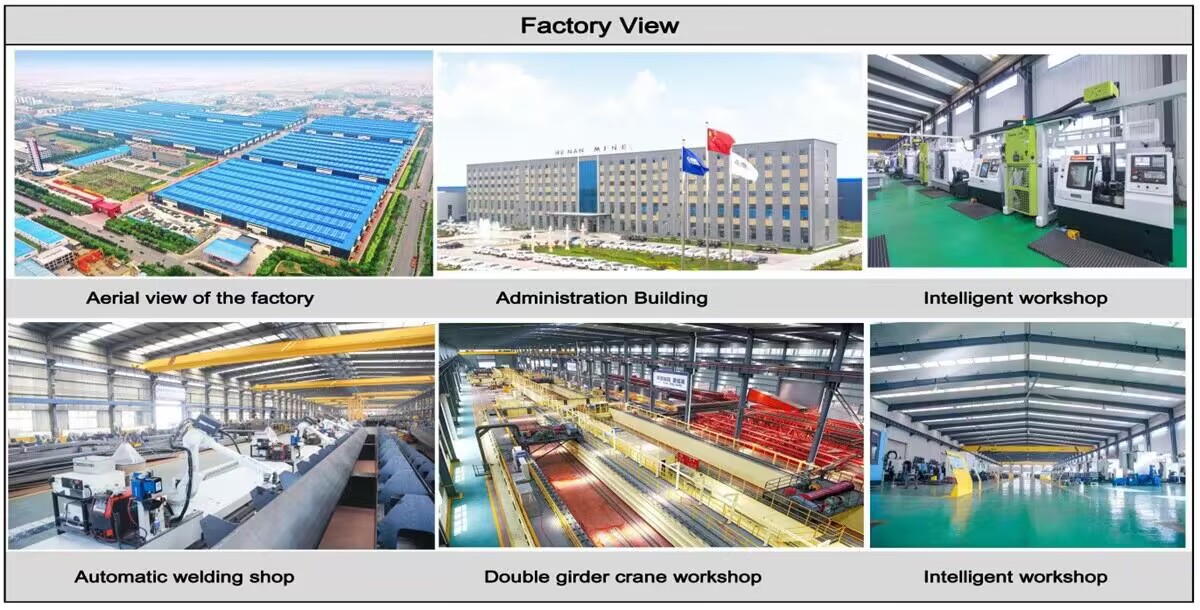
Workshop view:
The company has installed an intelligent equipment management platform, and has installed 310 sets (sets) of handling and welding robots. After the completion of the plan, there will be more than 500 sets (sets), and the equipment networking rate will reach 95%. 32 welding lines have been put into use, 50 are planned to be installed, and the automation rate of the entire product line has reached 85%.


Hot Tags: fixed gantry crane, China fixed gantry crane manufacturers, suppliers, factory
You Might Also Like



Send Inquiry