










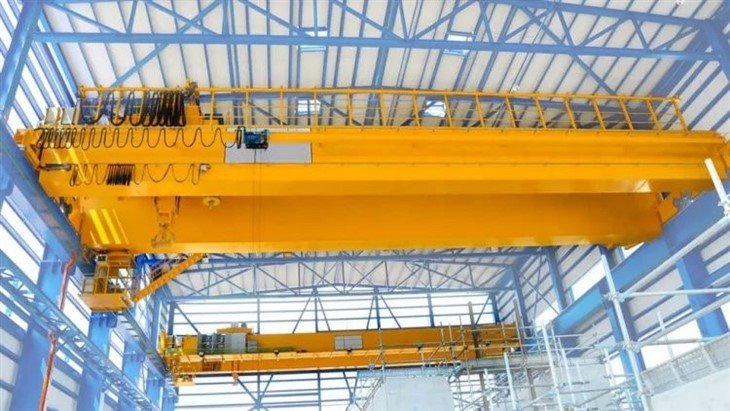


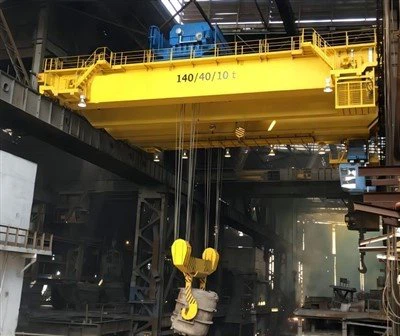
Double Girder Overhead Travelling Crane
This type of crane is typically designed with two parallel bridge girders that support the hoist trolley and other lifting equipment, creating a stable platform for lifting and moving heavy loads.
Some of the key features and benefits of double girder overhead travelling cranes include:
- High lifting capacity: Double girder overhead travelling cranes are capable of lifting heavy loads weighing up to several tons, making them ideal for handling large and bulky items.
- Wide span: The parallel bridge girders of these cranes can span a wide area, providing maximum coverage and flexibility in lifting and transporting loads.
- Dual speed operations: Many double girder overhead travelling cranes are equipped with dual speed operations that allow for precise load handling, improved productivity, and enhanced safety.
- Customizable design: Double girder overhead travelling cranes can be customized to meet the specific needs of different industries and applications, with options for specific hoist and trolley configurations, lifting speeds, and operating controls.
- Durability and reliability: These cranes are built to withstand heavy use and tough environments, with rugged construction and high-quality components to ensure reliable and long-lasting performance.
Overall, a double girder overhead travelling crane is a versatile and essential piece of equipment for any industry that requires heavy lifting and transport capabilities. By investing in a high-quality double girder overhead travelling crane, businesses can enhance productivity, improve safety, and maximize operational efficiency in a variety of settings.
- Capacity: 5-1200ton
- Capacity: 5-800/50ton
- Span length: 4-35m
- Lifting height: 3-50m
- Work duty: A4, A5, A6,A7
- Raged voltage: 220V~690V, 50-60Hz, 3ph AC
- Work environment temperature: -25℃~+50℃, relative humidity ≤85%
- Crane control mode: Floor control / Remote control / Cabin room

Pictures & Components
1. Whole set crane
A double girder overhead travelling crane is a type of construction equipment that is used for lifting and moving heavy loads over large distances. It consists of two parallel girders that are used to support a bridge which in turn supports a trolley and hoist unit. The crane is designed to be installed with its bridge suspended between two bays or building columns, allowing it to move along a fixed path. The double girder design provides greater stability and lifting capacity, making it ideal for handling large, heavy loads in industrial settings such as factories, warehouses, and shipyards. The crane can be operated using a wired or wireless control system, allowing the operator to move the trolley and hoist unit along the bridge as needed. It is also commonly used in construction and maintenance work, as well as in the transportation of goods and materials.

2. Main girder
The main girder of a Double Girder Overhead Travelling Crane (DGOTC) is the primary load-bearing component that spans the width of the building or workspace. It consists of two parallel beams that support the hoist trolley and other components of the crane. The size and strength of the main girder depend on the weight and dimensions of the loads to be lifted and moved, as well as the length of the span. The main girder is typically designed and fabricated according to international standards to ensure safety and reliability. The material used for the main girder can vary, but common materials include structural steel or aluminum alloys. The main girder of a DGOTC plays a crucial role in the crane's functioning and is an integral part of its overall structure.
3. Lifting System
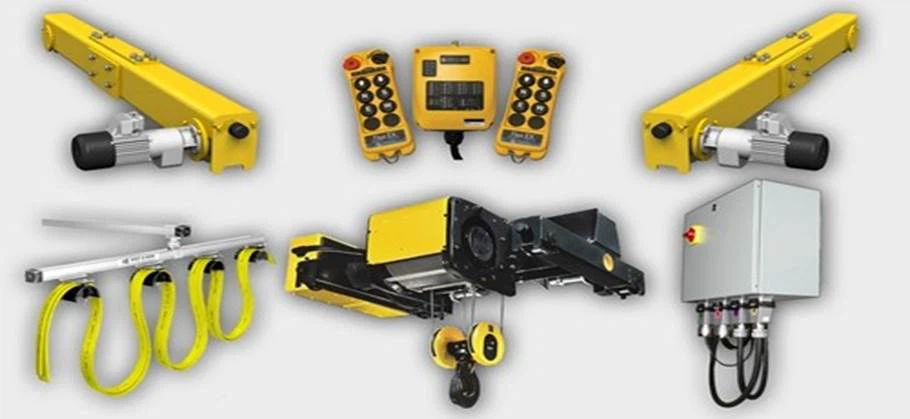
The lifting components of the crane include a hoist, trolley, and bridge. The hoist is used to lift and lower the load, while the trolley moves the load horizontally along the bridge. The bridge is mounted on the girders and travels across the length of the runway. The crane is powered by an electric motor and can be controlled by a remote or a pendant.

4. End Carriages
1) Double Girder Overhead Travelling Crane End Carriages are the components that support the bridge girders and enable the crane to move along the runway. These end carriages are connected to the bridge girders and consist of a frame, wheels, and a drive mechanism.
2) The frame of the end carriage is designed to provide support for the bridge girders and to transfer load to the runway. The wheels are mounted on the frame and enable the crane to move along the runway. The drive mechanism is used to power the wheels and move the crane.
3) Double Girder Overhead Travelling Crane End Carriages are available in different configurations, depending on the application and load requirements. They can be designed for different speeds, load capacities, and operating conditions.
4) The selection of the end carriage depends on the specific requirements of the installation, such as the span of the crane, the weight of the load, and the speed of operation. Proper installation and maintenance of the end carriage are important to ensure safe and reliable operation of the crane.

5. Crane traveling mechanism
1) Double girder overhead travelling crane is a type of industrial crane that is used to lift and transport heavy loads in manufacturing, construction, and logistics industries. It consists of two parallel girders, a hoist mechanism, and a travelling mechanism.
2) The crane travelling mechanism is responsible for moving the crane along the length of the runway beams that are installed on the building structure. It usually comprises of drive motors, wheels or rollers, and a control system that enables the crane operator to move the crane in various directions.
3) The travelling mechanism is designed to provide smooth and precise movement of the crane, even when carrying heavy loads. The drive motors and controls are often electric, which allows for increased precision and smoothness of operation.
4) Overall, the double girder overhead travelling crane with its advanced travelling mechanism is an excellent choice for heavy lifting and transportation needs in manufacturing, construction, and logistics industries.
6. Trolley traversing mechanism
1) The trolley traversing mechanism is a crucial component of a double girder overhead travelling crane. It is responsible for moving the trolley along the length of the bridge girder, and enables the crane to perform horizontal movements.
2) The trolley traversing mechanism consists of a motor, gearbox, brake, and a set of wheels or rollers. The motor provides the power needed to move the trolley, while the gearbox controls the speed and torque. The brake ensures that the trolley does not move when the motor is not in operation.
3) The trolley is mounted on wheels or rollers that are guided along rails fixed to the bridge girder. When the motor is activated, the wheels or rollers are moved forward or backward, allowing the trolley to travel along the length of the bridge girder.
4) The trolley traversing mechanism can be controlled using a variety of methods, including pendant control, radio control, or a cabin fitted with controls. These controls allow the operator to move the trolley forwards, backward, left, or right, making it easy to position the load with precision.
5) Overall, the trolley traversing mechanism is an essential component of a double girder overhead travelling crane, and plays a critical role in its operation. It enables the crane to transport loads horizontally, making it a versatile and efficient tool for many different applications.
7. Crane wheel
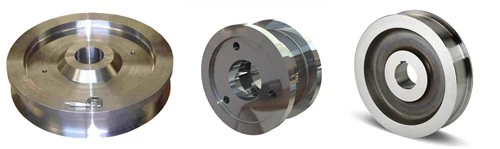
1) A double girder overhead travelling crane has 2 crane wheels that support the movement of the crane along the rails. These crane wheels are typically made of steel and are located on either side of the crane's bridge, which spans the gap between the two parallel girders. The crane wheels typically have flanges that help keep the crane on the rails and prevent it from derailing. The size and capacity of the crane wheels depend on the load capacity of the crane and the rail size and strength.
2) The crane wheel is a critical component of a double girder overhead travelling crane. It is a wheel that is mounted on an axle and is used to support and move the crane along the runway beam. The crane wheel is made of a durable material such as forged steel or cast iron, and has a flange that keeps it on the track. The size of the crane wheel will depend on the load capacity of the crane and the width of the runway beam. Proper maintenance of the crane wheel is important to ensure the safe and efficient operation of the crane. Over time, the crane wheel may wear out and need to be replaced to maintain the smooth movement of the crane along the runway beam.
3) The corner box type wheel sets are all led out by oil pipes, which is convenient for oiling and maintenance
The wheel material adopts ZG340-640, and is subjected to advanced power frequency heat treatment and quenching
8. Crane hook
Double girder overhead travelling cranes are used in industrial and manufacturing settings to lift and transport heavy loads. The crane hook is the component that actually lifts and moves the load. It is attached to the end of the hoist rope and can be lowered and raised using the crane controls. The size and weight capacity of the hook will depend on the specific crane being used. Safety features such as load limiters and emergency stop buttons are incorporated into the design to ensure safe operation.

9. Motor
1) The motor for a double girder overhead travelling crane is typically an AC induction motor. These motors are designed to provide high power output and efficient performance, making them ideal for heavy-duty crane applications.
2) The motor is typically coupled to a gearbox, which reduces the motor speed to provide the necessary torque for lifting heavy loads. The gearbox also allows for precise speed control, which is important for the safe and efficient operation of the crane.
3) The motor and gearbox are housed in a protective enclosure, which helps to prevent damage from dust, debris, and other environmental factors. The enclosure also helps to reduce noise levels, which is important for maintaining a safe and comfortable working environment for crane operators and other workers in the vicinity.
4) Overall, the motor is a critical component of a double girder overhead travelling crane, providing the power and control necessary to safely and efficiently move heavy loads.


10. Sound and light alarm system & limit switch
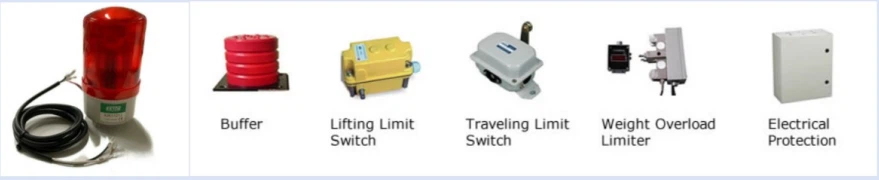
1) Every crane will be equipped a sound and light alarm system and so that it is an effective way to keep people safe in emergency situations. It is important to ensure that the system is regularly tested and maintained to ensure that it is in good working order.
2) The limit switch can be widely used in three - dimensional control and travel limitation of hoisting machinery, and it can protect the crane.
11. Safety Devices
There are several safety devices used in double girder overhead travelling cranes, including:
1) Overload Protection: This safety device ensures that the crane does not lift more weight than it can handle. It typically consists of an overload limiter that triggers an alarm or stops the crane if the load exceeds the safe limit.
2) Anti-Collision Device: This safety device prevents collisions between the crane and other objects or cranes on the same track. It generally consists of sensors that detect the proximity of other objects and trigger an alarm or stop the crane if a collision is imminent.
3) Emergency Stop Button: This safety device allows the crane operator to stop the crane in case of an emergency. The button is typically located in a visible and accessible place for the operator.
4) Limit Switch: This safety device limits the travel of the crane by setting a limit on the movement range. The limit switch is mounted on the crane's trolley and bridge and triggers an alarm or stops the crane if the limits are exceeded.
5) Warning Lights: This safety device alerts workers in the vicinity of the crane's movement. The lights typically flash to warn workers to stay clear of the crane's path.
These safety devices play an essential role in preventing accidents and ensuring worker safety around double girder overhead travelling cranes.
12. Control Mode
Double girder overhead travelling cranes can be controlled in different ways depending on the specific application and user preference.
1) Pendant control: This is the most commonly used control mode for double girder overhead travelling cranes. The operator uses a handheld pendant to control the crane movement, including lifting, lowering, trolley travel, and bridge travel.
2) Remote control: In this control mode, the operator controls the crane movement using a wireless remote control. This is commonly used when the operator needs to move around the work area or when the crane is being used for hazardous materials.
3) Cabin control: Cabin control is used in cranes where the operator needs to be located near the load for better visibility and control. The cabin is usually located at the top of the crane and the operator uses a control panel to control the crane movement.
4) Radio control: Radio control is similar to remote control but uses radio waves to communicate between the controller and the crane. This mode is commonly used for cranes that need to operate in a hazardous environment or in places where the operator cannot be present.
5) PLC control: Programmable Logic Controller (PLC) control is used in cranes that require complex automation and monitoring. The PLC system controls the crane movement, speed, and operation based on programmed inputs and feedback sensors.

13. Sketch

Main Technical Data

Advantages
1. High lifting capacity: Double girder overhead travelling cranes have a higher lifting capacity than single girder cranes because of their two girders. This makes them ideal for heavy-duty industrial applications.
2. Longer span: Double girder overhead travelling cranes can span over longer distances, making them suitable for larger facilities.
3. Increased hook height: The double girder design allows for a higher hook height than single girder cranes, which is important in applications where vertical clearance is a concern.
4. Improved stability: Double girder overhead travelling cranes are more stable than single girder cranes, providing a safer operating environment.
5. More adaptable: Double girder overhead travelling cranes can be customized to fit specific industrial applications, making them a more versatile solution.
6. Reduced maintenance: Double girder overhead travelling cranes require less maintenance than single girder cranes due to their larger size and better stability.
7. Longer lifespan: Due to their durable construction and reduced maintenance requirements, double girder overhead travelling cranes have a longer lifespan than single girder cranes.
8. Increased productivity: Double girder overhead travelling cranes can handle larger loads and operate over greater distances, leading to increased productivity in industrial settings.
Application
Double girder overhead travelling cranes are commonly used in various industries such as construction, manufacturing, and logistics. These cranes are designed to meet heavy-duty lifting requirements and can handle loads ranging from 5 to 500 tons. Some of the common applications of double girder overhead travelling cranes are:
1. Steel Manufacturing: These cranes are widely used in steel mills for handling raw materials, scrap steel, and finished products. They are also used for loading and unloading of large steel coils from trucks and cargo ships.
2. Automotive Industry: Double girder overhead cranes are widely used in the automotive industry for handling heavy automotive parts and equipment. They are used for lifting engines, vehicle frames, and other large automotive components during the manufacturing process.
3. Construction: These cranes are commonly used in construction sites for lifting and moving heavy building materials such as steel beams, concrete blocks, and precast panels. They are also used for erecting large steel structures and building bridges.
4. Manufacturing: Double girder overhead cranes are widely used in manufacturing facilities for handling heavy machinery and equipment. They are used for lifting large and heavy items such as generators, turbines, and compressors.
5. Logistics: These cranes are extensively used in the logistics industry for handling and moving heavy cargo containers and crates in ports, railways, and airports. They are also used for loading and unloading cargo from trucks and other types of vehicles.
Crane Production Procedure
1. Design and Engineering: The first step in the production of a double girder overhead travelling crane is designing and engineering. This includes determining the specifications of the crane, such as the load capacity, span, and height, as well as the type of material to be used in construction.
2. Material Selection: Once the design is complete, the next step is to select the materials that will be used to construct the crane. This includes steel, motors, brakes, electrical components, and other necessary parts.
3. Fabrication: After the materials are selected, the fabrication process begins. This involves cutting, bending, and welding the steel to create the various components of the crane. Each component is then treated with a protective coating to prevent corrosion.
4. Assembly: Once all the components have been fabricated, the assembly process begins. This involves attaching the various parts together using bolts and other fasteners. Motors, brakes, electrical wiring, and other components are also installed at this stage.
5. Inspection and Testing: The completed crane is then inspected and tested to ensure it meets all safety standards and functions properly. This includes load testing, electrical testing, and functional testing of all components.
6. Delivery and Installation: The final step in the production procedure is to deliver the crane to the customer and install it at the desired location. This involves using a crane or other lifting equipment to lift the crane into place and securing it to the supporting structure.
Overall, the production procedure for a double girder overhead travelling crane requires a skilled team, advanced equipment, and attention to detail to create a safe and reliable crane that meets the needs of the customer.

Workshop View
The company has installed an intelligent equipment management platform, and has installed 310 sets (sets) of handling and welding robots. After the completion of the plan, there will be more than 500 sets (sets), and the equipment networking rate will reach 95%. 32 welding lines have been put into use, 50 are planned to be installed, and the automation rate of the entire product line has reached 85%.


Hot Tags: double girder overhead travelling crane, China double girder overhead travelling crane manufacturers, suppliers, factory, Double Girder Overhead Crane, Double Girder Overhead Travelling Crane
Previous
Overhead Crane ConstructionNext
No InformationYou Might Also Like



Send Inquiry