










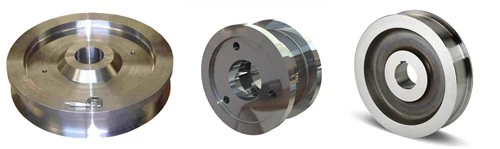
Forged Steel Wheels
1.Function
1)Support the entire weight of the gantry crane, including its own structure and the lifted load.
2)Enable the crane to move horizontally along the runway rails or tracks.
3)Transmit the driving force from motors to facilitate smooth travel.
4)Withstand side thrusts, vertical loads, and impacts during crane operations.

2.Wheel Drive System
1) Load Support and Distribution
Primary Function: Forged steel wheels are designed to bear heavy loads without deforming or breaking. This makes them essential in industries where machinery, vehicles, or equipment need to move large, heavy materials. They evenly distribute the weight of the load across the wheel, preventing localized stress and ensuring the longevity of both the wheel and the equipment.
Applications: Used in cranes, railway vehicles, heavy-duty trucks, and industrial machinery to transport goods and materials.
2)Ensuring Mobility
Function: Forged steel wheels enable the movement of equipment or vehicles across various terrains or tracks. Their strength ensures smooth, efficient movement, whether on railroads, concrete floors, or rough terrain.
Applications: Found in rail systems, material handling equipment (like forklifts), and construction machinery where movement over diverse surfaces is required.
3)Providing Durability and Resistance to Wear
Function: The forging process enhances the wear resistance of the steel, making these wheels last longer even under extreme operating conditions. The uniform grain structure achieved during forging gives the wheel a higher resistance to abrasion, cracks, and deformations.
Applications: Mining equipment, off-road construction vehicles, and industrial transport equipment where wheels face heavy usage.

3.Components of a Wheel Drive System Using Forged Steel Wheels
1)Motor or Engine:
The motor or engine is the primary source of power for the wheel drive system. It generates the energy required to move the vehicle or equipment. The motor could be electric, diesel, or hydraulic, depending on the application.
In cranes or rail vehicles, electric motors are often used, while in off-road vehicles or heavy machinery, diesel or hydraulic motors might be more common.
2)Transmission:
The transmission system connects the motor to the wheels and is responsible for transferring power from the motor to the wheels.
It may include gears, gearboxes, and coupling devices that adjust the power and torque output of the motor to match the operational needs of the system.
In railway systems, this could include gearboxes that control the speed and direction of the locomotive wheels.
3)Drive Axle or Shaft:
The drive axle or shaft transfers the rotational force from the motor to the wheels. This axle runs between the motor and the wheels, ensuring that the motion is effectively transferred.
Depending on the application, single or dual drive axles may be used for additional torque and load-bearing capacity, such as in gantry cranes or rail vehicles.
4)Wheel Bearings:
Wheel bearings support the forged steel wheels and allow them to rotate smoothly under load. They are crucial for reducing friction between the wheel and the axle.
Sealed bearings are commonly used to prevent dirt and debris from entering the bearing and causing wear.
5)Braking System:
In a wheel drive system, a braking system is essential to stop or control the speed of the vehicle. It is commonly integrated into the wheel assembly or connected to the drive shaft.
The braking system may use disc brakes, drum brakes, or regenerative braking systems, depending on the application.
6)Steering Mechanism (for vehicles with directional control):
For wheel drive systems used in vehicles, the steering mechanism controls the direction of the wheels. In industrial machinery or cranes, this may include differential steering or power steering systems.
In railway vehicles, however, the wheels are generally fixed in direction, and the steering is done by turning the track switches.

Material:
A) Carbon steel: A350LF2, A105, Q235, Q355D, A694F52, A516-GR65, EN10222, P280GH, P245GH, P250GH, JIS S25C, SS400, S20C, 16Mn, C22.8, Q345B/C/D, 1055, 1045, C50, C45, 10#, 20#, 35#, 45#, 40#, 50#, 55#, 60# and other carbon steel forgings.
B) Stainless steel: ASTM, A182, F304/304L, F316/316L, F316H, F310, F321, JB4728-2000, OCR18Ni10Ti, JB4728-2000, OCR17NI12Mo2, 2205, 2507, 2103, 904L, 254SMD, 304LN , 316LN, 1CR13, 2cr13, 3cr13, 4cr13, 321, 302, W1813N, W2014N, W2018N, W2020N, P550, Cr18Mn18N, 06Cr19Ni10(S30408), 022Cr19Ni10(S30403), 06Cr17Ni12Mo2(S31608), 022Cr17Ni 12Mo2(S31603), 06Cr25Ni20(S31008), 06Cr18Ni11Ti(S32168), 022Cr19Ni13Mo (S31703), 0Cr17Ni4Cu4Nb, 06Cr19Ni10N, 14Cr17Ni2, 13Cr13Mo, 06Cr13 and other stainless steel forgings.
C) Alloy steel: 40Cr, 15CrMo, 20CrMo, 25CrMo, 30CrMo, 35CrMo, 35CrMoV, 42CrMo, 20Cr2Ni4, 20CrNiMo, 40CrNiMo, 30Cr2Ni2Mo, 35CrMoV, 12Cr1MoV, 38CrMoAl, 18Cr2Nio4W, 40CrNi2Mo, 30CrMnSi, 25Cr2MoV, 17 Cr2Ni2Mo, 20MnMo, 20MnMoNb, 34CrNi3Mo, 20CrMnTi , 40CrMnMo, 30Cr2Ni2Mo, 34CrMo1, 20CrMnMo, 24CrMoV, 30Cr2MoV, 34CrNi1Mo, 17Cr2Ni2Mo, 34CrNi3MoV, 20CrMnTi, A182F1, F5, F9, F11, F22, 12Cr2Mo1, 10Cr9Mo1VNbN (F91), 10Cr9Mo W2VNbBN (F92), 12CrMoV, 4140, 4340, 4330 , 4130, 4150, 9CR2MO, 17NiCrMo6-4, 18CrNiMo7-6, 30CrNiMo8, 34CRNIMO, 34CrNiMo6, 36CrNiMo4, 34CrNi3Mo, 40CRNIMO, 40CrNiMoA, 50CrMo4, Q345D, 300M, 17-4PH, PH13-8Mo, 15-5PH, AerMet 100 and other alloys steel forgings.
- Diameter: Φ250, Φ350, Φ400, Φ500, Φ600, Φ700, Φ800, Φ 1000, Φ 1200 or as your requirement
- Technique: Casting or forging
- Quenching Depth: more than 25mm
- Heat Treatment: Quenching and tempering
- Work environment temperature: -25℃~+40℃, relative humidity ≤85%
- Reference Price Range: $80-1000/piece
- Rated Loading Capacity: 1~1200 ton
Sketch

Advantages
1.High Load Capacity:
Forged steel wheels are capable of carrying heavier loads than other types of wheels, such as cast or welded wheels, making them ideal for applications requiring high capacity.
2.Increased Longevity:
Due to their durability and wear resistance, forged steel wheels have a longer service life, which reduces maintenance and replacement costs.
3.Enhanced Safety:
The strength and durability of forged steel wheels reduce the risk of failure or damage, improving safety in industrial applications.
4.Improved Performance:
The uniform grain structure from the forging process results in better overall performance, including smoother operation and higher efficiency.
Application
1.Cranes and Hoists:
Forged steel wheels are used in the trolley and rail systems of overhead cranes, gantry cranes, and hoists, where they support the heavy lifting and movement of materials.
2.Railway Systems:
Locomotive wheels and railway freight cars often use forged steel wheels due to their strength and load-bearing capacity.
3.Material Handling Equipment:
Forklifts, lift trucks, and other material handling vehicles utilize forged steel wheels for smooth movement and durability on factory floors, warehouses, and construction sites.
4.Industrial Machinery:
Forged steel wheels are used in the rollers, pulleys, and axles of industrial machinery, ensuring reliability and efficiency in machinery operations.
5.Mining and Construction Equipment:
Heavy-duty vehicles, such as dump trucks, excavators, and earth-moving equipment, use forged steel wheels to withstand extreme wear and high loads.
6.Wind Turbine Equipment:
Forged steel wheels are also used in the gears and rollers for wind turbine components, where durability and resistance to harsh conditions are vital.
Production Procedure
1.Material Selection:
The primary material used for forging is high-quality carbon steel or alloy steel, which is carefully chosen based on the strength, hardness, and resistance to wear required for the specific application.
Alloy steel may be used for applications requiring increased resistance to heat or wear, while carbon steel is often used for general industrial applications.
2.Heating:
The steel billets are heated to a high temperature (usually around 1200°C or 2200°F) to make the material malleable, which is essential for the forging process.

3.Forging:
The heated steel is placed in a forging die or mold and subjected to immense pressure. The pressure reshapes the steel into the desired wheel shape.
The forging process compacts the material, aligning the grain structure and enhancing the mechanical properties of the wheel, such as tensile strength and impact resistance.

4.Machining:
After forging, the wheel is machined to precise dimensions. This includes processes such as turning, milling, and grinding to ensure smooth surfaces, proper alignment, and dimensional accuracy.
This step ensures the wheel is free of any surface defects and is properly balanced for use.
5.Heat Treatment:
The wheel is then subjected to heat treatment (such as quenching and tempering) to increase its hardness and toughness. The heat treatment process further enhances the wheel's ability to handle heavy loads and extreme stresses.

6.Testing and Inspection:
Once the wheel has been forged, machined, and heat-treated, it undergoes a series of quality control checks. These may include:
Ultrasonic testing: To detect internal flaws.
Hardness testing: To ensure the correct hardness has been achieved.
Dimensional checks: To verify the wheel meets the required size and shape specifications.


Workshop View
The company has installed an intelligent equipment management platform, and has installed 310 sets (sets) of handling and welding robots. After the completion of the plan, there will be more than 500 sets (sets), and the equipment networking rate will reach 95%. 32 welding lines have been put into use, 50 are planned to be installed, and the automation rate of the entire product line has reached.


Hot Tags: forged steel wheels, China forged steel wheels manufacturers, suppliers, factory, Steel Rail Wheels, Train Wheels, Crane Parts, Forged Crane Wheels, Forged Wheel, Forged Train Wheels
Previous
Steel Forged Crane Rail WheelYou Might Also Like


Send Inquiry