










Steel Forged Crane Rail Wheel
A steel forged crane rail wheel is a heavy-duty wheel designed for overhead cranes, gantry cranes, and other material handling equipment that runs on rails. These wheels are crucial for smooth movement, load-bearing, and durability in industrial environments.
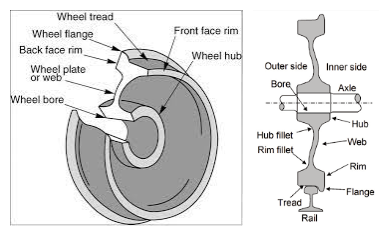
Key Features of Forged Steel Crane Rail Wheels:
Material:
Made from high-quality forged steel (typically AISI 1045, 1055, or 1060 carbon steel), providing superior strength and wear resistance.
Forging enhances grain structure, improving toughness and fatigue resistance compared to cast wheels.
Heat Treatment:
Often heat-treated (quenching & tempering) to achieve optimal hardness (typically HRC 40-55) for prolonged service life.
Flame or induction hardening on the tread surface increases wear resistance.
Design & Dimensions:
Available in various profiles (flat tread, conical, or crowned) to match different rail types (e.g., AISC, DIN, BS, or JIS standards).
Common diameters range from 200mm to 1000mm+, with widths suited for specific rail widths.
Load Capacity:
Designed to handle high dynamic loads (from a few tons to hundreds of tons).
Fatigue-resistant to endure repeated stress over long periods.
Precision Machining:
Machined to tight tolerances for smooth rolling and minimal vibration.
Bore finishing ensures proper fit with axles or bearings.

Material:
The material used for steel forged crane rail wheels is typically a high-quality alloy steel that offers excellent strength, wear resistance, and durability under heavy loads. Common materials include:
Common Materials for Forged Crane Rail Wheels:
AISI 1045 / C45 (Medium Carbon Steel)
Good strength and wear resistance.
Commonly used for moderate-duty applications.
AISI 4140 / 42CrMo4 (Chromium-Molybdenum Alloy Steel)
Higher strength, toughness, and fatigue resistance.
Suitable for heavy-duty and high-load applications.
AISI 4340 / 40CrNiMoA (Nickel-Chromium-Molybdenum Steel)
Superior impact resistance and durability.
Used in extreme-duty crane wheels and harsh environments.
AISI 1060 / 60Mn (High Carbon Steel)
High hardness and wear resistance.
Often used in applications requiring better abrasion resistance.
Heat Treatment:
Quenching & Tempering is usually applied to enhance hardness and toughness.
Surface hardening (e.g., induction hardening) may be used to improve wear resistance.
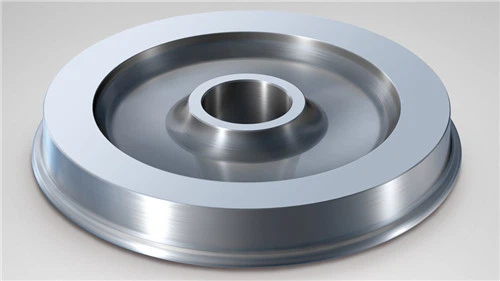
Sketch
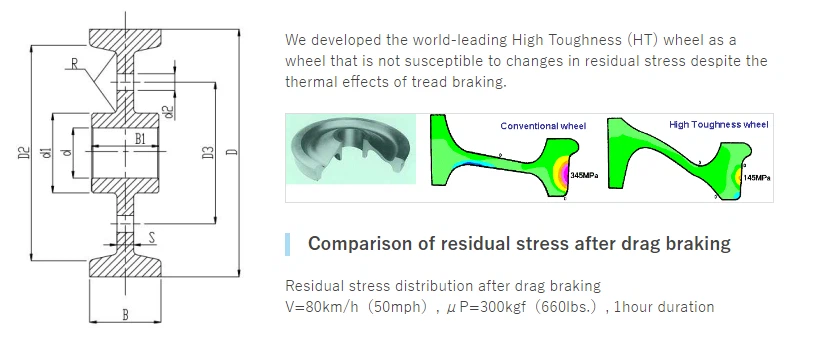
Advantages
Advantages of Steel Forged Crane Rail Wheels
Steel forged crane rail wheels offer several significant advantages over cast or other types of wheels, making them the preferred choice for heavy-duty applications:
Strength and Durability
Superior structural integrity due to the forging process that aligns the grain structure
Higher load-bearing capacity compared to cast wheels
Greater impact resistance to withstand shock loads
Wear Resistance
Longer service life due to hardened surfaces
Better resistance to deformation under heavy loads
Reduced maintenance requirements
Performance Benefits
Smoother operation with more precise dimensions
Better fatigue resistance for cyclic loading applications
Higher reliability in demanding environments
Safety Advantages
Lower risk of catastrophic failure (forged wheels don't have porosity or voids like cast wheels)
More consistent performance throughout the wheel's lifespan
Better heat treatment response allowing optimal hardness profiles
Economic Benefits
Lower total cost of ownership despite higher initial cost
Reduced downtime due to longer intervals between replacements
Better value over time through extended service life
These advantages make forged steel wheels particularly suitable for heavy-duty cranes, gantry systems, and other demanding material handling applications where reliability and safety are critical.
Application
Application of Steel Forged Crane Rail Wheels
Steel forged crane rail wheels are critical components in overhead cranes, gantry cranes, and other material handling systems. They are designed to withstand heavy loads, high stress, and continuous operation in industrial environments. Below are the key applications and benefits of forged steel crane rail wheels:
1. Overhead Cranes & Gantry Cranes
Used in steel mills, shipyards, and construction sites where heavy loads must be moved precisely.
Forged wheels provide high strength and wear resistance, ensuring long service life under heavy-duty conditions.
2. Port & Container Handling Cranes
Essential for ship-to-shore cranes, RTGs (Rubber-Tired Gantry Cranes), and STS cranes in ports.
Forged steel wheels handle dynamic loads, shock, and impact from moving shipping containers.
3. Mining & Heavy Industrial Applications
Used in mining cranes, ladle handling systems, and ore bridges where extreme durability is required.
Resistant to abrasion, deformation, and fatigue caused by harsh environments.
4. Railway & Transportation Systems
Applied in railway maintenance cranes and heavy-duty transfer cars.
Forged wheels ensure smooth rolling motion and reduced wear on rails.
5. Steel Plants & Foundries
Used in hot metal ladle cranes, slab handling, and coil transport systems.
Withstand high temperatures and heavy shock loads without cracking.


Production Procedure
The production of steel forged crane rail wheels involves several critical steps to ensure durability, strength, and precision. Below is a detailed step-by-step production procedure:
1. Material Selection
Raw Material: High-quality alloy steel (e.g., AISI 1045, 1055, 4140, or equivalent standards like DIN/EN).
Quality Check: Chemical composition analysis (C, Mn, Si, Cr, etc.) and ultrasonic testing for internal defects.
2. Heating & Forging
Preheating: The steel billet is heated to 1100°C–1200°C in a furnace for uniform plasticity.
Forging Process:
Open-Die Forging: Rough shaping under a hydraulic press.
Closed-Die Forging: Precision forging in dies to form the wheel profile (tread, flange, hub).
Hot Punching: A hole is punched for the axle bore.
3. Heat Treatment (To Enhance Mechanical Properties)
Normalizing: Heated to 850°C–900°C and air-cooled to refine grain structure.
Quenching & Tempering:
Quenching: Rapid cooling in oil/water to achieve high hardness.
Tempering: Reheated to 400°C–600°C to reduce brittleness while maintaining toughness.
4. Machining (CNC Precision Machining)
Turning: Lathe machining for dimensional accuracy (OD, bore, tread profile).
Flange & Tread Grinding: Ensures smooth contact with the rail.
Boring & Keyway Cutting: Precision drilling of the axle bore and keyway (if required).
5. Non-Destructive Testing (NDT)
Ultrasonic Testing (UT): Detects internal flaws.
Magnetic Particle Inspection (MPI): Checks surface cracks.
Hardness Testing: Ensures compliance with standards (e.g., HB 300–400).
6. Surface Treatment & Coating
Shot Blasting: Removes scale and improves surface finish.
Anti-Corrosion Coating: Zinc plating, phosphating, or paint (optional).
7. Final Inspection & Packaging
Dimensional Check: Verifies tolerances per ISO/ASME standards.
Load Testing: Simulates operational stress (for critical applications).
Packaging: Wooden crates or steel pallets for shipping.

4. Machining: The finished wheel is then machined to achieve the desired finish and dimensions. This includes grinding the edges, boring the center hole, and drilling the bolt holes.

5. Heat treatment: The forged wheel is then subjected to various heating and cooling processes to refine its chemical and physical properties. This helps to ensure that the wheel is strong, durable, and resistant to wear.

6. Finishing: The finished wheels are cleaned, inspected for defects and polished to a smooth finish.

7. Inspection: Finally, the finished steel rail wheel is rigorously inspected to ensure that it meets the required standards for strength, dimensions, and surface finish. Any defects are identified and addressed before the wheel is approved for use.

8. Delivery: The completed train wheels are loaded onto trucks, trains or ships and delivered to train manufacturers where they are installed on new trains or used to replace worn-out wheels on existing trains.


Workshop View
The company has installed an intelligent equipment management platform, and has installed 310 sets (sets) of handling and welding robots. After the completion of the plan, there will be more than 500 sets (sets), and the equipment networking rate will reach 95%. 32 welding lines have been put into use, 50 are planned to be installed, and the automation rate of the entire product line has reached.


Hot Tags: steel forged crane rail wheel, China steel forged crane rail wheel manufacturers, suppliers, factory, Train Wheels, Crane Parts, Forged Wheel, Forged Crane Wheels, Forged Train Wheels, Steel Rail Wheels
Previous
Industrial Crane WheelYou Might Also Like


Send Inquiry