










Custom Forged Wheels
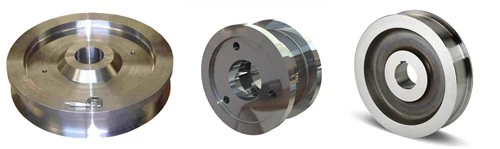
Crane rail wheels are critical components in overhead cranes, gantry cranes, and other rail-mounted material handling systems. They facilitate smooth movement along crane rails, ensuring stability, load-bearing capacity, and operational efficiency.

Function & Importance
- Load Support: Transfer the crane's load (including the trolley, hoist, and lifted materials) to the rail.
- Guidance: Keep the crane aligned on the rail to prevent derailment.
- Smooth Movement: Reduce friction for efficient travel, minimizing energy consumption.

Types of Crane Rail Wheels
- Double-Flanged Wheels: Common in overhead cranes, with flanges on both sides to prevent lateral displacement.
- Single-Flanged Wheels: Used where one-sided guidance is sufficient (e.g., certain gantry cranes).
- Flangeless Wheels: Paired with external guides, often in heavy-duty applications like blast furnaces.

Maintenance & Lifespan
- Regular Inspection: Check for cracks, wear, or flat spots.
- Lubrication: Reduces friction and prevents premature wear.
- Replacement: Wheels are replaced when wear exceeds 5–10% of the original diameter or when surface damage occurs.
Key Design Features
- Material: Typically forged steel (e.g., 65Mn, 42CrMo) for high strength and wear resistance.
- Heat Treatment: Hardened tread surfaces (HRC 50-55) to endure heavy loads and abrasion.
- Tread Profile: Convex or flat, matching the rail head to distribute stress evenly.
- Bore Design: Precision-machined to fit axle dimensions, often with keyways or splines.
- Diameter: Φ250, Φ350, Φ400, Φ500, Φ600, Φ700, Φ800, Φ 1000, Φ 1200 or as your requirement
- Technique: Casting or forging
- Quenching Depth: more than 25mm
- Heat Treatment: Quenching and tempering
- Work environment temperature: -25℃~+40℃, relative humidity ≤85%
- Reference Price Range: $80-1000/piece
- Rated Loading Capacity: 1~1200 ton
Sketch

Advantages
Crane rail wheels are crucial components in overhead cranes, gantry cranes, and other rail-based material handling systems. They offer several advantages that enhance performance, safety, and durability. Here are the key benefits:
1. High Load Capacity
Designed to withstand heavy loads, crane rail wheels distribute weight evenly, reducing stress on the rail and supporting structures.
Suitable for industries like steel, shipping, and construction where heavy lifting is routine.
2. Durability & Long Service Life
Made from high-quality materials (forged steel, alloy steel, or heat-treated metals) to resist wear, deformation, and fatigue.
Often hardened or tempered for increased hardness and longevity.
3. Smooth & Stable Movement
Precision-engineered for minimal friction, ensuring smooth travel along the crane rail.
Reduces vibration and noise, improving operational efficiency.
4. Reduced Maintenance Requirements
High-quality wheels minimize wear on both the wheel and rail, lowering maintenance frequency.
Some designs include lubrication systems to further decrease wear.
5. Safety & Reliability
Robust construction prevents wheel failure under heavy loads, reducing accident risks.
Flanged wheels help prevent derailment by keeping the crane aligned on the track.
6. Customization Options
Available in various sizes, materials, and tread profiles to match specific rail types (e.g., AISC, DIN, BS standards).
Can be tailored for different environments (indoor, outdoor, high-temperature, or corrosive conditions).
7. Energy Efficiency
Optimized rolling resistance reduces power consumption in electric cranes, leading to cost savings.
8. Corrosion & Heat Resistance
Special coatings or materials (stainless steel, hardened alloys) are available for harsh environments like ports, foundries, or chemical plants.
9. Compatibility with Different Rail Types
Works seamlessly with flat-bottom rails, grooved rails, and other crane rail profiles.
10. Cost-Effectiveness Over Time
Although initial costs may be higher, their durability and low maintenance lead to long-term savings.
Application
Crane rail wheels are specialized components used in overhead cranes, gantry cranes, and other rail-mounted material handling equipment. They facilitate smooth movement along crane rails, ensuring stability, load-bearing capacity, and precise positioning. Here's a detailed overview of their application and key considerations:
Applications of Crane Rail Wheels
Overhead Cranes
Used in bridge cranes (single or double girder) to move the crane along runway rails.
Common in factories, warehouses, and steel mills for heavy-load handling.
Gantry Cranes
Mounted on wheels to travel along ground rails, often used in shipyards, ports, and container terminals.
Jib Cranes
Some slewing jib cranes use rail wheels for rotational movement on circular tracks.
Stacker Cranes
Automated storage/retrieval systems (AS/RS) in warehouses rely on precision rail wheels for high-speed movement.
Port & Rail Cranes
Heavy-duty applications like container handling or railway loading/unloading require robust, wear-resistant wheels.
Specialized Industrial Cranes
Found in steel plants (ladle cranes), nuclear facilities, and mining operations where high load capacity and durability are critical.
Production Procedure
The production of crane rail wheels involves several critical steps to ensure durability, load-bearing capacity, and smooth operation. Below is a structured production procedure for manufacturing crane rail wheels:
Material Selection
Primary Material: High-quality alloy steel (e.g., 65Mn, 42CrMo, 60Si2Mn) for high strength and wear resistance.
Alternative Materials: Cast steel or forged steel for heavy-duty applications.
Quality Check: Chemical composition analysis (C, Mn, Si, Cr, Mo) to meet standards (e.g., ISO, DIN, ASTM).
Forging or Casting
Option A: Forging (Preferred for High Strength)
Heating: Billets heated to 1100–1200°C in a furnace.
Die Forging: Pressed into wheel shape using hydraulic or mechanical forging presses.
Advantages: Better grain structure, higher fatigue resistance.
Option B: Casting (For Complex Designs)
Sand Casting / Investment Casting: Molten steel poured into molds.
Post-Casting Treatment: Annealing to relieve internal stresses.
Precision Machining
CNC Turning/Facing: Final dimensional accuracy (±0.05mm).
Grinding: High-precision grinding for tread and flange surfaces.
Flange & Tread Profiling: Ensures proper rail contact geometry.
Non-Destructive Testing (NDT)
Ultrasonic Testing (UT): Detects internal flaws.
Magnetic Particle Inspection (MPI): Checks surface cracks.
Hardness Testing: Ensures uniform hardness (Rockwell/Brinell test).

Rough Machining
Turning: CNC lathe machines rough-cut the wheel profile.
Drilling: Center bore hole (if required).
Surface Grinding: Initial smoothing of tread and flange surfaces.

Heat Treatment
Quenching & Tempering:
Hardening: Heated to 850–900°C, then quenched in oil/water.
Tempering: Reheated to 400–600°C to reduce brittleness.
Induction Hardening (Optional): For enhanced tread hardness (HRC 50–60).

Surface Finishing & Coating
Shot Blasting: Removes scale and improves fatigue resistance.
Anti-Corrosion Coating: Zinc plating, phosphating, or painting.

Quality Inspection & Certification
Dimensional Check: Diameter, bore size, flange width.
Runout Testing: Ensures smooth rolling.
Load Testing: Simulates operational stress (if required).
Certification: Compliance with ISO 9001, FEM, DIN, or ASTM A504.

Packaging & Shipping
Protective Coating: Rust-preventive oil or VCI packaging.
Wooden Crating: Prevents damage during transit.

Overall, the process of producing forged crane wheels requires a high level of expertise and attention to detail. The quality of the finished product is crucial for ensuring the safe and reliable operation of the crane.

Workshop View
The company has installed an intelligent equipment management platform, and has installed 310 sets (sets) of handling and welding robots. After the completion of the plan, there will be more than 500 sets (sets), and the equipment networking rate will reach 95%. 32 welding lines have been put into use, 50 are planned to be installed, and the automation rate of the entire product line has reached.


Hot Tags: custom forged wheels, China custom forged wheels manufacturers, suppliers, factory, Crane Parts, Forged Wheel, Wheels, Train Wheels, Forged Crane Wheels, Forged Train Wheels
Previous
Custom Forged Train WheelYou Might Also Like


Send Inquiry