










Launching Girder Machine For Highway Concrete Beam

Products Description
Key Features of a Highway Launching Girder
The machine's design is focused on handling the specific challenges of highway girder erection:
High Capacity & Strong Main Beams: Designed to lift the extreme weights of pre-cast concrete girders (I-beams, U-beams, or box girders), which can weigh from 200 to over 900 metric tons. Its dual main girders are incredibly rigid to prevent bending (minimal deflection) under load.
Self-Launching Capability: This is its defining feature. The machine can propel itself forward to the next span without the need for a disassembly and reassembly by a large mobile crane. This is done through an integrated system of hydraulic jacks or wheels that "walk" the structure forward.
Precision Placement Systems:
Synchronized Hoists: Multiple winches on the lifting trolley are computer-controlled to lift and lower the girder perfectly level.
Micro-Adjustment: Hydraulic controls allow for fine-tuning the girder's position in all directions (up-down, left-right, forward-backward) for exact placement on the bearing pads.
Guidance Systems: Operators use laser guides or surveyor stakes to achieve the required placement accuracy.
Adaptable Support Legs: The front legs support on the next pier (often on temporary headers), while the rear legs support on the previously constructed deck. The distance between legs can often be adjusted for different span lengths.
Enhanced Safety Systems:
Automatic Anchoring: Legs securely clamp to the piers and deck before any lift.
Load Moment Indicators (LMI): Computers monitor the load weight and crane stability in real-time.
Wind Speed Monitoring: Operations are halted if wind speeds exceed safe limits.
Fail-Safe Brakes: Redundant braking systems engage automatically in case of power failure.
Specification
Machine Type Self-Propelled, Modular Launching Gantry Crane
Structural Form Double Main Box Girders with Overhead Lifting Trolley
Operation Mode Electric or Electro-Hydraulic Power Pack
Control System Centralized Cabin Control + Wireless Remote Control
Rated Lifting Capacity 200 to 900 Metric Tons
Lifting Speed 0.5 - 1.0 m/min (under full load)
Trolley Traversing Speed 3 - 8 m/min
Gantry Propelling Speed 5 - 12 m/min
Max. Girder Span 30 to 50 meters
Max. Girder Weight As per rated capacity (e.g., 900T)
Lifting Height 8 - 15 meters
Power Source Diesel Generator Set or External Grid Connection
Generator Capacity 200 kVA - 400 kVA (depending on size)
Drive System Hydraulic Motors or Frequency-Controlled Electric Motors Provides smooth acceleration and deceleration.

Pictures & Components
1. Main Load-Bearing Structure
This is the primary framework that carries all the loads.
Main Box Girders (1 or 2): The primary longitudinal beams that span the entire distance between the support points. They are typically designed as two strong, rigid box girders made of high-strength steel. This design provides exceptional resistance to bending and torsion under the immense load of a concrete beam.
Front Support Legs/Columns: The vertical structures at the forward end of the gantry. They transfer the machine's weight and the load of the lifted girder onto the next pier to be built. They are often height-adjustable.
Rear Support Legs/Columns: The vertical structures at the rear of the gantry. They transfer weight onto the previously constructed bridge deck. They are critical for stability during lifting operations.
Cross Beams & Bracings: Horizontal and diagonal members that connect the two main girders and the support legs. They ensure the entire structure acts as one rigid unit, preventing distortion and maintaining geometric stability.
2. Lifting and Handling System
This system performs the actual lifting, moving, and placing of the concrete girder.
Lifting Trolley (Crab): The unit that travels along the top of the main girders. It contains the hoisting machinery.
Hoists/Winches: Powerful electric or hydraulic motors with gearboxes that wind the wire ropes to lift and lower the load. There are typically multiple hoists synchronized to lift together.
Wire Ropes & Pulleys: High-strength, steel wire ropes routed through a system of pulleys (sheaves) to provide the mechanical advantage needed for lifting hundreds of tons.
Spreader Beam (Lifting Frame): An essential attachment that connects to the girder. It is a rigid beam that ensures the lifting force is applied at the girder's designated pick-up points, preventing harmful bending stresses in the concrete girder during the lift.
3. Propulsion (Launching) System
This system allows the entire machine to move itself forward to the next span.
Propulsion Drives: Hydraulic motors or electric motors that provide the power to move the gantry.
Wheels or Sliding Pads: The components that actually interface with the launching track or the deck. Some models use rubber-tired wheels, while others use low-friction sliding pads.
Launching Nose (on some models): A temporary, lightweight forward extension of the main girders that helps guide the launching process and prevents excessive tipping.
4. Support and Stability System
These components secure the machine during lifting and launching.
Anchoring Devices: Hydraulic clamps or mechanical pins that securely lock the support legs to the bridge piers and the deck. This is a critical safety system that prevents the gantry from shifting or overturning.
Horizontal Stabilizers: Hydraulic jacks or beams that provide additional lateral support to the legs, ensuring they remain perfectly vertical under load.
Jacking Systems: Integrated hydraulic jacks used for fine-leveling the entire gantry structure on the supports to ensure it is perfectly horizontal before a lift.
5. Power and Control System
The "brain and nervous system" of the machine.
Power Unit: A large diesel generator set or an electrical connection point that provides all the necessary power for the hoists, propulsion, and controls.
Operator's Cabin: A climate-controlled cabin mounted on the gantry, providing the operator with a clear view and housing the main control consoles.
Control System: A sophisticated computerized system using PLCs (Programmable Logic Controllers) to manage all motions. Its key functions include:
Synchronization: Ensuring all hoists lift and lower at exactly the same rate.
Motion Control: Managing the speed and precision of the trolley and gantry movement.
Wireless Remote Control: Allows an operator to walk alongside the girder for a perfect view during the critical final placement and landing.
Sensor Suite:
Load Moment Indicators (LMI): Constantly monitors the weight on the hook.
Anemometer: Measures wind speed and warns or shuts down operations if limits are exceeded.
Inclinometers: Monitor the level of the gantry and the girder.
Limit Switches: Prevent the trolley or hoists from moving beyond their safe travel range.
6. Safety Systems
Integrated features dedicated to preventing accidents.
Fail-Safe Brakes: Multiple, redundant braking systems (mechanical, hydraulic) that engage automatically if power is lost.
Emergency Stop Systems: Easily accessible E-stop buttons on the cabin and remote control.
Anti-Collision Sensors: Prevents the trolley from colliding with the end of the gantry or with another trolley.
Overload Protection: The control system will not allow a lift that exceeds the machine's rated capacity.

Sketch
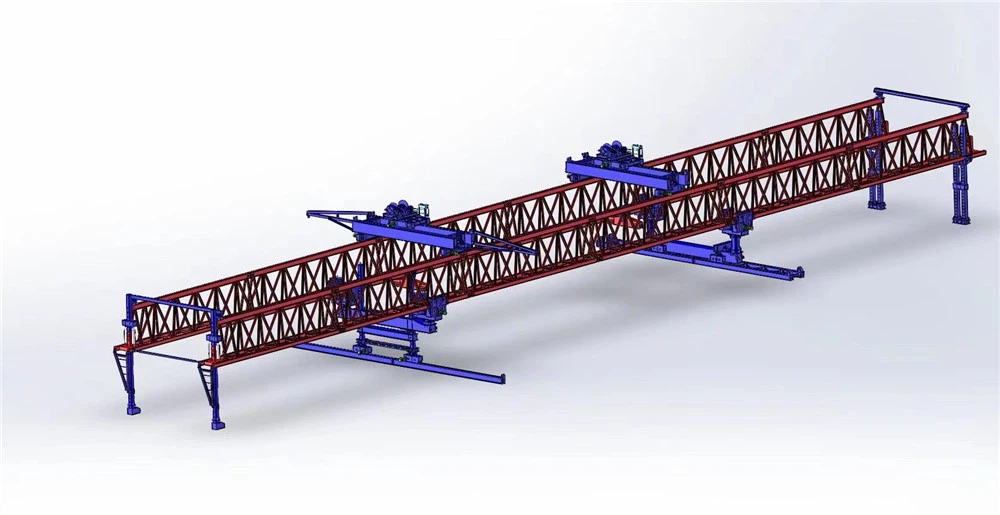

Advantages
Advantages of Using a Launching Girder Machine
The use of a launching gantry offers profound benefits over traditional methods like using multiple mobile cranes, making it the preferred choice for modern elevated highway projects.
1. Unmatched Efficiency and Speed
Assembly-Line Process: The machine creates a highly efficient, repetitive cycle: lift, place, launch forward, repeat. This systematic approach dramatically accelerates project timelines.
Rapid Launching: Its self-propelled design allows it to move to the next span in a matter of hours without disassembly, avoiding the downtime associated with mobilizing and demobilizing large cranes.
Faster Construction: Projects can progress at a rate of one span every few days, which is significantly faster than other methods.
2. Enhanced Safety
Reduced Ground Operations: Most work is performed overhead, minimizing the number of personnel and equipment working at ground level in the "danger zone" under suspended loads.
Inherent Stability: The machine is securely anchored to the robust bridge piers and deck, making it far less susceptible to instability caused by ground conditions (e.g., soft soil) that can affect mobile cranes.
Integrated Safety Systems: Built-in features like overload protection, automatic brakes, wind speed monitors, and anchoring systems actively prevent accidents.
3. Superior Precision and Quality
Millimeter Accuracy: Computer-controlled synchronization and micro-adjustment capabilities allow for the precise placement of girders onto their bearing pads. This accuracy is critical for ensuring the final deck alignment and smoothness of the road.
Controlled Environment: The lifting and placing process is protected from many variables that can affect crane operators, leading to more consistent and higher-quality results.
4. Minimal Ground Disruption and Environmental Impact
Works from Above: The machine requires very little ground space underneath the bridge alignment. This is its most significant advantage for projects in:
Urban Areas: Over existing roads, railways, or buildings with minimal traffic disruption.
Environmentally Sensitive Areas: Over rivers, wetlands, or protected habitats, greatly reducing the footprint and impact on the ecosystem.
Rough Terrain: Over deep valleys, gorges, or unstable slopes where establishing ground access for cranes is difficult or dangerous.
5. Economic Benefits (Cost-Effectiveness)
Lower Labor Costs: The process is highly mechanized and requires a smaller crew compared to managing multiple crane lifts.
Reduced Rental Costs: While the capital cost is high, it eliminates the need to rent several large-capacity mobile cranes for the entire project duration.
Predictable Scheduling: The efficiency and speed lead to shorter project timelines, reducing overall overhead and financing costs.
6. Reliability and Weather Resistance
Designed for the Task: Unlike general-purpose cranes, these machines are purpose-built for this specific application, leading to greater reliability and fewer operational hiccups.
Better Wind Tolerance: Their low, rigid profile and secure anchoring make them capable of operating safely in higher wind conditions than large lattice boom cranes.

Application
1. Long, Multi-Span Viaducts and Elevated Highways
This is their most common application. The longer the project (e.g., kilometers of continuous viaduct), the more economically justified the machine becomes. Examples include:
Urban expressways through cities.
Approach roads to major bridges.
Highways through flat, congested regions where building at grade is not an option.
2. Construction Over Operational Infrastructure
Over Live Traffic: Building a new highway over an existing road or railway without requiring a complete shutdown.
Over Railways: The ability to work with minimal intrusion is essential for railway authorities who cannot allow frequent possessions (track closures).
3. Construction in Challenging Terrain
Over Water: Building bridges over rivers, lakes, or estuaries without the need for extensive barges or floating cranes.
Over Valleys and Gorges: Where the valley is deep or the slopes are unstable, providing a stable working platform above the obstacle.
4. Use with Standardized Pre-Cast Girders
The machine is ideal for projects using repetitive, pre-cast elements like:
Pre-stressed Concrete I-Girders
Pre-stressed Concrete U-Beams
Pre-stressed Concrete Box Girders

Production Procedure
Production Procedure for a 160-Ton Bridge Erection Machine (BEM)
1. Project Definition & Design Phase
Client Requirements Analysis: Engineers work with the client to define precise specifications:
Lifting Capacity: 160 metric tons (primary requirement).
Span Length: Maximum span length the BEM must cover.
Bridge Geometry: Curvature, gradient, and cross-section of the bridge deck.
Girder Type: Pre-cast segmental box girders, I-girders, U-beams, etc.
Propulsion System: Type of movement (rolling, sliding, with or without a launch nose).
Control System: Level of automation (manual, semi-automatic, full remote control).
Site Conditions: Wind loads, seismic factors, and access limitations.
Detailed Engineering Design:
Structural Analysis: Finite Element Analysis (FEA) is performed on the main beams, supports, and lifting gear to ensure structural integrity under full 160-ton load and dynamic factors.
Mechanical Design: Design of all mechanical components: winches, hoists, trolleys, hydraulic systems, wheels, and bearings.
Electrical & Control System Design: Design of power distribution, motor controls, sensors (load, alignment, wind), and the operator interface.
Drawings & Documentation: Creation of detailed manufacturing drawings, bill of materials (BOM), and assembly instructions.
2. Procurement & Material Preparation
Sourcing of Materials: Procurement of raw materials per the BOM:
Main Beams: High-strength steel plates (e.g., ASTM A572 Gr. 50 or equivalent).
Components: Certified wire ropes, hooks, pulleys, high-grade hydraulic cylinders, valves, hoses, motors, gears, and electrical components from approved vendors.
Fasteners: High-tensile bolts, nuts, and washers.
Material Testing: Incoming materials are inspected for certification (Mill Test Certificates - MTCs) and undergo tests like ultrasonic testing (UT) for steel plates to detect internal flaws.
3. Fabrication & Manufacturing Phase
Cutting & Profiling:
Steel plates are cut to size using CNC plasma or oxy-fuel cutting machines for precision.
Drilling of bolt holes is done using CNC drilling machines to ensure perfect alignment.
Forming & Bending:
Plates for curved sections (e.g., on support legs or connectors) are bent using plate rolling machines or press brakes.
Welding & Assembly of Sub-components:
Main Girders: Plates are welded together to form the box or truss sections of the main longitudinal beams. This is a critical process.
Welding Procedure: Qualified welders follow a Welding Procedure Specification (WPS). All critical welds are non-destructively tested (NDT) via Magnetic Particle Testing (MT) or Dye Penetrant Testing (PT) for surface defects and Ultrasonic Testing (UT) or Radiographic Testing (RT) for internal defects.
Support Legs/Frames: Fabrication of the front and rear supports that bear the machine's weight on the bridge pier.
Lifting Gantry/Trolley: Fabrication of the cross-beam and trolley system that moves laterally and houses the winches.
Post-Weld Treatment:
Weld seams are ground smooth.
Critical structural components may be stress-relieved in a heat treatment furnace to remove residual stresses from welding.
Surface Preparation & Painting:
All components are shot-blasted to SA 2.5 standard to remove rust and mill scale and create a profile for paint adhesion.
A primer coat is applied immediately after blasting to prevent corrosion.
Intermediate and top coats of high-build, industrial-grade paint are applied. Color coding for safety and aesthetics is done as per specification.
4. Sub-Assembly & Pre-Assembly
Mechanical components are assembled into smaller units:
Winch Assembly: Mounting of winch drums, motors, gearboxes, and brakes onto a base frame.
Hydraulic Power Unit (HPU): Assembly of the hydraulic pump, reservoir, filters, and valves onto a skid.
Trolley Assembly: Mounting of wheels, drive motors, and the main hoist unit onto the trolley frame.
Electrical Panel Assembly: Wiring of PLCs, variable frequency drives (VFDs), circuit breakers, and controllers in a control panel.
5. Factory Acceptance Testing (FAT)
This is a crucial step to verify performance and safety before disassembly for shipment.
Dimensional Check: Verification of all critical dimensions against drawings.
Visual Inspection: Inspection of all welds, paint, and mechanical connections.
Functional Tests (No-Load):
Test all movements: trolley travel, hoist raising/lowering, main gantry propulsion. Check for smooth operation, limit switch functionality, and emergency stops.
Test hydraulic system for leaks and correct pressure.
Load Testing: (The Most Critical Test for a 160-ton BEM)
Static Load Test: The lifting system (hoist, trolley, beams) is subjected to a load 25% over its rated capacity (i.e., 200 tons). The load is lifted, held suspended for a period (e.g., 10-15 minutes), and carefully inspected for any deformation, deflection, or issues.
Dynamic Load Test: The system is tested at 110% of rated capacity (176 tons). The load is lifted and moved through the full range of operation to simulate working conditions.
Load tests are performed using calibrated load cells and certified test weights (often concrete blocks).
6. Dismantling, Packaging, and Shipment
After passing FAT, the machine is systematically dismantled into transportable modules.
Components are carefully packaged to prevent damage during transit. Lifting points are clearly marked.
All exposed hydraulic ports and electrical connectors are sealed.
A detailed packing list is created for each container or shipment.
7. Site Erection & Commissioning (Often supervised by the manufacturer)
Site Preparation: Foundation check on the bridge pier, ensuring a level and stable work area.
Erection: Using mobile cranes, the main components are assembled in the reverse order of dismantling.
Re-connection: All hydraulic hoses, electrical cables, and structural bolts are re-connected and torqued to specification.
Site Commissioning:
Re-testing of all safety systems and limit switches.
A final load test is often performed on-site with the client present, typically at 100% (160T) and sometimes 125% (200T) capacity, using the actual bridge girders or test weights to verify everything functions correctly in its final position.
Operator and maintenance training is provided to the client's team.
8. Documentation Handover
The project is concluded with the handover of all final documentation, including:
As-built drawings
Design calculations
Certificates for materials and welds (NDT reports)
FAT and load test reports
Equipment operation and maintenance manuals
Spare parts list


Workshop View
The company has installed an intelligent equipment management platform, and has installed 310 sets (sets) of handling and welding robots. After the completion of the plan, there will be more than 500 sets (sets), and the equipment networking rate will reach 95%. 32 welding lines have been put into use, 50 are planned to be installed, and the automation rate of the entire product line has reached 85%.


Hot Tags: launching girder machine for highway concrete beam, China launching girder machine for highway concrete beam manufacturers, suppliers, factory
You Might Also Like


Send Inquiry