







160 Ton Bridge Erection Machine For Construction
In summary, a 160 Ton Bridge Erection Machine is not just a crane; it is a sophisticated, self-contained construction system that revolutionized how we build large bridges, making the process faster, safer, and more precise.

How It Works: The Step-by-Step Process
The process, known as the Incremental Launching or Segmental Launching method, is cyclical:
Assembly: The BEM is assembled at the starting abutment of the bridge, often using a large mobile crane.
Segment Delivery: A prefabricated concrete or steel bridge segment (e.g., a 30-meter box girder weighing 160 tons) is transported to the starting area on a multi-axle trailer.
Lifting: The BEM's winches lower their hooks/spreader beam, which are connected to the segment. The winches then lift the segment clear of the transporter trailer.
Transportation: The entire gantry, now carrying the segment, moves forward along the already completed bridge deck until the segment is directly above its intended placement position.
Precise Placement: The winches carefully lower the segment. Hydraulic jacks on the supporting legs make micro-adjustments to ensure perfect alignment with the previous segment. Surveyors verify the position to millimeter accuracy.
Post-Tensioning: Once the segment is placed, workers thread and tension high-strength steel tendons through ducts in the segments to lock them together, creating a continuous bridge deck.
Launching Forward: After the segment is secured, the BEM detaches, lifts its legs, and propels itself forward to the end of the newly constructed section to prepare for the next cycle.
Repetition: This cycle repeats for each segment until the bridge span is complete.
Specification
General Specification: 160-Ton Bridge Erection Machine (BEM)
1.0 Primary Function
To lift, transport, and precisely place pre-cast concrete segments (girders, box beams, U-beams, T-beams) or full-span girders weighing up to 160 metric tons for the construction of viaducts, bridges, and flyovers.
2.0 Key Design Standards & Codes
ISO 4301-1:2016 (Cranes - Classification)
ISO 8686-1:2012 (Cranes - Design principles for loads and load combinations)
FEM 1.001 (Rules for the Design of Hoisting Appliances)
EN 1993 (Eurocode 3: Design of steel structures)
Local and national crane and construction safety regulations.

Pictures & Components
A 160-ton Bridge Erection Machine (BEM) is a critical piece of equipment used for the rapid and precise installation of precast concrete or steel girder bridges, especially on large-scale infrastructure projects like viaducts, highways, and railways.
Here is a detailed breakdown of its key components, categorized by their functional systems.
1. Main Structural Framework
This is the primary load-bearing skeleton of the machine.
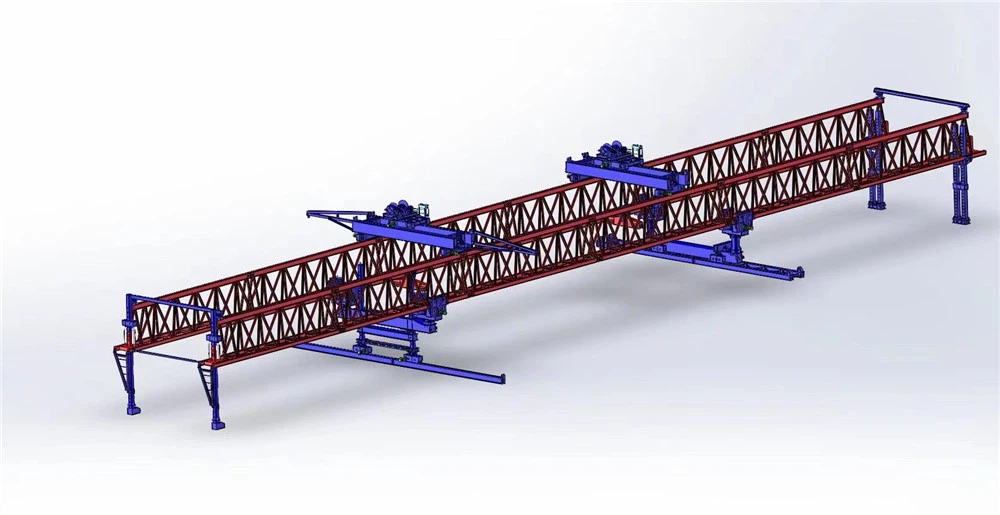
Main Girder / Truss: The long, horizontal beam that spans the entire length between piers. It provides the platform for all other components and must have immense strength and rigidity to support the 160-ton load without excessive deflection. It is often a box girder or lattice truss design.
Front Support (Nose): The cantilevered section at the front of the main girder. It provides stability during the launching process as the machine moves forward to the next span.
Rear Support Legs: The rigid legs at the back of the machine that anchor it to the previously constructed deck. They transfer the load during the lifting operation.
Front Support Legs (Launching Gantry): These are movable legs at the front that lower onto the next pier once the machine has been launched forward. They are equipped with hydraulic jacks for fine adjustment and load transfer.
2. Hoisting & Lifting System
The core system responsible for actually picking up and placing the girders.
Main Hoist Winches: High-capacity, electrically or hydraulically powered winches with precise speed control and braking systems. For a 160-ton machine, these are typically two winches of 80+ tons each, working in tandem.
Wire Ropes & Sheaves: High-strength steel cable ropes that run from the winches over a system of pulleys (sheaves) to the lifting trolley. They are designed for heavy-duty cycles and critical safety.
Lifting Trolley: The moving carriage that runs along rails on the bottom of the main girder. It houses the sheaves and the connection point for the spreader beam. It is driven by a separate motorized system to position the girder transversely.
Spreader Beam / Lifting Beam: A subordinate beam that connects to the girder at multiple points. Its purpose is to distribute the massive load evenly across the precast girder, preventing damage from concentrated stresses. It is often adjustable for different girder widths.
3. Launching & Propulsion System
This system allows the entire several-hundred-ton machine to move forward to the next span once the current one is placed.
Propulsion Winches / Hydraulic Cylinders: The primary mechanism for moving the machine. Some use winches that pull the machine along anchored cables, while others use a "walking" mechanism with synchronized hydraulic cylinders that push off the existing deck.
Launching Shoes / Skids: Low-friction sliding surfaces attached to the support legs that allow the main girder to slide forward relative to the piers during the launching sequence.
Guidance System: Rails or guides that ensure the machine moves in a straight line during launching, preventing misalignment.
4. Support & Stabilization System
Ensures the machine remains perfectly stable and level during all operations, which is critical for safety and precision.
Hydraulic Jacking Systems: Located at the top of each support leg. These jacks allow for micro-adjustments in height to level the main girder perfectly, compensating for any irregularities in the pier or deck heights.
Jacking Bases / Sole Plates: Large, robust plates that sit between the hydraulic jacks and the pier/deck surface. They distribute the immense point load over a larger area to prevent concrete crushing.
Horizontal Stabilizers: Lateral supports or bracing that prevent the machine from swaying sideways due to wind or accidental lateral loads.
5. Control & Power System
The "brain and heart" of the operation.
Operator's Cabin: A climate-controlled cabin with panoramic visibility, typically located for an optimal view of the lifting operations. It houses all control interfaces.
Centralized Control System: A sophisticated PLC (Programmable Logic Controller) or computer-based system that integrates and synchronizes all movements (hoisting, trolley travel, machine launching). It often includes overload protection and safety interlocks.
Power Unit: A large diesel generator set or an electrical power connection (if on a powered site) that provides the necessary energy for all winches, hydraulics, and controls.
Anemometer & Safety Sensors: Critical instruments that measure wind speed (locking out operations if too high), load weight, and girder tilt, ensuring operations stay within safe parameters.
6. Auxiliary Components
Work Platforms & Access Walkways: Safe access ways for maintenance and inspection along the entire length of the main girder.
Lighting Systems: For working during night shifts or in low-light conditions.
Safety Systems: Emergency stop buttons, fire extinguishers, warning alarms, and fall protection systems.
How the Components Work Together in a Typical Cycle:
Positioning: The machine is anchored over two piers, with its front legs retracted.
Lifting: The trolley moves into position above the delivery vehicle. The main hoists lower the spreader beam, which is connected to the new 160-ton girder. The winches then lift it clear of the transporter.
Placing: The trolley moves along the main girder to precisely position the new girder above its intended location. It is then slowly lowered into place on the bearing pads.
Launching (Propulsion): Once the span is complete, the machine is prepared to move. The front support legs extend down to the next pier. The rear legs are retracted, and the propulsion system (winches or hydraulic rams) pushes the entire main girder structure forward until it is centered over the next span.
Anchoring: The rear legs are lowered and anchored to the newly constructed deck, and the machine is leveled and made ready for the next lift.
This cyclical process allows for the rapid assembly of a long bridge span by span with minimal labor and high precision.

Sketch

Advantages
1. Unmatched Efficiency and Speed
Rapid Construction Cycle: These machines are designed for repetitive tasks. They can place a 160-ton pre-cast segment or girder in a matter of hours, drastically reducing the time required to complete a bridge deck compared to traditional methods like building falsework or using large mobile cranes.
Continuous Workflow: The machine creates a predictable and continuous workflow. While one segment is being placed, the next segments can be prepared and transported to the site, and the crew behind the machine can work on deck finishing (e.g., welding, grouting, parapet installation).
Minimal Downtime: The machine moves forward on the already-constructed bridge deck, setting itself up for the next placement with minimal teardown and setup time.
2. Enhanced Safety
Reduced On-Site Risks: It significantly minimizes the need for workers to perform dangerous tasks at great heights or over difficult terrain (e.g., deep valleys, rivers, busy roads). Most operations are controlled from a secure platform.
Stability and Control: Unlike cranes that can be affected by wind and require extensive outrigger setup, these machines are anchored to the stable, existing bridge structure. This provides a much more controlled and secure environment for lifting and precisely positioning heavy loads.
Elimination of Extensive Falsework: Building traditional temporary support structures (falsework) beneath the bridge is one of the most hazardous activities in construction. The launching girder eliminates this need entirely, protecting workers from potential collapses.
3. Superior Precision and Quality
Millimeter Accuracy: These machines are equipped with sophisticated hydraulic and electronic control systems that allow for extremely precise placement of girders or segments. This accuracy is critical for ensuring the final alignment and grade of the bridge, especially for high-speed rail where tolerances are minuscule.
Consistent Results: The automated and repetitive nature of the process ensures that every segment is placed with the same high level of precision, leading to a consistently high-quality final product.
4. Economic Advantages
Cost-Effectiveness for Long Spans: For projects involving long viaducts (typically over 1-2 km), the high initial investment in the machine is quickly offset by savings in labor, time, and materials (like the timber and steel for falsework).
Reduced Labor Costs: The process is highly mechanized and requires a smaller, specialized crew compared to labor-intensive methods like building falsework.
Lower Rental Costs: While the machine itself is expensive, it can be more economical than renting multiple ultra-high-capacity cranes for the entire duration of a long project.
5. Environmental and Social Impact
Minimal Ground Disturbance: Since it works from the top down and requires no extensive ground-based falsework, the machine has a very small footprint on the ground below. This is crucial when building over environmentally sensitive areas, wetlands, forests, or active railways and highways.
Less Traffic Disruption: When constructing over existing roads or railways, the machine can operate with minimal interference to the traffic below. There's no need for long-term lane closures to erect and dismantle falsework.
Reduced Noise and Pollution: The process is generally quieter and generates less dust and waste than traditional methods involving large amounts of on-site concrete pouring and falsework construction.
6. Ability to Work in Challenging Terrain
This is perhaps its greatest strength. A 160-ton bridge erection machine is indispensable in situations where other methods are impractical or impossible:
Over Deep Gorges or Valleys: Building falsework from the bottom is incredibly difficult and dangerous.
Over Waterways: Avoids the need for building coffer dams or working in water, which is ecologically damaging and expensive.
Over Existing Infrastructure: Allows construction to proceed smoothly over active highways, railways, or urban areas without disrupting them.

Application
Primary Applications
The 160-ton BEM is a cornerstone technology for the Precast Balanced Cantilever Method and Span-by-Span construction methods. Its applications are highly specialized:
1. Erection of Precast Concrete Segments (The Core Function):
This is the machine's primary job. Bridges are built from individual segments (often "I-girders" or "U-beams" for simpler spans, or "box girders" for complex ones) that are cast in a factory off-site.
The BEM travels along the already completed sections of the bridge, picks up the new segments delivered to the site by trucks, and precisely places them in their designated position.
Workers then temporarily post-tension the segments to the existing structure before performing final grouting and permanent post-tensioning.
2. Construction of Viaducts and Elevated Highways/Railways:
This is the most common application. When a new road or rail line needs to be built over difficult terrain-such as valleys, existing roads, rivers, or urban areas with limited space-building an elevated viaduct is often the best solution.
The BEM allows for construction with minimal disruption to the traffic and environment below, as most work happens overhead.
3. Balanced Cantilever Construction:
In this method, segments are placed symmetrically on both sides of a pier simultaneously to balance the loads and avoid excessive bending moments on the pier.
The 160-ton BEM is perfectly suited for this, as it can maneuver around the pier and handle the heavy segments required for long spans, which can exceed 150 meters.
4. Span-by-Span Construction:
This method involves constructing the bridge one complete span at a time, from one pier to the next.
The BEM sits atop the piers, launching itself forward after completing each span. This is a highly efficient, assembly-line-like process ideal for long bridges with constant span lengths and curvature.

Production Procedure
Production Procedure for a 160-Ton Bridge Erection Machine (BEM)
1. Project Definition & Design Phase
Client Requirements Analysis: Engineers work with the client to define precise specifications:
Lifting Capacity: 160 metric tons (primary requirement).
Span Length: Maximum span length the BEM must cover.
Bridge Geometry: Curvature, gradient, and cross-section of the bridge deck.
Girder Type: Pre-cast segmental box girders, I-girders, U-beams, etc.
Propulsion System: Type of movement (rolling, sliding, with or without a launch nose).
Control System: Level of automation (manual, semi-automatic, full remote control).
Site Conditions: Wind loads, seismic factors, and access limitations.
Detailed Engineering Design:
Structural Analysis: Finite Element Analysis (FEA) is performed on the main beams, supports, and lifting gear to ensure structural integrity under full 160-ton load and dynamic factors.
Mechanical Design: Design of all mechanical components: winches, hoists, trolleys, hydraulic systems, wheels, and bearings.
Electrical & Control System Design: Design of power distribution, motor controls, sensors (load, alignment, wind), and the operator interface.
Drawings & Documentation: Creation of detailed manufacturing drawings, bill of materials (BOM), and assembly instructions.
2. Procurement & Material Preparation
Sourcing of Materials: Procurement of raw materials per the BOM:
Main Beams: High-strength steel plates (e.g., ASTM A572 Gr. 50 or equivalent).
Components: Certified wire ropes, hooks, pulleys, high-grade hydraulic cylinders, valves, hoses, motors, gears, and electrical components from approved vendors.
Fasteners: High-tensile bolts, nuts, and washers.
Material Testing: Incoming materials are inspected for certification (Mill Test Certificates - MTCs) and undergo tests like ultrasonic testing (UT) for steel plates to detect internal flaws.
3. Fabrication & Manufacturing Phase
Cutting & Profiling:
Steel plates are cut to size using CNC plasma or oxy-fuel cutting machines for precision.
Drilling of bolt holes is done using CNC drilling machines to ensure perfect alignment.
Forming & Bending:
Plates for curved sections (e.g., on support legs or connectors) are bent using plate rolling machines or press brakes.
Welding & Assembly of Sub-components:
Main Girders: Plates are welded together to form the box or truss sections of the main longitudinal beams. This is a critical process.
Welding Procedure: Qualified welders follow a Welding Procedure Specification (WPS). All critical welds are non-destructively tested (NDT) via Magnetic Particle Testing (MT) or Dye Penetrant Testing (PT) for surface defects and Ultrasonic Testing (UT) or Radiographic Testing (RT) for internal defects.
Support Legs/Frames: Fabrication of the front and rear supports that bear the machine's weight on the bridge pier.
Lifting Gantry/Trolley: Fabrication of the cross-beam and trolley system that moves laterally and houses the winches.
Post-Weld Treatment:
Weld seams are ground smooth.
Critical structural components may be stress-relieved in a heat treatment furnace to remove residual stresses from welding.
Surface Preparation & Painting:
All components are shot-blasted to SA 2.5 standard to remove rust and mill scale and create a profile for paint adhesion.
A primer coat is applied immediately after blasting to prevent corrosion.
Intermediate and top coats of high-build, industrial-grade paint are applied. Color coding for safety and aesthetics is done as per specification.
4. Sub-Assembly & Pre-Assembly
Mechanical components are assembled into smaller units:
Winch Assembly: Mounting of winch drums, motors, gearboxes, and brakes onto a base frame.
Hydraulic Power Unit (HPU): Assembly of the hydraulic pump, reservoir, filters, and valves onto a skid.
Trolley Assembly: Mounting of wheels, drive motors, and the main hoist unit onto the trolley frame.
Electrical Panel Assembly: Wiring of PLCs, variable frequency drives (VFDs), circuit breakers, and controllers in a control panel.
5. Factory Acceptance Testing (FAT)
This is a crucial step to verify performance and safety before disassembly for shipment.
Dimensional Check: Verification of all critical dimensions against drawings.
Visual Inspection: Inspection of all welds, paint, and mechanical connections.
Functional Tests (No-Load):
Test all movements: trolley travel, hoist raising/lowering, main gantry propulsion. Check for smooth operation, limit switch functionality, and emergency stops.
Test hydraulic system for leaks and correct pressure.
Load Testing: (The Most Critical Test for a 160-ton BEM)
Static Load Test: The lifting system (hoist, trolley, beams) is subjected to a load 25% over its rated capacity (i.e., 200 tons). The load is lifted, held suspended for a period (e.g., 10-15 minutes), and carefully inspected for any deformation, deflection, or issues.
Dynamic Load Test: The system is tested at 110% of rated capacity (176 tons). The load is lifted and moved through the full range of operation to simulate working conditions.
Load tests are performed using calibrated load cells and certified test weights (often concrete blocks).
6. Dismantling, Packaging, and Shipment
After passing FAT, the machine is systematically dismantled into transportable modules.
Components are carefully packaged to prevent damage during transit. Lifting points are clearly marked.
All exposed hydraulic ports and electrical connectors are sealed.
A detailed packing list is created for each container or shipment.
7. Site Erection & Commissioning (Often supervised by the manufacturer)
Site Preparation: Foundation check on the bridge pier, ensuring a level and stable work area.
Erection: Using mobile cranes, the main components are assembled in the reverse order of dismantling.
Re-connection: All hydraulic hoses, electrical cables, and structural bolts are re-connected and torqued to specification.
Site Commissioning:
Re-testing of all safety systems and limit switches.
A final load test is often performed on-site with the client present, typically at 100% (160T) and sometimes 125% (200T) capacity, using the actual bridge girders or test weights to verify everything functions correctly in its final position.
Operator and maintenance training is provided to the client's team.
8. Documentation Handover
The project is concluded with the handover of all final documentation, including:
As-built drawings
Design calculations
Certificates for materials and welds (NDT reports)
FAT and load test reports
Equipment operation and maintenance manuals
Spare parts list


Workshop View
The company has installed an intelligent equipment management platform, and has installed 310 sets (sets) of handling and welding robots. After the completion of the plan, there will be more than 500 sets (sets), and the equipment networking rate will reach 95%. 32 welding lines have been put into use, 50 are planned to be installed, and the automation rate of the entire product line has reached 85%.


Hot Tags: 160 ton bridge erection machine for construction, China 160 ton bridge erection machine for construction manufacturers, suppliers, factory
You Might Also Like


Send Inquiry