










190 T Bridge Lancher For Construction Machine
A 190 T Bridge Launcher is a self-propelled, movable gantry system used to lift and place pre-cast concrete segments or steel girders for constructing viaducts, overpasses, and other elevated highway or railway structures. The "T" stands for "Tonne" (metric ton), indicating its lifting capacity, but the "190" is the span length in meters.

How It Works: The Step-by-Step Process
This machine is used primarily for the Incremental Launching or Segmental Launching method of construction.
Assembly: The bridge launcher is assembled on the ground at one end of the bridge, often on a completed section of the deck or on a temporary launching pad.
Positioning: It moves forward on rails or directly on the bridge deck until its main girder spans the gap between two piers.
Lifting and Placement:
Pre-cast concrete segments or steel girders are transported to the site and fed to the launcher from the rear.
The launcher's powerful hoists lift a segment.
It then moves the segment precisely to the front of the construction face and places it in its designated position.
Temporary Stressing: Workers temporarily post-tension the newly placed segment to the previously built section to hold it in place.
Launching Forward: Once a full span (or a cycle of segments) is complete, the entire launcher machine "walks" forward to the next position, ready to build the subsequent span.
Repetition: This cycle repeats until the entire bridge deck is complete.
Specification
General Specification: 190 T Bridge Launcher / Undercarriage Girder Launcher
This machine is a self-launching, movable undercarriage system used for the incremental launching of precast bridge segments.
1. Main Lifting Capacity & Performance
Rated Hoisting Capacity: 190 Metric Tons (per segment)
Number of Lifting Points: Typically 2 or 4 (using hydraulic winches or hoists)
Lifting Speed: 0.5 - 1.5 m/min (adjustable)
Lowering Speed: 0.5 - 1.5 m/min (adjustable)
Fine Adjustment: Precision hydraulic controls for segment alignment (lateral, vertical, longitudinal).
2. Structural System
Main Girder (Launching Nose):
Type: Box girder or truss structure.
Length: Configurable, typically 50m to 120m, depending on bridge span requirements. Often modular for transport and assembly.
Height: 4m - 8m, depending on design span and load.
Material: High-strength steel (e.g., Q345B, Q460C or equivalent ASTM A572).
Supporting Legs / Front & Rear Supports:
Function: Transfer the entire load of the launcher and bridge deck to the bridge piers.
Adjustability: Hydraulically adjustable for height to accommodate varying pier heights and deck gradients.
Clamping Mechanism: Hydraulic clamps to securely grip the pier heads.
3. Launching & Propulsion System
Propulsion Type: Hydraulic "walking" or "stepping" mechanism.
Propulsion Force: 200 kN - 500 kN (depending on friction and gradient).
Moving Speed: 2 - 5 m/min during launching.
Stroke per Cycle: 1 - 3 meters.
Control: Centralized, computerized control system for synchronized movement.
4. Hydraulic System
Operating Pressure: 25 MPa - 35 MPa (approx. 3600 - 5000 psi).
Power Unit: Diesel engine or electric motor-driven hydraulic power pack.
Actuators: High-precision hydraulic cylinders for lifting, supporting, and propulsion.
Safety Features: Hydraulic locks, pressure relief valves, and emergency stop systems.
5. Electrical & Control System
Control Mode: Centralized PLC (Programmable Logic Controller) with a human-machine interface (HMI) in a control cabin.
Monitoring: Real-time monitoring of loads, pressures, alignment, and system status.
Safety: Interlocking logic to prevent erroneous operations, overload protection, and emergency stop circuits.
Power Supply: Onboard generator set or external power source (typically 380V/50Hz or 480V/60Hz).
6. General Data & Environmental Conditions
Self-Weight: Approximately 250 - 450 tons (highly dependent on span and design).
Design Standards: Complies with relevant international standards (e.g., DIN, EN, AISC, GB).
Working Wind Speed: ≤ 14 m/s (Beaufort 6 - Strong Breeze).
Non-Working (Survival) Wind Speed: Designed to withstand up to 36 m/s (Beaufort 12 - Hurricane) when anchored.
Operating Temperature: -20°C to +50°C.
7. Application
Bridge Types: Precast Segmental Bridges, Box Girder Bridges, Balanced Cantilever Bridges.
Max Bridge Span: Can be configured for spans from 40m to 70m.
Max Bridge Grade (Slope): Typically up to 4-5%.

Pictures & Components
Key Components of the 190 T Bridge Launcher
The machine is a complex system of structural, mechanical, hydraulic, and electrical components. Here are the main ones, broken down by function:
1. Main Structural Components
Main Girder / Boom: The primary, long-spanning beam of the launcher. It is a robust box-section or truss structure that provides the reach to place segments ahead of the piers. It must resist immense bending and shear forces.
Supporting Legs / Front & Rear Supports: These are the "feet" of the machine. They are hydraulically operated and transfer the entire load of the machine and the lifted segment to the bridge piers or the completed deck.
Front Support: Often placed on the next pier to be built upon.
Rear Support: Anchors the machine on the already constructed deck.
Gantry Frame: The main chassis that houses the propulsion system and connects the supporting legs. It provides the base for the entire superstructure.
2. Lifting and Handling System
Hoisting Winch: The core lifting mechanism. It consists of a powerful electric or hydraulic motor, a gearbox, and a drum around which the wire rope is wound. It is precisely controlled to lift and lower the 190 T load.
Wire Ropes & Sheaves: High-strength steel cables and pulleys that form the reeving system to transmit the hoisting force from the winch to the lifting trolley or spreader beam.
Trolley: A movable carriage that runs along the bottom flange of the main girder. It allows for longitudinal positioning of the segment along the span.
Spreader Beam / Lifting Frame: A rigid beam that connects to the segment using lifting rods or cables. Its key function is to distribute the massive lifting force evenly across the concrete segment to prevent cracking or damage. It often has fine-adjustment capabilities (tilting, rotating) for perfect alignment.
3. Propulsion and Movement System
Traveling Wheels / Crawlers: Located on the gantry frame, these wheels allow the entire launcher to move forward along the bridge deck once a segment is placed.
Drive Units: Hydraulic or electric motors that power the traveling wheels. The system is designed for slow, controlled, and highly stable movement.
Guidance System: Rails or sensors that ensure the launcher moves in a straight line along the center of the deck.
4. Hydraulic System
Hydraulic Power Unit (HPU): The heart of the hydraulic system, consisting of pumps, reservoirs, filters, and coolers.
Hydraulic Cylinders: Used for numerous functions:
Extending and retracting the supporting legs.
Fine-tuning the position of the main girder.
Operating clamps or other auxiliary functions.
Control Valves: Precisely regulate the flow and pressure of hydraulic fluid to the various actuators.
5. Electrical and Control System
Operator's Cabin: A climate-controlled cabin with an ergonomic layout, giving the operator a clear view of the operation. It contains all the control joysticks, switches, and monitoring screens.
Programmable Logic Controller (PLC): The "brain" of the launcher. It processes commands from the operator and sensors to coordinate complex movements, ensuring safety and precision.
Sensors and Limit Switches: Monitor critical parameters like:
Load Moment: Ensures the machine is not overloaded.
Tilt / Inclination: Keeps the machine level.
Wind Speed: Automatically halts operations if winds are too high.
Positioning: For the trolley, winch, and supports.
Power Cable Reel: Manages the heavy-duty electrical cable that supplies power from an external generator or the construction site's grid.

Sketch
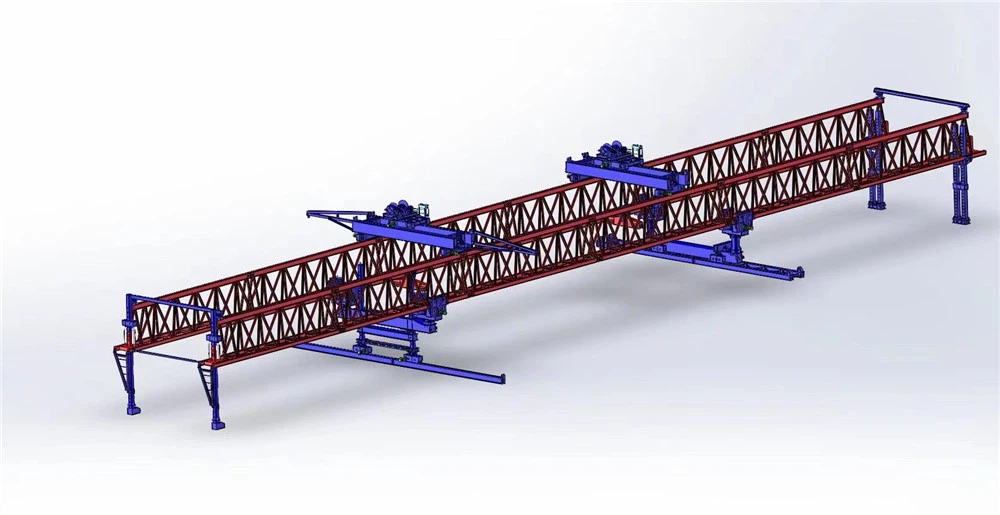

Advantages
Key Advantages of a 190 T Bridge Launcher
The "190 T" capacity indicates it's a mid-to-heavy-range machine, suitable for a wide array of bridge construction projects. Its advantages are multifaceted:
1. Unmatched Safety
Reduced Ground Workforce: The majority of operations, including lifting, moving, and positioning segments, are performed by the machine operator high above the ground. This drastically reduces the number of workers in the "drop zone" below, minimizing the risk of on-site accidents.
Stability: The launcher is a fixed, rigid structure that moves on the already-constructed bridge deck. It is far less susceptible to wind and weather conditions compared to large floating cranes, making operations safer in variable climates.
Controlled Environment: The entire assembly process happens in a predictable, machine-controlled cycle, reducing human error.
2. High Construction Speed and Efficiency
Cycle-Based Construction: The launcher works on a repetitive cycle: lift segment -> move it forward -> precisely position it -> stress the tendons. This systematic process allows crews to achieve a consistent production rate, often placing one segment per side every 1-2 days.
Parallel Operations: While the launcher is placing segments at the front, other critical activities like segment delivery, epoxy application, and post-tensioning of previously placed segments can happen simultaneously behind it. This parallel workflow significantly accelerates the overall project timeline.
Rapid Traversing: The launcher can move itself forward over multiple piers quickly to set up for the next span, saving valuable time compared to dismantling and reassembling cranes.
3. Ability to Work in Challenging Terrain
This is arguably its most significant advantage.
Over Obstacles: It can construct bridges over deep gorges, rivers, railways, busy highways, and existing urban infrastructure without any need for ground access or temporary supports in the obstacle below.
Minimal Ground Footprint: The launcher requires only the bridge piers to be constructed. There is no need for massive crane pads, access roads through sensitive environments, or disruption to the traffic/ecology below.
4. Superior Precision and Quality
Guided Placement: The launcher uses hydraulic rams and sophisticated guidance systems (like GPS and laser-guided total stations) to place multi-ton segments with millimeter-level accuracy. This is crucial for the alignment and final profile of the bridge.
Consistent Results: The machine-controlled process ensures that every segment is placed with the same high standard, leading to a higher quality, more durable final structure.
5. Economic and Environmental Benefits
Reduced Temporary Works: Eliminates the need for expensive and time-consuming falsework (temporary support structures) that would be required for cast-in-place methods, especially over obstacles.
Minimized Disruption: When building over existing roads or railways, the launcher's operations cause minimal disruption. This avoids costly traffic diversions, night work premiums, and business interruptions, which are major concerns for public infrastructure projects.
Lower Environmental Impact: By avoiding the need to create ground-level access roads and work sites in sensitive areas, it preserves the natural terrain and reduces the project's environmental footprint.
6. Adaptability and Versatility
Handles Complex Alignments: Modern launchers can be configured to construct bridges with both horizontal and vertical curves.
Balanced Cantilever Construction: The 190 T capacity is well-suited for the balanced cantilever method, where segments are placed symmetrically on both sides of a pier to maintain stability during construction.

Application
Primary Application: The Incremental Launching or Span-by-Span Method
This machine is a cornerstone of the Span-by-Span construction method, which is highly efficient for building long, continuous bridges over obstacles like rivers, valleys, or existing roads and railways.
Typical Workflow:
Segment Casting: Pre-cast concrete segments (like box girders or U-beams) are manufactured in a casting yard, often located at one end of the bridge site.
Transport to the Gantry: The segments are transported to the launching gantry, typically on trailers.
Lifting and Positioning: The 190 T launcher uses its powerful hoists to lift the segments from the transport vehicles.
Assembly: The gantry moves the segment into its precise position in the bridge span. Workers then temporarily post-tension the segments together.
Launching Forward: Once a complete span is assembled and permanently stressed, the entire gantry structure moves forward to the next span position.
Repetition: This cycle repeats until the entire bridge deck is complete.

Production Procedure
Production Procedure: 190 T Bridge Launcher
1. Project Definition & Design Phase
Client Requirements Analysis:
Understand the specific project needs: span length, girder weight (190 T capacity), curve radius, gradient, and site conditions.
Define key performance parameters: launching speed, control system type (manual, semi-automatic, remote), and safety factors.
Conceptual & Detailed Design:
Structural Design: Create 3D models and Finite Element Analysis (FEA) for all major components to ensure they can withstand operational loads, including dynamic and wind loads.
Main Beams/Girders: The primary load-bearing structure.
Support Legs (Front & Rear): Provide temporary support on piers and the deck.
Nose Unit: The cantilevered front section that reduces bending moments.
Mechanical Design: Design the drive system, lifting system, and traversal system.
Drive System: Hydraulic motors, reducers, and wheels.
Lifting/Telescoping System: Hydraulic cylinders for lifting the girder and adjusting leg heights.
Walking Mechanism: Design of how the launcher moves forward.
Hydraulic System Design: Design the circuit, specifying pumps, valves, cylinders, motors, hoses, and accumulators. Ensure synchronous operation of multiple cylinders.
Electrical & Control System Design: Design the control cabinet, sensor placement (pressure, position, inclination), and the Human-Machine Interface (HMI). Plan for fail-safe mechanisms and emergency stop systems.
Design Review & Approval:
Internal and client review of all designs, drawings, and calculations.
Final Bill of Materials (BOM) is generated.
2. Procurement & Material Preparation Phase
Raw Material Procurement:
Source high-strength steel plates (e.g., Q345B, Q460C), profiles, and tubes as per the BOM.
All materials must come with mill test certificates.
Outsourced Components Procurement:
Purchase standard components: hydraulic pumps, motors, cylinders, valves, hoses, electrical sensors, PLCs, and winches from qualified suppliers.
3. Fabrication & Manufacturing Phase
Steel Cutting & Profiling:
Cut steel plates to size using CNC plasma or oxy-fuel cutting machines for precision.
Bevel edges as required for welding.
Sub-Assembly Fabrication:
Main Girder Fabrication: Weld web plates, flange plates, and stiffeners into box or truss sections. This is a critical process requiring:
Jigging & Fixturing: Use of strong-backs and jigs to control distortion and ensure dimensional accuracy.
Submerged Arc Welding (SAW): For long, critical welds on flanges and webs.
Multi-Pass Welding: For thick plates to ensure penetration and strength.
Leg & Nose Unit Fabrication: Weld components for the support legs and nose assembly.
Other Components: Fabricate trolley frames, connection pins, and brackets.
Machining:
Machine critical mating surfaces, pin holes, and bearing seats on CNC boring mills and lathes to achieve high tolerances.
Surface Treatment & Painting:
Blast Cleaning: Shot blast all components to Sa 2.5 standard to remove rust and mill scale and create a surface profile for paint adhesion.
Priming: Apply a high-build zinc-rich epoxy primer.
Painting: Apply intermediate and top coats (typically polyurethane) as per specification. Paint thickness is measured to ensure compliance.
4. Pre-Assembly & Integration Phase
Structural Pre-Assembly:
Assemble the main girders, support legs, and nose unit in the factory workshop.
Check overall dimensions, alignment, and squareness.
Fit and ream holes for high-strength bolts to ensure perfect fit.
Mechanical System Installation:
Install the walking wheels, drive units, reducers, and bearings.
Assemble the lifting trolley and its traversal mechanism.
Hydraulic System Installation:
Mount hydraulic cylinders, pumps, valve blocks, and oil tanks.
Route and connect hydraulic hoses and pipes. Ensure lines are clean and properly clamped.
Electrical System Installation:
Install control cabinets, junction boxes, cable trays, and sensors.
Run and terminate all power and control cables.
5. Factory Acceptance Testing (FAT) Phase
This is a crucial step to ensure the machine functions correctly before disassembly for shipment.
Visual & Dimensional Inspection:
Verify paint quality, welding quality, and overall workmanship.
Check critical dimensions against drawings.
Hydraulic System Testing:
Pressure Test: Test the entire hydraulic system at 1.5 times the maximum working pressure to check for leaks and integrity.
Function Test: Operate all hydraulic cylinders (lifting, telescoping) and motors (walking, traversal) individually. Check for smooth operation, synchronization of cylinders, and drift.
Electrical & Control System Testing:
Check all wiring for continuity and correct termination.
Power up the system and test all I/O points of the PLC.
Test the HMI, emergency stop circuits, limit switches, and safety interlocks.
No-Load Functional Test:
Simulate the complete launching cycle without load:
Lift the main beam (simulated).
Traverse the trolley.
Walk the entire launcher forward and backward a short distance.
Verify all sequences and control logic.
Load Test (if feasible in factory):
If possible, perform a static load test with weights or hydraulic jacks to 1.25 times the rated capacity (237.5 T) to validate the structural design and lifting system.
6. Dismantling, Packing & Shipping
Systematic Dismantling:
Dismantle the launcher into transportable modules (main girder segments, legs, nose, trolley, etc.).
Clearly mark all components and connection points for easy reassembly on site.
Packing & Preservation:
Protect machined surfaces and hydraulic cylinder rods from corrosion and damage.
Seal open hydraulic ports and electrical connectors.
Pack all loose parts, pins, bolts, and tools in wooden crates.
Documentation:
Prepare and ship all manuals: Operation, Maintenance, Parts, and Hydraulic/Electric Schematics.
Provide certified material reports, weld procedure qualification records, and FAT reports.
7. On-Site Erection & Commissioning
Site Preparation: Ensure the foundation/pier is ready and safe for assembly.
Erection: Use cranes to assemble the launcher according to the erection drawings.
Re-connection: Reconnect all hydraulic hoses and electrical cables.
Commissioning:
Check fluid levels (hydraulic oil).
Bleed hydraulic systems.
Perform final functional tests with the actual bridge girder (initially at low load) to fine-tune the system.
Operator Training: Train the client's crew on operation, daily checks, and basic troubleshooting.


Workshop View
The company has installed an intelligent equipment management platform, and has installed 310 sets (sets) of handling and welding robots. After the completion of the plan, there will be more than 500 sets (sets), and the equipment networking rate will reach 95%. 32 welding lines have been put into use, 50 are planned to be installed, and the automation rate of the entire product line has reached 85%.


Hot Tags: 190 t bridge lancher for construction machine, China 190 t bridge lancher for construction machine manufacturers, suppliers, factory
You Might Also Like


Send Inquiry