










120 Ton Bridge Lancher Construction Machine
A 120-Ton Bridge Launcher, often called a Launching Gantry or Incremental Launching Gantry (ILG), is a heavy-duty, self-propelled machine used to erect precast concrete or steel bridge segments. The "120-Ton" designation typically refers to its maximum lifting capacity per segment.
It is a cornerstone of modern bridge construction, enabling the rapid and efficient assembly of viaducts and bridges, especially in challenging environments like deep valleys, over water bodies, or existing roads and railways.

How It Works: The Step-by-Step Process
The process, known as the Incremental Launching Method (ILM), is highly methodical:
Phase 1: Segment Casting and Preparation
Precast segments are manufactured in a casting yard near the bridge site.
The completed segments are transported to the launching area, typically on multi-axle trailers.
Phase 2: The Launching Cycle (Repeated for each span)
Segment Lifting: The 120-ton lifting gantries pick up segments and place them in their correct position under the main gantry, starting from the pier outwards.
Temporary Stressing: The newly placed segment is temporarily post-tensioned to the previously assembled section of the bridge deck to form a continuous structure.
Alignment Check: The precise geometry (level and alignment) of the deck is checked and adjusted using the support legs' hydraulic jacks.
Internal Prestressing: Once several segments are in place and aligned, internal prestressing tendons are threaded through ducts and tensioned to create the final structural strength for that section of the bridge.
Gantry Launching (The "Walk"): After a complete span is assembled and stressed, the entire gantry machine releases from the piers, propels itself forward to the next set of piers, and re-anchors itself. The launching nose often goes first to provide support on the next pier.
Cycle Repeat: The cycle repeats until the entire bridge deck is complete.
Specification
Technical Specification: 120-Ton Capacity Bridge Launching Machine
Document Version: 1.0
Date: October 26, 2023
1.0 General Overview
Machine Type: Self-Propelled, Modular Bridge Launching Gantry
Primary Function: To lift, transport, and precisely place pre-cast concrete segments for the construction of balanced cantilever or span-by-span bridges.
Model Designation: BLM-120
Rated Lifting Capacity: 120 Metric Tons per lifting frame
Application: Suitable for viaducts and bridges with constant or variable radii, grades, and super-elevation.

Pictures & Components
1. Main Structural Framework
This is the primary skeleton that supports the entire machine and the bridge segments.
Main Girder (Bridge Girder): The primary, long-spanning beam that sits on top of the piers. It must be incredibly strong and stiff to resist bending under the full load of the bridge segments. It's often a welded steel box-section or truss structure.
Front Support (Nose): A cantilevered section of the main girder that extends beyond the front pier. It provides support for placing the next segment before the permanent pier is built underneath it.
Rear Support Legs: The fixed legs at the back of the machine that transfer the load to the already constructed part of the bridge deck.
Portal Frames: The vertical structures at the front and rear that provide stability and support for the lifting and traversal systems.
2. Support and Propulsion System
This system allows the launcher to move forward along the bridge alignment after each segment is placed.
Support Shoes (or Piers): Temporary or permanent bearing points that rest on the bridge piers. They distribute the massive load of the machine and the segments safely to the substructure.
Hydraulic Jacking System:
Lifting Jacks (Vertical): Powerful hydraulic cylinders located at the support points to raise or lower the entire launcher for alignment and to transfer load during the launching cycle.
Propulsion Jacks (Horizontal/Walking): These are the "legs" of the machine. They work in a walking motion:
Grip the pre-installed deck or a special track.
Push or pull the entire main girder forward by a set distance (e.g., one segment length).
Retract and reset for the next step.
Sliding Bearings/Pads: Low-friction surfaces (often using PTFE) that allow the main girder to slide smoothly over the support points during propulsion.
3. Lifting and Handling System
This is the core system for manipulating the bridge segments.
Launching Car (Trolley or Hoist): A movable trolley that runs along rails on the bottom flange of the main girder. It carries the segment from the back of the machine to its placement position at the front.
Lifting Winches: Electric or hydraulic winches mounted on the launching car. They house the high-strength steel cables (wire ropes).
Wire Ropes & Sheaves (Pulleys): The cable system that does the actual lifting. It's routed through a series of pulleys to provide mechanical advantage and control.
Spreader Beam/Lifting Frame: A robust beam attached to the lifting cables. It ensures that the precast segment is lifted evenly, without inducing excessive bending stresses. For very wide decks, there may be two trolleys and spreader beams working in sync.
4. Auxiliary and Control Systems
These systems provide power, control, and safety.
Hydraulic Power Unit (HPU): The "heart" of the machine, consisting of diesel engines or electric motors driving hydraulic pumps. It generates the high-pressure fluid needed for all jacks, winches, and controls.
Electrical Control System & Operator Cabin: The "brain" of the operation. Includes:
Programmable Logic Controller (PLC): Automates complex sequences like synchronized lifting and propulsion.
Operator Interface: Allows the operator to control all functions with precision.
Sensors: Monitor loads, positions, pressures, and alignments in real-time.
Safety Systems:
Overload Protection: Load cells and pressure sensors prevent the machine from exceeding its 120-ton capacity.
Anti-collision Systems: Limit switches and sensors prevent the trolley or other components from moving beyond safe limits.
Emergency Stop Buttons: Located at multiple points on the machine.
Anemometer (Wind Speed Sensor): Critical for halting operations during high winds.
5. Auxiliary Components for Erection
Segment Transport Wagons: While not part of the launcher itself, these are essential for feeding segments to the machine. They move along the completed deck to deliver new segments to the lifting area at the rear of the launcher.
Temporary Falsework: In some configurations, temporary props or towers may be used to provide additional support for the launcher or the cantilevered segments during construction.
How the Components Work Together in a Typical Cycle:
Feeding: A precast segment is brought to the rear of the launcher by a transport wagon.
Lifting: The launching car's winches lower the spreader beam, which is connected to the segment. The segment is lifted clear of the wagon.
Traversing: The launching car moves along the main girder, carrying the segment to the front (nose) of the machine.
Placing & Adjusting: The segment is precisely lowered into its final position. Fine-adjustment jacks on the spreader beam allow for millimeter-perfect alignment. The segment is then temporarily stressed to the previous segment using post-tensioning bars.
Propelling: Once the segment is secured, the propulsion jacks engage. The entire main girder of the launcher is slid forward by one segment length, ready for the next cycle.
Cycle Repeat: The process repeats until the bridge span is complete.
Key Takeaway: A 120-ton Bridge Launcher is an integrated system where the structural frame provides the strength, the hydraulic system provides the motion, the winches and trolley handle the load, and the electronic controls ensure every action is precise, synchronized, and safe.

Sketch
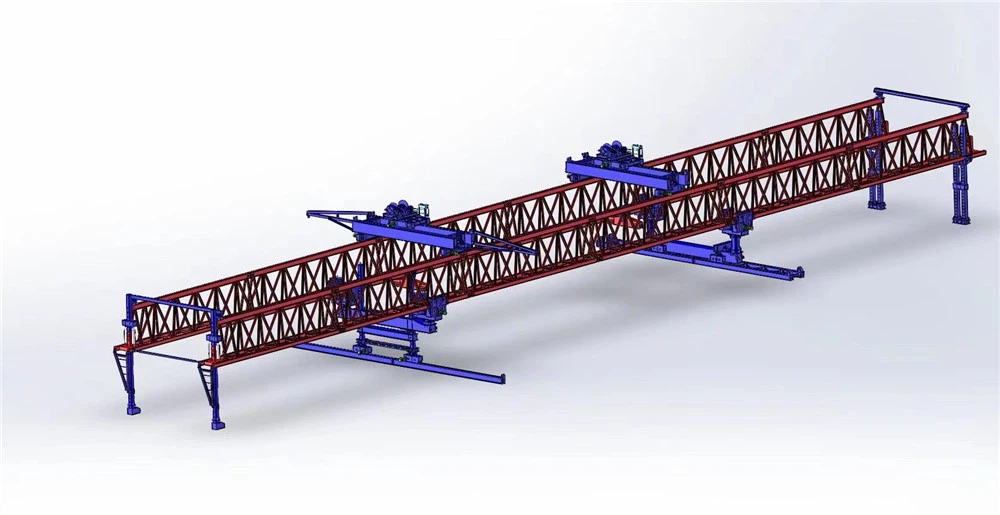

Advantages
1. Enhanced Safety
This is the most significant advantage.
Reduced Worker Exposure: Minimizes the need for workers to be at great heights for extended periods. Assembly and placement are controlled from a central operator's cabin.
Elimination of Temporary Falsework: Traditional methods require building massive temporary supports (falsework) underneath the bridge span, which is hazardous and vulnerable to collapse. The launcher is self-supporting, eliminating this risk.
Controlled, Predictable Operations: The launching process is a carefully engineered sequence, reducing the unpredictability associated with crane operations and manual labor.
2. Superior Efficiency and Speed
Rapid Cycle Times: Once the system is set up, it can place pre-cast segments or girders very quickly-often one segment per day or faster. This leads to a consistent construction pace, typically 20-40 meters per day.
Parallel Construction Activities: While the launcher is placing segments at the front, other crews can work simultaneously on deck finishing, barrier installation, and pier construction behind it.
Reduced Relocation Time: Compared to assembling and disassembling large cranes for each span, a launcher can "walk" from one pier to the next in a matter of hours.
3. High Precision and Quality
Accurate Segment Placement: The machine is equipped with hydraulic jacks and computerized controls that allow for millimeter-level adjustments. This ensures each pre-cast segment or girder is placed with extreme precision.
Consistent Results: The mechanized process eliminates many of the human errors associated with traditional methods, leading to a higher quality, more uniform final structure.
4. Economic Advantages
Lower Labor Costs: While the machine itself is a major capital investment, it requires a much smaller crew to operate than traditional methods, leading to significant long-term labor savings.
Reduced Material for Falsework: The massive savings in temporary falsework materials (timber, steel) and their associated fabrication and dismantling costs are a major economic benefit.
Faster Project Completion: The speed of construction leads to earlier project delivery, which has immense financial benefits for the project owner (early revenue generation from tolls, etc.) and reduces overall financing costs.
5. Excellent Adaptability and Access
Ability to Cross Obstacles: Bridge launchers are ideal for constructing viaducts over difficult terrain such as deep valleys, rivers, existing roads, railways, or environmentally sensitive areas where building temporary supports is impractical, dangerous, or prohibited.
Minimal Ground Footprint: The load is transferred directly onto the permanent piers, causing minimal disturbance to the ground below. This is crucial in urban environments or over active transportation corridors.
6. Improved Environmental Impact
Less Site Disturbance: By avoiding the need for extensive falsework and access roads for cranes, the launcher minimizes the disruption to the land underneath the bridge.
Reduced Waste: The precision of the method leads to less material waste. The avoidance of temporary works also means less material is used and eventually discarded.

Application
Primary Applications and Project Scenarios
This machine is ideally suited for specific types of projects where traditional methods (like building falsework from the ground) are impractical, dangerous, or too slow.
Elevated Highways and Viaducts: Especially in urban areas where construction must minimize disruption to traffic, businesses, and communities below.
River Crossings: Building bridges over wide rivers or valleys without the need for extensive scaffolding in the water, which is environmentally beneficial and reduces risk.
Crossings over Active Infrastructure: This is a critical application. Building bridges over:
Operational Highways: Without needing full road closures.
Railway Tracks: Avoiding disruption to train schedules and ensuring worker safety.
Deep Gorges or Ravines: Where building temporary supports from the bottom is extremely difficult and expensive.
Projects with Repetitive Spans: The method is most efficient when the bridge consists of multiple spans of similar length (e.g., 30m to 50m).

Production Procedure
Production Procedure: 120-Ton Bridge Launcher Machine
1. Project Definition & Planning Phase
Objective: Establish clear requirements, budget, and timeline.
Key Activities:
Client Requirements Analysis: Determine the specific needs: maximum span length, curve radius capability, deck width, load capacity (120-ton), type of girders (pre-cast, steel box, etc.), and project site conditions.
Conceptual Design: Create initial sketches and select the launcher type (e.g., overhead launching gantry, underslung launching gantry).
Project Planning: Develop a detailed project schedule (Gantt chart), resource allocation plan, and budget.
Risk Assessment: Identify potential technical and logistical challenges.
2. Detailed Engineering & Design Phase
Objective: Create precise manufacturing and assembly drawings.
Key Activities:
Structural Design & Analysis:
Use Finite Element Analysis (FEA) software (e.g., ANSYS, SAP2000) to model the main girders, support legs, and lifting systems under various load cases (dead load, live load, wind load, dynamic effects).
Ensure structural integrity and compliance with international standards (e.g., DIN, EN, AISC, GB).
Mechanical Design:
Design the propulsion system (hydraulic or electric wheels/crawlers).
Design the lifting/lowering system (synchronous hydraulic jacks).
Design the balancing mechanism for gradient adjustment.
Specify all mechanical components (bearings, gears, shafts).
Hydraulic System Design:
Design the circuit for propulsion, lifting, and balancing.
Select components: pumps, motors, cylinders, valves, hoses, and accumulators.
Ensure precise synchronization of multiple jacks.
Electrical & Control System Design:
Design the control cabin and operator interface (HMI).
Develop the PLC (Programmable Logic Controller) program for automated and manual operations.
Design safety interlocks, sensors (for position, pressure, tilt), and emergency stop systems.
Creation of Manufacturing Drawings: Produce detailed part drawings, assembly drawings, and Bill of Materials (BOM).
3. Procurement & Material Sourcing Phase
Objective: Acquire all necessary raw materials and purchased components.
Key Activities:
Raw Material Procurement: Order high-strength steel plates (e.g., Q345B, S355), profiles (I-beams, H-beams), and sheets as per the BOM.
Component Procurement: Purchase standard parts:
Hydraulic components (pumps, motors, cylinders from brands like Bosch Rexroth, Parker).
Electrical components (PLC, sensors, motors from brands like Siemens, Schneider).
Mechanical components (wheels, bearings, gears).
Supplier Qualification: Ensure all suppliers meet quality standards. Conduct inspections for critical components.
4. Fabrication & Manufacturing Phase
Objective: Manufacture all custom structural and mechanical parts.
Key Activities:
Material Preparation:
Cutting: Use CNC plasma/oxy-fuel cutting machines or laser cutters to cut steel plates to size.
Edge Preparation: Bevel edges for welding as per the drawings.
Sub-Assembly Fabrication:
Panel Line Fabrication: Weld stiffeners onto main web and flange plates to create panels for the main girders.
Leg & Support Fabrication: Weld and machine the support legs and vertical columns.
Nose Unit Fabrication: Build the front guiding nose section.
Machining:
Machine critical connection points, pin holes, and bearing seats on CNC boring mills or lathes to ensure high dimensional accuracy.
Surface Treatment:
Blasting & Painting: Shot-blast all components to Sa 2.5 standard to remove rust and mill scale.
Apply a primer, intermediate, and topcoat of high-quality industrial paint for corrosion protection.
5. Pre-Assembly & Quality Control (QC) Phase
Objective: Assemble major modules and verify quality before final assembly.
Key Activities:
Structural Sub-Assembly:
Weld the fabricated panels together to form the complete main girders (left and right).
Assemble the front and rear support frames.
Dimensional Inspection: Check critical dimensions, alignments, and squareness using laser trackers or total stations.
Non-Destructive Testing (NDT):
Perform Ultrasonic Testing (UT) or Magnetic Particle Inspection (MPI) on critical welds to ensure they are free from defects.
Module Assembly:
Assemble the propulsion modules (wheels/crawlers with hydraulic motors) onto the support legs.
Pre-assemble the hydraulic jacking systems.
6. Final Assembly & Integration Phase
Objective: Integrate all mechanical, hydraulic, and electrical systems onto the structure.
Key Activities:
Erection of Main Structure: Use overhead cranes to position the two main girders on support trestles.
Cross-Bracing Installation: Connect the girders with cross beams and bracings to form a rigid box structure.
Mechanical System Installation: Install the nose unit, trolley (if applicable), and all mechanical linkages.
Hydraulic System Installation:
Mount hydraulic power units (HPUs), cylinders, valves, and run hydraulic hoses/pipes.
Connect the system and fill with hydraulic fluid.
Electrical System Installation:
Run cable trays and electrical wiring throughout the machine.
Install the control cabin, PLC, HMI, sensors, and lighting.
System Integration: Connect all electrical controls to the hydraulic and mechanical systems.
7. Factory Acceptance Testing (FAT) Phase
Objective: Verify that the machine operates as designed in a controlled environment.
Key Activities:
Visual Inspection: Check for completeness, paint quality, and proper installation.
Hydraulic System Test:
Check for leaks.
Test pressure relief valves.
Test the synchronization of lifting jacks.
Functional Tests (No Load):
Test propulsion system (forward/backward movement).
Test lifting/lowering of the main beam.
Test the balancing system.
Test all emergency stop functions and safety interlocks.
Load Test (Static & Dynamic):
Static Load Test: Apply a test load (typically 110% to 125% of the rated 120-ton capacity) using calibrated weights or hydraulic jacks. Measure deflections and ensure they are within design limits.
Dynamic Load Test: Move the test load along the span to simulate real operating conditions and check stability.
8. Dismantling, Packaging, and Shipping
Objective: Prepare the machine for transport to the project site.
Key Activities:
Modular Dismantling: Dismantle the machine into transportable modules (e.g., main girder segments, legs, nose unit, HPU).
Packaging: Protect machined surfaces and hydraulic fittings. Use wooden crates and steel frames for large components.
Shipping: Plan logistics for heavy and oversized loads. Prepare shipping documents and manuals.
9. Site Erection & Commissioning
Objective: Re-assemble the machine on-site and make it ready for operation.
Key Activities:
Site Preparation: Prepare the foundation and assembly area.
Erection: Use mobile cranes to re-assemble the machine, reversing the dismantling process.
Re-connection: Reconnect all hydraulic and electrical systems.
Site Acceptance Test (SAT): Perform final functional tests under site conditions to ensure everything is working correctly.
Operator Training: Train the client's crew on operation, maintenance, and safety procedures.
10. Project Handover & Documentation
Objective: Officially transfer the machine to the client.


Workshop View
The company has installed an intelligent equipment management platform, and has installed 310 sets (sets) of handling and welding robots. After the completion of the plan, there will be more than 500 sets (sets), and the equipment networking rate will reach 95%. 32 welding lines have been put into use, 50 are planned to be installed, and the automation rate of the entire product line has reached 85%.


Hot Tags: 120 ton bridge lancher construction machine, China 120 ton bridge lancher construction machine manufacturers, suppliers, factory
You Might Also Like


Send Inquiry