










160T Self-balancing Bridge Erecting Machine
160T: Refers to its maximum rated lifting capacity of 160 tons (metric tons). This is its most important performance parameter, determining the weight of the largest precast beam segment it can lift.
Self-balancing: This is its most core and advanced technological feature. It refers to the fact that during the lifting and span-crossing (moving itself to the next pier) process, the bridge erecting machine automatically achieves overall force balance through its internal mechanical structure and hydraulic system, without the need for counterweights or complex anchoring on the piers or the already erected bridge deck.
Bridge Erection Machine: A large, mobile crane specifically designed for erecting precast concrete box girders or T-beams span by span onto bridge piers.

How Does the "Self-Balancing" Mechanism Work?
The "Self-Balancing" Working Principle (Core Technology)
This is its biggest difference from traditional counterweight-type or tail-anchored bridge erecting machines.
During beam hoisting: The main beam is supported on the already erected bridge deck and the piers to be erected via three independently controllable hydraulic outrigger systems (front, middle, and rear). The overturning moment generated during hoisting is coordinated and regulated by the hydraulic systems between the outriggers, forming a stable "simply supported beam" or "continuous beam" support system, internally balanced, requiring no external counterweight.
During span crossing (self-propelled movement):
The middle and rear outriggers are firmly supported on the already erected bridge deck.
The front outrigger retracts and "extends" forward to the pier and is secured.
The traveling mechanism under the middle and rear outriggers drives the main beam forward.
Upon reaching the predetermined position, each outrigger readjusts its support state, preparing for the erection of the next span.
Throughout the entire span crossing process, the center of gravity is always controlled within the stable area formed by the supporting outriggers, preventing overturning.
Key Design Parameters & Performance Specifications
| Parameter | Specification |
|---|---|
| Lifting Capacity (per girder) | 120 Metric Tons |
| Maximum Span (Pier to Pier) | 50 meters (Typical), customizable up to 60m |
| Minimum Curve Radius | 2,000 meters (can be designed for tighter radii) |
| Maximum Supported Grade | ±4% |
| Lifting Hoists | 2 x Main Hoists (typically 120-ton capacity each) |
| Hoist Lifting Speed | 0-5 m/min (variable speed control) |
| Trolley Traversing Speed | 0-10 m/min (variable speed control) |
| Main Beam Launching Speed | 0-5 m/min (variable speed control) |
| Machine Self-Propelling Speed | 0-5 m/min (variable speed control) |
| Control System | Centralized PLC with frequency control for all motions. Remote control operation. |
| Power Supply | 380V / 50Hz / 3 Phase (or as per project requirement) |

Pictures & Components
Core Functional Systems & Components
1. Main Structural System (The "Skeleton")
Main Girder (Beam): The primary, long-spanning box-type or truss-type beam that provides the reach over the bridge pier and gap. It carries the hoisting trolley.
Front Support Legs: These are adjustable legs that extend down from the front of the main girder to rest on the next pier (the one ahead). They transfer the load during girder placement.
Rear Support Legs: These legs anchor the machine to the previously placed girder or the pier it's standing on. They are critical for stability.
Self-Balancing Mechanism (Core Feature): This is not a single part but a system, often integrated into the rear support. It uses:
Balance Weight Box (or Hydraulic Balance Cylinders): Instead of a massive fixed concrete block, it may use a smaller, movable weight that shifts hydraulically, or a system of large hydraulic cylinders that generate a counterbalancing force directly, reacting against the rear support structure.
Pivot/Hinge Connection: A crucial point, often near the rear support, allowing the main girder to tilt slightly and transfer moment forces into the balancing system.
2. Hoisting and Traversing System (The "Muscle")
Hoisting Winch: A high-capacity, dual-brake winch with a capacity exceeding 160T (with safety factor). It provides the power to lift the girder.
Lifting Trolley: A motorized cart that runs along rails on the top/bottom of the main girder. It carries the winch and pulley system, allowing the girder to be moved longitudinally (from the rear to the front of the machine).
Wire Ropes & Pulley Blocks: A heavy-duty reeving system (multiple falls) that multiplies lifting force and provides redundancy and control.
Lifting Beams (Spreaders): A adjustable lifting frame that connects the wire ropes to the girder. It ensures the girder is lifted evenly at two points, preventing excessive bending.
3. Hydraulic System (The "Nerves & Blood")
Hydraulic Power Unit (HPU): The central pump station providing pressurized oil to all hydraulic functions.
Support Leg Cylinders: Large, double-acting hydraulic cylinders for precisely raising, lowering, and clamping the front and rear legs.
Balance System Cylinders: The powerful cylinders that actuate the self-balancing mechanism (e.g., pushing/pulling the balance weight or generating reactive force).
Trolley Drive Motors: Hydraulic motors that propel the lifting trolley.
Outrigger/Side Stability Cylinders: Optional but common for additional stability during lifting.
4. Walking/Propulsion System (The "Feet")
Longitudinal Walking Mechanism: Allows the entire machine to move forward along the bridge deck to the next work station. Consists of:
Walking Tracks or Rails: Temporary rails laid on the bridge deck.
Walking Wagons/Cars: Motorized bogies under the front and rear supports.
Push-Pull Hydraulic Cylinders: Provide incremental "stepping" motion.
5. Electrical & Control System (The "Brain")
Main Control Cabinet & PLC: The programmable logic controller is the brain, integrating all commands and safety interlocks.
Operator Cabin: Located for optimal visibility, equipped with joysticks, touchscreen HMIs, and monitoring displays.
Sensors & Instrumentation:
Load Cells: For real-time weight measurement.
Inclinometers: Monitor the level and tilt of the main girder (critical for self-balancing).
Limit Switches & Encoders: For position control of trolley, legs, and winch.
Pressure Sensors: Monitor hydraulic system status.
Power Distribution: Circuit breakers, transformers, and cable reels.
6. Auxiliary & Safety Components
Anchoring & Tie-Down Systems: Bolts, clamps, and rods to securely fasten the machine to the bridge structure during operation.
Emergency Braking System: Independent backup braking for the winch and trolley.
Warning Devices: Sirens, beacon lights, and alarms.
Wind Speed Indicator: Operation is halted at high wind speeds.
Platforms, Ladders, and Guardrails: For safe access and maintenance.
Typical Work Cycle (Highlighting Component Interaction)
Setup & Anchoring: The machine is assembled or walked into position over the pier. Rear legs are anchored, front legs are lowered onto the next pier.
Self-Balancing Activation: The balance system (cylinders/weight) is engaged, "pre-loading" the machine to counteract the upcoming girder weight.
Lifting: The girder is lifted from the transport vehicle by the winch and lifting beams.
Traversing & Placement: The trolley carries the girder forward along the main girder. The self-balancing system constantly adjusts to keep the machine stable. The girder is precisely positioned onto the bearing pads.
Retraction & Walking: The trolley and lifting gear retract. The walking system is activated to move the entire machine forward to the next span.

Sketch
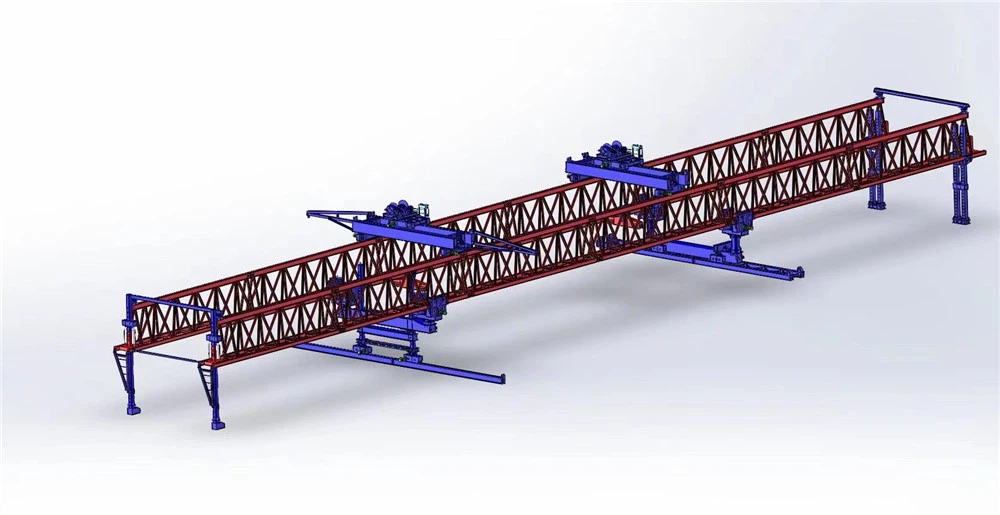

Advantages
A 160T Self-Balancing Bridge Erecting Machine (BBM) is a specialized piece of equipment designed for the precise and safe installation of pre-cast bridge segments, box girders, and T-beams.
Here are the key advantages of such a machine, broken down into categories:
1. Core Technical & Safety Advantages
Self-Balancing Mechanism: This is the most critical feature. The machine uses a counterweight system (often hydraulic or mechanical) to automatically balance itself during the lifting and launching of asymmetrical girders. This eliminates the need for extensive counterweighting on the machine's main structure, significantly reducing stress on the already-constructed bridge piers and deck.
High Lifting Capacity & Precision: The 160-ton capacity allows it to handle the vast majority of pre-cast segments for highway, railway, and viaduct projects. It provides millimeter-level precision in positioning girders, which is crucial for alignment and post-tensioning.
Increased Stability & Safety: The balanced design drastically reduces the overturning moment. This makes operations much safer in challenging conditions like crosswinds, on curves, or on grades. It minimizes the risk of catastrophic failure during the critical lifting phase.
Reduced Load on Bridge Structure: By balancing its own load, the machine transfers minimal torsional and bending forces to the piers and already-erected deck sections. This allows for lighter, more economical bridge designs and is essential when working on existing or sensitive structures.
2. Operational & Efficiency Advantages
Faster Erection Cycle: The self-balancing feature streamlines the process. There's less time spent on manual balancing adjustments, allowing for quicker pick, move, and place cycles. This leads to faster project timelines.
Enhanced Maneuverability: These machines are designed to traverse the completed deck sections. Their balanced nature makes launching (moving forward to the next span) smoother and safer.
Adaptability to Complex Geometries: It can erect girders on horizontal curves, vertical grades, and even super-elevated sections more easily than traditional unbalanced machines, thanks to its inherent stability.
Reduced Foundation Requirements: Since it imposes lighter loads on piers, it sometimes eliminates the need for temporary shoring or heavy pier reinforcement, saving time and cost on substructure work.
3. Economic & Project Advantages
Cost-Effectiveness: While the initial investment is high, the gains in speed, safety, and reduced labor/ground support requirements lead to lower overall project costs, especially for long-span, multi-bridge projects.
Labor Optimization: It requires a smaller ground crew compared to multiple cranes or traditional launching methods. Operations are more centralized and controlled from the machine's cabin.
Minimal Ground Disruption (Overhead Launching): The machine operates from the deck level, minimizing the need for large ground-based crane access, road closures, or disruption to the terrain underneath (rivers, roads, valleys). This is a major advantage in environmentally sensitive or densely populated areas.
Versatility: A 160T BBM can often be configured with different lifting frames and attachments to handle various girder types (box, I-beam, U-beam) and widths, making it a valuable asset for a contracting company across multiple projects.
4. Comparative Advantages Over Traditional Methods
vs. Multiple Mobile Cranes: Safer, more precise, less ground space required, and more efficient for repetitive, long-span work.
vs. Unbalanced Launching Gantries: Offers greater safety margins, allows work on lighter piers, and is better suited for complex alignments.
vs. Full-Span Launching: More flexible for varying span lengths and site conditions, with a lower initial capital cost for the equipment.
Summary:
The 160T Self-Balancing Bridge Erecting Machine is a safer, faster, and more structurally considerate solution for modern bridge construction. Its primary advantage lies in its self-balancing capability, which unlocks a cascade of benefits: enhanced safety through stability, reduced loads on the permanent structure, operational efficiency, and overall cost savings for large-scale bridge projects. It is the equipment of choice for constructing elevated highways, railway viaducts, and river crossings where precision, speed, and minimal ground impact are paramount.

Application
Typical Application Scenarios
Long, Multi-Span Viaducts: Ideal for continuous, straight, or gently curved elevated highways and railways where spans are repetitive (typically 20m to 50m). This is its most efficient application.
Construction Over Existing Obstacles: Essential for building bridges over busy roads, railways, rivers, or valleys where minimal disruption and high safety are paramount. The machine works from above, avoiding the need for ground-based cranes in sensitive areas.
Urban Flyover Projects: Where worksite space is limited, the machine's fixed rail path and overhead operation minimize ground footprint and traffic impact.
Projects with Limited Access: When the bridge site is difficult for large mobile cranes to access (e.g., soft ground, remote locations), the erector provides a stable, dedicated lifting solution once the initial setup is complete.

Production Procedure
160T Self-Balancing Bridge Erection Machine Manufacturing Process
Phase 1: Design and Process Preparation
Contract and Technical Review:
Confirm customer technical specifications, bridge parameters (span, curve radius, longitudinal slope, beam type and weight, etc.), working environment, and special requirements.
Conduct feasibility analysis and preliminary design.
Detailed Design:
Structural Design: Complete the full set of drawings for the main beam (double guide beam), front/rear outriggers, middle outriggers, lifting trolley, traverse track, and hydraulic and electrical systems. Focus on finite element analysis (FEA) to ensure structural strength, stiffness, and stability (especially overturning resistance) meet standards.
Mechanism Design: Detail the design of lifting, longitudinal movement, traverse movement, and dragging mechanisms, and calculate the selection of motors, reducers, brakes, wire ropes, and lifting devices.
Hydraulic System Design: Design the hydraulic circuits for the self-balancing core outriggers' lifting, extension, and leveling functions, ensuring synchronization accuracy and safety locking.
Electrical and Control System Design: Design drive control, safety monitoring (stress, levelness, travel limits), remote/wired control system, and fault diagnosis system.
Process Documentation:
Develop Manufacturing Process Specifications, Welding Procedure Qualification Reports (PQR), and Welding Procedure Specifications (WPS).
Develop assembly and inspection procedures for key components (main beams, legs).
Develop lists and acceptance standards for purchased and outsourced parts.
Second Stage: Raw Material and Purchased Component Procurement
Steel Procurement and Pre-treatment:
Procure sheet metal and profiles that meet design requirements (mainly Q345B and above).
Perform shot blasting and rust removal, and apply shop primer (weldable rust-preventive paint).
Key Purchased Component Procurement:
Electromechanical Components: Motors, reducers, brakes, drums, high-pressure wire ropes, pulleys, bearings.
Hydraulic Components: Hydraulic pump stations, cylinders, proportional valves, balance valves, lock valves, piping and fittings.
Electrical Components: PLC, frequency converter, sensors (tilt, pressure, wire encoder), remote control, electrical cabinet.
Safety Components: Overload limiter, height limiter, anemometer, emergency stop switch.
Phase Three: Structural Component Manufacturing (Core Process)
Material Cutting and Forming:
CNC Cutting: Precision cutting of sheet metal using a CNC plasma/flame cutting machine to ensure beveling quality.
Profile Pre-treatment: Straightening, cutting, drilling.
Panel Rolling and Bending: Used for cylindrical structures or partial sections of box beams.
Assembly and Welding:
Component Assembly and Welding: Assembling and welding main beam segments, leg segments, crossbeams, etc., on specialized jigs. Strict control of assembly gaps and misalignment.
Welding Operations: Performed by certified welders according to WPS standards. Major welds (main beam web and flange welds, critical leg welds) require full penetration and undergo non-destructive testing (UT ultrasonic testing or RT radiographic testing).
Post-weld treatment: Stress relief treatment (e.g., vibration aging or heat treatment), correcting welding deformation.
Machining:
Machinerying of key connection parts, such as outrigger hinge holes, wheel axle mounting surfaces, flange mating surfaces, etc., to ensure dimensional accuracy and geometric tolerances.
Fourth Stage: Electromechanical-Hydraulic System Assembly and Final Assembly
Component Pre-assembly:
Assemble the crane trolley (including lifting mechanism and traversing mechanism).
Assemble each outrigger assembly (including wheel boxes, hydraulic jacking device, and lateral adjustment mechanism).
Assemble the driver's cab, electrical cabinet, and hydraulic pump station.
Main Beam Assembly:
On the final assembly platform, connect each segment of the main beam into a whole using high-strength bolts. Inspect the overall accuracy of the main beam, including camber and lateral bending.
Final Assembly:
Lift the main beam onto the support frame.
Install the front outriggers, middle outriggers, and rear outriggers in sequence, and connect the hydraulic lines and electrical wiring.
Install the lifting trolley, traverse rails, ladder platform, and other auxiliary structures.
Fully connect the electrical and hydraulic control systems.
Phase 5: Factory Commissioning and Testing (Crucial)
No-load Commissioning:
Check the operating direction, speed, and stability of each mechanism.
Test the response and reliability of the control system (local/remote).
Adjust the hydraulic system pressure, synchronization, and pressure holding performance.
Calibrate all safety limit switches and sensors.
Static Load Test:
Conduct a static load test at 125% of the rated load (200T). Lift the test load 100-200mm off the ground and hold it for at least 10 minutes.
Measure the main beam deflection, outrigger settlement, and permanent structural deformation; check for cracks in the structure.
Dynamic Load Test:
Conduct a dynamic load test at 110% of the rated load (176T). Perform lifting-braking, traveling, and combined movements.
Test the dynamic performance of the mechanism, braking reliability, and structural vibration.
Self-Balancing Function Specific Test:
Simulate through-hole conditions to test the automatic leveling and stability of the front and rear outriggers during lifting and support transitions.
Test the anti-overturning capacity and balance adjustment response under unilateral load.
Sixth Stage: Painting, Marking, and Shipment
Overall Painting:
Sandblast or grind the entire surface to Sa2.5 grade.
Spray primer, intermediate coat, and topcoat. Colors according to customer or company standards.
Apply rust-proof protection to critical areas (such as friction surfaces).
Marking and Labeling:
Install permanent nameplates (including model, rated lifting capacity, manufacturing date, serial number, etc.).
Affix/spray safety warning signs, lifting point markings, and operation instruction signs.
Document Delivery:
Compile and deliver the following documents: Product Certificate of Conformity, Certificates of Conformity and Instructions for Major Purchased Components, Operation and Maintenance Manual, General Drawing and Consumable Parts Catalog, Type Test Report (if any), Welding and Flaw Detection Report, etc.
Disassembly and Shipping:
Based on transportation conditions, the entire machine will be scientifically disassembled into modules (main beam segments, outriggers, trolleys, etc.).
Properly protect the interfaces, provide rust-proof packaging, and prepare a shipping manifest.


Workshop View
The company has installed an intelligent equipment management platform, and has installed 310 sets (sets) of handling and welding robots. After the completion of the plan, there will be more than 500 sets (sets), and the equipment networking rate will reach 95%. 32 welding lines have been put into use, 50 are planned to be installed, and the automation rate of the entire product line has reached 85%.


Hot Tags: 160t self-balancing bridge erecting machine, China 160t self-balancing bridge erecting machine manufacturers, suppliers, factory
You Might Also Like


Send Inquiry