










120 Ton Bridge Launcher Equipment
A 120-ton bridge launcher is a heavy-duty mobile system designed for the rapid deployment of bridges, typically used in military, emergency, or civil engineering applications. These machines are capable of transporting and launching large bridge sections to span gaps such as rivers, ravines, or damaged infrastructure.

Key Features
Key Features of a 120-Ton Bridge Launcher:
High Load Capacity – Can handle bridge sections weighing up to 120 tons.
Mobility – Mounted on a heavy-duty transporter (wheeled or tracked) for rapid deployment.
Hydraulic Launching Mechanism – Uses hydraulic systems to extend and position bridge sections.
Modular Design – Supports different bridge types (e.g., Bailey-type, armored vehicle-launched bridges).
Military & Civil Use – Used by armed forces for tactical crossings and in disaster relief for infrastructure repair.
Specification
Here are the typical specifications for a 120-ton Bridge Launcher Equipment used in construction and military applications:
General Specifications:
Maximum Launching Capacity: 120 metric tons
Bridge Span: Typically 30m to 60m (adjustable based on design)
Launching Speed: 5–15 m/min (varies by model)
Operation Mode: Hydraulic/Electric/Power-pack driven
Control System: Remote-controlled or manual operation
Mobility: Mounted on a wheeled or tracked vehicle (military) or a self-propelled modular transporter (civil engineering)
Structural Specifications:
Material: High-strength steel (ASTM A572 or equivalent)
Deployment Mechanism: Telescopic or articulated boom system
Stabilization: Outriggers or hydraulic jacks for balance
Load Distribution: Adjustable support beams for different bridge types
Power & Hydraulics:
Hydraulic Pressure: 250–350 bar
Power Source: Diesel engine or electric motor (depends on model)
Pump Capacity: 40–60 L/min flow rate
Environmental & Operational Conditions:
Operating Temperature: -20°C to +50°C
Terrain Compatibility: Rough, uneven, or soft ground (with stabilization)
Safety Features: Overload protection, emergency stop, and anti-slip mechanisms

Pictures & Components
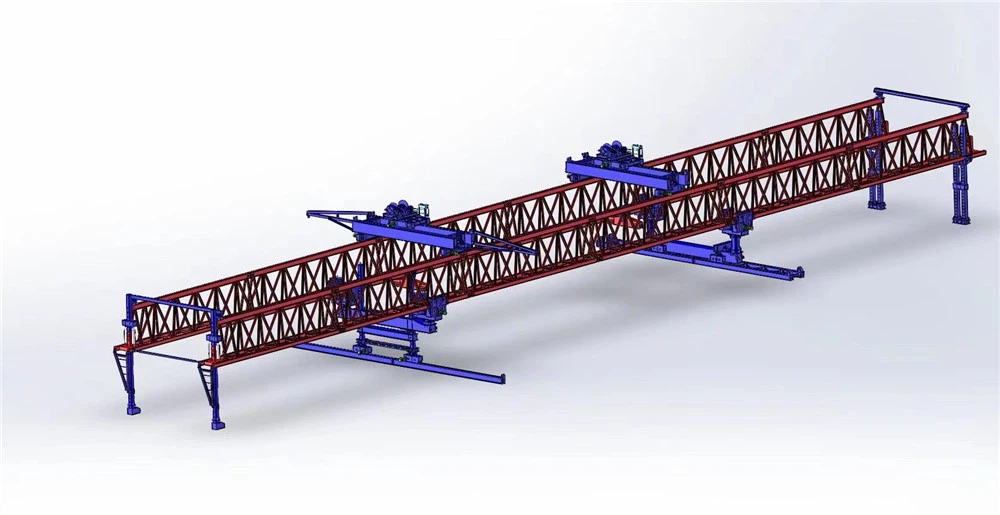
A 120-ton bridge launcher is a heavy-duty mobile system used to deploy military or emergency bridges quickly. Below are the key components typically found in such equipment:
1. Chassis & Mobility System
Heavy-duty multi-axle transporter (6x6, 8x8, or tracked)
All-terrain suspension & drivetrain
Hydraulic stabilization legs (for deployment stability)
2. Bridge Launching Mechanism
Bridge Deck Modules (usually aluminum or steel-composite)
Launching Boom/Gantry (hydraulic or mechanical extension system)
Rollers/Conveyors (to slide the bridge into position)
Hydraulic Actuators (for precise bridge deployment)
3. Hydraulic & Power Systems
High-pressure hydraulic pumps & cylinders
Power take-off (PTO) from the vehicle engine or auxiliary engine
Control valves & hoses for precise movements
4. Bridge Structure
Modular Bridge Sections (foldable or telescopic)
Locking Mechanisms (pins, clamps, or automatic latches)
Load-bearing supports (abutments/ramps for ground contact)
5. Control System
Operator cabin or remote-control panel
Hydraulic/electric joystick controls
Sensors for alignment & load distribution
6. Safety & Support Components
Stabilizers/Outriggers (prevents tilting during launch)
Winch & Recovery System (for retraction or adjustments)
Lighting & Warning Systems (for night operations)
7. Optional Features
Armored Cab (for military use in combat zones)
Self-recovery Winch (for extraction if stuck)
Rapid Deployment System (automated unfolding)

Sketch

Advantages
The 120-ton Bridge Launcher Equipment is a specialized military or engineering vehicle designed to deploy mobile bridges quickly, enabling troops, vehicles, and supplies to cross obstacles like rivers, trenches, or damaged infrastructure. Here are its key advantages:
1. Rapid Deployment
Allows for quick bridge installation (often in minutes), significantly faster than traditional bridge-building methods.
Enhances mobility in combat or disaster relief scenarios.
2. High Load Capacity (120 Tons)
Supports the crossing of heavy military vehicles, including main battle tanks, armored personnel carriers (APCs), and logistics trucks.
Ensures uninterrupted movement of critical supplies and reinforcements.
3. Enhanced Mobility & Flexibility
Can be mounted on tracked or wheeled vehicles, allowing operation in diverse terrains (mud, sand, rough terrain).
Self-contained system reduces dependency on additional engineering support.
4. Improved Battlefield Survivability
Reduces vulnerability by minimizing exposure time during river crossings.
Can be deployed under fire, maintaining operational tempo.
5. Multi-Role Utility
Useful in both military operations (combat bridging) and civilian disaster response (floods, earthquakes).
Can replace damaged bridges temporarily until permanent repairs are made.
6. Automated & Crew-Operated Options
Some models feature semi-automated deployment, reducing manual labor and errors.
Crew protection features (armored cabins) in combat versions.
7. Cost-Effective Logistics
Reduces the need for complex pontoon bridges or lengthy detours.
Saves time and resources in both military and humanitarian missions.
8. Compatibility with Modern Armies
Integrates with existing military logistics and engineering units.
Used by advanced armed forces (e.g., US, China, Russia, NATO allies).
Conclusion:
The 120-ton Bridge Launcher is a force multiplier, providing rapid, heavy-capacity bridging solutions that enhance mobility, logistics, and operational success in both combat and emergency scenarios.

Application
The 120-ton bridge launcher equipment is a heavy-duty mechanical system designed for rapid deployment of temporary bridges, primarily used in military, emergency response, and civil engineering applications. Below are its key applications and features:
Applications:
Military Operations
Rapid deployment of tactical bridges for troop movements, tanks, and heavy vehicles in combat zones.
Gap-crossing in destroyed or under-construction infrastructure.
Disaster Relief & Emergency Response
Quick restoration of connectivity after earthquakes, floods, or landslides.
Temporary bypasses for damaged bridges in humanitarian missions.
Civil Engineering & Construction
Temporary access bridges for heavy machinery in infrastructure projects.
Support in railway and highway construction where permanent bridges are under repair.
Logistics & Transportation
Facilitates movement of oversized cargo (e.g., wind turbine blades, heavy machinery) where existing bridges are inadequate.
Key Features:
High Load Capacity – Supports up to 120 tons, making it suitable for tanks (e.g., M1 Abrams, Leopard 2) and heavy construction equipment.
Modular & Rapid Deployment – Can be assembled quickly (often within hours) without heavy cranes.
Adaptability – Works with various bridge types (e.g., Bailey bridges, Mabey Johnson bridges).
Mobility – Mounted on heavy transport vehicles (e.g., trucks, tracked carriers) for quick relocation.
Remote Operation – Some models allow semi-automated launching to reduce personnel risk.
Examples of Use:
Military: NATO forces use bridge launchers for rapid river crossings in conflict zones.
Civilian: Deployed in flood-hit regions (e.g., during Hurricane Katrina) to restore transport links.

Production Procedure
The production of a 120-ton bridge launcher involves multiple stages, including design, material procurement, fabrication, assembly, testing, and commissioning. Below is a structured production procedure for such heavy-duty bridge launching equipment:
1. Design & Engineering
Requirement Analysis: Define load capacity (120 tons), span length, terrain adaptability, and mobility requirements.
CAD Modeling: Create 3D models (using AutoCAD, SolidWorks, or similar) for structural integrity.
Finite Element Analysis (FEA): Simulate stress distribution, deflection, and safety factors.
Regulatory Compliance: Ensure adherence to standards (e.g., ISO, AASHTO, EN 1090).
2. Material Procurement
High-Strength Steel: Purchase ASTM A572/A514 or equivalent for booms, girders, and supports.
Hydraulic Components: Select pumps, cylinders, and valves rated for 120-ton capacity.
Electrical Systems: Motors, sensors, and control panels (IP-rated for outdoor use).
Fasteners & Welding Consumables: High-tensile bolts and certified welding rods.
3. Fabrication Process
A. Structural Fabrication
Cutting: Plasma/laser cutting of steel plates for girders, trusses, and support frames.
Welding:
Submerged arc welding (SAW) for main beams.
Shielded metal arc welding (SMAW) for joints.
Ultrasonic/X-ray testing for weld integrity.
Machining: CNC milling/drilling for precision components (pivot points, connection plates).
B. Hydraulic & Electrical Systems
Hydraulic Assembly: Install cylinders, hoses, and pressure relief valves.
Electrical Wiring: Integrate sensors (load cells, tilt sensors) and PLC-based control systems.
4. Assembly
Frame Assembly: Bolt/weld main girders, outriggers, and launching nose.
Mechanical Integration: Mount winches, rollers, and track systems (if mobile).
Hydraulic Testing: Pressure tests for leaks (up to 1.5× operating pressure).
Control System Calibration: Test remote operation and safety interlocks.
5. Quality Control & Testing
NDT Inspection: Dye penetrant, magnetic particle, or ultrasonic tests.
Load Testing:
Static Load Test: 120-ton load held for 24 hours.
Dynamic Load Test: Simulated launching cycles (extend/retract bridge sections).
Field Trials: Deploy on a test track to verify mobility and stability.
6. Painting & Corrosion Protection
Surface Preparation: Sandblasting (SA 2.5 standard).
Coating:
Primer: Epoxy zinc-rich.
Topcoat: Polyurethane for UV/weather resistance.
7. Final Inspection & Certification
Documentation: Compile mill certificates, weld logs, and test reports.
Third-Party Certification: Engage notified bodies (e.g., TÜV, Lloyd's Register) for compliance.
8. Delivery & Commissioning
Transport: Disassemble for shipping (if modular).
On-Site Assembly: Reassemble and align components.
Operator Training: Conduct hands-on sessions for deployment/retrieval.


Workshop View
The company has installed an intelligent equipment management platform, and has installed 310 sets (sets) of handling and welding robots. After the completion of the plan, there will be more than 500 sets (sets), and the equipment networking rate will reach 95%. 32 welding lines have been put into use, 50 are planned to be installed, and the automation rate of the entire product line has reached 85%.


Hot Tags: 120 ton bridge launcher equipment, China 120 ton bridge launcher equipment manufacturers, suppliers, factory
You Might Also Like


Send Inquiry