










Strongway Gantry Crane
Products Description
1)A strongway gantry crane is a type of heavy-duty lifting equipment designed for outdoor use, particularly in industries like shipbuilding, steel manufacturing, construction, and freight handling. It consists of two parallel beams (or girders) that run along tracks mounted on the ground. This design provides the crane with greater stability, higher lifting capacity, and the ability to span wider areas.
2)strongway gantry cranes are known for their ability to handle very heavy loads, ranging from several tons to hundreds of tons. The design allows for the integration of more powerful hoisting mechanisms and stronger structures compared to single girder gantry cranes.The crane's two parallel girders provide a large horizontal span, enabling the crane to cover a broad working area. The lifting height can be customized based on the specific application needs, such as for lifting tall loads or working in large spaces.
3)Built for heavy-duty applications, these cranes are made with high-strength materials and engineered to withstand harsh environmental conditions, including high winds, extreme temperatures, and dust or dirt in the air.strongway gantry cranes are used in a wide range of industries for tasks like loading and unloading cargo, moving heavy equipment, or lifting precast concrete elements. They are commonly found in shipyards, ports, rail yards, manufacturing plants, and construction sites.
4)These cranes come with advanced control systems, including remote controls or operator cabins for precise and safe operation. Features like variable speed control, anti-sway technology, and load moment limiters are often incorporated for ease of use and safety.The cranes can be tailored to meet the specific needs of the customer, with options for different span widths, lifting capacities, travel speeds, and power sources (electric, diesel, or hybrid).strongway gantry cranes are equipped with safety systems to protect both operators and loads. These systems may include limit switches, emergency stop buttons, overload protection, and safety guards to prevent accidents.
Core Components:Gearbox, motor, Gear
Place of Origin:Henan, China
Warranty:2 years
Weight (KG):3500 kg
Video outgoing-inspection;Provided
Machinery Test Report;Provided
Application;warehouse, ports, yard, etc
Keywords:Model Gantry Crane
Control way:Ground Handle Control(push Button)
Capacity:10-600t
Material:Q235B/Q345B
Lifting speed:1-15m/min
Lifting mechanism;Electric Winch Trolley
Girder Type:Double Box

Pictures & Components
1.Main beam
1. Structural Design:
Box-type or I-beam Structure: The main beam is typically designed in the form of a box girder or an I-beam (also called an H-beam). The box girder provides higher torsional rigidity, making it more suitable for larger cranes with heavy load capacities, while I-beams are more commonly used in smaller cranes due to cost-effectiveness.
Material Strength: The beam is made from high-strength steel to ensure durability and the ability to withstand the heavy loads the crane is designed to lift.
Welded Construction: In most designs, the main beam is welded together, although in some cases, bolted or riveted joints may also be used.
2. Function and Role:
Load Distribution: The main beam distributes the weight of the load between the two end girders. It works in conjunction with the trolley, hoist mechanism, and supporting gantry legs to lift and move the load efficiently.
Supporting Mechanisms: The crane's hoisting system (including the hook, drum, and lifting ropes) and traveling mechanisms (which allow the crane to move along the tracks) are mounted on the main beam.
Connection to Other Components: The main beam is typically connected to the end beams via the crane's frame, and the end beams in turn support the gantry legs that move along the tracks.
Lifting System
1)Heavy Duty and High Capacity:
strongway gantry cranes are designed for heavy-duty applications, and the lifting system is specifically built to handle high-capacity loads, often ranging from 5 tons to several hundred tons.The hoisting system can be designed to handle different load types, including single, multi-point, or even suspended loads, depending on the application.
2)Precision and Safety:
Precision is critical for ensuring that loads are lifted and lowered accurately and safely.The lifting system may feature anti-sway technology to reduce load swing and improve control, especially when lifting large, heavy, or unstable loads.Load moment limiters and overload protection are essential for preventing the crane from lifting loads beyond its rated capacity.
3)Dual-Girder Synergy:
The use of two girders in the design allows for better distribution of the load and greater rigidity, which is essential when lifting large or heavy loads.This system also enables greater hook height and larger lifting spans, making it ideal for industrial and construction applications that require significant lifting power.

3.End carriage
Types of End Carriages:
1)Single Drive End Carriage:
This type of end carriage is powered by a single motor, which drives the movement of the entire crane. The motor typically drives one set of wheels (on one side of the end carriage), and the other side is powered passively (i.e., the wheels simply follow the movement).Single drive systems are typically used for cranes with lighter loads and shorter spans.
2)Double Drive End Carriage:
In a double drive system, both end carriages (left and right sides) have separate motors. This design provides more power, ensuring the crane can move smoothly even under heavy loads or longer spans.The independent drive system on each end allows for more precise control and higher performance.
3)Non-Powered (Manual) End Carriage:
In some applications, especially for smaller or manual cranes, the end carriage may not have a motor and may instead be moved manually or by a simple winch or gear system.These cranes are usually used for lighter-duty tasks where automation or powered movement is not necessary.

4.Crane travelling mechanism
Control and Safety Features:
1)Control System:
The crane's traveling mechanism is controlled through an operator cabin, remote control, or PLC-based system, depending on the type of crane and the complexity of the operation.The control system allows the operator to manage the crane's movement speed, direction, and stopping points, as well as coordinate its movements with the lifting and hoisting systems.
2)Anti-Sway and Positioning Systems:
Anti-sway systems can be integrated into the traveling mechanism to minimize the swinging of loads during horizontal movement, particularly when lifting heavy, large, or irregularly shaped objects.Load moment limiters are also important for preventing overloading and ensuring safe operation when traveling with heavy loads.
3)Safety and Overload Protection:
The traveling mechanism is equipped with safety features such as overload sensors, limit switches, and emergency stop buttons.Limit switches prevent the crane from traveling too far along the rails or beyond the safe operational limits.
4)Speed Control:
The crane may have variable speed control for precise movement during the lifting and traveling process, allowing for smooth and controlled starts and stops.
5.Trolley travelling mechanism
Key Functions of the Trolley Traveling Mechanism:
1)Horizontal Movement:
The primary function of the trolley traveling mechanism is to provide horizontal movement across the main girder(s) of the crane. This allows the hoisting system (and therefore the load) to be positioned exactly where it is needed.The trolley can move the hoist from one side of the crane to the other, enabling the crane to cover a wide area within its working span.
2)Precise Load Positioning:
The trolley allows the operator to position the hook or lifting attachment precisely over the load for lifting, or conversely, over the designated spot for placing the load.In critical applications, micro-movement controls can be incorporated to ensure extremely fine positioning of the load.
3)Coordination with the Hoisting Mechanism:
The trolley works in coordination with the hoisting system, which raises and lowers the load. The combination of vertical (hoist) and horizontal (trolley) movement enables precise handling of loads in three-dimensional space.The trolley and hoist work together to lift, move, and position loads with high precision and efficiency.
6.Crane wheel
Key Components of the Wheels:
1)Wheel Materials:
The wheels are typically made from high-strength steel, which is designed to withstand heavy loads, impact, and wear over time. Steel wheels are ideal for handling the high stresses placed on the crane's wheels during movement.The material choice ensures durability, strength, and wear resistance, which are essential in high-demand industrial environments.
2)Wheel Design:
The wheels are often designed with flanges (raised edges) to prevent the crane from derailing and to keep it securely on the track. The flange helps maintain alignment and stability as the crane moves along the rails.The diameter and width of the wheels are designed to support the specific load capacity and operating environment of the crane. Larger wheels may be required for cranes that carry heavier loads.
3)Wheel Bearings:
Bearings are installed inside the wheel assembly to reduce friction and facilitate smoother rotation. These bearings support the wheel's axles, allowing them to rotate freely as the crane moves.Heavy-duty bearings are typically used to handle the substantial weight and stresses the wheels experience during operation.
4)Axles:
The axles are the components that connect the wheels together and are mounted on the end carriage. They provide the structural support for the wheel assembly.High-strength steel is often used for the axles, and they are designed to withstand the stresses associated with lifting heavy loads and moving the crane across the runway.
5)Wheel Hub:
The wheel hub connects the wheel to the axle and allows for rotation. It is the central part of the wheel assembly where the bearing system is typically housed.The wheel hub is designed to be durable and able to withstand the forces generated during crane movement, especially under heavy load conditions.

7.Crane Hook
1)Material and Construction:
The hook is typically made of high-strength steel or alloy steel to handle the substantial stresses involved in lifting heavy loads. The steel is often heat-treated to improve strength and durability.For particularly heavy-duty applications, forged steel or machined steel may be used to create a hook that can bear large loads without compromising safety.
2)Shape and Size:
The hook typically has a curved shape, with an open end that allows for easy attachment and detachment of the load.The size of the hook depends on the capacity of the crane and the types of loads it is designed to handle. Larger cranes will have larger hooks to accommodate bigger loads, while smaller cranes have more compact hooks.
3)Safety Latch or Locking Mechanism:
Many crane hooks are equipped with a safety latch or locking mechanism to prevent the load from accidentally slipping off the hook during the lifting process.The safety latch typically consists of a spring-loaded mechanism that automatically closes over the opening of the hook, keeping the load securely attached.Some systems feature manual or automatic latching systems that ensure the hook remains locked while lifting.
4)Swivel Hook (Optional):
In some applications, a swivel hook may be used. This type of hook is mounted on a swivel bearing that allows it to rotate freely while lifting, enabling the load to move or rotate without causing twisting or damage to the lifting rope or chain.Swivel hooks are particularly useful in situations where the load needs to be rotated or manipulated as it is being lifted or moved.

Motor
1)AC Motors (Alternating Current):
AC motors are the most common type of motor used in strongway gantry cranes because they are cost-effective, reliable, and efficient for heavy-duty applications.Squirrel-cage induction motors are frequently used, as they offer a simple design, robust performance, and low maintenance.AC motors are used for both the hoisting and traveling mechanisms and can be equipped with variable frequency drives (VFDs) for speed control.
2)DC Motors (Direct Current):
DC motors are sometimes used in cranes, especially when precise speed control and smoother operation are required. They are typically used for the hoisting system where variable speed control is necessary for fine load positioning.Although DC motors offer better torque at low speeds and more control, they require more maintenance than AC motors because of the commutator and brush components.
3)Hydraulic Motors (Less Common):
In some specialized gantry cranes (e.g., in outdoor environments or mobile cranes), hydraulic motors may be used to provide power to the crane's driving systems, especially for the traveling mechanism or trolley.Hydraulic systems are typically more complex and are used when more torque is required at low speeds or when precise control is needed in lifting heavy loads.

.
Sound and light alarm system & limit switch
1)Sound and Light Alarm System:
The sound and light alarm system is an essential safety feature that provides audible and visual signals to indicate the crane's operational status, potential hazards, or emergency situations. These systems help improve communication and awareness in noisy and busy industrial environments.
2)Limit Switches:
Limit switches are mechanical or electronic devices designed to limit the movement of the crane's components, ensuring that they do not exceed safe operating limits. They are integrated into various parts of the crane to protect against accidents such as over-travel, overloading, or mechanical damage.

10.Safety Devices
1)Overload Protection System:
The overload protection system is designed to prevent the crane from lifting loads that exceed its rated capacity. If the crane is overloaded, the system will either stop the lifting operation or activate an alarm.
2)Limit Switches:
Limit switches prevent the crane from moving beyond its safe operating limits, whether in terms of travel distance, height, or weight. They stop the crane's movement when certain thresholds are reached.
3)Emergency Stop Button:
An emergency stop button (or emergency stop switch) is one of the most important safety devices on the crane. It allows the crane operator or nearby personnel to immediately stop the crane in an emergency situation.
4)Anti-Collision Devices:
Anti-collision systems are essential for preventing the crane from colliding with other cranes, structures, or obstacles in its operational area.
5)Safety Brakes:
Safety brakes are essential to stop or hold the crane's movements safely in case of failure in the drive or power systems.
6)Safety Locking Mechanism:
A safety locking mechanism prevents accidental or unintended movement of crane components, especially when they are in a parked or stationary position.
7)Crane Travel Speed Limit:
In some cases, the crane may be equipped with systems to limit its speed, particularly for traveling on long gantry rails.
11.Control Mode
1)Pendant Control (Wired Control)
Pendant control involves a handheld device with buttons or switches, which the operator uses to control the crane's movements. The pendant is typically connected to the crane via a cable.
2)Radio Remote Control (Wireless Control)
Radio remote control systems use wireless technology to allow operators to control the crane from a distance, providing greater flexibility and improving safety.
3)Cabin Control (Operator's Cabin)
Cabin control systems involve an operator's cabin, which is typically located on the crane's main girder or on a dedicated platform above the crane. The operator controls the crane's movements from inside the cabin using joysticks, push buttons, and pedals.
4)Automated Control (Automatic Crane Systems)
Automated control systems use sophisticated technology to operate the crane with minimal human intervention. These systems use sensors, controllers, and software to manage movements, positioning, and operations based on predefined parameters.
5)Driverless or Remote Supervision (Supervision by Control Room)
In some cases, a control room may monitor the crane's movements while the crane itself operates autonomously or under limited manual intervention. This system is often part of a supervised automation solution.

12.Sketch

Main technical

Advantages
1. High Lifting Capacity and Stability
Enhanced Load Handling: The double girder design allows for greater lifting capacity compared to a single girder crane. The two girders provide more structural support, enabling the crane to lift very heavy and oversized loads.
Improved Stability: The double girder system offers greater stability during operation, especially when lifting large or unbalanced loads. This reduces the risk of tipping and enhances the overall safety of operations.
2. Greater Span and Reach
Wider Span: Double girder cranes can achieve larger spans, meaning they can cover a wider area. This makes them ideal for applications where the crane needs to move large loads over long distances, such as in ports, shipyards, or steel mills.
Longer Travel Distance: The ability to support larger spans means that double girder cranes can travel longer distances across the facility or yard, optimizing space usage and improving workflow efficiency.
3. Enhanced Precision and Control
Improved Load Control: strongway gantry cranes are often equipped with advanced control systems that allow for precise load positioning. This is critical when handling sensitive materials, oversized items, or in environments where high precision is required (e.g., assembly lines, ports).
4. Durability and Longevity
Stronger Structure: Due to the double girder design, these cranes are generally more durable and able to withstand harsh working conditions. They are often built from higher-quality materials and are better suited for continuous heavy-duty use.
Resistance to Wear and Tear: Double girder cranes have less wear and tear over time compared to lighter models. The increased support and stability reduce the stresses placed on the structure, ensuring that components last longer.
5. Versatility in Applications
Variety of Configurations: strongway gantry cranes can be customized to suit a wide range of applications, from indoor to outdoor operations, from small warehouses to large shipyards. The design can be adjusted to accommodate specific lifting and travel requirements.
Adaptability to Different Loads: The crane's ability to carry heavy and oversized loads makes it suitable for diverse industries, including construction, manufacturing, rail yards, ports, and steel mills.
Application:
1. Port and Container Handling
Ports and shipping yards are among the most common environments where strongway gantry cranes are used. These cranes are essential for loading and unloading heavy cargo containers from ships, trucks, and trains.
2. Shipbuilding and Shipyards
In shipyards, strongway gantry cranes are commonly used to build, repair, and maintain large ships, boats, and marine structures. The cranes are particularly useful for heavy lifting and precise positioning of large sections of ships.
3. Steel Mills and Heavy Industries
Steel mills, foundries, and other heavy industries rely on strongway gantry cranes to move raw materials, semi-finished products, and finished goods. These industries deal with very heavy loads and require cranes that can handle extreme weights and harsh environments.
4. Construction and Infrastructure Projects
In large-scale construction and infrastructure projects, strongway gantry cranes are often used for lifting and moving large construction materials like concrete, steel beams, and prefabricated modules.
5. Warehouse and Logistics Operations
Warehouse and distribution centers use strongway gantry cranes for efficient storage, retrieval, and movement of goods, especially in large warehouses with high storage racks or complex layouts.
6. Mining and Quarry Operations
In mining and quarrying, strongway gantry cranes are used to lift heavy machinery, mine ore, and move large quantities of material in mining facilities.
7. Aerospace and Aircraft Manufacturing
In the aerospace industry, strongway gantry cranes are used to assemble and move large components of aircraft or spacecraft, such as fuselages, wings, and engines.
Crane production procedure
1. Design stage: Understand the specific needs of customers, including load-bearing capacity, span, height and use environment. Carry out preliminary design according to the needs and draw scheme drawings, including structural design, power system and control system design. Carry out structural strength, stability and dynamic analysis to ensure that the design meets relevant standards and specifications.
2. Material preparation: Select suitable materials according to design requirements, such as high-strength steel, aluminum alloy, etc., to ensure good mechanical properties and durability. Purchase the required raw materials and components according to the design drawings, including motors, reducers, hooks, control systems, etc.
3. Processing and manufacturing: Cut the steel and process the main beam, end beam and other structural parts according to the design dimensions. Connect the cut parts by welding to form the main structural frame of the crane. Finish the welded components, including drilling, turning and milling, to ensure the matching accuracy of each component.
4. Assembly: Preliminary assembly of the processed components to check the stability and matching of the structure. Install the lifting mechanism, trolley running mechanism and trolley running mechanism to ensure that all moving parts can run smoothly.
5. Electrical system installation: Install motors, inverters, control panels and other electrical components to ensure that the electrical system is connected correctly. Arrange the cable lines reasonably to ensure safety and beauty, and reduce interference and wear.
6. Commissioning and testing: Test the various functions of the crane, including lifting, moving, braking and alarm systems, to ensure that all functions are normal. Carry out safe load tests to ensure that the crane operates stably under maximum load and meets safety standards.
7. Inspection and quality control: Carry out quality inspections on each link of production to ensure that all components meet design and standard requirements. Carry out qualification certification according to relevant regulations to ensure that the equipment meets national and industry standards.
8. Delivery and installation: Transport the manufactured crane to the customer site. Install it at the customer site, including fixing the foundation, commissioning and connecting the power supply. Provide operation training to customers to ensure that they can use the equipment safely and effectively, and officially deliver it for use.

Workshop view:
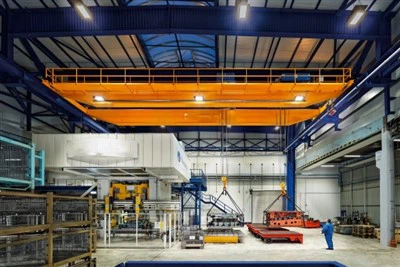
The company has installed an intelligent equipment management platform, and has installed 310 sets (sets) of handling and welding robots. After the completion of the plan, there will be more than 500 sets (sets), and the equipment networking rate will reach 95%. 32 welding lines have been put into use, 50 are planned to be installed, and the automation rate of the entire product line has reached 85%.


Hot Tags: strongway gantry crane, China strongway gantry crane manufacturers, suppliers, factory
You Might Also Like



Send Inquiry