










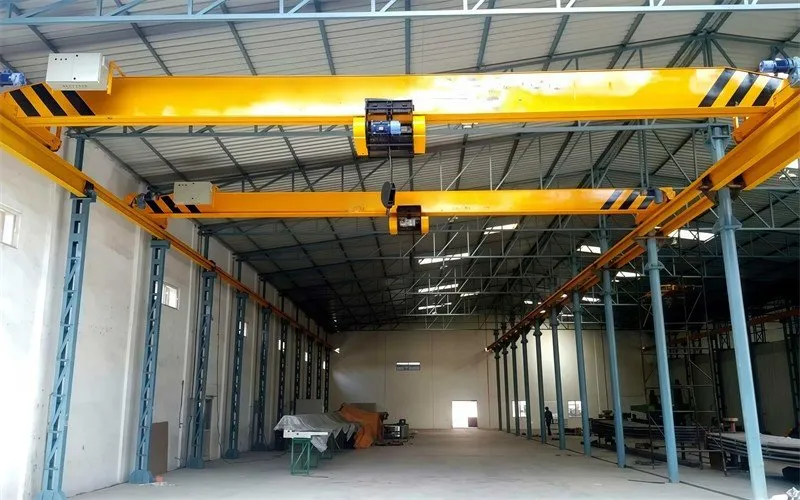
Single Girder Eot Crane
Products Description
Single girder eot crane - Product Introduction.A Single Girder EOT Crane is a highly efficient material handling solution designed to move heavy loads in industrial environments such as warehouses, manufacturing facilities, and workshops. These cranes are engineered for reliability, cost-effectiveness, and versatility, making them ideal for a wide range of applications.
Single girder eot crane -Key Features:Compact Design:The single girder structure reduces weight and maximizes space utilization.Ideal for facilities with limited headroom and low clearance requirements.High Efficiency:Equipped with a robust hoist system for smooth and precise load lifting.Ensures minimal energy consumption and maximum operational efficiency.
Single girder eot crane-Durable Construction:Made from high-grade steel with excellent structural integrity.Resistant to wear and tear, ensuring a long service life.Ease of Installation:
Simple and quick to install due to its lightweight design.Suitable for both new constructions and retrofitting existing systems.
Single girder eot crane-Customization Options:Available with different lifting capacities, spans, and heights to suit specific project requirements.Multiple control options, including remote control and cabin control.
Core Components Engine, Motor, Gear
Place of Origin Henan, China
Warranty 2 years
Weight (KG) 1550 kg
Lifting Capacity 16 ton
Lifting mechanism Europe type hoist
Lifting speed 0.8/5m/min
Industrial voltage 380v50hz3p or customers' requirements
Control method Pendant+Remote(Customized)
Working duty A5
Working Temperature -25~+40℃
Application factory/warehouse logistics/freight yard
Color Customers' Requirements

Pictures & Components
1.Main beam
1) Single Girder EOT Crane - Main Beam Overview The main beam is the most crucial structural component of a Single Girder EOT Crane. It acts as the primary load-bearing element, supporting the hoist and facilitating the smooth movement of loads across the crane's span. A well-designed main beam ensures the crane operates efficiently, safely, and reliably, even under demanding conditions.
2) Key Features of the Main Beam:High-Strength Construction:Made from premium-grade structural steel (e.g., Q235B or Q345B) for superior strength and durability.Designed to handle dynamic and static loads efficiently.Optimized Design:Typically features a box girder or I-beam profile, depending on load requirements and application.Lightweight yet rigid design reduces the overall deadweight of the crane, improving energy efficiency.
3) Precision Engineering:Fabricated with advanced welding and cutting techniques to ensure uniformity and accuracy.Optimized camber design prevents deformation under heavy loads.Surface Treatment:Anti-corrosion coating, such as primer and polyurethane paint, enhances durability and resistance to rust, even in harsh environments.
4)Integrated Mechanisms:Equipped with rail tracks for the hoist and trolley to travel seamlessly along the beam.Reinforced with stiffeners for added strength and stability.Customization:Available in various spans, lengths, and capacities to suit different applications.Adaptable to work with specific lifting speeds, load capacities, and duty cycles.

Lifting System
Single Girder EOT Crane - Lifting System Overview The lifting system is the core functional component of a Single Girder EOT Crane, responsible for raising, lowering, and holding loads. It includes a combination of hoisting mechanisms designed for safety, efficiency, and reliability in handling various materials. The lifting system is engineered to ensure smooth operation, high precision, and long service life.
Components of the Lifting System:Electric Wire Rope Hoist or Chain Hoist:The primary lifting device, typically mounted on the single girder.Wire Rope Hoist: Ideal for higher capacities and greater lifting heights.Chain Hoist: Suitable for lighter loads and applications requiring compact equipment.
Motor:A powerful motor drives the hoist, ensuring smooth and reliable lifting.Equipped with energy-efficient, low-maintenance motors that comply with international standards (e.g., IE2/IE3 energy class).
Gearbox:The lifting mechanism includes a hardened and precision-machined gearbox for smooth power transmission and durability.Reduces noise and vibration during operation.Rope/Chain:Made from high-tensile steel for strength, wear resistance, and extended service life.Designed to ensure smooth and safe lifting operations.
Brake System:Electromagnetic or hydraulic brakes ensure safe operation by securely holding the load in position.Provides automatic braking in case of power failure.Hook Block:A robust hook assembly with swiveling capabilities, ensuring safe and stable load handling.Equipped with a safety latch to prevent accidental detachment of loads.

3.End carriage
1) Single Girder EOT Crane - End Carriage Overview The end carriage is a critical structural and functional component of a Single Girder EOT Crane. It is mounted on both ends of the crane girder and supports the movement of the crane across the runway beams. The end carriages enable smooth, precise, and efficient horizontal travel of the crane, ensuring stability and reliable operation.
2) Key Features of the End Carriage:Rugged Construction:Fabricated using high-strength steel to ensure structural integrity.Designed to bear the load of the main girder, hoist, and trolley while moving along the runway.
3) Compact Design:Lightweight and space-saving design to optimize crane movement within the facility.Allows for easy integration into tight spaces or pre-existing infrastructure.Precision-Machined Components:End carriage wheels and shafts are precision-machined for smooth rolling and minimal resistance.Gearboxes are aligned accurately for optimal power transmission.
4) Drive Mechanism:Equipped with motors and gearboxes for controlled and reliable movement.Includes a direct-drive mechanism or coupling drive to ensure efficient power transmission.Anti-Collision Systems:Can include sensors or bumpers to prevent collisions between cranes or between the crane and runway ends.Ease of Maintenance:Modular design simplifies replacement or maintenance of components, minimizing downtime.

4.Crane travelling mechanism
1) Key Components of the Crane Travelling Mechanism:End Carriages:Mounted at both ends of the girder to support and guide the crane along the runway tracks.
Integrated with wheels, motor drives, and gearboxes.
Wheels:Forged or cast steel wheels ensure smooth movement on the tracks.Options include flanged or unflanged wheels, depending on the track type.Hardened for wear resistance and long service life.
Motors:High-performance motors power the travelling mechanism.Motors are typically three-phase with advanced features like variable frequency drives (VFD) for speed control.Energy-efficient and designed for high-duty cycles.
Gearboxes:Precision-engineered gearboxes transmit power from the motors to the wheels.Helical or spur gearboxes provide high torque with minimal noise and vibration.
Drive Units:Direct drive or coupled drive systems ensure efficient power transmission from the motor to the wheels.Designed for synchronized movement of both end carriages.Couplings and Shafts:Flexible couplings connect motors to gearboxes, absorbing shock loads and vibrations.Shafts ensure smooth transmission of motion across the mechanism.
5.Trolley travelling mechanism
1)Trolley Frame:A robust steel structure that supports the hoist and connects to the wheels.Designed for strength and minimal vibration during operation.Wheels:High-strength steel or cast iron wheels run on the girder's bottom flange.Precision-machined wheels with low rolling resistance for smooth movement.Options for single-flanged, double-flanged, or unflanged wheels based on the crane's girder design.
2) Motor:A compact, high-efficiency motor drives the trolley mechanism.Equipped with features like soft start and variable frequency drives (VFD) for speed control.Gearbox:Transfers the motor's power to the wheels through a system of helical or spur gears.Optimized for torque and efficiency while minimizing noise and wear.
3) Guide Rollers:Positioned alongside the wheels to prevent derailment and enhance stability.Reduces lateral movement for smooth travel.Control System:Pendant control or remote control for precise operation.Offers variable speed options for accurate positioning.
6.Crane wheel
1) Types of Crane Wheels Single-Flanged Wheels:Have one flange to guide the wheel along the track.Commonly used in systems where lateral stability is controlled by other mechanisms.
2)Double-Flanged Wheels:Flanges on both sides ensure better guidance and prevent derailment.Typically used for high-precision operations or in environments with minimal lateral stability.
3)Flat Wheels:Lack flanges and are used on flat rail systems.Require external guiding rollers or mechanisms for stability.Customized Wheels:Designed for specific track shapes or applications, such as grooved or V-type wheels.

7.Crane Hook
1)Types of Crane Hooks Single Hook:Simple, lightweight design used for lifting lighter loads.Common in general-purpose applications.Double Hook:Features two prongs to distribute the load evenly.Suitable for lifting large, bulky, or asymmetrical loads.
2)Ramshorn Hook:A specific type of double hook designed for heavy loads.Often used in industrial applications requiring higher load capacities.Custom Hooks:Specially designed hooks tailored for specific industries or load requirements.Key Features of Crane Hooks
3)High-Strength Materials:Typically made from forged alloy steel or carbon steel for maximum strength and toughness.Heat-treated to achieve high load-bearing capacity and resistance to wear.
4)Safety Latch:Equipped with a spring-loaded latch to prevent accidental detachment of the load.Rotational Mechanism:Many hooks are mounted on a swivel, allowing 360° rotation for easy positioning of loads.Fatigue Resistance:Engineered to withstand repeated loading and unloading cycles without failure.Corrosion Protection:Surface coatings, such as galvanization or painting, provide resistance to rust and corrosion.

Motor
Single Girder EOT Crane - Motor Overview The motor is a vital component of a Single Girder EOT Crane, powering various mechanisms such as the hoisting system, trolley traveling system, and crane traveling system. It provides the energy required to lift, move, and position loads efficiently. Designed for high performance, reliability, and durability, the motors used in Single Girder EOT Cranes are engineered to handle demanding operational conditions while maintaining energy efficiency and safety.
Types of Motors Used in Single Girder EOT Cranes Hoist Motor:Powers the hoisting mechanism for lifting and lowering loads.Typically equipped with variable speed controls for precise positioning.Trolley Traveling Motor:Drives the movement of the trolley along the crane's girder.Designed for smooth and controlled horizontal movement.
Crane Traveling Motor:Powers the crane's movement along the runway beams.Designed to handle heavy loads and ensure steady travel.Dual-Purpose Motors:Some systems use motors capable of powering multiple crane functions

.
Sound and light alarm system & limit switch
Single Girder EOT Crane - Sound and Light Alarm System The sound and light alarm system is a key safety feature of a Single Girder EOT Crane. It is designed to alert workers and operators in the vicinity of the crane about its operation, thereby minimizing the risk of accidents and enhancing workplace safety. This system is especially critical in busy industrial environments where visibility and awareness might be limited.
Key Features of the Sound and Light Alarm System Audible Warning:Emits a loud alarm or buzzer sound to alert personnel of the crane's movement or lifting operations.Sound intensity typically ranges from 85–120 dB, ensuring it is heard in noisy industrial environments.Visual Warning:Flashing or rotating lights (typically red or amber) signal the crane's activity.High-intensity LED lights ensure visibility in low-light conditions or long distances.
Automatic Activation:The alarm system is automatically triggered during crane operations, such as traveling, lifting, or lowering.Durability:Enclosed in robust, weatherproof, and dustproof casings (IP54, IP65) for reliable operation in harsh environments.
Energy Efficient:LED lights and efficient sound mechanisms ensure low power consumption.Functions of the Sound and Light Alarm SystemOperation Alerts:Warns nearby workers that the crane is in motion or engaged in lifting operations.

10.Safety Devices
1)Key Safety Devices in Single Girder EOT Cranes Overload Protection Device Monitors the load weight and prevents the crane from lifting loads beyond its rated capacity.Alerts the operator with sound or light signals or automatically halts the operation to avoid structural damage.
2)Emergency Stop Button;Allows the operator to instantly stop all crane operations in case of an emergency.Located on the crane control panel or pendant control for easy accessibility.Limit Switches;Hoist Limit Switch: Stops the hoist when the hook reaches the upper or lower limit, preventing over-lifting or over-lowering.
3)Crane Travel Limit Switch: Stops the crane's movement at the runway beam's end to prevent derailment.Anti-Collision System;Uses sensors to detect the proximity of other cranes or obstacles.Automatically slows down or stops the crane to avoid collisions during operation.
4)Sound and Light Alarm System;Alerts nearby workers of the crane's movement or lifting operations.Comprises loud sound alarms and flashing lights, improving safety in noisy or visually crowded environments.Overload Warning Indicator Displays the load weight on a digital or analog screen and alerts the operator if the load approaches or exceeds the crane's capacity.
5)Brake System;Includes electromagnetic or hydraulic brakes for controlled stopping of the crane during operations or emergencies.Prevents load sway or uncontrolled movement, ensuring stability during lifting or travel.
11.Control Mode
1)Key Safety Devices in Single Girder EOT Cranes Overload Protection Device,Monitors the load weight and prevents the crane from lifting loads beyond its rated capacity.Alerts the operator with sound or light signals or automatically halts the operation to avoid structural damage.
2) Emergency Stop Button;Allows the operator to instantly stop all crane operations in case of an emergency.Located on the crane control panel or pendant control for easy accessibility.Limit Switches Hoist Limit Switch: Stops the hoist when the hook reaches the upper or lower limit, preventing over-lifting or over-lowering.Trolley Limit Switch: Prevents the trolley from moving beyond the girder's length.Crane Travel Limit Switch: Stops the crane's movement at the runway beam's end to prevent derailment.
3) Anti-Collision System;Uses sensors to detect the proximity of other cranes or obstacles.Automatically slows down or stops the crane to avoid collisions during operation.Sound and Light Alarm System;Alerts nearby workers of the crane's movement or lifting operations.Comprises loud sound alarms and flashing lights, improving safety in noisy or visually crowded environments.
4) Overload Warning Indicator;Displays the load weight on a digital or analog screen and alerts the operator if the load approaches or exceeds the crane's capacity.
Brake System;Includes electromagnetic or hydraulic brakes for controlled stopping of the crane during operations or emergencies.Prevents load sway or uncontrolled movement, ensuring stability during lifting or travel.

12.Sketch

Main technical

Advantages
Key Advantages of Single Girder EOT Cranes Cost-Effective;Lower Initial Investment:Requires fewer materials (single girder vs. double girder), leading to reduced production costs.Economical Installation:Simple design and lightweight structure make installation easier and more affordable.Reduced Operational Costs:
Lower energy consumption due to lighter design, reducing power requirements.
Lightweight and Compact Design Lighter Crane Weight:The single girder structure reduces the overall weight of the crane, minimizing the load on building structures.Space Efficiency Compact design requires less headroom, allowing for optimal use of workspace and maximizing floor space utilization.Simpler Structure:Fewer components compared to double girder cranes make it easier to maintain and operate.
Versatile Applications Suitable for various industries, including manufacturing, warehouses, workshops, assembly lines, and maintenance tasks.Can handle loads ranging from light to medium-duty operations, typically up to 20 tons. Easy Installation and Maintenance Quick Installation:Simplified structure and fewer components ensure faster installation.Low Maintenance Requirements:Less complex mechanical and electrical systems reduce downtime and maintenance costs.
High Efficiency Smooth Operation:Advanced mechanisms, such as variable speed controls and precise trolley movement, enable efficient load handling.Improved Productivity:Quick and reliable lifting and transportation of materials improve operational workflow.Energy Efficient:Consumes less energy due to its lightweight and compact design.
Enhanced Safety Features Equipped with modern safety devices like:Overload protection systems Limit switches Emergency stop buttons Sound and light alarm systems Ensures safe operation for both workers and equipment.
Flexible Control Options Offers multiple control modes for different operational needs:Pendant control: Cost-effective and straightforward.Remote control: Ensures operator safety and flexibility.Cabin control: Ideal for more demanding applications requiring direct supervision.
Application:
Common Applications of Single Girder EOT Cranes Manufacturing Plants Use: In manufacturing units, single girder EOT cranes are employed to handle raw materials, semi-finished products, and finished goods. They play a vital role in assembly, machining, and other manufacturing processes.Example: Lifting steel coils, moving assembly parts, or transporting components along production lines.
Warehouses and Distribution Centers Use: These cranes are extensively used in warehouses for material handling, including loading, unloading, and organizing stock. Their ability to move across aisles makes them ideal for managing goods in narrow spaces.Example: Moving packages, storing products in high shelves, or loading/unloading trucks.
Garages and Workshops Use: In workshops and garages, single girder EOT cranes assist in lifting and moving heavy machinery or vehicle parts during repairs and maintenance. They are essential for tasks requiring precision and safety.Example: Lifting engines, machinery components, or car parts for inspection, maintenance, or repair.
Construction Sites Use: Single girder EOT cranes are used on construction sites for lifting materials and transporting them to different locations within the construction zone. They help in handling smaller building materials or machinery.Example: Lifting construction materials like bricks, cement bags, beams, or smaller equipment.
Steel Mills and Metal Fabrication Use: These cranes are employed for transporting raw materials, semi-finished products, and finished goods in steel mills or metal fabrication workshops. Single girder EOT cranes help move heavy materials like billets, plates, or sheets.Example: Moving hot metal billets or coils for further processing or transport.
Paper and Pulp Industries Use: In the paper and pulp industry, single girder cranes are used to handle heavy rolls of paper and other materials used in production. They are also useful for moving large equipment or machinery within the plant.Example: Lifting and positioning large rolls of paper, handling pulp bales, or assisting in machine setup.
Crane production procedure
1. Design stage: Determine the parameters of the crane, such as rated load, span and lifting height, according to the customer's needs and working environment. Carry out detailed structural design, including main beam, end beam, crane, lifting mechanism, etc., to ensure that the design meets safety standards and usage requirements. Select appropriate materials according to the design, usually high-strength steel to ensure the stability and durability of the structure.
2. Manufacturing stage: Prepare the required raw materials and parts according to the design drawings. Cut, bend and shape the steel to prepare structural components such as main beams and end beams. Weld the various components and assemble them into an overall structure. This step requires guaranteed welding quality to ensure strength and stability.
3. Machining: Machining key components such as motors, gears, bearings, etc. to ensure that their size and accuracy meet the requirements. Anti-corrosion treatment of components, such as painting and galvanizing, increases the durability and aesthetics of the equipment.
4. Electrical system installation: Install electrical components such as motors, controllers, switches, sensors and alarm systems. Connect and wire cables to ensure the normal operation of the electrical system.
5. Assembly phase: Assemble all components and systems as a whole, connect the lifting mechanism, trolley running mechanism and control system. Perform a comprehensive inspection of the assembled crane to ensure that all components and systems are working properly, and perform preliminary debugging.
6. Testing phase: Perform static load test on the crane to check the structural strength and stability. Perform dynamic test on the crane, including tests on lifting, moving, braking and other functions, to ensure that its performance meets the design requirements. Check the functions of safety devices, such as limit switches, overload protection, etc., to ensure the safety of the equipment during operation.
7. Quality control: Perform quality control on each link in the production process to ensure compliance with industry standards and customer requirements. Record various data and inspection results in the production process for subsequent traceability and analysis.
8. Delivery and installation: Pack and prepare the completed crane for transportation to ensure that it is not damaged during transportation. Deliver the crane to the customer's site for installation, and perform on-site debugging and acceptance. Provide operation training to customers to ensure that they are proficient in the use and maintenance of the crane.

Workshop view:
The company has installed an intelligent equipment management platform, and has installed 310 sets (sets) of handling and welding robots. After the completion of the plan, there will be more than 500 sets (sets), and the equipment networking rate will reach 95%. 32 welding lines have been put into use, 50 are planned to be installed, and the automation rate of the entire product line has reached 85%.


Hot Tags: single girder eot crane, China single girder eot crane manufacturers, suppliers, factory, Single Girder Overhead Crane Company, Eot Crane, Double Girder Overhead Cranes
Previous
New Types Of CranesYou Might Also Like


Send Inquiry