










Overhead Shop Crane
Products Description
1) The lifting capacity of a double-beam bridge crane can usually reach tens of tons or even hundreds of tons, which is suitable for carrying heavy objects. Its span can be designed according to site requirements, usually between 10 and 30 meters, which is suitable for material transportation needs with larger spans. The double-beam structure makes the crane more evenly stressed, has strong overall rigidity, runs smoothly, and is safer and more reliable when lifting.
2) Many modern double-beam bridge cranes are equipped with electrified and automated control systems, which are convenient to operate and improve production efficiency. It can be used in many industries such as machinery manufacturing, metallurgy, chemical industry, electric power, shipbuilding, logistics, etc.
3) The bridge of a double-beam bridge crane consists of two parallel main beams and transverse end beams to form an integral structure that supports the crane to travel on the track. The lifting mechanism is usually driven by an electric hoist or a special crane motor, which is responsible for lifting or lowering the cargo. The operating mechanism is divided into a trolley operating mechanism and a trolley operating mechanism, which is responsible for the movement of the crane on the track and conveniently covers the entire working area. The electrical system includes control cabinets, cables, sensors, etc., which are mainly used to control the operation of the crane and ensure the safe operation of the equipment.
4) Advantages
Sturdy structure: double beam design, strong load-bearing capacity, suitable for large span and high frequency heavy object handling.
High efficiency: high degree of automation, reducing manual intervention and improving production efficiency.
Good safety performance: equipped with multiple safety protection devices, such as limit switch, overload protection, etc.
Warranty:1 Year
Weight (KG):1000 kg
Feature:Bridge Crane
Condition:New
Rated Lifting Moment:100kn
Max. Lifting Load:32t
Span:3-28m
Control method:Remote control or Cabin control
Work Duty:A3-A8
Color:Yellow .Red . Orange or customized
Lifting mechanism:electric hoist

Pictures & Components
Main girder
The main beam usually adopts a box beam structure, that is, it is welded by the upper cover plate, the lower cover plate, the web plate and the side plate to form a closed structure. The advantage of the box structure is that it has excellent bending and torsion resistance and can withstand large loads and complex stress conditions. Some light or medium-load double-beam bridge cranes may adopt I-beam steel structures. Although the strength of the I-beam steel structure is slightly inferior to that of the box beam, it is lighter and suitable for occasions with smaller lifting weights. The main beam is usually made of high-quality steel plates through welding technology, and the quality of the weld directly affects the overall strength and durability of the main beam. In modern crane manufacturing, the welding process of the main beam usually adopts automated or semi-automated welding to ensure accuracy and consistency.
2)The span of the main beam depends on the environment in which the crane is used and the working area that needs to be covered. The double-beam structure is suitable for large-span applications and is usually used in workshops and warehouses that need to cover a wide area. The design height of the main beam directly affects the lifting height of the crane. A main beam with a larger height can provide a higher lifting capacity and is suitable for working conditions that require a high lifting height.

Lifting System
Motor: Provides a power source to drive the lifting mechanism. The power and speed of the motor directly affect the lifting speed and lifting weight.
Reducer: Used to reduce the speed of the motor and increase the output torque so that the lifting mechanism can lift the heavy object smoothly and powerfully. The reducer is usually multi-stage to ensure a sufficient reduction ratio.
Drum: The drum realizes the lifting and lowering of the heavy object by winding the wire rope. The diameter and length of the drum need to match the lifting height and load to ensure the smooth winding of the wire rope.
Wire rope: The wire rope connects the drum and the hook and is an important medium for transmitting the lifting force. The strength and diameter of the wire rope directly affect the lifting capacity.
Hook: The hook is used for actual mounting and lifting of heavy objects. It is usually made of high-strength alloy steel and can withstand large weights.
6) Brake: The lifting system is usually equipped with an electromagnetic brake to prevent the heavy object from accidentally falling in the event of power failure or emergency to ensure safety.


End Carriages
1) Lateral movement: The wheels of the end beam move along the track, supporting the lateral movement of the crane, so that the entire crane can carry out material handling in a wide factory building.
2) Anti-derailment device: In order to ensure safety, the end beam is usually equipped with an anti-derailment device to prevent the crane from derailing due to unexpected circumstances during operation.
3) Conductive system: Some end beams also integrate conductive systems, such as cable pulleys or busbars, to ensure that the crane has a stable power supply during operation.
4) The end beams are located at both ends of the bridge crane, connecting the two main beams and playing the role of supporting the entire bridge structure. Their rigidity and strength are crucial to the overall stability of the crane.

Crane traveling mechanism
1) Crane motor: The crane motor is the main power source of the crane running mechanism. The crane travel and speed control of the crane are achieved by controlling the start and stop and speed of the trolley motor. The crane motor is usually equipped with a brake device to ensure accurate positioning when stopping and prevent sliding.
2) Reducer: Since the output speed of the motor is high, directly acting on the wheel will cause the speed to be too fast and uncontrollable. Therefore, the reducer is used to reduce the high-speed rotation of the motor and increase the output torque at the same time, so that the crane can run smoothly at a suitable speed. To ensure the smooth operation of the crane when starting and stopping, the reducer is usually designed to be multi-stage.
3) Transmission mechanism: The coupling connects the motor and the reducer to transmit the power of the motor. The coupling can also absorb certain vibrations and protect the motor and reducer. The power is transmitted to the wheel system of the trolley through the transmission shaft to ensure that the trolley travels smoothly and has sufficient driving force.
4) Wheel system: The trolley running mechanism is usually composed of a driving wheel and a passive wheel. The driving wheel drives the trolley to travel on the track through the motor and the transmission system, while the passive wheel is used to keep the trolley running smoothly. Wheels are usually made of high-strength steel to ensure that they will not deform under heavy loads. The diameter, material and structural design of the wheels have a direct impact on the load-bearing capacity and running smoothness of the truck.
5.Trolley traveling mechanism
1) Motor drive: The operator starts the trolley motor through the control system. The motor is the power source of the trolley's running mechanism and drives the movement of the trolley through electricity. The speed of the motor can be adjusted by a frequency converter or a speed regulating device to achieve different walking speeds.
2) Reducer conversion power: The high speed of the motor is converted into a low-speed, high-torque output through a reducer. The reducer is usually multi-stage to ensure the smooth operation of the trolley. The reducer amplifies the power torque of the motor and provides sufficient power to overcome the friction and load in the movement of the trolley.
3) Transmission system: The coupling connects the motor with the reducer and transmits power to the transmission shaft. The coupling can compensate for slight misalignment of the shaft and reduce vibration. The transmission shaft transmits the output power of the reducer to the wheel system of the trolley.
4) Wheel system: The driving wheel is the main power wheel of the trolley, which is directly driven by the motor through the transmission system to drive the trolley to move on the bridge. The passive wheel is used to support the trolley and guide the direction of movement to ensure the stability of the trolley. The passive wheel does not provide power, but only carries and guides.
5) Track operation: The trolley runs on tracks on the bridge. The tracks are usually fixed to the bottom or side of the bridge to ensure smooth movement of the trolley. The tracks need to be kept straight and level to prevent the trolley from drifting or derailing. There is rolling friction between the wheels and the tracks, and the movement of the trolley depends on overcoming this friction. The design of the wheels and the maintenance of the tracks are crucial to the smooth operation of the trolley.
6.Crane wheel
1) Wheel construction
Wheel material: Wheels are usually made of high-strength steel to withstand the heavy load of the crane. Steel wheels have high wear resistance and load-bearing capacity.
Wheel structure: Wheels are generally designed as round or ring-shaped with inner grooves to adapt to the shape of the track and provide a stable contact surface. The inner hole design of the wheel must also match the axle to ensure that the wheel can be installed correctly.
2) Wheel type
Drive wheel: The drive wheel is the main power wheel of the trolley running mechanism, driven by an electric motor, and drives the trolley to move on the track through a transmission system. The drive wheel usually has high wear resistance and load-bearing capacity.
Passive wheel: The passive wheel is used to support the trolley and guide its direction of movement, and does not directly transmit power. The design requirements of the passive wheel are equally high to ensure the stable operation of the trolley.

7.Crane hook
The hook of a double-beam bridge crane is an important component of the crane system. It can grab, lift and carry materials through its special design and structure. The material, structure, installation and maintenance of the hook need special attention to ensure the efficiency and safety of the crane. Regular inspection and maintenance are the key to ensure the long-term stable operation of the hook.
1) Regular inspection: The hook needs to be regularly inspected for structural integrity, including the wear of the hook body, bearings, locks and other components. The inspection also includes whether the hook body has cracks, deformation and other problems.
2) Lubrication and maintenance: For the rotating part of the hook, regular lubrication and maintenance are required to reduce friction and wear and extend the service life.
3)Replacement and repair: When the hook is severely worn, damaged or has other safety hazards, it needs to be replaced or repaired in time. The maintenance and replacement of the hook needs to be carried out in accordance with the manufacturer's regulations and standards.

8.Motor
Maintenance of the motor
1) Regular inspection: Regularly check the operating status of the motor, including the temperature, vibration, noise, etc. of the motor. Check the insulation resistance and winding status of the motor to ensure its normal operation.
2) Cleaning and lubrication: Keep the motor clean and regularly clean the dust and debris inside the motor. Lubricate the bearings and other moving parts to reduce friction and wear.
3) Replacement and repair: When the motor fails, it needs to be repaired or replaced in time. The failure may include overheating, abnormal vibration, noise and other problems of the motor.

. 

9.Sound and light alarm system & limit switch
1. Sound and light alarm system
1) Warning function: The main function of the sound and light alarm system is to alert the operator and surrounding personnel to the operating status of the crane. It can emit sound alarms and flashing light signals to attract attention.
2) Safety reminder: The system is usually used to remind the operator of abnormal conditions of the crane, such as overload, collision warning, or reaching the limit position.
2. Limit switch
1) Position control: Limit switches are used to detect the operating position of each moving mechanism of the crane to prevent the crane from exceeding the design range during operation. They help protect the mechanical structure and load safety of the crane.
2) Automatic stop: When the crane or its accessories approach or reach the set limit position, the limit switch will trigger an automatic stop to prevent further movement to avoid damage.

10.Safety Devices
1) Overload protection device: The overload protection device is used to monitor the load of the crane to prevent the load from exceeding the design load capacity of the equipment. When the load exceeds the safety range, the device will send out an alarm signal and automatically stop lifting or other movements to protect the safety of the equipment and load.
2) Emergency stop device: In an emergency, the operator can immediately stop all movements of the crane through the emergency stop device to prevent accidents. Usually set on the operation panel and key positions for quick triggering.
3) Safety belts and guardrails: Safety belts and guardrails are used to protect operators and maintenance personnel from accidental falls during operation or maintenance.
4) Braking system: The braking system is used to control the moving speed and stop position of the crane to ensure smooth operation. In the event of a fault or emergency, additional braking force is provided.
5) Electrical protection device: Prevent short circuits in the electrical system and protect motors and electrical components. Prevent electrical systems from failing under overload conditions.
11.Control Mode
1) Manual control: Manual control is the most traditional control method, which controls various functions of the crane, such as lifting, walking and trolley operation, through buttons, switches and joysticks on the operation panel. It is simple to operate and suitable for environments that do not require complex operations.
2) Wireless remote control: The wireless remote control system allows the operator to operate near or far away from the crane, and transmits control instructions through wireless signals. Improves operational flexibility and comfort, suitable for scenarios that require operators to move and observe.
3) Automatic control: The automatic control system automatically performs crane operations based on preset programs and parameters without human intervention. Improves operational accuracy and is suitable for repetitive work or scenarios that require high precision.
4) Computer control: Use computers for comprehensive control and monitoring, and operate and monitor through a graphical interface. Able to record and analyze operational data and provide decision support.

Sketch

Main technical data
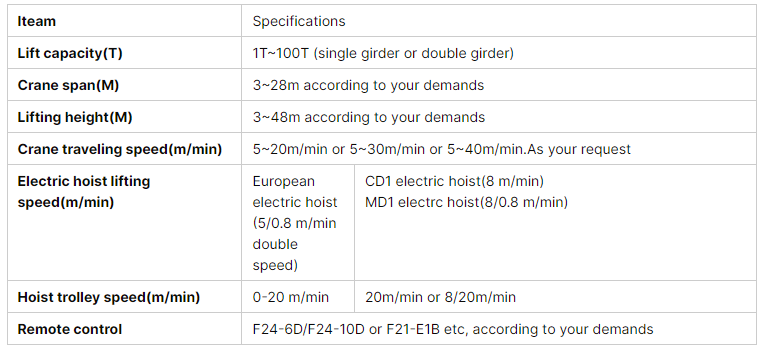
Advantages
High load-bearing capacity: Double-beam bridge cranes use a double-beam structure, which enables them to withstand larger loads. Each beam shares a part of the load, thereby increasing the overall load-bearing capacity. The double-beam design provides greater stability and is suitable for handling heavy loads.
Larger lifting height and span: The bridge design of double-beam bridge cranes allows for higher lifting heights, allowing them to operate in larger working areas. The large span of the bridge can cover a wider working area, which is very suitable for large workshops and storage facilities.
Efficient working performance: Double-beam bridge cranes have a faster travel speed and can quickly complete material handling tasks and improve production efficiency. Due to its stable structure, the crane can remain stable during operation, reducing vibration and swaying.
Flexible operation: It can be equipped with a variety of control methods, such as manual control, wireless remote control, automatic control, etc., which is flexible and convenient to operate. It has a high-precision control system that can accurately adjust the position and load of the hook to improve the accuracy of the operation.
Convenient maintenance and overhaul: The structure of the double-beam bridge crane is relatively simple, which is convenient for daily maintenance and overhaul. The equipment status can be detected in real time through the operation panel and monitoring system, making it easy to find and eliminate faults.
Application
Manufacturing: used to lift large pieces of steel, steel plates, furnace materials, etc. Steel mills usually need cranes with high load-bearing capacity to handle heavy materials and for lifting hull components, heavy equipment and materials to help assemble and repair ships.
Construction: used to lift construction materials such as concrete beams, steel structures and prefabricated components. The high lifting capacity and large span of double-beam bridge cranes are suitable for the needs of construction sites. Used to lift heavy equipment and materials in tunnel construction to assist in tunnel excavation and construction.
Power industry: used to lift generator sets, large equipment and maintenance tools to ensure smooth equipment maintenance and overhaul work in power plants. Used to lift transformers and other power equipment for easy installation and maintenance.
Mining: used to lift ore, equipment and mine construction materials to help mining and transportation operations in mines. Used to carry heavy materials and equipment generated during mineral processing.
5) Facility maintenance and overhaul: In terms of plant maintenance, it is used to maintain and repair equipment in large plants, such as motors, fans and conveyors. In addition, it can also be used to lift equipment and tools during the maintenance process to ensure the normal operation and maintenance of the equipment.
Crane production procedure
Demand analysis and design: Understand the specific needs of customers, including the working environment, load requirements, span, lifting height, etc. of the crane. Determine technical specifications and performance parameters according to the needs and develop a preliminary design plan. According to the preliminary design, carry out detailed structural design and component design, and draw detailed engineering drawings.
Material procurement: Select reliable suppliers and evaluate them to ensure the quality and delivery time of the materials. Sign a procurement contract with the supplier to clarify the material specifications, quantity, price and delivery time.
Manufacturing and processing: Cut, bend, weld and other processing of steel to manufacture major components such as bridges, end beams, and support structures. Carry out precision processing of components to ensure that the size and shape of each part meet the design requirements. Install motors, reducers and drive systems to ensure the normal operation of the crane's power system. Install electrical equipment such as control panels, sensors, limit switches, and complete the wiring and connection of the electrical system. Weld and fix each component to ensure the stability of the structure.
Testing and debugging: Check the structural connections and welding parts of the crane to ensure that there are no defects. Test the connection and function of the electrical system to ensure that each electrical component is working properly. Adjust the control parameters according to the test results to optimize the operating performance. Deal with problems found during testing to ensure that the equipment meets the design requirements.
5. Acceptance and delivery: Conduct final quality inspection to ensure that all components and systems meet design standards and quality requirements. Conduct final performance tests to verify the functions and safety performance of the crane. Deliver the completed crane to the customer for on-site installation and commissioning. Provide operation training to customers, explaining the use of the equipment and maintenance knowledge.

Workshop view:
The company has installed an intelligent equipment management platform, and has installed 310 sets (sets) of handling and welding robots. After the completion of the plan, there will be more than 500 sets (sets), and the equipment networking rate will reach 95%. 32 welding lines have been put into use, 50 are planned to be installed, and the automation rate of the entire product line has reached 85%.


Hot Tags: overhead shop crane, China overhead shop crane manufacturers, suppliers, factory
Previous
Overhead Crane FreestandingYou Might Also Like


Send Inquiry