










Casting Steel Overhead Crane
Casting steel overhead cranes are made from high-quality cast steel, which provides exceptional strength and durability. They have a long service life and are highly resistant to wear and tear.
The design of casting steel overhead cranes varies depending on the application and the load capacity required. They can be single or double girder cranes, and they can be operated manually or through automated systems.
Some common features of casting steel overhead cranes include:
- High load capacity: These cranes can lift and move heavy loads, ranging from a few hundred kilograms to several tons.
- Smooth operation: They have precision controls and are easy to operate, ensuring smooth and safe movement of loads.
- Easy maintenance: Casting steel overhead cranes are designed for easy maintenance and repair, reducing downtime and operating costs.
- High durability: The use of cast steel provides exceptional strength and durability, making these cranes suitable for heavy-duty applications.
- Versatility: They can be used in various industries and applications, such as manufacturing, construction, and transportation.
Overall, casting steel overhead cranes offer a cost-effective and reliable solution for lifting and moving heavy loads in various industries.
- Capacity: 5-800/50ton
- Span length: 4-35m
- Lifting height: 3-50m
- Work duty: A4, A5, A6,A7
- Raged voltage: 220V~690V, 50-60Hz, 3ph AC
- Work environment temperature: -25℃~+50℃, relative humidity ≤85%
- Crane control mode: Floor control / Remote control / Cabin room

Pictures & Components
1. Whole set crane
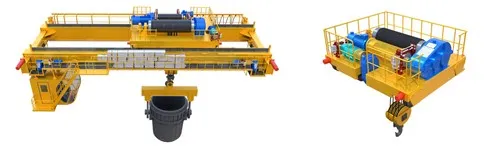
1) A casting steel overhead crane is a type of overhead crane that is used for lifting and moving heavy loads in industries such as steel manufacturing, foundries, and metalworking. This type of crane is specifically designed to handle heavy loads and withstand the harsh working environment in these industries.
2) The main components of a casting steel overhead crane are the hoist, trolley, bridge, and end trucks. The bridge is the overhead structure that spans the width of the work area, and the end trucks are located at each end of the bridge and support the trolley. The trolley moves along the bridge, and the hoist is suspended from the trolley and does the lifting.
3) Casting steel overhead cranes can be operated manually or with a remote control, depending on the application. They are used to lift and move heavy castings, steel coils, and other heavy materials. These cranes are designed to be durable and require minimal maintenance, making them a popular choice for industrial applications where heavy lifting is required.

2. Main girder
1) The main girder of a casting steel overhead crane is typically made of high strength steel in order to support the heavy loads that will be transported. The main girder is designed to distribute the weight of the load throughout the crane's structure, ensuring that the weight is evenly distributed and reducing the risk of damage or structural failure.
2) The main girder is typically designed with a box beam configuration, which provides maximum strength and rigidity. The beam is further reinforced with horizontal and vertical braces, which provide additional support and stability. For larger cranes, multiple girders may be used to create a stronger and more stable structure.
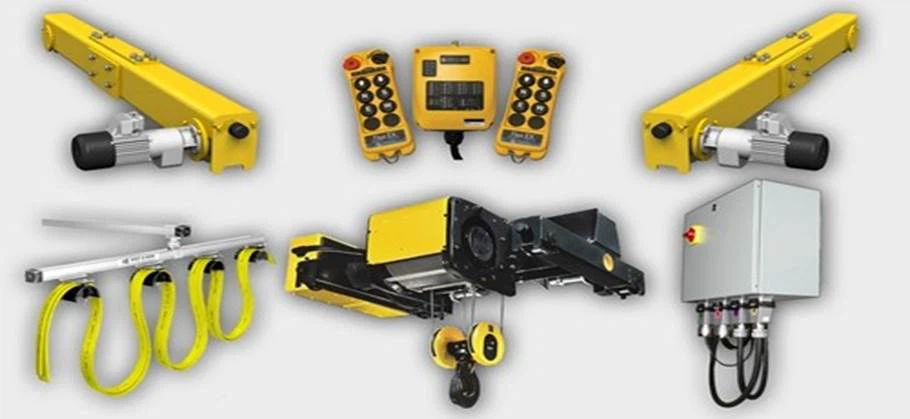
3) In addition to its strength and rigidity, the main girder may also be designed to provide additional features such as a walkway for maintenance access or a cable management system to organize and protect the wires and cables that power the crane's motors and controls.
4) Overall, the main girder is a critical component of a casting steel overhead crane, providing the strength and stability needed to safely and efficiently move heavy loads.

3. Lifting System
1) Casting steel overhead crane lifting system is a type of crane that is specifically used in the casting industry. It is used to lift and transport heavy loads of molten metal and other materials around a casting facility. These cranes are designed to be durable and able to withstand high temperatures and harsh operating conditions.
2) The lifting system of a casting steel overhead crane consists of a number of components, including the hoist, trolley, bridge, and end trucks. The hoist is the mechanism that actually lifts the load, while the trolley is the part of the crane that moves the hoist back and forth along the bridge. The bridge is the main horizontal beam of the crane, which is supported by the end trucks at either end.
3) Casting steel overhead crane lifting systems can be either single girder or double girder. In a single girder system, the hoist and trolley run on a single beam, while in a double girder system, they run on two parallel beams. Double girder systems are generally more heavy-duty and able to lift larger loads.
4) Overall, casting steel overhead crane lifting systems are an essential component of a modern casting facility, allowing for safe and efficient transport of heavy materials throughout the facility.
4. End Carriages
1) Casting steel overhead crane end carriages are the structural components of an overhead crane that support the bridge and the hoist trolley. These end carriages are designed to carry the weight of the bridge and the load being lifted by the hoist.
2) Casting steel is a method of manufacturing end carriages that involves pouring molten steel into a mold to create a solid part. This method of manufacturing results in a high-strength and durable end carriage that can withstand heavy loads and rough conditions.
3) The design of casting steel overhead crane end carriages may vary depending on the specific requirements of the crane. Some end carriages may be designed with adjustable wheels to allow for easy movement of the crane along the runway tracks. Other end carriages may be designed with fixed wheels that require less maintenance.
4) Overall, casting steel overhead crane end carriages are an essential component of an overhead crane. They provide the necessary support and stability required for the safe and efficient operation of the crane.
5. Crane traveling mechanism
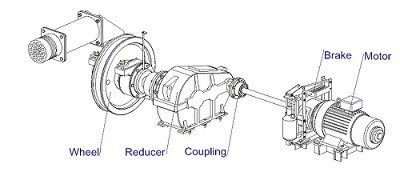
The crane traveling mechanism is an essential part of an overhead crane, which helps move the crane along the gantry and transport the load to different places. The crane traveling mechanism of a casting steel overhead crane usually consists of the following components:
1) Crane wheels: These are the wheels that run on the gantry rails and support the weight of the crane and the load it carries.
2) Driven wheels: These are the wheels that are powered by the crane's motor and are responsible for moving the crane along the rails.
3) Gearbox: This component helps to convert the rotating motion of the motor into the linear motion required to move the crane.
4) Brake system: A crane traveling mechanism also requires a brake system to ensure the safety of the crane and the load it carries.
5) Control system: This system helps to operate the crane traveling mechanism and to control the crane's movement, speed, and direction.
6) Electrical system: This system comprises electrical panels, cables, and switches, which control the crane's motors and other equipment.
In summary, a robust and efficient crane traveling mechanism is essential for a casting steel overhead crane to transport heavy loads smoothly and safely.
6. Trolley traversing mechanism
1) The casting for the steel overhead crane trolley traversing mechanism is typically made using a variety of techniques and materials, depending on the specific application and requirements.
2) In general, the casting process involves melting down the raw materials (usually steel or iron alloys) and pouring them into a mold or pattern to create the desired shape and structure. The liquid metal is then allowed to solidify and cool, creating a strong and durable casting that can withstand the stresses and strains of heavy-duty use.
3) Some common methods for casting steel overhead crane trolley traversing mechanisms include sand casting, investment casting, and die casting. Each of these approaches has its own advantages and disadvantages, depending on factors like complexity, cost, and production volume.
4) Once the casting is complete, it may undergo additional processing and finishing steps such as machining, polishing, or coating to enhance its performance and appearance. Finally, the trolley traversing mechanism is assembled and installed as part of the larger overhead crane system, ready to take on the challenges of heavy lifting and material handling.
7. Crane wheel
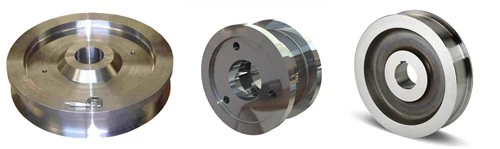
Casting steel overhead crane forged crane wheel is a crucial component of an overhead crane system. It is responsible for carrying the load and enabling the crane to move along the rail track. The crane wheel is usually made of high-grade steel or cast iron and is designed to withstand the heavy load and constant use. The casting steel crane wheel is made using a casting process that involves pouring molten steel into a mold to create the desired shape. The forged crane wheel, on the other hand, is made using a forging process that involves applying heat and pressure to shape the metal. Both types of crane wheels have their advantages and disadvantages, and the choice between the two will depend on the specific needs of the application. However, it is important to ensure that the crane wheel is of high quality and meets the required standards for safety and performance.
8. Crane hook
The crane hook is a critical component of overhead cranes that is responsible for lifting and moving heavy loads. It is typically made of high-strength steel that is capable of withstanding significant loads and stresses.
To cast a steel crane hook, the following steps are usually involved:
1) Design and Modeling: The crane hook is designed using specialized software and modeled in 3D for testing and simulation.
2) Molding: A mold is created using sand or other casting materials to shape the hook. The mold is typically made in two halves, with the top half being removable to allow for casting.
3) Melting and Pouring: Steel is melted in a furnace and poured into the molds through a dedicated channel called a sprue. The molten metal is left to cool and solidify.
4) Cleaning and Finishing: Once the hooks have cooled, they are removed from the molds and cleaned of any leftover sand or debris. They are then finished by removing extraneous material and polishing them to a smooth finish.
5) Testing and Inspection: The crane hooks are then thoroughly tested and inspected to ensure they meet the specifications and are safe to use.
Once the steel crane hooks have passed all the tests and inspections, they are ready to be installed on overhead cranes and put to work in various industries such as manufacturing, construction, and mining.

9. Motor
1) Casting steel overhead crane motors are highly durable and can withstand heavy loads and harsh operating conditions in industrial settings such as manufacturing plants or construction sites. They are typically made of high-quality steel alloy that is cast in a molding process.
2) The casting process helps to ensure the uniformity and consistency of the motor's structure, which contributes to its strength and long-lasting performance. Additionally, casting allows for intricate designs and shapes that can optimize the motor's performance and improve efficiency.
3) Overall, casting steel overhead crane motors are a reliable choice for heavy-duty lifting applications, and their durability and strength make them a popular option for industrial operations.

10. Sound and light alarm system & limit switch
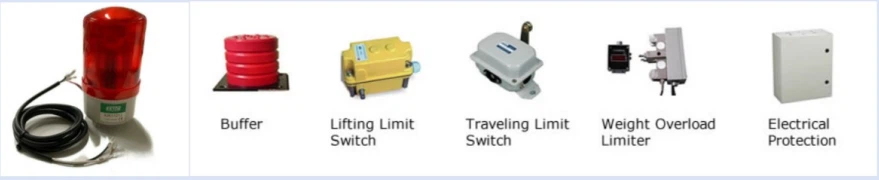
1) The sound and light alarms system will alert the operator about any potential hazards or issues during the operation of the crane. This system can be placed on the control panel and will feature audible alarms, flashing lights, and warning messages.
2) The limit switch, on the other hand, prevents the crane from over-traveling or overloading. This switch will be mounted on the crane's end stops and will stop the crane from moving beyond its safe limits.
3) When the crane reaches its defined limit or exceeds its weight capacity, the limit switch will automatically shut down the crane, and the sound and light alarms system will also activate, alerting the operator of the overloading or over-traveling.
4) By adding these safety features to the casting steel overhead crane, the risk of accidents and injuries is minimized while also improving the crane's productivity and efficiency.
11. Safety Devices
There are several safety devices that can be installed on casting steel overhead cranes to prevent accidents and injuries. These devices include:
1) Overload protection system - This system prevents the crane from lifting loads that are heavier than its maximum capacity.
2) Anti-collision system - This system uses sensors to detect other cranes, objects, or people in the path of the crane, and alert the operator or automatically stop the crane to prevent collisions.
3) Emergency stop system - This system allows the operator to stop the crane immediately in an emergency situation.
4) Limit switches - These switches control the movement of the crane by stopping it at predetermined positions.
5) Automatic cut-off system - This system cuts off the power to the crane when certain conditions are met, such as loss of power, loss of load, or excessive heat or vibration.
6) Safety hooks - These hooks have a latch or locking mechanism that prevents the load from slipping off the hook accidentally.
7) Warning lights and alarms - These devices alert workers in the area of the crane's movement and warn them of potential danger.
By installing these safety devices, operators and workers can reduce the risk of accidents and injuries on casting steel overhead cranes.
12. Control Mode
The control mode for a casting steel overhead crane varies depending on its design and application. The most common control modes for casting steel overhead cranes are:
1) Pendant control: This control mode uses a hanging pendant with buttons for the operator to control the crane's movements. This control mode is simple and easy to use, but it requires the operator to be in close proximity to the crane.
2) Radio remote control: This control mode uses a remote control unit that communicates with the crane through a wireless radio signal. This allows the operator to control the crane's movements from a safe distance, and it is often used in hazardous environments.
3) Cab control: This control mode places the operator inside a cab on the crane, where they can control the crane's movements using a joystick or other controls. This control mode provides a better view of the work area and allows for greater precision in movement.
4) Automated control: Some casting steel overhead cranes are designed to be fully automated, with computerized controls that allow for precise and repeatable movements. This control mode is often used in high-tech manufacturing environments where precision and efficiency are critical.
Ultimately, the control mode for a casting steel overhead crane depends on the specific needs of the application, and a variety of different control modes may be used depending on the situation.

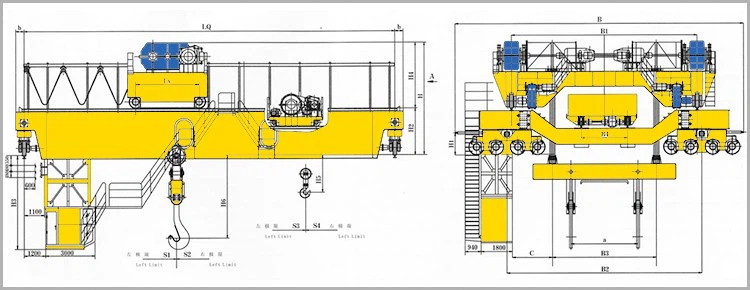
13. Sketch
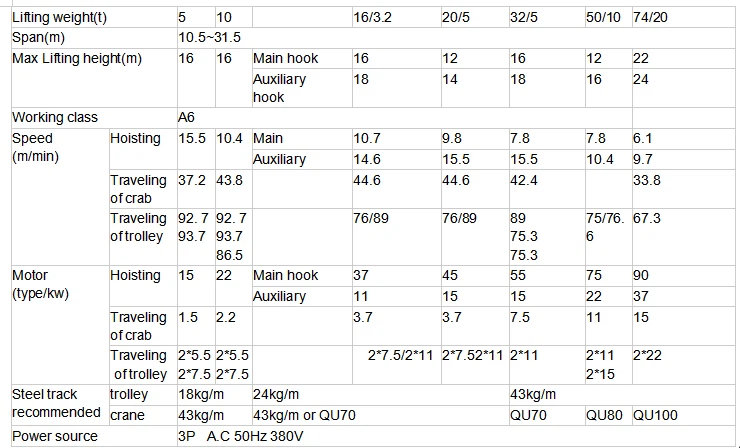
Main Technical Data
Advantages
Below are some advantages of casting steel overhead crane:
1. High strength and durability: Casting steel provides a highly durable and strong material that can handle heavy loads and harsh working conditions.
2. Long service life: The use of high-quality casting steel ensures that the crane has a long service life, reducing maintenance and replacement costs.
3. Corrosion-resistant: Casting steel is highly resistant to corrosion, making the overhead crane ideal for use in harsh environments such as chemical plants and marine yards.
4. Improved safety: The casting process ensures that the crane has a uniform and solid structure, which reduces the risk of accidents and improves safety.
5. Easy to manufacture and maintain: Casting steel overhead cranes are easy to manufacture and maintain, resulting in reduced downtime and improved productivity.
6. Controllable quality: The use of casting ensures that the quality of the overhead crane can be easily controlled, resulting in consistent quality across all products.
Application
Steel casting overhead crane is a specialized type of overhead crane designed to handle the lifting, transfer, and placement of steel casting products in industrial production processes. Steel casting is the process of forming molten steel into solid shapes or products, which are used in a wide range of industries such as automotive, oil and gas, construction, and heavy machinery manufacturing.
The main applications of steel casting overhead cranes include:
1. Steel Foundries: Foundries produce a large volume of steel products that are required to be moved from one place to another. Steel casting overhead cranes are used to move steel molds, ladles, and other casting-related equipment.
2. Steel Production Plants: Steel casting overhead cranes are used to move hot steel sheets and other steel products for processing in steel production plants.
3. Heavy Machinery Manufacturing: In heavy machinery manufacturing plants, steel casting overhead cranes are used to move large steel components such as gears, shafts, and frames.
4. Shipbuilding: Steel casting overhead cranes are used to move large steel components and sections during shipbuilding.
5. Aerospace Industry: Steel casting overhead cranes are used in the aerospace industry to move large steel components during the manufacturing process of aircraft, missiles, and other aerospace vehicles.
Overall, steel casting overhead cranes play a vital role in industrial production processes by providing a safe and efficient method of handling steel casting products.
Crane Production Procedure
The production procedure for casting steel overhead crane typically involves the following steps:
1. Design: The first step in the production procedure is the design. This involves creating a 3D model of the crane, which includes all the necessary components such as the bridge, trolley, hoist, electrical system, and control system.
2. Mould making: After the design is finalized, the manufacturer creates the moulds that will be used to cast the steel parts of the crane. The mould is typically made of wood or metal and is designed to match the shape and size of the crane components.
3. Steel melting: The next step is to melt the steel that will be used to cast the crane components. This is typically done using an electric arc furnace or a blast furnace.
4. Casting: Once the steel is melted, it is poured into the mould and allowed to cool and solidify. During the casting process, the steel is poured into the mould at a precise temperature and rate to ensure the parts are formed correctly and free of defects.
5. Heat treatment: After the casting process is complete, the parts are subjected to heat treatment to improve their mechanical properties. This involves heating the parts to a specific temperature and then quenching them in water or oil.
6. Machining: Once the parts have been heat treated, they are machined to their final dimensions and shape. This involves using CNC machines to remove any excess material and create the necessary surface finishes.
7. Assembly and testing: Finally, the crane components are assembled together and tested to ensure they meet the required performance standards. The tests typically include load testing, cycle testing, and electrical testing to ensure the crane is safe and reliable to use.

Workshop View
The company has installed an intelligent equipment management platform, and has installed 310 sets (sets) of handling and welding robots. After the completion of the plan, there will be more than 500 sets (sets), and the equipment networking rate will reach 95%. 32 welding lines have been put into use, 50 are planned to be installed, and the automation rate of the entire product line has reached 85%.


Hot Tags: casting steel overhead crane, China casting steel overhead crane manufacturers, suppliers, factory, Ladle Foundry Bridge Crane, Rolling Mill Overhead Crane, Steel Factory Overhead Crane, Casting Steel Overhead Crane, Ladle Foundry and Casting Steel Mill Overhead Crane, Steel Mill Overhead Cranes
You Might Also Like


Send Inquiry