





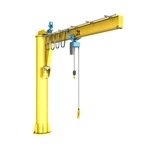


Column Frame Free Standing Over Head Crane
Products Description
The production of a Column Frame Free Standing Overhead Crane involves several critical stages, from conceptual design and engineering to fabrication, assembly, and installation. These cranes are designed to be independent of building structures, offering flexibility in manufacturing and handling heavy loads in various industrial environments.
A Column Frame Free Standing Overhead Crane is a type of industrial lifting equipment used for handling heavy loads in a workspace. The crane consists of vertical support columns (hence the "column frame" name) that hold up a horizontal beam (bridge), along which a hoist moves to lift and transport materials. These cranes are typically used in factories, warehouses, construction sites, or other environments that require lifting heavy materials and equipment. They stand alone and do not require support from the building structure.
3)Key Benefits of Column Frame Free Standing Overhead Cranes
Flexibility: They can be installed in almost any environment, independent of the structure.
Heavy Load Capacity: They can lift significant loads ranging from a few tons to hundreds of tons, depending on the design.
Space Efficiency: They optimize the use of floor space by utilizing vertical clearance for load movement.
Customizability: These cranes can be customized to meet specific lifting needs, such as different span lengths, load capacities, and heights.
Warranty period :1 year
Weight (KG) :3000 kg
Video factory inspection :Available
Mechanical test report :Available
Product name: Single beam bridge crane
Color :Gray / Ocean blue / Yellow / Orange
Material Good quality: Q235B / Q345B
Crane features: European type
Control method: Remote control
Lifting mechanism: Electric chain hoist
Main electrical components :Schneider
Power supply :3-phase 380v 50hz / Custmized
Travel speed :0 ~ 10 m/min
Work level:A5

Pictures & Components
1. Column Frame (Vertical Supports)
Columns: The vertical support structures that anchor the crane to the ground and provide stability. They are typically made from heavy-duty steel beams or tubular steel and are designed to support the entire crane structure.
Footings or Foundations: Concrete footings are often used to secure the columns to the ground and prevent any shifting or tilting. They must be designed to handle the crane's weight and operational forces.
2. Bridge (Horizontal Beam)
Bridge Girder/Beam: The horizontal structure that spans between the two vertical columns. The bridge is the part of the crane that moves horizontally along the tracks and supports the hoist system.
End Trucks: These are mounted on either side of the bridge and house the wheels and motors. The end trucks allow the bridge to travel along the runway.
3. Hoist Mechanism
Hoist: The hoist is the lifting device mounted on the bridge. It consists of the motor, gearbox, and lifting mechanism (e.g., wire ropes, chains) that raise and lower the load.
Lifting Components: This includes the hook, chain, or wire rope that actually lifts the load, often with a lifting drum or chain sprockets to wind and unwind the lifting medium.
Trolley: The hoist is usually mounted on a trolley that runs along the bridge beam, allowing it to move back and forth to position the load.
4. Runway System (Rail System)
Runway Beams: The rail system that the crane moves on. These rails are typically mounted on the floor of the building or workshop, and the end trucks of the crane travel along these rails.
Wheels and Bearings: Heavy-duty wheels are mounted on the end trucks and travel along the runway beams. Bearings ensure smooth operation and reduce friction.
5. Drive and Control System
Motors: Electric motors provide the power for both the hoisting (lifting) and the horizontal travel of the crane. These motors are often AC or DC motors depending on the crane design.
Gearbox/Reducers: These transfer power from the motor to the hoist mechanism and travel system, adjusting the speed and torque.
Inverter/Variable Frequency Drives (VFD): These are used for controlling motor speed and allowing precise motion control for smooth operation.
Control Panel: The control panel allows the operator to manage crane functions, including moving the bridge, hoisting the load, and operating safety features. This panel may be mounted on the crane or operated remotely.
Remote Control: Some cranes come with remote control systems, allowing operators to control the crane's movements from a safe distance.
6. Safety Systems
Limit Switches: These are installed to prevent over-travel of the hoist, ensuring it does not go beyond its safe range. Limit switches stop the motion automatically when the crane reaches the end of its travel.
Overload Protection: Sensors or load cells are installed to detect excessive weight. If the crane is overloaded, it automatically halts the operation to prevent damage or accidents.
Emergency Stop Button: A button installed on the crane's control panel or remotely to stop the crane immediately in case of an emergency.
Anti-Sway System: Some advanced cranes are equipped with systems that reduce the load sway during movement, providing more stable and safe handling.
7. Electrical and Power Supply
Power Supply: The crane is powered by electricity, usually supplied via cable festoons or through a conductor rail system running along the bridge.
Cables and Festoon Systems: The cables that provide power to the crane's electrical systems are often supported by festoon systems, which allow the cables to move with the crane's travel.
Control Wiring: Wiring connects the electrical components (motors, limit switches, and controls), enabling the operator to manage crane operations efficiently.
8. Structural Supports and Bracing
Cross Bracing: Steel braces may be used to provide additional structural support to the crane frame and prevent wobbling or swaying during operation.
Stabilizers: Some cranes have stabilizing elements to ensure smooth operation, especially under heavy load conditions.
9. Maintenance and Lubrication Systems
Lubrication Systems: Bearings, motors, and other moving components require regular lubrication to reduce wear and tear and ensure smooth operation.
Inspection Points: Regular inspection and maintenance points are integrated into the crane design to allow easy access for routine checks and repairs.
12.Sketch

Main technical

Advantages
1. Independence from Building Structure
No Need for Building Support: Unlike other types of overhead cranes that require support from the building's structure, a column frame free-standing crane is self-supporting. This allows for greater flexibility in installation, particularly in spaces where modifying the building is not feasible or desirable.
Flexibility in Layout: Since the crane is independent, it can be positioned anywhere within a facility, offering flexibility in factory layout, workflow, and equipment positioning.
2. Heavy Load Capacity
Ability to Lift Heavy Loads: These cranes are designed to handle heavy loads, with capacities ranging from a few tons up to hundreds of tons. The robust construction of the column frame and beam ensures that the crane can support large, heavy loads, making it ideal for industries such as manufacturing, construction, and material handling.
3. Space Optimization
Maximizing Floor Space: The overhead design of the crane allows it to utilize vertical space, leaving the floor clear for other operations or storage. This is particularly valuable in warehouses or factories where floor space is limited.
4. Customizable to Specific Needs
Adjustable Span and Height: Column frame free-standing cranes can be customized to meet the specific dimensions and load-bearing requirements of a facility. This means that they can be tailored to fit the available space and the specific lifting needs of the business.
5. Cost-Effective
No Need for Structural Modifications: Since the crane is independent of the building structure, there is no need for costly modifications or reinforcements to the existing facility. This can lead to lower initial installation costs compared to cranes that rely on building supports.
Reduced Maintenance Costs: These cranes are designed for durability and longevity, meaning maintenance costs can be lower in the long term. Additionally, the flexibility of installation can help optimize maintenance procedures and reduce downtime.
6. Improved Safety
Safety Features: These cranes are often equipped with a variety of safety mechanisms, including overload protection, emergency stops, limit switches, and anti-sway systems to ensure safe operation.
Application
1. Manufacturing and Assembly
Heavy Machinery Handling: Used in factories and production lines to lift and position heavy machinery, parts, or components during the manufacturing or assembly process.
Material Handling: These cranes are commonly used to move raw materials (such as steel beams, metal plates, or other components) to different stages of the production process.
2. Warehouses and Distribution Centers
Load and Unload Goods: In warehouses, these cranes are used for lifting and moving heavy boxes, pallets, or bulk goods for storage or distribution. They improve the efficiency of the loading and unloading .
3. Construction and Building Sites
Building Material Handling: Column frame free-standing cranes are widely used in construction sites to move heavy materials like steel beams, cement blocks, and construction equipment.
Lifting and Positioning: In building construction, these cranes help place heavy construction elements like pre-cast concrete walls, girders, and steel columns into position.
4. Automotive and Aerospace Industries
Car and Aircraft Assembly: In automotive plants, these cranes help position car bodies or other heavy components. Similarly, in aerospace, they are used to move large aircraft parts or assemblies during the manufacturing process.
5. Steel and Metal Processing
Handling Heavy Metal Materials: In steel mills and metal fabrication shops, column frame overhead cranes are used to lift and move heavy metal sheets, plates, coils, or other bulky items during the processing phase.
Positioning Metal Components: These cranes help position large metal parts for welding, cutting, or further machining operations.
Casting Handling: Used in foundries to handle molten metal or heavy castings, ensuring safe and precise material handling.

Workshop view:
The company has installed an intelligent equipment management platform, and has installed 310 sets (sets) of handling and welding robots. After the completion of the plan, there will be more than 500 sets (sets), and the equipment networking rate will reach 95%. 32 welding lines have been put into use, 50 are planned to be installed, and the automation rate of the entire product line has reached 85%.


Hot Tags: column frame free standing over head crane, China column frame free standing over head crane manufacturers, suppliers, factory, Ladle Foundry and Casting Steel Mill Overhead Crane, Steel Factory Overhead Crane, Ladle Foundry Bridge Crane, Steel Mill Overhead Cranes, Casting Steel Overhead Crane, Rolling Mill Overhead Crane
You Might Also Like


Send Inquiry