










Top Running Single Girder Crane
A single girder overhead crane is a popular choice for material handling due to its cost-effectiveness, simplicity, and versatility.
Key Features of Top-Running Single Girder Cranes:
Capacity: Typically 1 ton to 20 tons (some go up to 32 tons).
Span: Up to 30 meters (depends on design & reinforcement).
Lifting Height: Customizable (up to 30m or more with special designs).
Hoist Type: Electric wire rope hoist or chain hoist (e.g., Demag DC-Pro, ABUS EHB).
Control: Pendant, radio remote, or cabin-operated.
Speed Options: Variable frequency drive (VFD) for smooth operation.
End Trucks: Double-girder style for better load distribution.
Runway Beam: Steel structure (I-beam or box girder) mounted on columns.
Overall, the top running single girder crane is a reliable and cost-effective solution for handling heavy loads in industrial settings.
- Capacity: 1-20ton
- Capacity: 3.2-80ton
- Span length: 4-31.5m
- Lifting height:customized according to clients' site conditions
- Work duty: FEM Standard A5
- Raged voltage: 220V~690V, 50-60Hz, 3ph AC
- Protection class: IP54 IP55
- Crane control mode: Pendantcontrol / Remote control / Cabin control

Pictures & Components
A single girder overhead crane is a type of crane that consists of a single bridge beam supported by end trucks and is typically used for light to moderate lifting applications. Here are the key components of a top-running single girder crane:
1. Bridge Girder (Main Beam)
The primary horizontal beam that spans the width of the crane runway.
Usually made of rolled steel (I-beam) or fabricated box sections for heavier loads.
Supports the hoist and trolley.

2. End Trucks (End Carriages)
Wheeled structures at each end of the girder that allow the crane to move along the runway rails.
Consist of wheels, bearings, and drive mechanisms (for powered cranes).

3. Hoist & Trolley
Electric or manual hoist – The lifting mechanism (chain hoist or wire rope hoist).
Trolley – The frame that carries the hoist and moves along the girder.
4. Runway Rails
Steel tracks mounted on runway beams (either floor-supported or ceiling-suspended).
The crane moves along these rails.

5. Drive Mechanism (for powered cranes)
Bridge drive – Motors and gearboxes that move the crane along the runway.
Trolley drive – Moves the trolley along the girder (if motorized).
6. Controls
Pendant control (wired or wireless) – Used by the operator to move the crane, hoist, and trolley.
Radio remote control (for advanced systems).

7. Bumpers & End Stops
Rubber or hydraulic bumpers to absorb impact at the ends of the runway.
Limit switches to prevent over-travel.
8. Electrical System
Festoon system or cable reels – For power supply to the crane.
Control panel & wiring – Manages motor operations.
9. Brakes & Safety Devices
Mechanical brakes – Prevent unintended movement.
Overload protection – Prevents lifting beyond capacity.
Emergency stop (E-stop) – For immediate shutdown.
10. Runway Beams (Support Structure)
Steel beams (I-beams or fabricated) that support the runway rails.
Can be freestanding or attached to building columns.
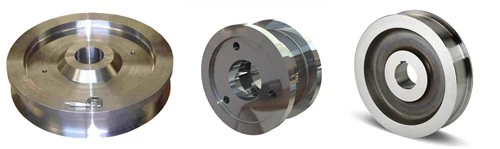
11. Crane hook
The crane hook is attached to the hoist and is available in various configurations (e.g., safety latch hook, C-hook, ramshorn hook) depending on the application.
Hooks are typically rated for different capacities (e.g., 1 ton to 20 tons or more).

12.Motor
1. Types of Motors Used in Single Girder Cranes
Hoist Motor: Powers the lifting mechanism (typically an electric hoist with a built-in motor).
Travel Motor (Bridge & Trolley): Moves the crane along the runway (bridge travel) and the hoist along the girder (trolley travel).
2. Common Motor Specifications
Power Range:
Hoist Motor: 1.5 kW to 15 kW (depending on capacity, e.g., 1-ton to 10-ton cranes).
Travel Motor: 0.2 kW to 3 kW (for smooth movement).
Voltage: 220V/380V (3-phase AC), 480V (industrial), or 24V/48V (for low-voltage systems).
Speed:
Hoist: 8-30 m/min (variable speed options available).
Travel: 10-30 m/min (adjustable via frequency inverter).
Duty Cycle: S3 (Intermittent) or S4 (Continuous with starts/stops).

8. Sound and light alarm system and limit switch safety device
A single girder crane typically includes several safety devices, with the sound and light alarm system and limit switches being critical for safe operation. Below is an overview of these components and their functions:
1. Sound and Light Alarm System
Purpose: Provides audible and visual warnings before and during crane movement to alert nearby personnel.
Components:
Buzzer/Horn: Emits a loud sound when the crane is activated or approaching a limit.
Strobe Light/Beacon: Flashing LED or rotating light for high-visibility warnings.
Activation Triggers:
When the crane is powered on.
Before starting or stopping movement.
When approaching a limit switch (end-of-travel warning).
In emergency stop situations.
2. Limit Switch Safety Device
Purpose: Prevents the crane (or hoist) from over-traveling beyond safe limits, protecting against collisions and mechanical damage.
Types:
Hook Upper/Lower Limit Switch: Stops the hoist when the hook reaches maximum height or depth.
Trolley Travel Limit Switch: Prevents the trolley from moving beyond the girder's ends.
Bridge (Crane) Travel Limit Switch: Stops the crane when it reaches the runway's end.
Common Types of Limit Switches:
Mechanical Limit Switches (lever-operated, cam-type).
Magnetic Proximity Switches (non-contact, more durable).
Rotary Encoder-Based Limits (for precise positioning).
Safety Compliance
These systems comply with OSHA, ANSI, ISO, and CMAA standards for overhead cranes.
Regular testing and maintenance are required to ensure functionality.
Integration with Crane Control
The alarm and limit switches are wired into the crane's control panel.
Some systems include programmable logic controllers (PLCs) for advanced automation and safety interlocking.

10. Control Mode
A single girder overhead crane typically has several control modes to suit different operational needs. The choice depends on factors like precision requirements, frequency of use, and safety considerations. Here are the top control modes used for single girder cranes:
1. Pendant Control (Push Button Pendulum)
Description: The most common and economical option, operated via a handheld pendant with buttons for hoisting, lowering, and trolley/bridge movement.
Best for: General-purpose workshops, warehouses, and light-to-medium-duty applications.
Advantages: Simple, cost-effective, and easy to use.
Disadvantages: Limited range (operator must be near the crane).
2. Radio Remote Control (Wireless)
Description: Uses a wireless remote control (RF or Bluetooth) for operating the crane from a distance.
Best for: Large workshops, hazardous environments, or when the operator needs mobility.
Advantages: Greater flexibility, improved visibility, and safer operation in high-temperature or confined spaces.
Disadvantages: Slightly higher cost; requires battery management.
3. Cabin Control (Operator Cab)
Description: The crane is operated from an enclosed or open cab mounted on the crane.
Best for: Heavy-duty, high-frequency operations (e.g., steel mills, foundries).
Advantages: Better visibility for precise handling, ergonomic for long shifts.
Disadvantages: Higher cost and requires more space.
4. Automated/Semi-Automated Control (PLC & Sensors)
Description: Uses programmable logic controllers (PLCs), sensors, and software for automated movement.
Best for: Repetitive tasks (e.g., production lines, automated warehouses).
Advantages: Reduces labor costs, improves precision, and enhances safety.
Disadvantages: High initial cost and requires technical expertise.
5. Floor Control (Via Long Pendant or Joystick)
Description: A longer cable pendant or floor-mounted joystick allows operation from a fixed position.
Best for: Situations where remote control is unnecessary, but pendant control is too restrictive.
Advantages: More stable than wireless, no battery dependency.
Disadvantages: Cable management can be cumbersome.

11. Sketch

Main Technical Data


Advantages
A single girder overhead crane is a popular choice for many industrial applications due to its cost-effectiveness, efficiency, and versatility. Here are the top advantages of using a top-running single girder crane:
1. Cost-Effective Solution
Lower initial cost compared to double girder cranes due to simpler design and fewer components.
Reduced installation and maintenance expenses.
2. Lightweight & Space-Saving Design
Requires less headroom than double girder cranes, making it ideal for facilities with height restrictions.
Compact structure allows for better space utilization in workshops or warehouses.
3. Easy Installation & Maintenance
Simple structure with fewer parts means quicker installation and easier servicing.
Minimal maintenance requirements, reducing downtime and operational costs.
4. High Efficiency & Smooth Operation
Electric hoist trolley ensures precise load handling.
Smooth travel along the runway beams with minimal sway.
5. Versatility in Applications
Suitable for light to medium-duty lifting (typically up to 20 tons).
Used in workshops, warehouses, assembly lines, and manufacturing plants.
6. Customizable Options
Adjustable span, lifting height, and speed to match specific needs.
Can be equipped with variable frequency drives (VFDs) for better speed control.
7. Reliable & Durable
Made from high-quality steel for long-term performance.
Sturdy construction ensures stability and safety during operation.
8. Energy Efficient
Consumes less power compared to larger cranes, reducing operational costs.
9. Compliance with Safety Standards
Meets international safety regulations (ISO, OSHA, CMAA) with features like overload protection and limit switches.
10. Ideal for Moderate Duty Cycles
Best suited for applications that don't require continuous heavy lifting, offering a balance between performance and cost.
Application
Single girder cranes are widely used in various industries due to their cost-effectiveness, compact design, and ease of installation. Here are some of the top applications of single girder overhead cranes:
1. Manufacturing & Assembly Lines
Used for lifting and moving raw materials, machine parts, and finished products.
Common in automotive, electronics, and machinery manufacturing.
2. Warehousing & Logistics
Efficiently handles pallets, containers, and heavy packages.
Ideal for loading/unloading goods in distribution centers.
3. Steel & Metal Processing
Transfers steel coils, sheets, and metal bars in foundries and rolling mills.
Often equipped with electromagnetic or vacuum lifters.
4. Construction Material Handling
Moves cement bags, bricks, and prefabricated structures.
Used in precast concrete plants and construction supply yards.
5. Power Plants & Energy Sector
Lifts turbines, generators, and heavy maintenance equipment.
Suitable for hydro, thermal, and nuclear power facilities.
6. Paper & Printing Industry
Handles paper rolls and heavy printing machinery.
Ensures smooth material flow in production lines.
7. Mining & Mineral Processing
Transports ores, minerals, and bulk materials in processing plants.
8. Aviation & Aerospace
Assembles aircraft components and moves heavy engine parts.
9. Food & Beverage Industry
Hygienic designs available for lifting bulk food items and packaging.
10. Maintenance & Repair Shops
Used in workshops for lifting heavy machinery during servicing.
Types Of Cranes For Different Working Conditions

Crane Production Procedure

Workshop View
The company has installed an intelligent equipment management platform, and has installed 310 sets (sets) of handling and welding robots. After the completion of the plan, there will be more than 500 sets (sets), and the equipment networking rate will reach 95%. 32 welding lines have been put into use, 50 are planned to be installed, and the automation rate of the entire product line has reached.


Hot Tags: top running single girder crane, China top running single girder crane manufacturers, suppliers, factory, Single Girder Overhead Travelling Crane, Single Girder Overhead Crane
You Might Also Like


Send Inquiry