










SSingle Girder Overhead Crane For Warehouse
A Single Girder Overhead Crane is a cost-effective and efficient lifting solution commonly used in warehouses, workshops, and light industrial applications. It consists of a single bridge girder supported by end trucks that move along runway beams, enabling smooth lifting and transportation of loads.
Key Features of a Single Girder Overhead Crane for Warehouses:
Lifting Capacity – Typically ranges from 1 ton to 20 tons, suitable for light to medium-duty applications.
Span – Adjustable based on warehouse width, usually up to 30 meters.
Hoist Type – Electric wire rope hoist or chain hoist, depending on load requirements.
Control System – Pendant control (wired or wireless) or cabin-operated for precise handling.
Runway System – Can be top-running or underhung, depending on structural support.
Speed Options – Adjustable lifting, cross-travel, and long-travel speeds for efficiency.
Safety Features – Overload protection, limit switches, emergency stop, and anti-collision systems.
- Capacity: 1-20ton
- Capacity: 3.2-80ton
- Span length: 4-31.5m
- Lifting height:customized according to clients' site conditions
- Work duty: FEM Standard A5
- Raged voltage: 220V~690V, 50-60Hz, 3ph AC
- Protection class: IP54 IP55
- Crane control mode: Pendantcontrol / Remote control / Cabin control

Pictures & Components
A Single Girder Overhead Crane for a warehouse typically consists of several key components that work together to lift, move, and transport loads efficiently. Here are the main components:
1. Bridge Girder (Main Girder)
The primary horizontal beam that spans the width of the crane runway.
Supports the hoist and trolley.
Usually made of rolled steel or box-type welded construction for strength.

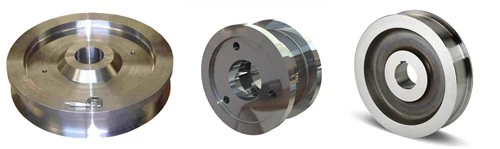
2. End Trucks (End Carriages)
Located at each end of the bridge girder.
Equipped with wheels that run along the runway rails.
Contain drive mechanisms for crane movement (motorized or manual).

3. Hoist Unit
The lifting mechanism that raises and lowers loads.
Can be electric chain hoist or wire rope hoist, depending on capacity.
Includes a motor, gearbox, drum (for wire rope), or chain sprockets.

4. Trolley
A frame that carries the hoist and moves horizontally along the girder.
Can be motorized (for powered movement) or manual push-type.

5. Runway System
Comprises runway beams (supported by columns or building structure).
Includes runway rails (steel tracks) for smooth crane movement.
6. Electrical System
Control Panel – Manages crane operations (up/down, forward/backward).
Pendant Control (Push Button Station) – Handheld remote for operator control.
Festoon System or Cable Reel – Provides power to the crane along the runway.
Limit Switches – Safety feature to prevent over-travel.

7. Braking System
Ensures safe stopping of the crane and hoist.
Includes mechanical brakes (for hoist) and rail brakes (for runway).
8. Bumpers (Buffer Stops)
Rubber or spring-loaded devices at crane ends to absorb impact.
Prevents damage from accidental collisions.

9. Safety Devices
Overload Limiter – Prevents lifting beyond rated capacity.
Emergency Stop Button – For immediate shutdown.
Anti-Sway System (Optional) – Reduces load swing.
10. Support Structure (Runway Columns & Brackets)
Steel columns or building framework that supports the runway beams.
Optional Components
Radio Remote Control – For wireless operation.
Crane Cab (Operator Cabin) – For seated control (rare in single girder cranes).
LED Lighting – For better visibility in the workspace.

11. Control Mode
A Single Girder Overhead Crane is a cost-effective and efficient solution for material handling in warehouses. Here's an overview of its control modes and key features:
Control Modes for Single Girder Overhead Crane in Warehouses
Pendant Control (Push Button Pendulum)
Operator uses a handheld pendant control with buttons for hoisting, traversing, and trolley movement.
Simple and cost-effective for light to medium-duty applications.
Suitable for frequent, precise load positioning.
Radio Remote Control (Wireless)
Operator controls the crane via a wireless remote (RF transmitter).
Provides greater mobility and safety by allowing operation from a safe distance.
Ideal for larger warehouses or hazardous environments.
Cabin Control (Operator Cabin)
An enclosed or open cabin is mounted on the crane for the operator.
Used for heavy-duty, long-hour operations where visibility and comfort are critical.
Less common in small warehouses due to higher costs.
Automated/Semi-Automated Control (PLC & Sensors)
Programmable Logic Controller (PLC)-based automation for repetitive tasks.
Can integrate with Warehouse Management Systems (WMS).
Used in high-efficiency warehouses with predefined load paths.
Key Features for Warehouse Applications
Lifting Capacity: Typically 1 ton to 20 tons (varies based on needs).
Span: Adjustable to fit warehouse layout (usually 5m to 25m).
Hoisting Speed: Adjustable for precise load handling.
End Trucks: Equipped with steel wheels or polyurethane wheels for smooth travel.
Safety Features:
Limit switches (to prevent overtravel).
Overload protection.
Emergency stop button.
Anti-collision sensors (if multiple cranes operate in the same area).

11. Sketch

Main Technical Data


Advantages
A Single Girder Overhead Crane is a popular choice for warehouse applications due to its cost-effectiveness, efficiency, and versatility. Here are some key advantages:
1. Cost-Effective Solution
Lower initial cost compared to double girder cranes due to simpler design and fewer components.
Reduced installation and maintenance expenses.
2. Space-Saving Design
Compact structure, ideal for warehouses with limited headroom.
Requires less vertical space, maximizing usable floor area.
3. Lightweight & Easy to Install
Lighter than double girder cranes, reducing structural support requirements.
Faster installation, minimizing downtime in warehouse operations.
4. High Efficiency & Load Handling
Suitable for light to medium-duty lifting (typically up to 20 tons).
Smooth and precise load movement with electric hoist operation.
5. Flexibility & Customization
Can be adapted with different hoist types (chain hoist, wire rope hoist).
Available in top-running or underhung configurations based on needs.
6. Low Maintenance
Fewer moving parts compared to double girder cranes, reducing wear and tear.
Easy access for inspections and repairs.
7. Improved Safety
Equipped with limit switches, overload protection, and emergency stop for safe operation.
Reduces manual handling risks, enhancing workplace safety.
8. Energy Efficiency
Modern models use variable frequency drives (VFDs) for smoother operation and energy savings.
Ideal Warehouse Applications:
Loading/unloading goods
Transporting pallets & raw materials
Assembly line support
Storage organization
Conclusion:
A single girder overhead crane is a practical, economical, and efficient solution for warehouses needing reliable material handling without excessive costs or space usage.
Application
Benefits for Warehouse Applications:
✔ Space-Saving: Maximizes vertical storage without obstructing floor space.
✔ Efficient Material Handling: Speeds up loading/unloading, reducing labor costs.
✔ Durability: Low maintenance with robust construction (steel girder, corrosion-resistant coatings).
✔ Safety Features: Includes overload protection, limit switches, and emergency stop.
✔ Customizable: Can integrate with automated systems (AS/RS) for smart warehouses.
Types Of Cranes For Different Working Conditions

Crane Production Procedure
The production procedure for a Single Girder Overhead Crane used in warehouses involves several key stages, from design to final testing. Below is a step-by-step outline of the manufacturing process:
1. Design & Engineering
Requirements Analysis: Determine load capacity (usually 1-20 tons), span length, lifting height, and operating environment (warehouse conditions).
CAD Modeling: Create 3D designs for the girder, end carriages, hoist, and electrical systems.
Structural Calculations: Ensure compliance with standards (ISO, FEM, DIN, or ASME).
Material Selection: Choose steel grades (e.g., Q235B/Q345B for the girder) and components (wheels, motors, wire ropes).
2. Material Procurement
Main Girder: Steel plates (cut to size via CNC plasma/laser cutting).
End Carriages: Fabricated from rolled steel sections or plates.
Electrical Components: Hoist motor, control panel, limit switches, and pendant/remote control.
3. Fabrication Process
A. Main Girder Production
Cutting & Welding:
Steel plates are cut and welded into an I-beam or box-section girder.
Automated submerged arc welding (SAW) ensures precision.
Straightening & Aging:
Heat treatment to relieve stress and prevent deformation.
Drilling & Machining:
Holes for connections and rail mounting are drilled.
B. End Carriages Assembly
Frame Construction: Welded steel frames with wheels (single/double flange).
Wheel Installation: Wheels are mounted with bearings for smooth travel along the runway beam.
C. Hoist & Trolley Assembly
Electric hoist (chain or wire rope) is mounted on a trolley that moves along the girder.
Brakes, gearbox, and motor are installed per safety standards.
4. Surface Treatment
Shot Blasting: Removes rust and improves paint adhesion.
Painting: Anti-corrosion primer + epoxy paint (standard colors: orange, blue, or custom).
5. Electrical System Installation
Wiring for the hoist, travel motors, and control system.
Safety devices (limit switches, overload protection, emergency stop).
6. Assembly & Testing
Mechanical Assembly:
Main girder is connected to end carriages.
Hoist/trolley is mounted on the girder.
Functional Tests:
No-load Test: Check smooth movement of hoist and bridge travel.
Load Test: Verify performance at 100%, 125% of rated capacity (per ISO 4310).
Safety Checks: Verify brakes, limit switches, and electrical insulation.
7. Packaging & Delivery
Crane is disassembled (if modular) for shipping.
Components are packed in wooden crates with waterproofing.

Workshop View
The company has installed an intelligent equipment management platform, and has installed 310 sets (sets) of handling and welding robots. After the completion of the plan, there will be more than 500 sets (sets), and the equipment networking rate will reach 95%. 32 welding lines have been put into use, 50 are planned to be installed, and the automation rate of the entire product line has reached.


Hot Tags: ssingle girder overhead crane for warehouse, China ssingle girder overhead crane for warehouse manufacturers, suppliers, factory, Single Girder Overhead Crane, Single Girder Overhead Travelling Crane
You Might Also Like


Send Inquiry