







15ton Single Girder Overhead Travelling Crane
A 15 ton single girder overhead travelling crane is a versatile and cost-effective lifting solution widely used in factories, warehouses, and workshops. Here are its key features:
1. Load Capacity & Span
Capacity: 5 metric tons (suitable for medium-duty lifting).
Span: Typically 5m to 25m (adjustable based on workshop requirements).
2. Single Girder Design
Main Girder: Made of high-strength steel (box-type or I-beam) for durability.
Compact Structure: Saves headroom compared to double girder cranes.
3. Hoisting Mechanism
Electric Hoist: Usually equipped with a 5-ton wire rope hoist or chain hoist.
Lifting Height: Standard 6m to 18m (customizable).
Lifting Speed: ~8 m/min (adjustable with variable frequency drive for precision).
4. Travelling Mechanism
Crane Travel: Moves along runway beams via end carriages with wheels.
Travel Speed: ~20 m/min (can be regulated).
Cross Travel (Trolley): Moves along the girder for precise load positioning.
5. Power Supply & Control
Power: 3-phase, 380V, 50Hz (standard) or customizable.
Control: Pendant push-button or radio remote control for safe operation.
6. Safety Features
Overload Protection: Prevents lifting beyond capacity.
Limit Switches: For hoisting and travel movements.
Emergency Stop: For immediate shutdown.
Anti-collision Device (optional for multiple cranes).
7. Durability & Maintenance
Corrosion-resistant paint for long service life.
Low maintenance due to simple structure.
8. Applications
Factories, warehouses, workshops.
Material handling in production lines, loading/unloading.
9. Customization Options
Explosion-proof, heat-resistant, or outdoor versions.
Variable speed control for delicate loads.
- Capacity: 1-20ton
- Capacity: 3.2-80ton
- Span length: 4-31.5m
- Lifting height:customized according to clients' site conditions
- Work duty: FEM Standard A5
- Raged voltage: 220V~690V, 50-60Hz, 3ph AC
- Protection class: IP54 IP55
- Crane control mode: Pendantcontrol / Remote control / Cabin control

Pictures & Components
A 5 ton single girder overhead travelling crane consists of several key components that work together to lift, move, and position heavy loads efficiently. Here are the main components:
1. Main Girder (Single Girder)
The primary load-bearing beam, usually made of rolled steel (I-beam) or welded box-type construction.
Supports the hoist and trolley, handling the crane's rated capacity (5 tons).
2. End Carriages (End Trucks)
Located at both ends of the main girder, equipped with wheels for movement along the runway beams.
Includes drive wheels (powered) and idler wheels (non-powered).
3. Hoist Unit
The lifting mechanism, typically an electric wire rope hoist or chain hoist (for lighter capacities).
Includes:
Motor (for lifting and lowering).
Drum or chain sprocket (for rope/chain winding).
Hook block (to attach the load).
Brake system (for safe load holding).

4. Trolley (Crab Unit)
A mechanism that moves the hoist along the length of the main girder.
Can be motorized (for powered movement) or manual push-type (for lighter cranes).
5. Runway Beams
Installed on the building structure (columns or support brackets) to guide the crane's movement.
Usually made of I-beams or fabricated girders.
6. Bridge Drive Mechanism
Consists of motors, gearboxes, and wheels to move the entire crane along the runway.
Can be single-end drive (one motor) or double-end drive (two synchronized motors for heavier cranes).
7. Electrical System & Controls
Control pendant / Radio remote / Cabin-operated for user control.
Limit switches (to prevent over-travel).
Power supply system (festoon system or conductor bars).

8. Safety Components
Overload limiter (prevents lifting beyond 5 tons).
Emergency stop button.
Bumpers (to absorb shocks at runway ends).
Anti-collision devices (if multiple cranes operate on the same runway).
9. Buffers & Stoppers
Rubber or spring buffers to absorb impact at the end of travel.
Mechanical stoppers to prevent derailment.
10. Festoon System / Cable Reel
Manages power and control cable movement as the crane travels.
Each component plays a crucial role in ensuring safe and efficient crane operation. Proper maintenance and inspection are essential for long-term performance.
3. Electric Wirerope Hoist
Electric Wire Rope Hoist – The lifting mechanism with a motor, drum, wire rope, and hook for vertical lifting.
A single girder electric wire rope hoist consists of a single horizontal beam (girder) that supports the weight of the hoist and the load being hoisted. The hoist is equipped with a wire rope that is wound around a drum and attached to a lifting hook.

4. End Carriages
The end carriages are the wheeled structures mounted at each end of the bridge girder, enabling the crane to travel along the runway rails.
Key Components of End Carriages:
Wheels & Wheel Blocks
Typically 4 wheels (2 per end carriage) for standard cranes.
Made of forged steel or ductile iron for durability.
Some models use double-flanged wheels to prevent derailment.
Drive Mechanism (for powered cranes)
One end carriage houses the travel motor, gearbox, and brakes.
The other end is typically the idle (non-driven) carriage.
Common drive types: single-end drive (SED) or double-end drive (DED) for heavier loads.
Buffers & Bumpers
Absorb shocks when the crane reaches the end of the runway.
Made of rubber, polyurethane, or hydraulic dampers.
Connecting Frame
Joins the end carriage to the main girder.
Designed for rigidity and alignment to prevent skewing.
Rail Clamps (Optional)
Used to lock the crane in position when not in use.

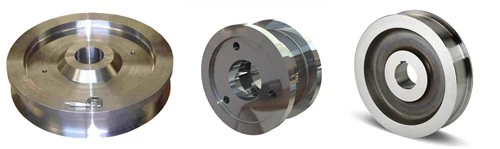
5. Crane wheel
A 5 ton single girder overhead travelling crane typically consists of a single bridge girder supported by end trucks that move along runway beams. The crane wheels are critical components that facilitate the crane's movement along the runway. Here's a detailed breakdown of the crane wheel system for this type of crane:
1. Crane Wheel Specifications
Load Capacity: Designed to support the crane's total weight (including the hoist, trolley, and maximum lifted load-5 tons in this case).
Number of Wheels: Usually 4 wheels (2 per end truck), but some designs may use 8 wheels (4 per end truck) for better load distribution.
Wheel Material: Typically forged steel (high-grade carbon steel or alloy steel) for durability and wear resistance.
Wheel Diameter: Commonly ranges from 250mm to 500mm, depending on the crane's span and load requirements.
Wheel Type:
Double Flange Wheels (common for runway guidance).
Single Flange Wheels (if additional side guides are used).
Flangeless Wheels (if the crane uses separate guide rollers).
2. Wheel Bearing & Lubrication
Bearings: Usually tapered roller bearings or spherical roller bearings to handle radial and axial loads.
Lubrication: Grease-lubricated for long service life and reduced maintenance.
3. Runway Rail Compatibility
The wheels run on steel runway rails (commonly A36 or ASME A120 standards).
Rail profiles may include:
ASCE Rail (American Standard Crane Rail).
KR Standard Rail (common in Europe/Asia).
Flat-top rails (used with flanged wheels).
4. Wheel Alignment & Maintenance
Proper wheel alignment is crucial to prevent uneven wear and derailment.
Regular inspection for cracks, wear, and flat spots is necessary.
Lubrication of wheel bearings should be done periodically.
5. Common Wheel Issues
Wear & Flat Spots: Due to heavy loads or improper braking.
Misalignment: Causes uneven wear and increases resistance.
Bearing Failure: Leads to wheel seizure if not maintained.
6. Replacement & Upgrades
Wheels should be replaced if wear exceeds manufacturer recommendations.
Upgrading to hardened steel wheels or polyurethane-coated wheels can extend lifespan in harsh environments.
6. Crane hook
The hook is a critical load-bearing component, typically part of the hoist assembly. For a 5-ton crane:
Hook Type: Forged steel hook (DIN/ISO standards, e.g., DIN 15400).
Safety Factor: Minimum 4:1 (tested to 125% of SWL).
Hook Size: ~Ø25–30mm (exact size depends on design standards).
Rotation: Swivel or fixed hook (depending on application).
Safety Latch: Spring-loaded latch to prevent sling/disengagement.

7. Motor
A 5 ton single girder overhead travelling crane typically consists of several key components, including the hoist motor, travel motor (for bridge movement), and trolley travel motor (if applicable). Below are the details regarding the motors used in such a crane:
1. Hoist Motor (Lifting Motor)
Function: Powers the hoisting mechanism to lift and lower loads (up to 5 tons).
Type: Usually an AC induction motor (e.g., 3-phase, squirrel cage) or a variable frequency drive (VFD) motor for smoother control.
Power Range: Typically 7.5 kW to 11 kW (10 HP to 15 HP), depending on speed and duty cycle.
Speed: Single-speed or dual-speed options (e.g., 8/0.8 m/min for fast/slow lifting).
2. Bridge Travel Motor (Long Travel Motor)
Function: Moves the entire crane along the runway beams.
Type: AC or geared motor (e.g., 1.5 kW to 3 kW per motor, with two motors for dual-drive cranes).
Speed: Typically 20 m/min to 30 m/min.
3. Trolley Travel Motor (Cross Travel Motor – if applicable)
Function: Moves the hoist along the single girder (for positioning the load horizontally).
Type: Smaller AC motor (e.g., 0.5 kW to 1.5 kW).
Speed: Around 10 m/min to 20 m/min.

8. Sound and light alarm system and limit switch safety device
A 5 ton single girder overhead travelling crane equipped with a sound and light alarm system and limit switch safety devices ensures safe and efficient operation in industrial environments. Below are the key features and functions of these safety components:
1. Sound and Light Alarm System
Purpose: Alerts personnel when the crane is in operation or approaching hazardous conditions.
Features:
Audible Alarm (Buzzer/Horn): Emits a loud warning sound before crane movement (e.g., startup, trolley travel, or hoisting).
Visual Alarm (Strobe/LED Light): Flashing beacon provides a clear visual warning, especially in noisy environments.
Activation Modes:
Pre-movement warning (before crane starts).
Emergency warning (in case of malfunction or overload).
2. Limit Switch Safety Devices
Limit switches prevent the crane from exceeding safe travel ranges, protecting both equipment and personnel.
Types of Limit Switches in a Single Girder Crane:
Hoisting Limit Switch
Prevents over-hoisting by cutting power when the hook block reaches the upper safe limit.
Protects against wire rope damage or hook collision with the drum.
Trolley Travel Limit Switch
Stops the trolley at the end of the girder to avoid collisions with end stops or structural components.
Bridge (Long Travel) Limit Switch
Prevents the crane from over-travelling along the runway beams.
Lower Limit Switch (Optional)
Some cranes include a lower limit switch to prevent excessive unwinding of the wire rope.
9. Safety Device
A 5 ton single girder overhead travelling crane must be equipped with various safety devices to ensure safe operation and compliance with industry standards (such as ISO, OSHA, CMAA, or GB standards). Below are the essential safety devices typically installed:
1. Overload Limit Switch (Load Limiter)
Prevents the crane from lifting loads exceeding 5 tons (rated capacity).
Automatically cuts off power if an overload is detected.
2. Emergency Stop Button (E-Stop)
Allows immediate shutdown in case of an emergency.
Should be installed at an easily accessible location (e.g., pendant control or operator cabin).
3. End Limit Switches (Travel & Hoisting)
Hoisting limit switch – Prevents over-hoisting (upper and lower limits).
Trolley travel limit switch – Stops the trolley at the end of the girder.
Bridge travel limit switch – Prevents the crane from hitting end stops on the runway.
4. Anti-Collision Device (for multiple cranes)
Used when two or more cranes operate on the same runway to avoid collisions.
5. Phase Failure & Under-Voltage Protection
Protects the motor from damage due to power supply issues.
6. Insulated Rail & Grounding Protection
Prevents electrical hazards by ensuring proper grounding.
7. Braking System
Hoist brake – Prevents load slipping when stopping.
Trolley & bridge travel brakes – Ensures smooth stopping.
8. Safety Latch on Hook
Prevents the load from slipping off the hook.
9. Warning Devices (Alarm/Buzzer)
Audible or visual alarms alert workers before crane movement.
10. Over-Speed Protection (for variable frequency drives)
Prevents dangerous speeds during operation.
11. Buffer & Bumper
Absorbs impact when the crane reaches the end of the runway.
12. Load Moment Indicator (Optional for advanced safety)
Monitors load weight and crane stability.

10. Control Mode
A 5 ton single girder overhead travelling crane typically employs several control modes to ensure safe and efficient operation. The choice of control mode depends on factors like precision requirements, working environment, and frequency of use. Here are the common control modes:
1. Pendant Control (Push Button Pendant)
Description: A handheld pendant with buttons for crane movement (hoisting, traversing, and travelling).
Advantages:
Simple and cost-effective.
Operator has direct control.
Suitable for indoor and light-duty applications.
Disadvantages:
Limited range (operator must be near the crane).
Not ideal for high-speed or heavy-duty operations.
2. Radio Remote Control (Wireless)
Description: Uses a wireless remote to operate the crane from a distance.
Advantages:
Greater flexibility and mobility for the operator.
Improved safety (operator can position themselves optimally).
Suitable for hazardous or large working areas.
Disadvantages:
Higher cost than pendant control.
Requires battery maintenance and signal reliability checks.
3. Cabin Control (Operator Cab)
Description: The crane is operated from an enclosed or open cab mounted on the crane.
Advantages:
Better visibility and precision for heavy-duty or high-speed operations.
Comfortable for long shifts (climate-controlled options available).
Disadvantages:
More expensive.
Requires proper access systems (ladders/platforms).
4. Automatic/Semi-Automatic Control (PLC-Based)
Description: Uses programmable logic controllers (PLCs) for automated movements (e.g., preset paths, load positioning).
Advantages:
High precision and repeatability.
Reduces manual labor; ideal for repetitive tasks.
Disadvantages:
Higher initial and maintenance costs.
Requires skilled technicians for programming.
5. Dual Control (Pendant + Remote or Other Combinations)
Description: Allows switching between multiple control modes (e.g., pendant and radio remote).
Advantages:
Flexibility for different operational needs.
Disadvantages:
More complex wiring and setup.

11. Sketch

Main Technical Data


Advantages
There are several advantages of a single girder overhead travelling crane:
1. Reduced cost: Due to their simple design and lightweight construction, single girder overhead travelling cranes are less expensive than double girder cranes.
2. Easy installation: The installation of a single girder crane is comparatively easier and quicker as compared to double girder cranes.
3. Lower headroom requirement: As the single girder crane has a lower headroom requirement, it is not necessary to have high ceilings in the manufacturing plant.
4. Lightweight construction: The single girder crane is lightweight in construction, resulting in less stress on the building structure.
5. Low maintenance: The reduced number of moving parts in the single girder crane means less maintenance compared to a double girder crane.
6. Ideal for light loads: The single girder crane is ideal for light loads up to 20 tons, making it perfect for small manufacturing organizations.
7. High efficiency: The single girder crane offers efficient material handling capabilities, reducing labor cost and increasing productivity.
Application
A single girder overhead travelling crane is a popular type of crane used in various applications where materials need to be lifted and moved from one location to another. Here are some common applications of single girder overhead travelling cranes:
1. Manufacturing and production facilities: Overhead cranes are commonly used in factories and production plants to move raw materials, finished products, and heavy machinery from one location to another. They are particularly useful for lifting and positioning heavy and bulky items, which would be difficult or impossible for workers to move manually.
2. Warehousing and storage facilities: Overhead cranes are also commonly used in warehouses and storage facilities to move heavy items around for storage or loading onto trucks for transportation. They are particularly useful in multi-level storage facilities where items need to be moved between floors and levels.
3. Construction sites: Single girder overhead travelling cranes are also used in the construction industry for building projects. They are used to move heavy equipment and materials around the construction site, such as steel beams, concrete blocks, and piping.
4. Shipping and logistics: Overhead cranes are also used in shipping ports and logistics centers to move cargo containers and heavy goods onto and off ships or trucks. They are particularly useful for handling delicate and expensive cargo.
5. Power generation: Overhead cranes are used in power plants for maintenance and repair work. They are used to move heavy machinery and equipment around, such as turbines and generators.
In summary, single girder overhead travelling cranes are versatile machines that can be used in a variety of industries and applications where heavy lifting and moving is required.
Types Of Cranes For Different Working Conditions

Crane Production Procedure

Workshop View
The company has installed an intelligent equipment management platform, and has installed 310 sets (sets) of handling and welding robots. After the completion of the plan, there will be more than 500 sets (sets), and the equipment networking rate will reach 95%. 32 welding lines have been put into use, 50 are planned to be installed, and the automation rate of the entire product line has reached.


Hot Tags: 15ton single girder overhead travelling crane, China 15ton single girder overhead travelling crane manufacturers, suppliers, factory, Single Girder Overhead Crane, Single Girder Overhead Travelling Crane
You Might Also Like


Send Inquiry