










Electric Hoist Double Beam Bridge Crane
Products Description
A double beam bridge crane with an electric hoist is a robust and versatile lifting solution widely used in industrial settings for heavy-duty material handling. Here are its key features:
1. Dual-Girder Design
Two parallel main beams provide superior strength and stability compared to single-girder cranes.
Suitable for heavy loads (typically 5 tons to 550+ tons).
2. Electric Hoist System
Powered by an electric chain or wire rope hoist for smooth and precise lifting.
Variable speed control for accurate load positioning.
Options for single or dual hoists for tandem lifting.
3. High Load Capacity & Span
Handles heavy loads efficiently with a wide span (up to 35 meters or more).
Ideal for factories, warehouses, steel plants, and shipyards.
4. End Trucks & Runway System
Equipped with heavy-duty end trucks with wheels for smooth travel along the runway rails.
Can be top-running (more common for heavy loads) or under-running (for lighter loads).
5. Precision Control
Pendant control / Radio remote control / Cabin-operated for safe and flexible operation.
Smooth trolley and bridge movement via geared motors.
6. Safety Features
Overload protection (limit switches).
Emergency stop buttons.
Anti-collision systems (for multiple cranes).
Insulated / explosion-proof options available.
7. Customizable Configurations
Adjustable lifting height & span.
Special coatings (heat-resistant, corrosion-resistant).
Festoon or conductor bar power supply systems.
8. Durability & Low Maintenance
Robust steel construction with high-grade components.
Long service life with minimal upkeep.
Capacity 10 metric tons (10,000 kg)
Type Single girder or double girder (depending on span)
Span 5 - 25 meters (customizable)
Lifting Height 6 - 30 meters (standard)
Duty Class FEM 1Am - 2m (ISO A3 - A5)
Ambient Temp -20°C to +40°C (standard)
Girder Box-type (welded steel)
End Trucks Double-wheel configuration
Wheel Load ~12-15 tons per wheel
Runway Rail QU70/QU80 (GB standard)
Type Electric wire rope hoist
Rope Diameter 13-15 mm (6x36+IWRC)
Motor Power 13-15 kW (hoisting)
Brake Dual electromagnetic brakes

Pictures & Components
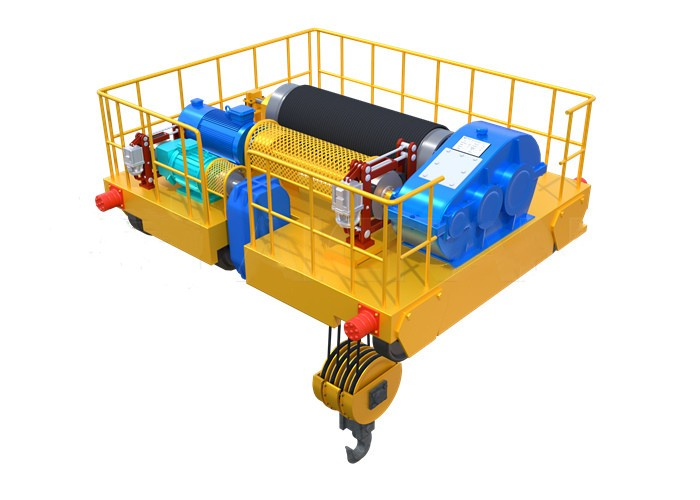
An Electric Hoist Double Beam Bridge Crane is a robust lifting system commonly used in industrial settings for heavy-duty material handling. It consists of several key components that work together to ensure efficient and safe operation. Here's a breakdown of the main components:
1. Bridge (Double Girder)
The primary horizontal beam that spans the width of the workspace.
Consists of two parallel girders (box-type or I-beam) for enhanced strength and stability.
Supports the hoist and trolley mechanism.
 |
 |
2. End Trucks (End Carriages)
Located at each end of the bridge girders.
House the wheels and drive mechanisms for crane movement along the runway rails.
Equipped with buffers (shock absorbers) to prevent harsh impacts.
 |
 |
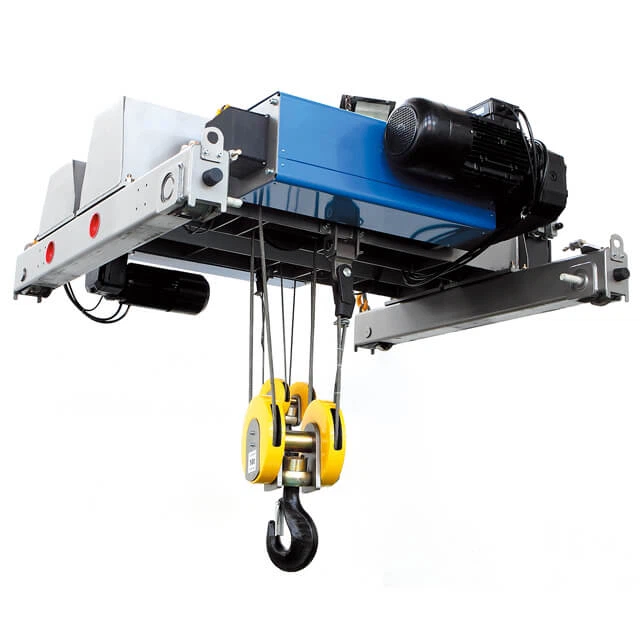
3. Hoist Unit
The electric-powered lifting device that raises and lowers loads.
Types: Chain hoist or Wire rope hoist.
Includes:
Electric motor (for lifting)
Gearbox (reduces speed, increases torque)
Drum or chain sprocket (for rope/chain winding)
Brake system (safety mechanism to hold loads)
4. Trolley (Hoist Trolley)
The mechanism that moves the hoist along the length of the bridge girders.
Consists of:
Trolley frame
Trolley wheels
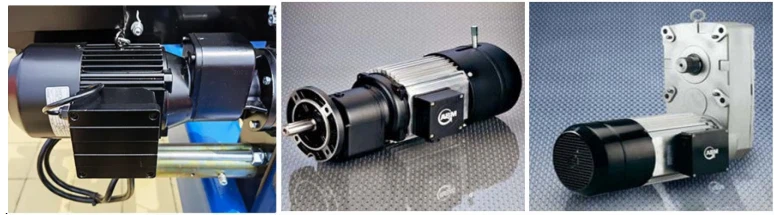
Trolley drive motor (for transverse movement)
Guide rollers (to prevent misalignment)
5. Runway System
The tracks on which the crane moves longitudinally.
Includes:
Runway rails (mounted on support columns or building structure)
Rail clamps (to secure the crane when not in use)
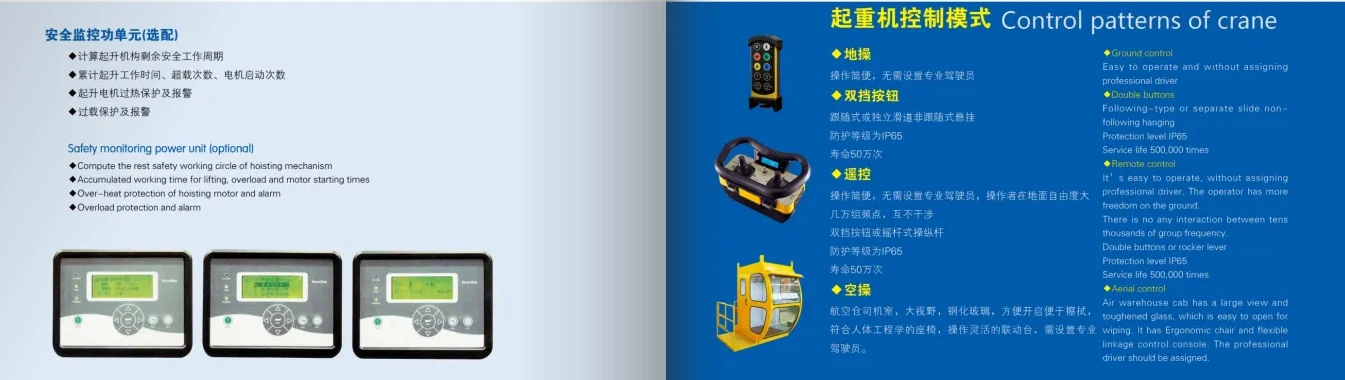
6. Electrical System & Controls
Control panel (houses contactors, relays, and overload protection)
Pendant control (handheld remote for operator control)
Radio remote control (optional for wireless operation)
Limit switches (prevent over-travel of hoist/trolley)
Power supply system (festoon system, cable reels, or conductor bars)
.

7. Safety Components
Overload limiter (prevents lifting beyond capacity)
Emergency stop button
Anti-collision system (for multiple cranes in same bay)
Warning lights & alarms
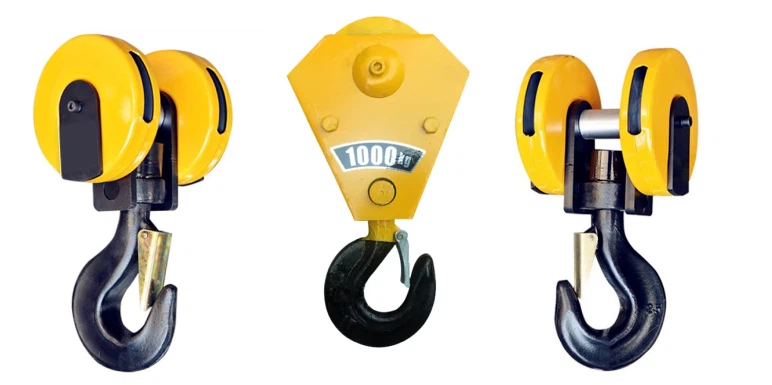
Safety hooks & latches (for load security)
8. Cab (Optional)
Operator cabin (for cranes with frequent or heavy-duty use).
Includes joystick controls, seat, and instrumentation.
9. Festoon System (Cable Management)
Carries power and control cables along the bridge and trolley.
Prevents cable tangling during crane movement.
10. Bumpers & Buffers
Absorb impact at the end of travel to protect the crane structure.

SKETCH

Main technical

Advantages
A double beam bridge crane with an electric hoist is a highly efficient and versatile lifting solution widely used in industrial and construction settings. Here are its key advantages:
1. High Load Capacity & Stability
The double girder design provides superior strength, allowing for heavier loads (typically 5 to 550 tons) compared to single girder cranes.
Better weight distribution minimizes deflection, ensuring stability during lifting operations.
2. Extended Span & Coverage
Suitable for wide work areas (up to 35 meters or more), making it ideal for factories, warehouses, and workshops.
Can cover a larger working area with smooth longitudinal and transverse movements.
3. Precise & Smooth Operation
Equipped with variable speed control for precise load positioning.
Electric hoists offer smooth lifting and lowering, reducing load swing.
4. Durability & Long Service Life
Robust steel construction resists wear, corrosion, and heavy-duty use.
Low maintenance requirements due to high-quality components.
5. Enhanced Safety Features
Includes overload protection, limit switches, emergency stop, and anti-collision systems.
Secure lifting with brakes and fail-safe mechanisms.
6. Flexibility & Customization
Can be fitted with different hoist types (wire rope or chain hoist).
Options for explosion-proof, heat-resistant, or remote-controlled operation.
7. Energy Efficiency
Modern electric hoists consume less power while maintaining high performance.
Regenerative braking in some models helps save energy.
8. Space Optimization
The compact design of the electric hoist allows for higher hook height compared to single girder cranes, maximizing vertical workspace.
9. Automation & Smart Control
Can be integrated with PLC systems, radio remote controls, or fully automated operations for Industry 4.0 applications.
10. Cost-Effective for Heavy-Duty Use
Though initially more expensive than single girder cranes, its longevity, efficiency, and reduced downtime make it cost-effective for heavy industries.
Application:
A double beam bridge crane with an electric hoist is a versatile and robust lifting solution widely used in various industrial and commercial applications. It consists of two parallel beams (bridges) supported by end trucks that run on elevated runways, with an electric hoist mounted on a trolley for horizontal and vertical load movement.
Key Applications:
Manufacturing Facilities:
Moving raw materials, finished products, and heavy machinery.
Assembly line operations for positioning components.
Warehousing & Logistics:
Loading/unloading goods from trucks and containers.
Stacking and retrieving heavy pallets in storage facilities.
Steel & Metal Industries:
Handling steel coils, sheets, and structural beams.
Assisting in forging, casting, and machining processes.
Construction & Infrastructure:
Lifting construction materials (concrete blocks, steel girders, pipes).
Assisting in prefabricated structure assembly.
Power Plants & Heavy Industries:
Maintenance of turbines, generators, and boilers.
Handling heavy mechanical parts during repairs.
Automotive & Aerospace:
Moving engines, chassis, and large vehicle components.
Positioning aircraft parts during assembly.
Shipbuilding & Ports:
Handling ship components and containers.
Loading/unloading cargo in dockyards.
Mining & Cement Plants:
Transporting ore, minerals, and bulk materials.
Handling heavy equipment in processing plants.
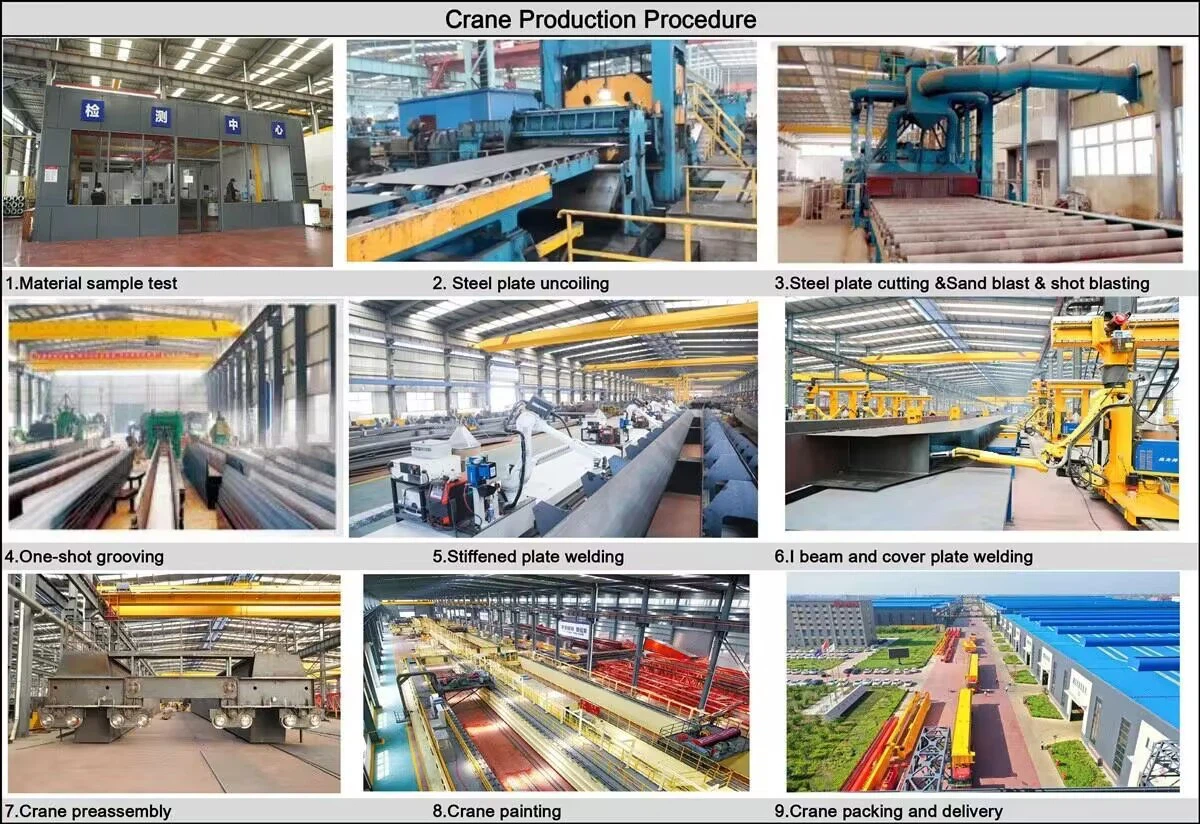
Crane production procedure
The production procedure for an Electric Hoist Double Beam Bridge Crane involves several key stages, from design and material procurement to assembly and testing. Below is a general step-by-step outline of the manufacturing process:
1. Design & Engineering
Customer Requirements Analysis: Determine load capacity, span, lifting height, duty cycle (FEM/ISO classification), and environmental conditions.
Structural Design:
Design the double girder bridge (main beams, end carriages) using CAD software (e.g., AutoCAD, SolidWorks).
Calculate stresses, deflection, and fatigue life per standards (ISO, DIN, FEM, or ASME).
Electrical & Mechanical Design:
Select hoist type (wire rope/electric chain hoist), motor power, control system, and safety devices (limit switches, overload protection).
Approval: Finalize drawings and get client/regulatory approval.
2. Material Procurement
Main Beams: Steel plates (Q235B, Q345B) or prefabricated I-beams.
End Carriages: Fabricated from steel sections (channels, angles) or welded plates.
Electrical Components: Hoist, motors, gearboxes, wheels, brakes, cables, and pendant/radio remote control.
Other Components: Rails, buffers, hooks, and safety devices.
3. Fabrication of Main Components
A. Double Girder Fabrication
Cutting: Steel plates are cut to size (laser/plasma/oxyfuel cutting).
Welding:
Fabricate box-type or I-section girders via submerged arc welding (SAW) or MIG/MAG welding.
Stress-relieving (heat treatment) to prevent distortion.
Machining: Drill holes for connections and surface machining (if required).
B. End Carriage Assembly
Welded Construction: Fabricate end carriages with wheels, buffers, and drive mechanisms.
Wheel Installation: Mount forged steel wheels with bearings for bridge movement.
C. Hoist Trolley Assembly
Frame Construction: Build trolley frame to mount the electric hoist.
Drive Mechanism: Install motors, gearboxes, and wheels for trolley travel along the girders.
4. Surface Treatment & Painting
Blasting: Shot-blasting to remove rust and improve paint adhesion.
Priming/Painting: Apply anti-corrosion primer and topcoat (usually epoxy or polyurethane).
Curing: Bake or air-dry painted components.
5. Electrical System Installation
Wiring: Install power supply systems (festoon/cable reels), control panels, and sensors.
Hoist Integration: Mount the electric hoist (wire rope or chain) onto the trolley.
Safety Devices: Install limit switches, overload protection, and emergency stop.
6. Assembly & Testing
A. Bridge Assembly
Girder-End Carriage Joining: Bolt or weld girders to end carriages.
Alignment Check: Ensure parallel girders and proper wheel alignment.
B. Functional Tests
No-Load Test: Run crane without load to check movement (hoisting, trolley, bridge travel).
Load Test:
Static Test: 125% of rated load (held for 10+ minutes to check deformation).
Dynamic Test: 110% of rated load to verify performance under motion.
Safety Checks: Verify brakes, limit switches, and emergency stops.
7. Quality Inspection & Certification
Dimensional Checks: Verify span, lift height, and alignment.
NDT Testing: Ultrasonic/X-ray welding inspections (if required).
Certification: Issue compliance certificates (CE, ISO, OSHA, or local standards).
8. Disassembly & Packaging
Modular Dismantling: Break down into transportable sections (girders, end carriages, hoist).
Packaging: Protect components with waterproof wrapping and secure for shipping.
9. Installation & Commissioning (On-Site)
Reassembly: Erect runway rails, assemble bridge, and mount hoist/trolley.
Final Testing: Perform on-site load tests and operator training.
10. Documentation & Delivery
Provide manuals (operation, maintenance), test reports, and warranty documents.
Workshop view:
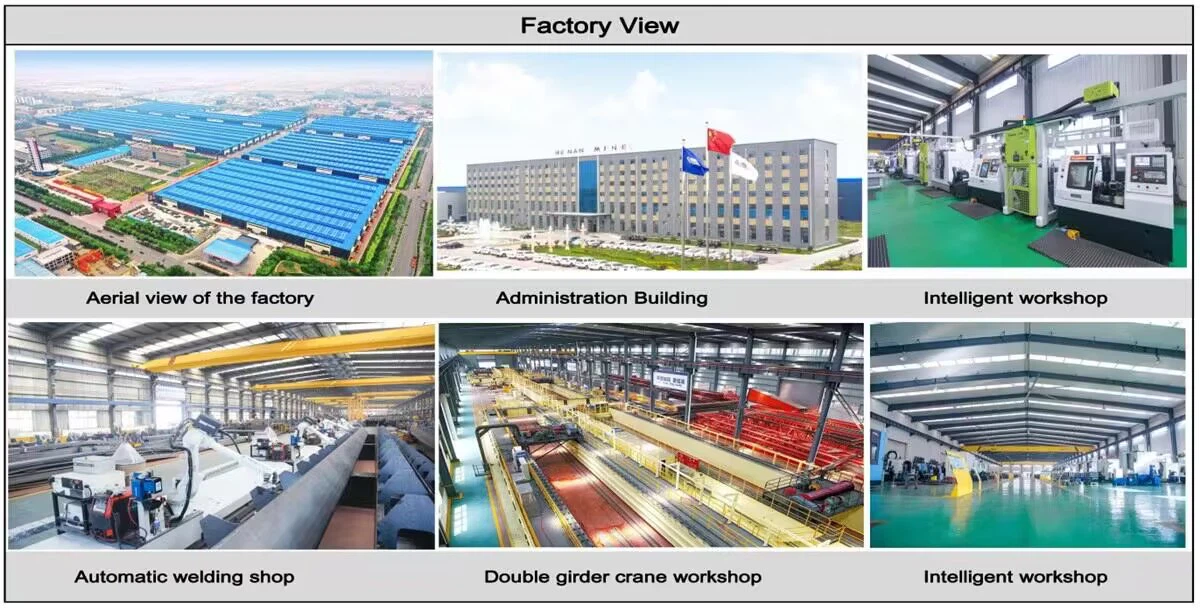
The company has installed an intelligent equipment management platform, and has installed 310 sets (sets) of handling and welding robots. After the completion of the plan, there will be more than 500 sets (sets), and the equipment networking rate will reach 95%. 32 welding lines have been put into use, 50 are planned to be installed, and the automation rate of the entire product line has reached 85%.


Hot Tags: electric hoist double beam bridge crane, China electric hoist double beam bridge crane manufacturers, suppliers, factory, Double Girder Overhead Travelling Crane, Double Girder Overhead Crane
You Might Also Like


Send Inquiry