







Double Girder Overhead Traveling Crane
Products Description
A Double Girder Overhead Traveling Crane is a type of overhead crane that features two bridge girders supporting the crane trolley and hoist. It is commonly used in industrial environments such as manufacturing plants, steel mills, and warehouses where heavy lifting and long spans are required.
Core Components:Bearing, Gearbox, Motor, Pump
Place of Origin:Henan, China
Warranty:1 Year
Weight (KG):2000 kg
Video outgoing-inspection:Provided
Machinery Test Report:Provided
Design:Double beam
Effectiveness:high efficiency
Operating speed:High speed operation
Stability:Anti-swing function
Color:Optional
Power Source:110V/220V/230V/380V/440V,customized
Span:7.5-31.5m
Pictures & Components
1.Main beam
Box-Girder Design (most common):
Offers excellent strength-to-weight ratio and torsional resistance. Constructed using welded steel plates to form a hollow rectangular beam.
Reinforcement Plates:
Added to areas where the hoist/trolley loads are concentrated, improving fatigue resistance.
Cambering:
Main beams are often cambered (slightly arched) to counteract deflection under heavy loads.
Welding Quality:
All seams and connections are precision-welded and often tested (e.g., ultrasonic or magnetic particle testing).
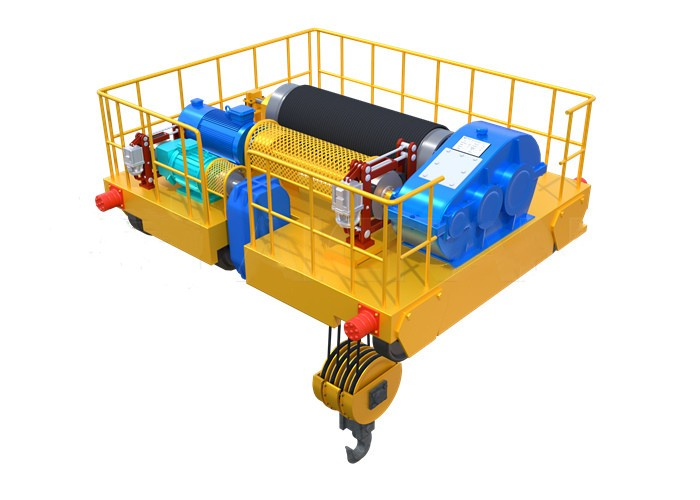
2.Lifting System
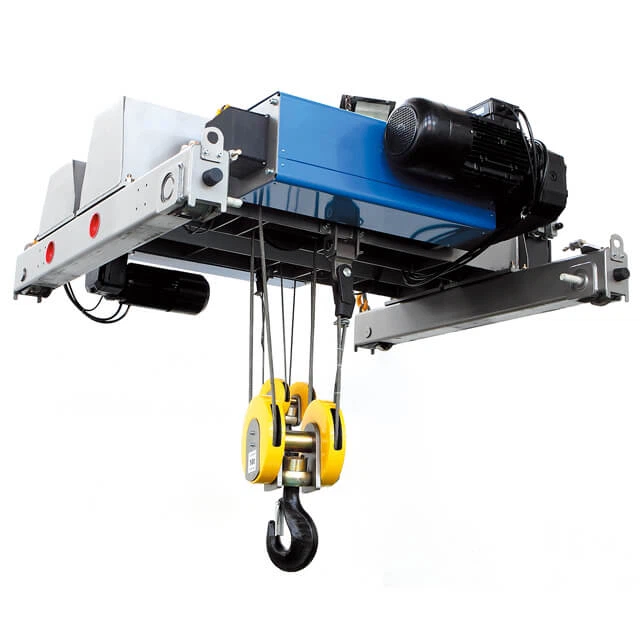
Trolley Frame:Mounted on top of the double girders; houses the hoist and drive system.
Hoisting Mechanism:Usually a wire rope hoist or winch drum system; powered electrically.
Motor:Drives the hoisting drum; often includes variable frequency drive (VFD).
Drum & Wire Rope:Wire rope winds on the drum to raise/lower the hook.
Hook Block:Includes pulleys/sheaves and a heavy-duty hook to attach the load.
Brake System:Ensures load holding; usually electromagnetic or hydraulic brakes.
Limit Switches:Prevent over-lifting or over-lowering to ensure safety.
 |
 |
3.End carriage
Structure:Welded box-type steel structure or rolled beam construction
Location:Positioned at both ends of the bridge girders
Function:Supports the main beams and houses travel wheels, motors, and gearboxes
Movement:Enables longitudinal travel of the entire crane along the runway
 |
 |
4.Crane travelling mechanism
The crane traveling system of a Double Girder Overhead Traveling Crane enables the entire crane bridge (including the girders, trolley, and lifting system) to move horizontally along the length of the runway. This movement allows the crane to position loads anywhere along the working area's X-axis (longitudinal direction).
5.Trolley travelling mechanism
The trolley traveling system of a Double Girder Overhead Traveling Crane is responsible for moving the trolley and hoisting mechanism laterally along the bridge girders (cross travel, or Y-axis motion). This system ensures precise positioning of the load between the two main girders, enabling full coverage of the crane's working area in combination with long travel and lifting motion.
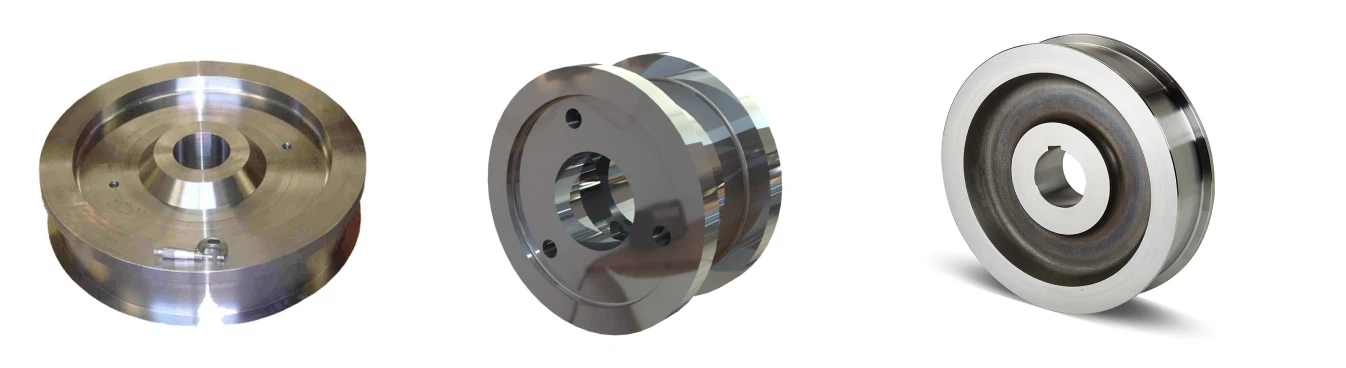
6.Crane wheel
1)Common Design Features
Double-flanged wheels are often used for safety and better guidance
Modular wheel blocks allow easy maintenance and replacement
Self-aligning bearings reduce misalignment stress
Anti-skewing systems work with wheels to prevent uneven wear or derailment
2)Problems from Poor Wheel Design or Maintenance
Excessive rail/wheel wear
Skewing (uneven wheel travel)
High noise or vibration
Reduced crane lifespan
Misalignment & tracking issues
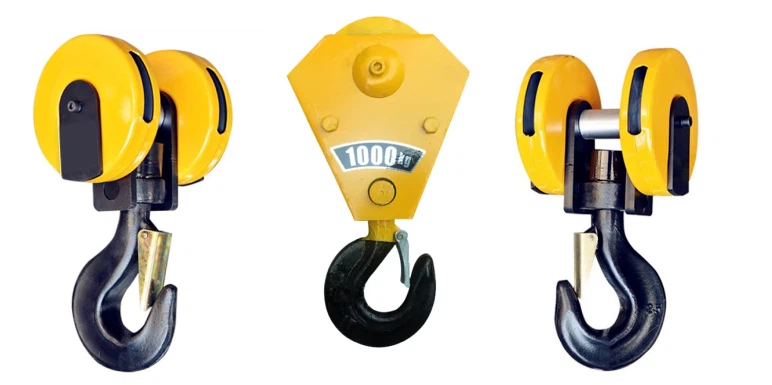
7.Crane Hook
The hook of a Double Girder Overhead Traveling Crane is the final lifting element that directly engages with the load. It is suspended from the hoist or trolley via wire ropes and pulleys and is designed to safely bear and transfer the load to the lifting mechanism.
Key Functions of the Hook
Lifts and lowers loads
Engages with slings, chains, or lifting devices
Transfers vertical load to the hoisting mechanism
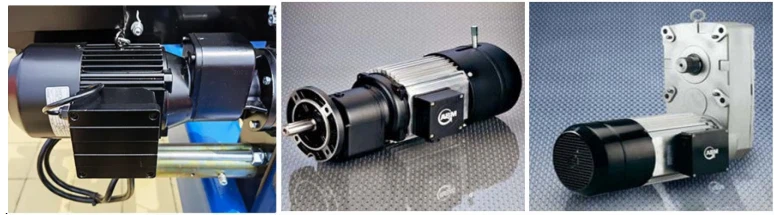
8.Motor
Common Motor Features
Integrated brake: Electromagnetic or spring-loaded fail-safe brakes for instant stopping
Gearbox attachment: Most motors are coupled with a gear reducer for torque control
VFD Compatibility: Motors are often controlled via Variable Frequency Drives (inverters) for soft start/stop and speed regulation
Encoders or Sensors: For motion feedback and anti-sway or auto-positioning systems

.
9.Sound and light alarm system & limit switch
1)Sound and Light Alarm System
Purpose:
To warn workers of crane movement or abnormal conditions to prevent accidents and enhance operational safety.
2)Limit Switches
Purpose:
To automatically stop motion when a specific limit is reached (e.g., max hoist height, trolley position) to prevent mechanical damage or overtravel.

10.Safety Devices
Overload Protection Device:Prevents the crane from lifting loads beyond its rated capacity
Limit Switches:Stops motion at predefined travel or lift limits (hoist, trolley, bridge)
Emergency Stop Button:Immediately shuts off power to halt all crane functions in an emergency
Sound and Light Alarm:Warns workers of crane movement, hoisting, or system faults
Buffer (End Stopper):Absorbs impact at runway/trolley ends to prevent mechanical collision
Anti-collision Device:Prevents cranes from colliding with each other or runway ends
Rail Clamps / Wheel Locks:Secures the crane during power failure or strong winds (for outdoor use)
Grounding Protection:Prevents electrical shocks; especially critical in electrified rail systems
Over-speed Protection:Stops the hoist if lifting speed exceeds safe thresholds
Load Display System:Shows real-time lifted weight to the operator
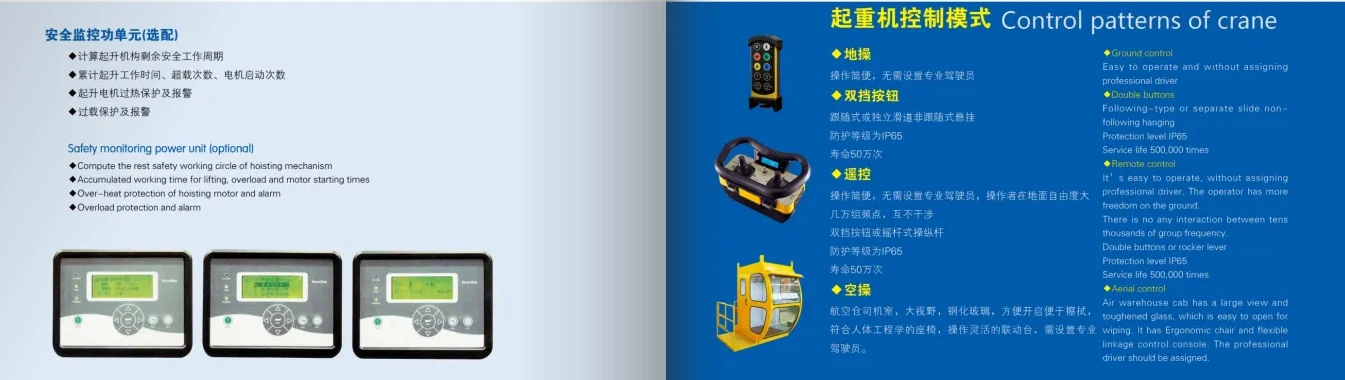
11.Control Mode
Low-cost manual operation:Pendant control
Operator safety and flexibility:Wireless remote control
Heavy-duty continuous use:Cabin control
Smart automation and tracking:PLC/automatic control
12.Sketch

Main technical

Advantages
1. High Load Capacity
Superior Load Handling: The double girder design allows for better load distribution and higher weight capacity than a single girder crane. This is ideal for lifting heavy loads, often over 50 tons or more.
Stability: The two beams provide enhanced stability and resistance to torsion under heavy lifting conditions.
2. Longer Span and Greater Lifting Height
Longer Span: Double girder cranes can cover wider spans (distance between rails) than single girder cranes, making them perfect for large facilities and warehouses.
High Lifting Height: The design allows for more headroom under the crane, which gives more vertical clearance for lifting loads to greater heights.
3. Improved Lifting Speed and Precision
Smooth Movement: With a well-designed motor and hoist system, the double girder crane offers precise control over lifting speeds, making it ideal for applications where accuracy is crucial.
Enhanced Sway Control: Some models offer sway control systems that minimize load swinging during lifts, which is important in applications where stability and precision are essential.
4. Durability and Reliability
Robust Structure: The double girder frame is strong and durable, making it suitable for handling heavy-duty operations with high frequency and harsh environments.
Longer Lifespan: Due to its structural integrity and ability to handle higher loads, this crane has a longer service life with reduced maintenance costs.
5. Flexibility in Design and Operation
Customization: Double girder cranes can be customized with various options such as different hoist types, control systems, or safety features. This flexibility allows the crane to be tailored to specific operational requirements.
Multiple Control Options: Can be operated using pendant controls, wireless remote controls, or cabin controls, providing flexibility in operator preferences and applications.
6. Better Performance in Heavy Duty Environments
Outdoor or Tough Environments: These cranes are ideal for heavy industrial environments, such as steel mills, shipyards, and ports, where the demand for high lifting capacity and operational flexibility is critical.
Ideal for Material Handling: With its robust build and high capacity, it's great for applications involving steel, construction materials, and bulk goods.
7. Safety Features
Enhanced Safety: Double girder cranes typically come with advanced safety systems, such as overload protection, limit switches, sound and light alarms, anti-collision devices, and emergency stop functions.
Higher Safety Standards: Built-in features ensure compliance with global safety standards (ISO, ASME, FEM, etc.), reducing the risk of accidents during crane operation.
8. Space Efficiency
Optimal Use of Facility Space: Double girder cranes allow for maximum headroom and minimal obstruction of the workspace, enabling better utilization of vertical space.
Compact Design: Though offering more lifting capacity, they often take up less space compared to other cranes with similar capacities.
Application:
1. Steel and Metal Industries
Applications:
Handling heavy steel coils, ingots, billets, plates, and structural steel
Feeding materials to rolling mills or furnaces
Moving large dies and molds
Why used: High capacity (often 20–300 tons), precise control, heat-resistant components
2. Manufacturing Plants
Applications:
Moving large machine components or assemblies
Assisting in equipment installation or production line feeding
Why used: Reliable lifting, long spans, high hook lift for complex layouts
3. Power Plants
Applications:
Turbine assembly and maintenance
Lifting transformers, generators, and large pipes
Why used: Stable and accurate handling of delicate or oversized equipment
4. Shipbuilding and Marine Yards
Applications:
Moving ship components like engines, panels, and hull sections
Assisting in dry dock and block assembly
Why used: Long span coverage and high lifting capacity
5. Railway and Train Maintenance Depots
Applications:
Lifting locomotives, bogies, and carriages for repair or inspection
Why used: Precision lifting and positioning, often with synchronized hoists
6. Heavy Equipment and Machinery Assembly
Applications:
Transporting large machine parts during assembly
Installing heavy machinery in workshops
Why used: Ability to customize lifting speeds, control systems, and load tracking
7. Mining and Cement Industries
Applications:
Handling of crushers, motors, and raw material hoppers
Maintenance of grinding mills and kilns
Why used: Durable design that withstands dusty and corrosive environments
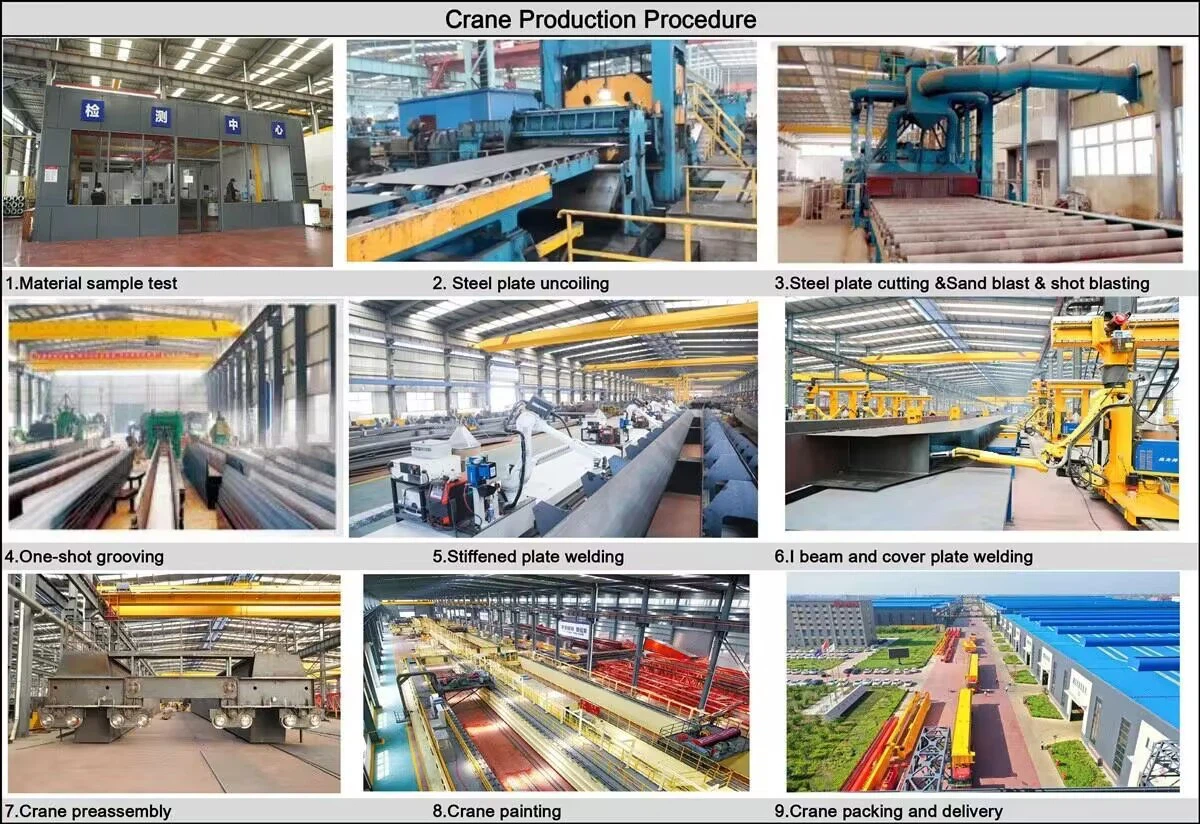
Crane production procedure
1. Engineering & Design
Load analysis, duty classification (FEM/ISO/GB), and span calculation
Selection of key specifications: lifting capacity, lifting height, span, speed
CAD drawings and structural analysis (Finite Element Method if needed)
Electrical and control system schematics
Preparation of Bill of Materials (BOM)
2. Material Preparation
Procurement of Q235B / Q345B steel plates, I-beams, rails, etc.
Surface treatment (sandblasting, pickling) to remove rust and impurities
Cutting of steel parts using CNC plasma or laser cutting machines
Material inspection and marking
3. Fabrication of Main Components
A. Main Girders (Double Beams)
Assembly of top flanges, bottom plates, and web plates
Full-length welding using automatic welding machines
Welding inspection (UT/RT) and stress relief if required
Internal stiffeners and mounting brackets installation
Cambering the beams to compensate for deflection
B. End Carriages
Fabrication of box or plate-type structures
Installation of wheel seats and axle holders
Machining of joint faces to precise tolerances
C. Trolley Frame
Fabrication of the trolley steel structure
Mounting of hoisting mechanism (drum, motor, gearbox)
Assembly of trolley wheels, buffers, and drive units
D. Hoisting Mechanism
Machining of drum, gearbox, sheaves, and hook block
Assembly of motor, brake, coupling, and rope drum
Winding of steel wire rope and hook block installation
4. Machining & Precision Processing
Key components like drums, shafts, and sheaves are CNC machined
Boring of shaft holes, gear fitting, and alignment checking
Dynamic balancing of rotating elements (if needed)
5. Electrical System Assembly
Wiring of control panels, frequency inverters, contactors, and relays
Programming of PLC or remote control units (if automated)
Installation of limit switches, alarms, and sensor systems
6. Assembly and Pre-testing
Crane main girders, end carriages, and trolley are assembled on ground
Alignment and bolting of joints
Electrical connection of motors, brakes, and control units
Dry run test: travel motors, trolley, and hoist checked without load
7. Load Testing & Quality Inspection
No-load test: Verify all functions-lifting, traveling, braking, limit switches
Rated load test (100%) and overload test (usually 125%)
Functionality test of emergency stop, limit switches, alarms
Deflection check of girders (should be within specified limits)
Inspection report signed off by QA team
8. Surface Treatment & Painting
Anti-corrosion treatment (e.g., zinc-rich primer)
Painting according to project specification (commonly yellow or orange)
Logo or nameplate installation
9. Packing and Delivery
Disassembly into transportable sections (main girders, end trucks, trolley)
Packed using steel frames, shrink wrap, or wood cases for export
Delivery arranged by road, rail, or sea as required
10. On-site Installation & Commissioning (Optional)
Assembly on customer site
Final alignment, wiring, and load testing
Operator training and maintenance guidance
Handover with full documentation: manual, certificate, test report, wiring diagram
Workshop view:
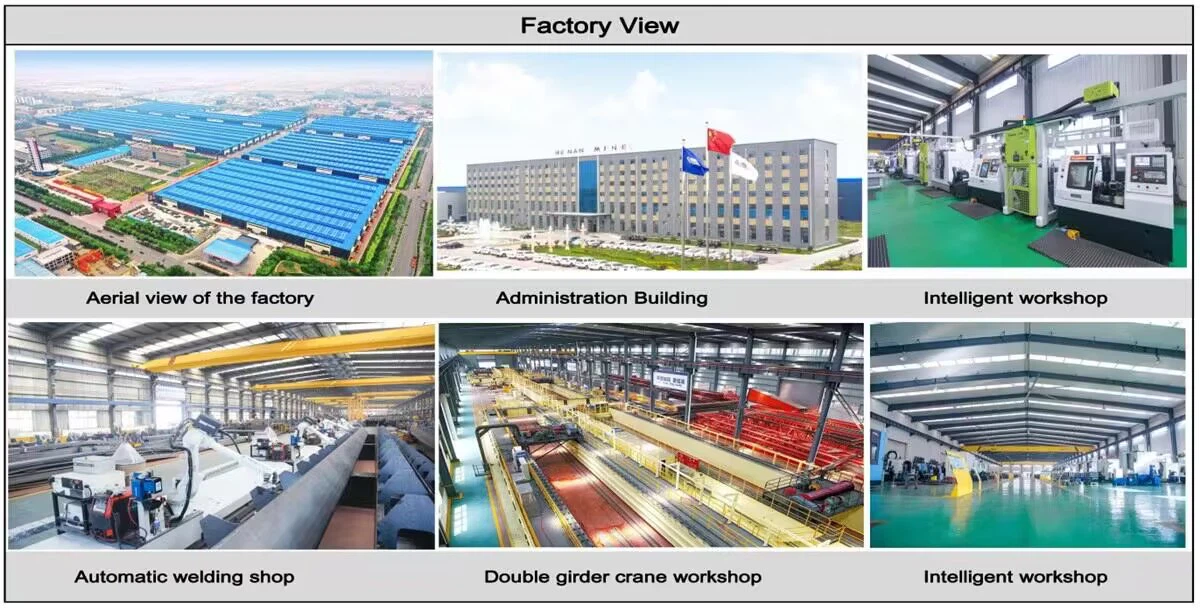
The company has installed an intelligent equipment management platform, and has installed 310 sets (sets) of handling and welding robots. After the completion of the plan, there will be more than 500 sets (sets), and the equipment networking rate will reach 95%. 32 welding lines have been put into use, 50 are planned to be installed, and the automation rate of the entire product line has reached 85%.


Hot Tags: double girder overhead traveling crane, China double girder overhead traveling crane manufacturers, suppliers, factory, Double Girder Overhead Travelling Crane, Double Girder Overhead Crane
You Might Also Like




Send Inquiry