







Aerial Lifting Platform Scissor Lift
Products Description
A scissor lift is a type of aerial work platform (AWP) characterized by its criss-crossing "scissor" mechanism that provides vertical elevation. Its primary feature is strictly vertical movement, making it ideal for tasks that require stable, high-reaching work over a large platform area.
Core Functional Features
Vertical-Only Movement: Unlike boom lifts, scissor lifts do not articulate or extend over obstacles. They move straight up and down, providing a highly stable base directly beneath the platform.
Large, Stable Platform: The work platform is notably spacious, allowing multiple workers, tools, and materials to be elevated together. It typically has high toe-guards and a chain across the entrance for safety.
Scissor Mechanism: The lifting action is provided by a hydraulic cylinder that pushes the linked, folding scissor legs apart, raising the platform smoothly and steadily.
Self-Propelled Models: Most modern scissor lifts are self-propelled, meaning an operator on the platform can drive the lift around a worksite, position it precisely, and then elevate-all from the platform controls.
Rough Terrain vs. Electric Models: This is a major distinguishing feature:
Rough Terrain (RT): Features large, pneumatic tires, a more powerful engine (usually diesel), and 4-wheel drive for use on outdoor, uneven, and unpaved surfaces. They have higher weight capacities and can often handle slopes.
Electric (Slab/Indoor): Features solid, non-marking tires (to protect indoor floors), are battery-powered, and are exceptionally quiet and emission-free. They are designed for smooth, indoor surfaces like warehouses, retail stores, and convention centers.
Application
Primary Applications of Scissor Lifts by Industry
1. Construction
This is one of the most common applications. Scissor lifts are essential from ground-breaking to finishing touches.
Initial Construction: Installing steel frames, roofing, overhead piping, and electrical conduits.
Interior Work: Drywall installation and finishing, ceiling grid and tile installation, painting walls and ceilings, installing lighting fixtures (like in large atriums), and HVAC ductwork.
Exterior Work: Cladding, window installation, and painting on mid-rise buildings.
2. Warehousing & Logistics
Scissor lifts are fundamental for efficient and safe operations in large storage facilities.
Stock Picking & Order Fulfillment: Accessing high shelves in racking systems safely and efficiently.
Inventory Management: Allowing workers to count stock, check labels, and perform cycle counts at height.
Facility Maintenance: Changing lights, cleaning high windows, inspecting and maintaining sprinkler systems, and working on overhead conveyors.
3. Manufacturing & Industrial Facilities
Plants and factories use scissor lifts for both production and maintenance.
Machine Maintenance: Providing safe access to the upper parts of large industrial machinery, assembly robots, and presses for repair and lubrication.
Assembly Lines: Used in the assembly of large products like aircraft, ships, or industrial equipment where workers need to access different levels of the product.
Plant Infrastructure: Installing and maintaining lighting, electrical systems, and piping that run along the ceiling of a factory.
4. Retail & Commercial Properties
For large stores and shopping malls, scissor lifts are the go-to solution for maintenance and merchandising.
Lighting and Signage: Changing light bulbs in high ceilings (a very frequent task), installing and maintaining large banners and promotional signs.
Display Setup: Decorating for holidays, setting up high product displays, and adjusting shelving layouts.
Cleaning: Cleaning high windows, dusting exposed ductwork, and maintaining skylights.
5. Entertainment & Event Staging
The event industry relies heavily on scissor lifts for quick and safe setup and teardown.
Rigging: Hanging lighting, speakers, projection screens, and scenery for concerts, theater productions, and conferences.
Stage Construction: Building and accessing different levels of stage sets.
Venue Maintenance: Maintaining permanent lighting and sound systems in theaters, arenas, and concert halls.
6. Telecommunications & Utilities
While boom lifts are often used for external access, scissor lifts have their place.
Data Centers: Installing and maintaining overhead cable trays and server rack infrastructure.
Utility Plants: Performing maintenance and inspections on control panels and internal infrastructure of power and water treatment plants.
Advantages
Advantages of Using a Scissor Lift (Why they are chosen for these applications)
Superior Stability: The wide base and direct vertical lift provide an extremely stable platform, which is crucial when working with heavy tools or materials.
High Weight Capacity: They can hold significantly more weight (multiple workers, tools, supplies) compared to most ladders or scaffolding.
Enhanced Productivity: Workers can complete tasks much faster than repeatedly moving a ladder or building scaffolding. The large platform acts as a mobile workbench.
Improved Safety: Eliminates the risk of falls from ladders and the instability of makeshift platforms. Includes safety features like guardrails, toe boards, and emergency lowering systems.
Maneuverability: Modern electric models are compact, have a tight turning radius, and can be used indoors without emitting fumes.
Limitations to Consider
No Horizontal Reach: The biggest limitation. You cannot reach "over" an obstacle; the base must be directly below the work area. A boom lift is needed for such tasks.
Rough Terrain Requirement: Standard models are for flat, solid surfaces. Uneven ground requires a specialized "rough terrain" scissor lift.
Accessibility: The work area must be clear enough to drive the platform into position.
Parameters table

Pictures


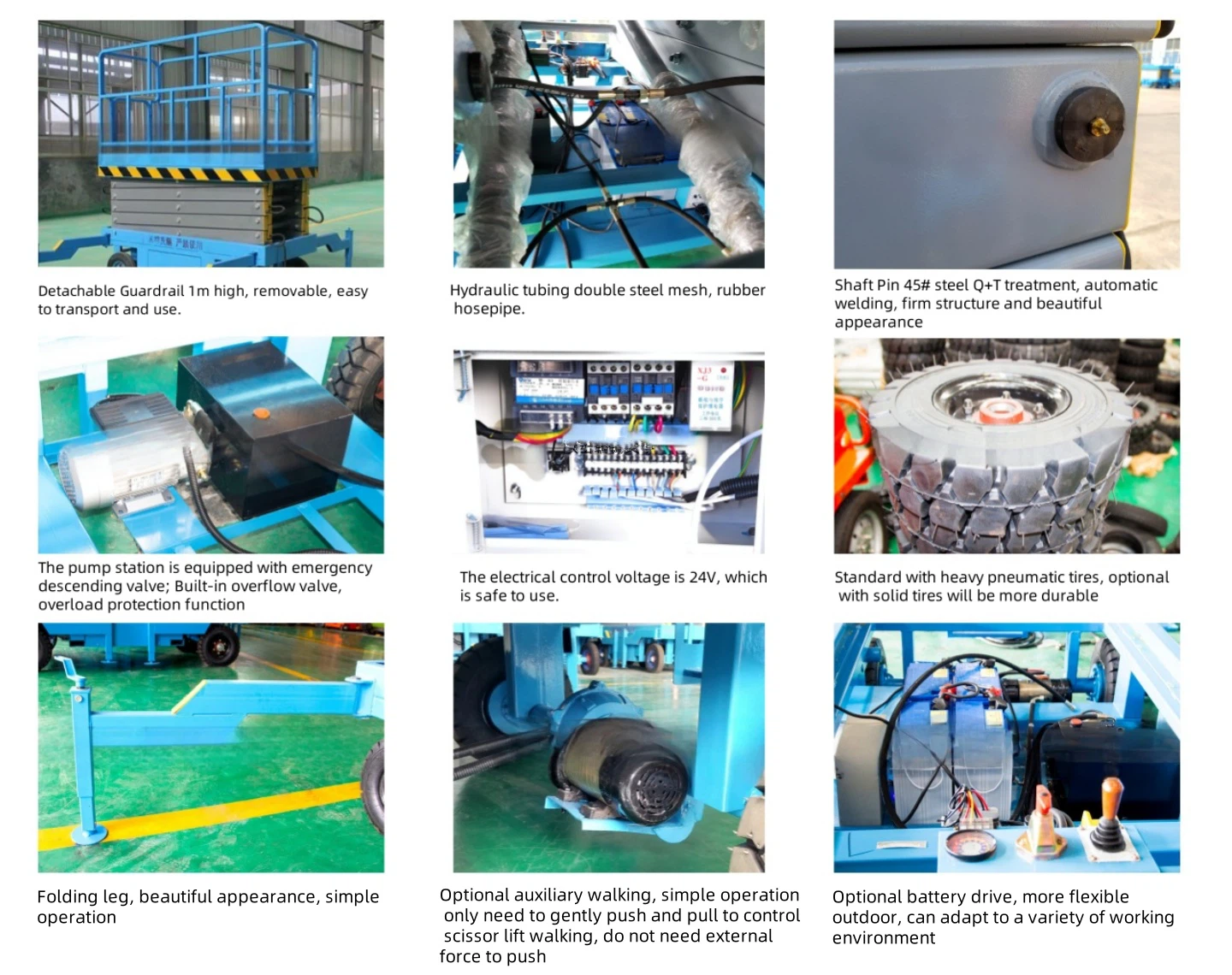
Parts Details

Workshop view:
The company has installed an intelligent equipment management platform, and has installed 310 sets (sets) of handling and welding robots. After the completion of the plan, there will be more than 500 sets (sets), and the equipment networking rate will reach 95%. 32 welding lines have been put into use, 50 are planned to be installed, and the automation rate of the entire product line has reached 85%.


Hot Tags: aerial lifting platform scissor lift, China aerial lifting platform scissor lift manufacturers, suppliers, factory
You Might Also Like


Send Inquiry