










Self-propelled Hydraulic Scissor Lift
Products Description
Core Function & Mobility Features
These features distinguish self-propelled models from simpler push-around or towable lifts.
Self-Propelled Drive System: The most defining feature. An electric motor drives the wheels, allowing the operator to control the lift's movement (forward, reverse, turning) from the platform. This drastically improves efficiency and reduces operator fatigue over large workspaces.
Hydraulic Power System: Provides smooth, controlled, and powerful lifting and lowering of the scissor mechanism. Hydraulics are known for their reliability and ability to handle heavy loads with stability.
Pothole Protection System: A critical safety feature. Automatic braking valves (often on each wheel) instantly stop the lift from descending if a hydraulic line fails or if the chassis loses stability, preventing a catastrophic collapse.
Rough Terrain Capability (for specific models): Many self-propelled scissor lifts are equipped with large, pneumatic (air-filled) tires, high ground clearance, and robust drive motors to navigate uneven surfaces, gravel, and mild outdoor terrain.
Control & Operation Features
These features focus on the user interface and how the lift is operated.
Platform Controls: The primary control station is located on the platform itself. It typically features:
Thumb-wheel or toggle switches for drive and steering.
Clearly marked buttons for Up/Down.
An emergency stop button.
Battery charge indicator.
Ground Controls: A secondary set of controls located on the base of the lift. These are used for raising the platform to a working height for the first time, troubleshooting, and emergency lowering. They often have a key to prevent unauthorized use.
Proportional Control / Variable Speed: High-quality models offer proportional control, meaning the drive speed and lift/lower speed are directly proportional to how far the operator pushes the control. This allows for precise, smooth, and safe positioning.
Zero Tail Swing / Compact Design: Many models are designed so that the base frame does not extend beyond the platform's footprint when turning. This allows for operation in very narrow aisles and tight spaces without fear of hitting obstacles.
Safety & Stability Features
These are non-negotiable features that protect the operator, the load, and the surrounding environment.
Tilt/Incline Sensors: Monitors the level of the chassis. If the lift is driven onto too steep of a slope (exceeding its rated capacity), the sensor will cut power to the drive functions and often the lift function, alerting the operator to the danger.
Auto Braking System: The drive system is electronically regulated so that when the control is released, the lift comes to a smooth and immediate stop. It also holds the lift firmly on an incline.
Guardrails & Toeboards: A fully enclosed platform with standard guardrails and kick plates to prevent tools and people from falling off.
UL/ANSI Compliance: Manufactured to meet or exceed strict safety standards set by organizations like UL (Underwriters Laboratories) and ANSI (American National Standards Institute).
Power & Performance Features
These features impact the lift's runtime, capability, and environmental footprint.
Electric/Battery Power: Virtually all self-propelled scissor lifts are powered by heavy-duty, rechargeable deep-cycle batteries. This makes them emission-free, quiet, and ideal for indoor use (warehouses, factories, convention centers).
Extended Runtime: Modern systems are highly efficient, often allowing for a full 8-hour shift (or more) on a single charge, depending on usage.
High Load Capacity: Designed to lift significant weight. Capacities commonly range from 500 to 5,000 lbs (227 to 2,268 kg) or more, allowing multiple workers and their tools to be on the platform simultaneously.
High Working Height: Self-propelled scissor lifts are built for substantial reach. Typical working heights range from 20 to 50 feet (6 to 15 meters) or more.
Application
Key Applications and Industries
Self-propelled scissor lifts are ubiquitous across industries that require efficient, safe, and repetitive overhead work. Their primary application is any task that needs to be done at height between approximately 20 to 50 feet (6 to 15 meters).
1. Construction
Interior Fit-Out: Installing drywall, ceilings (grid and tiles), lighting fixtures, HVAC ductwork, sprinkler systems, and electrical conduits inside buildings.
Exterior Work: Facade installation, cladding, window washing, and painting on low-to-mid-rise buildings.
Steel Erection: Connecting steel beams and decks on industrial and commercial projects.
Concrete Placement: Providing access for finishing ceilings and high walls after formwork is stripped.
2. Warehousing & Logistics
Storage Rack Maintenance: Installing, repairing, or replacing pallet racking beams and uprights.
Inventory Management: Accessing high shelves for stock counting, picking, or organizing.
Building Maintenance: Changing lights, cleaning high windows, inspecting and repairing roof structures, and maintaining fire suppression systems.
Loading Docks: Servicing dock levelers and overhead doors.
3. Manufacturing & Industrial Facilities
Equipment Installation & Maintenance: Installing assembly line machinery, conveyor systems, and large tools.
Plant Maintenance: Performing routine maintenance on piping, valves, tanks, and electrical systems overhead.
Painting & Sanding: Providing a stable platform for finishing large products like aircraft components, ship sections, or industrial equipment.
4. Retail & Entertainment
Store Setup & Maintenance: Installing signage, changing light bulbs in high ceilings, decorating, and setting up displays in big-box stores and malls.
Event Staging: Setting up lighting rigs, sound systems, banners, and props in convention centers, arenas, and theaters.
Film & Television: Used as a mobile platform for camera operators, lighting technicians, and riggers.
Advantages
1. Superior Mobility and Maneuverability
Self-Propelled: Unlike manual push-around scissor lifts, these models have electric or engine-powered drive systems. Operators can easily drive the lift forward, backward, and turn in place, drastically reducing effort and time spent repositioning.
Rough Terrain Capability: Many models are equipped with large, pneumatic tires and powerful drive motors, allowing them to traverse uneven ground, gravel, and mild obstacles on job sites with ease.
Tight Spaces: Their compact chassis and zero-turn radius (or very tight turning circles) allow them to operate efficiently in congested areas like warehouses, factories, and between equipment.
2. Enhanced Productivity and Efficiency
Rapid Positioning: The ability to drive at elevated heights (on many models) allows workers to move from one task to another without needing to lower the platform, descend, move, and then raise again. This saves a tremendous amount of time over the course of a workday.
Integrated Power Systems: Most self-propelled scissor lifts have 110V/220V power outlets on the platform, allowing operators to run power tools, lights, and diagnostic equipment directly from the lift, eliminating the need for long extension cords.
Larger Platform Capacity: They are designed to carry multiple workers, tools, and materials simultaneously, making them ideal for tasks requiring teamwork or heavy equipment.
3. Exceptional Stability and Safety
Solid Foundation: The scissor mechanism provides a very stable and rigid vertical lifting motion. There is much less side-to-side sway compared to articulating or telescopic boom lifts when fully extended, creating a more confident and secure feeling for workers on the platform.
Automatic Pothole Protection: A critical safety feature on most modern models. Hydraulic outriggers or stabilizers automatically deploy and level the machine as it is raised, preventing dangerous tipping on uneven surfaces.
Safety Systems: They come standard with features like:
Platform Gates: To prevent falls.
Emergency Lowering Systems: Manual or battery-backed to lower the platform in case of power failure.
Tilt Sensors: That disable functions if the lift becomes unstable.
Ground Controls: Allow for troubleshooting or emergency override from the ground.
4. Versatility and Application
Indoor/Outdoor Use: Electric models are perfect for indoor use due to zero emissions and quiet operation. Diesel or bi-energy models are built for outdoor and rough terrain applications.
Wide Range of Sizes: Available in a vast range of working heights (from ~20 ft to over 50 ft) and platform sizes to suit virtually any task, from stocking high shelves to installing overhead utilities on a construction site.
5. Ease of Operation
Simple Controls: Typically operated via a clearly labeled control panel in the platform with intuitive toggle switches or buttons for drive, lift, and steering. This reduces training time and operator error.
Comfortable Operation: The large, enclosed platform provides a comfortable and spacious area to work from, reducing fatigue.
Parameters table

Pictures


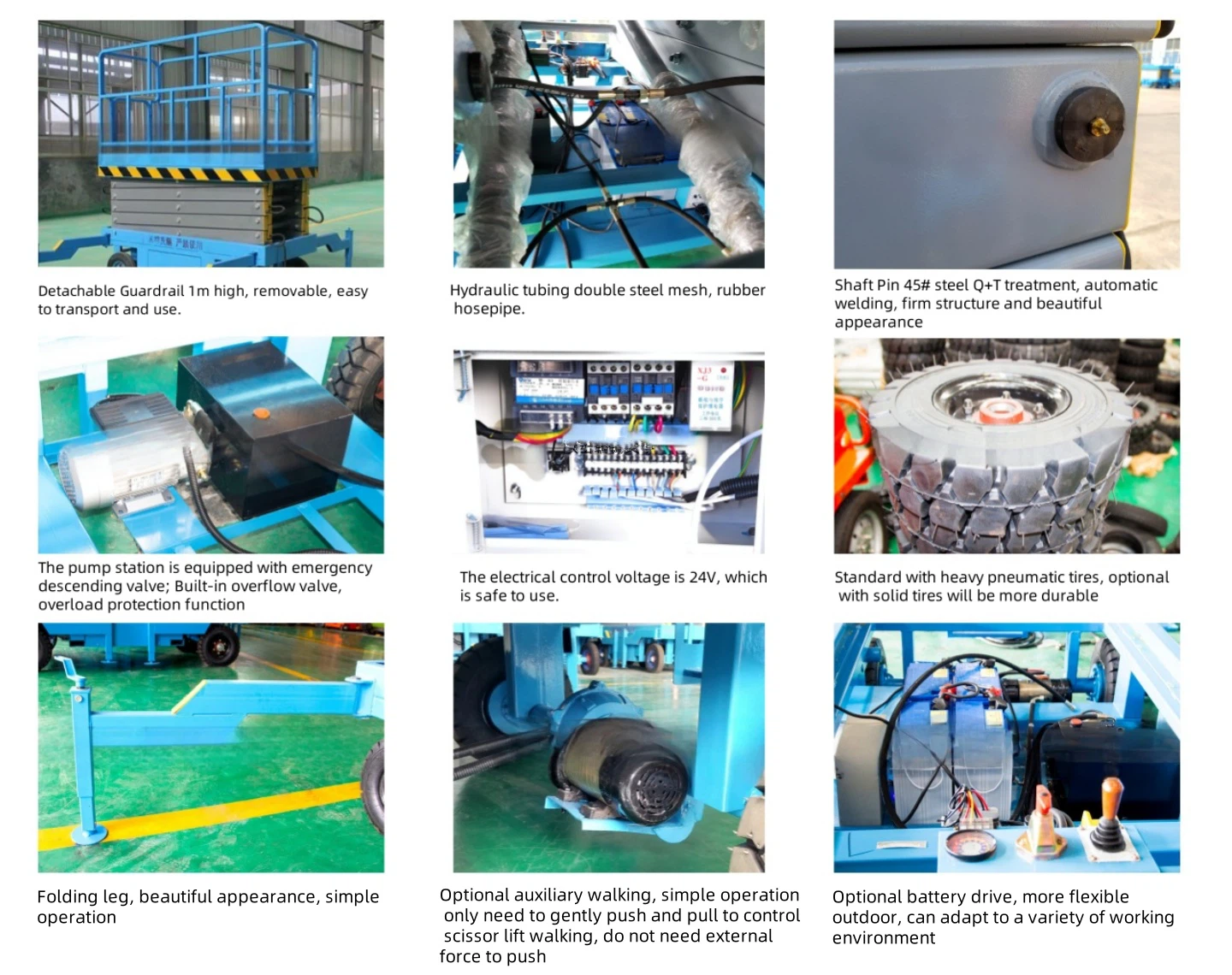
Parts Details

Workshop view:
The company has installed an intelligent equipment management platform, and has installed 310 sets (sets) of handling and welding robots. After the completion of the plan, there will be more than 500 sets (sets), and the equipment networking rate will reach 95%. 32 welding lines have been put into use, 50 are planned to be installed, and the automation rate of the entire product line has reached 85%.


Hot Tags: self-propelled hydraulic scissor lift, China self-propelled hydraulic scissor lift manufacturers, suppliers, factory
You Might Also Like


Send Inquiry