








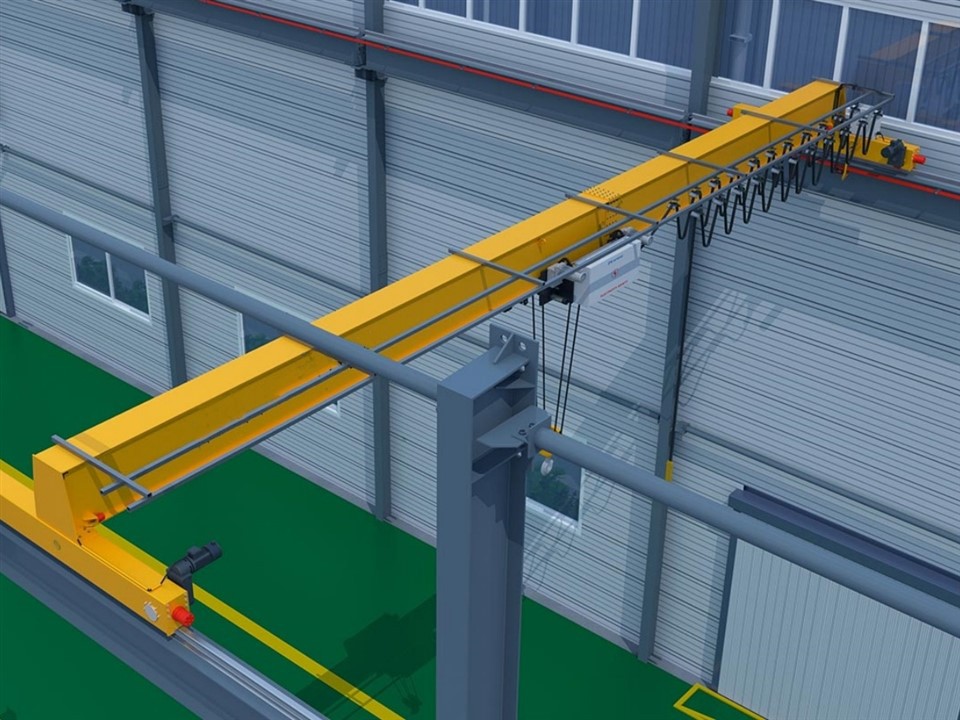


Underslung Eot Crane
Products Description
The Underslung EOT Crane is a versatile and efficient lifting solution designed for operations where space is at a premium and traditional overhead cranes may not be feasible. This innovative crane system is mounted to the bottom flange of a runway beam, making it ideal for workshops, warehouses, and industrial facilities with low headroom or unique structural constraints.
The Underslung EOT Cranes are optimized for facilities with low ceilings or limited space. Designed with high-grade materials to ensure reliability and longevity for heavy-duty operations.Offers a variety of lifting capacities, spans, and hoist options to meet different application needs. Utilizes advanced motors and control systems for precise load handling and minimal vibration. Safety-focused. Equipped with overload protection, emergency stop function, and meets international safety standards.
3) With a commitment to quality and innovation, our underslung EOT cranes are designed to deliver unmatched performance and adaptability. Whether you need a standard model or a fully customized solution, our team ensures seamless integration into your operations, boosting productivity and safety.
Core Components:Bearing, Gearbox, Motor
Place of Origin:Henan, China
Warranty:2 years
Weight (KG):110000 kg
Video outgoing-inspection:Provided
Machinery Test Report:Provided
Lifting speed:5-15M/MIN
Trolley running speed:20-40M/MIN
Crane running speed:50-100M/MIN
Protection grade:IP54
Crane traveling speed:20/30 M/min
Power source:3 phase 380V 50hz or request
Control method:pendant control/wire rope remote control
Colour:request
Lifting mechanism:Wire Rope Electric Hoist

Pictures & Components
1.Main beam
The main beam of an underslung Electric Overhead Traveling (EOT) crane is a critical structural component that supports the weight of the load and carries the trolley. It is typically mounted underneath the runway beams or tracks, as opposed to the top-running design, making it ideal for spaces with limited headroom or lower ceiling heights.
The main beam is generally made of steel, often with I-beam, box beam, or welded construction for strength and durability. The design needs to account for both the load it will carry and the operational environment.The beam must have the proper stiffness to prevent excessive deflection or bending under load, ensuring smooth and safe operation.
The beam must be designed to withstand the maximum load that the crane is intended to carry, with appropriate safety margins. This includes both the weight of the crane trolley and any external loads being lifted.In an underslung crane, the beam is mounted under the tracks, and the trolley travels along it. This setup provides better clearance for the crane in areas where headroom is restricted.
Lifting System
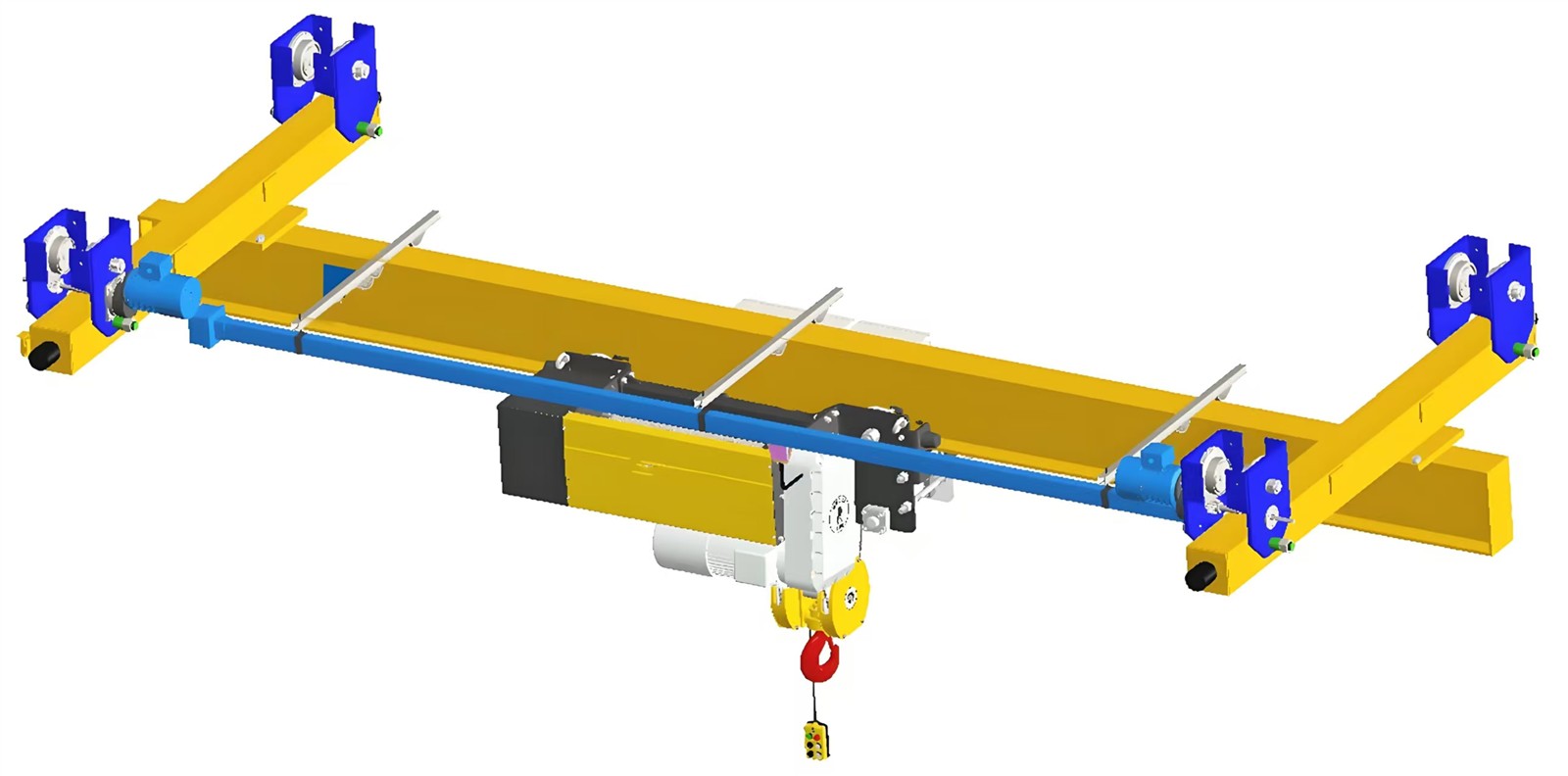
The lifting system of an underslung EOT (Electric Overhead Traveling) crane is designed to support and lift loads efficiently, typically in industrial settings. An underslung crane, as the name suggests, has its lifting mechanism mounted beneath the crane bridge rather than above it (as in an overhead crane).
Hoist Mechanism
The hoist is the primary component responsible for lifting and lowering loads. It includes:
Motor: Typically an electric motor that drives the hoist mechanism.
Reducer/Gearbox: Reduces the speed of the motor and increases the torque.
Drum or Winch: A drum or winch is used to store the hoisting rope or chain.
Rope or Chain: The rope or chain is wound and unwound on the drum, lifting or lowering the load.
Hook or Lifting Device: The hook is attached to the load and is the final element for connecting and lifting the material.
Bridge and Trolley System
Bridge: The bridge is the horizontal structure that spans the crane's work area. For an underslung crane, this is typically supported from below, often mounted on the walls or columns of the building.
Trolley: The trolley runs along the bridge and houses the hoist mechanism. It moves horizontally to position the hoist over the desired location.Track System
The crane is typically mounted on tracks along which the bridge and trolley move. The tracks guide the crane's movement and support the load as it is moved.
The tracks are usually located on the building's roof, ceiling, or supporting structure.
Control System
The control system for an underslung crane typically includes a pendant control or a radio remote control to operate the crane's movements (hoisting, trolley, bridge, and other motions).
The system is equipped with safety features such as overload protection, limit switches, and emergency stop functions.
Power Supply
The crane is powered by an electrical supply system, which includes cables running from the power source to the crane's hoisting motor and other components.

3.End carriage
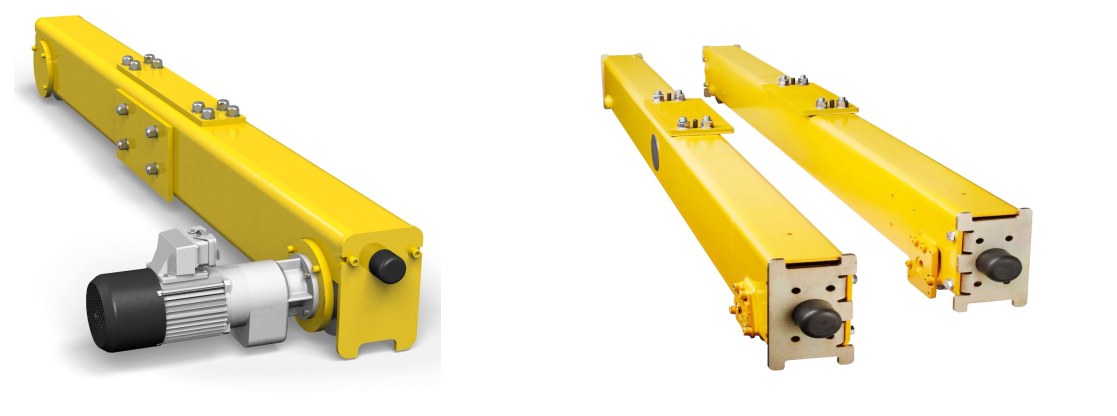
The end carriage of an underslung EOT (Electric Overhead Travelling) crane refers to the component at either end of the crane that supports the trolley and allows it to travel along the crane runway. In an underslung crane system, the crane's hoisting mechanism is suspended from the bridge, and the end carriages are mounted beneath the bridge structure.
The end carriages often contain guide rollers or wheels that travel along the runway rails to maintain stability during movement.They support the entire weight of the crane bridge and the hoisting mechanism.They enable the crane bridge to move along the runway beams (horizontal movement), allowing the crane to travel across the work area.They distribute the load of the crane uniformly across the supporting structure (typically a building or gantry system).
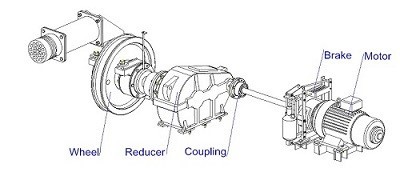
4.Crane travelling mechanism
1) Operation principle
The traveling mechanism is powered by electricity, supplied via a conductor system (like a bus bar or festoon cable system).When the operator activates the crane's control system (through a pendant controller, wireless remote, or cabin), the drive motors receive an electrical signal to start.The motor drives the gearbox, which reduces the motor's speed to an appropriate level for smooth crane movement.Torque from the gearbox is transmitted to the wheels via couplings or direct drive, depending on the design.The driven wheels on the end carriages move the crane along the runway rails. Non-driven wheels provide support and stability.By regulating the motor speed, the crane's traveling speed can be adjusted.The crane's direction is controlled by the motor's rotation, which determines forward or reverse motion.A braking system, often electromagnetic or hydraulic, is employed to stop or hold the crane in position when needed.
2) Functional characteristics
Movement and Navigation:The travelling mechanism allows the crane to move horizontally along the tracks or beams. In an underslung crane, the crane is suspended from the track, and the travelling mechanism moves the crane along the length of the runway. The trolley moves from one end to the other, covering the entire span of the structure.
Drive System:The movement is typically powered by electric motors, which are responsible for driving the wheels or trolleys that run on the rail system. The motors are coupled with gearboxes to control speed and torque.
Load Handling:The crane's travelling mechanism is designed to carry the load of the crane's body and the payload. It needs to have sufficient strength and stability to handle the dynamic forces during operation, such as lifting, stopping, and reversing the direction of travel.
Speed Control:Speed of movement is essential for efficient operation. Modern systems often incorporate variable frequency drives (VFDs) that allow smooth acceleration and deceleration, minimizing mechanical stress and enhancing performance.
Precision:Precision in movement is critical for accurate positioning of the load, ensuring that the crane can handle operations like lifting, positioning, and stacking in precise locations.
Braking System:The braking system is essential for stopping and controlling the motion of the crane. It includes dynamic braking (using the motor's own resistance to slow down), mechanical brakes, or a combination of both.
5.Trolley travelling mechanism
The trolley traveling mechanism of an underslung EOT (Electric Overhead Traveling) crane is a key component that enables the horizontal movement of the trolley (which holds the hoisting mechanism) along the beam of the crane. In the case of an underslung crane, the trolley is mounted beneath the bridge girder, as opposed to an overhead crane, where the trolley is mounted on top of the girder.
Trolley Wheels:
These are typically made of high-strength steel and are mounted on the trolley to support its movement along the beam.
The wheels are designed to fit into the girder rail and are powered by electric motors.
Drive Mechanism:
The drive system consists of electric motors, reduction gearboxes, and couplings.
The motor provides the necessary torque to rotate the wheels, allowing the trolley to move horizontally along the beam.
The speed and direction of the trolley are controlled by a variable frequency drive (VFD) or a similar control system.
End Trucks:
The end trucks support the trolley assembly and house the trolley wheels, motors, and other mechanical components.
These trucks are attached to the girder of the crane and allow the trolley to move back and forth along the length of the beam.
Electrical Control System:
The trolley traveling mechanism is typically controlled by a remote control or a pendant control system that allows the operator to move the trolley along the bridge.
The system can include safety features such as limit switches that prevent the trolley from traveling too far in either direction.
Bearings & Rollers:
Bearings support the rotation of the wheels and reduce friction during movement.
Rollers may be used in the trolley frame to ensure smooth movement and reduce wear on the wheels and rails.
Rail Track (Bridge Girder):
The trolley moves along the rails installed on the bridge girder. These are usually I-beams or box girders designed to support the load of the crane and trolley.
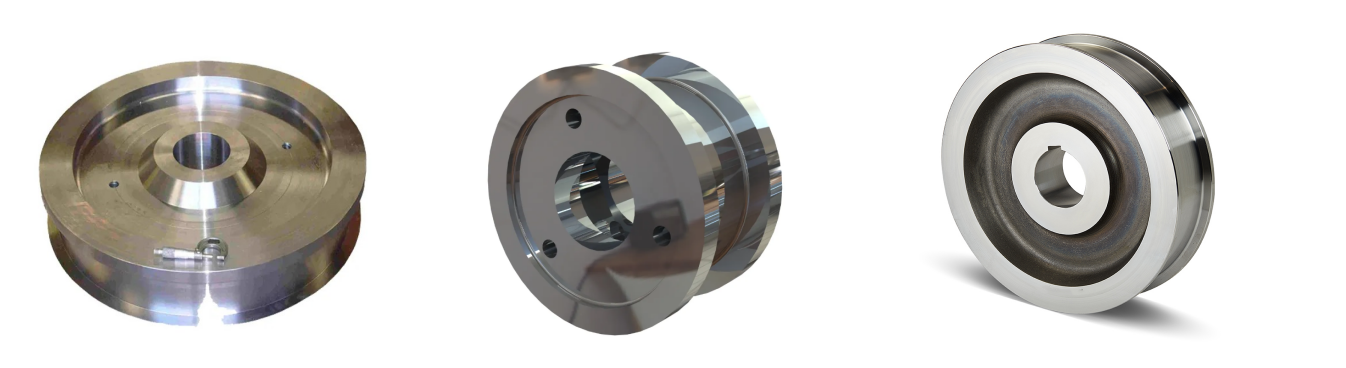
Crane wheel
An underslung Electric Overhead Traveling (EOT) crane is a type of crane where the crane bridge runs on rails that are suspended beneath the supporting structure. The crane wheel system is a crucial component of such cranes, as it facilitates smooth and efficient movement along the track.
Function of Crane Wheels:
The crane wheels are used to support the weight of the crane bridge and allow it to move along the rails of the runway. In an underslung EOT crane, the wheels are typically located on the underside of the crane bridge.
Design:
Material: Crane wheels are usually made from high-quality alloy steel, hardened and machined to ensure durability and resistance to wear. They may also be coated with a protective layer to prevent corrosion.
Diameter and Size: The size of the crane wheels depends on the load capacity and dimensions of the crane. Larger wheels are typically used for heavier load-bearing applications.
7.Crane Hook
An underslung EOT (Electric Overhead Traveling) crane is a type of crane where the crane's bridge is mounted underneath the runway beams, unlike the top-running cranes, where the bridge runs on top of the rails. The crane hook in an underslung EOT crane is the component that carries the load and is attached to the hoist mechanism, which moves along the crane's bridge.
Crane Hook Features for Underslung EOT Crane
Design: The crane hook is typically made of high-strength forged steel for durability and to withstand heavy loads.
Load Capacity: It is designed to handle specific load capacities, which vary depending on the size and specification of the crane. The load capacity is typically labeled on the crane or hook.
Safety Features:
Anti-fall mechanism: To prevent the load from falling.
Hook latch: Ensures that the load is securely attached to the hook.
Swivel capability: Some crane hooks are designed to swivel to allow for more flexibility when lifting and positioning the load.

Motor
The motor of an underslung EOT (Electric Overhead Traveling) crane is a critical component that powers the movement of the crane along its designated path.
Purpose
The motor provides the necessary torque to drive the crane's hoisting mechanism, as well as the horizontal movement (travel) along the beams.It ensures smooth and precise operations for lifting, lowering, and transferring loads.
Types of Motors Used
Hoist Motor: Powers the hoisting mechanism for lifting and lowering loads.Travel Motor: Powers the crane's movement along the runway or beam.Typically, AC motors are used, such as squirrel cage induction motors, for their durability and efficiency.
Design Features
Compact and Low-Weight Design: Fits the underslung configuration.
Robust Construction: Built to withstand industrial environments.
Thermal Protection: Protects the motor from overheating during prolonged use.
Braking System: Integrated or external brakes to hold the load in position.
.
Sound and light alarm system & limit switch
1) Sound and light alarm system
The sound and light alarm system for an underslung EOT (Electric Overhead Traveling) crane is a safety feature designed to alert personnel in the vicinity of the crane's operation. It is typically installed to provide both audible and visual signals when the crane is in motion or performing specific functions, to ensure that workers are aware of the crane's presence and operation, reducing the risk of accidents.
Sound Alarm (Audible Signal):This could be a horn or siren that produces a loud, distinct sound.It is usually activated when the crane is in operation or moving to warn nearby workers.The alarm can also be activated in specific conditions, such as during the lowering or lifting of loads, or when approaching an obstacle.
Light Alarm (Visual Signal):A flashing or rotating light (often mounted on the crane's structure) is used as a visual alert.The light color can vary, but common choices include red, yellow, or blue.It may be configured to flash when the crane is in operation, or as a warning when the load reaches a certain height or position.
2) Limit switch
A limit switch on an underslung EOT crane is a safety device used to limit the movement of the crane and prevent it from over-traveling beyond a certain point, which could damage the crane or surrounding equipment. Limit switches are crucial for the safe operation of the crane and are commonly installed at the ends of the travel paths (longitudinal and cross-travel), as well as for controlling the hoist's upward and downward movement.
Travel Limit Switches:These switches stop the movement of the crane when it reaches the end of its travel path. They are usually installed at both ends of the crane's track.Purpose: To prevent the trolley or bridge from running off the end of the track.
Hoist Limit Switches:These are installed to control the lifting mechanism, ensuring that the hoist motor stops when the hook reaches the upper or lower limit.Purpose: To prevent over-hoisting (lifting beyond the allowed limit) or over-lowering (lowering the hook too much).
Safety Limit Switches:These are often used as a backup to prevent unexpected crane movements and to protect both the crane and the operator.Purpose: To act as an emergency stop or fail-safe mechanism in case the normal limit switch malfunctions.

10.Safety Devices
1. Limit Switches
Purpose: Limit switches are installed to prevent over-travel of the crane components (hoist, trolley, and bridge). They automatically stop the motion of the crane when it reaches the end of its travel limit.
Types:
End-of-travel limit switches: Stops the crane at the maximum permissible travel.
Hoist limit switches: Prevents the hook from traveling too far up or down.
2. Overload Limiters
Purpose: Overload limiters ensure that the crane does not lift more than its rated capacity, preventing structural damage or accidents.
Operation: These devices sense the weight of the load being lifted and trigger an alarm or stop the hoist if the load exceeds the maximum safe limit.
3. Brakes
Purpose: Brakes are essential to stop the crane's motion safely and to hold the load in position when required.
Types:
Mechanical Brakes: Used for stopping the crane.
Electrical Brakes: Used for quick stopping or holding the load in position.
Automatic Brake Release: Prevents load from dropping in the event of power failure.
4. Anti-collision Devices
Purpose: Anti-collision devices are used to prevent collisions between the crane and other structures or equipment in the operating area.
Operation: These devices use sensors or infrared beams to detect obstacles and stop the crane or slow it down to avoid accidents.
5. Overheat Protection
Purpose: Overheat protection is installed on motors and other electrical components to prevent damage caused by excessive temperatures.
Operation: Thermal overload relays or temperature sensors automatically stop the crane if temperatures exceed safe limits.
6. Emergency Stop Button
Purpose: The emergency stop button is a manual control used to stop the crane immediately in case of an emergency.
Location: It is usually located at convenient points, such as the crane operator's cabin or remote control, for quick access.
7. Load Sway Control
Purpose: Load sway control systems reduce the swinging of the load during operation, which can be dangerous.
Operation: The system uses sensors to detect sway and automatically corrects the movement of the crane to stabilize the load.
8. Warning Lights and Audible Alarms
Purpose: Warning lights and alarms notify personnel of the crane's operation status, ensuring that they are aware of potential hazards.
Types:
Flashing Lights: Indicate the crane is in motion.
Audible Alarms: Signal when the crane is nearing a limit or an emergency condition exists.
9. Control Pendant with Safety Features
Purpose: The crane operator uses a pendant to control crane movements. It often includes safety features such as a dead man's switch or emergency stop button.
Operation: If the operator releases the control pendant or fails to press a button, the crane will stop to prevent accidents.
10. Double-Girder Safety
Purpose: In underslung cranes with double girder configurations, safety is enhanced by distributing the load between two beams, which reduces the likelihood of structural failure.
11.Control Mode
1) Ground handle control: The operator controls the operation of the crane by holding a control handle connected by a cable. There are multiple buttons on the handle, which are used to control the lifting, lateral movement and trolley movement of the crane. The cable is generally of a certain length, allowing the operator to operate at a safe distance.
2) Wireless remote control: The operation of the crane is controlled by a wireless remote control, which usually has buttons or rockers to control lifting, lateral movement and trolley operation. Without cable connection, the operator can move freely and operate the equipment at a long distance.
3) Cab control: The operator sits in the cab installed on the crane and operates directly through handles, buttons or joysticks. The cab is usually installed on the trolley or car of the crane, and the operator can directly observe the lifting operation site.
4) Centralized control (PLC control system): Use a programmable logic controller (PLC) for automated control to control the various actions of the crane through pre-programmed programs. The operator can control and monitor the operating status of the crane in the central control room or remotely through the human-machine interface (HMI).

12.Sketch

Main technical

Advantages
1. Maximized Headroom:
Optimal space utilization: By mounting the hoist under the girder, underslung cranes provide more vertical clearance, which is especially important in spaces with limited headroom.
Larger lifting height: This is ideal for applications where the lifting height is critical but the building structure or space has limited headroom.
2. Compact Design:
Space efficiency: The underslung design reduces the crane's overall size, making it a great choice for areas with height restrictions.
Minimal structural interference: Because the crane's mechanism hangs beneath the beam, there's less intrusion into the building's upper area, making it suitable for narrow or low-ceiling environments.
3. Better Stability in Certain Applications:
Reduced sway and vibrations: The underslung design can reduce the sway compared to top-running cranes because the weight of the load is better balanced.
Enhanced safety: The setup minimizes the risk of load instability or collisions with structural elements of the building.
4. Lower Building Construction Costs:
No need for additional support structures: Since the crane is mounted beneath the girder, there's less need for costly reinforcement or modification to the building's structure.
Efficient use of building space: This design allows for greater utilization of overhead space, avoiding the need for larger, more expensive buildings.
5. Increased Flexibility:
Versatile applications: Underslung cranes are often used in industries where space constraints and specific lifting requirements are present, such as in workshops, warehouses, and manufacturing facilities.
Suitable for smaller or irregularly shaped spaces: Their compact nature allows them to be used in smaller or unusually shaped facilities where traditional top-running cranes might not be suitable.
6. Energy Efficiency:
Lower power consumption: The mechanism is designed for efficient energy use, with less energy loss compared to other crane types, particularly in systems that use advanced motors and drive mechanisms.
7. Simpler Installation:
Quicker installation process: Since the structure doesn't require the same level of reinforcement as a top-running crane, the installation process can be faster and more cost-effective.
8. Reduced Maintenance:
Easier access for repairs and inspections: Maintenance can be easier because the underslung design often allows for simpler access to the crane's components.
9. Ideal for Existing Structures:
Perfect for retrofitting: If an existing building requires a crane system, an underslung EOT crane is often a good choice because it can be installed without needing significant structural alterations.
Application
1. Low Headroom Areas
Underslung EOT cranes are ideal for spaces with low headroom or where the ceiling height is limited. Since the crane is mounted below the supporting structure, it saves space, which is especially useful in factories or warehouses with low-clearance buildings.
2. Heavy Duty Lifting Operations
These cranes can be used in industries that require heavy lifting capabilities, such as steel plants, heavy engineering, and construction, where heavy loads need to be moved in confined spaces or over machines.
3. Production Lines
In manufacturing or assembly lines where cranes are needed to move materials or products along a fixed path, underslung EOT cranes provide an efficient means to transport goods without taking up excessive overhead space, allowing for a streamlined production environment.
4. Warehouses and Storage Facilities
For warehouses, especially those storing large or bulky materials, the underslung crane offers a solution for moving products efficiently while utilizing available space optimally. The design ensures more room for shelving and storage.
5. Narrow Aisle Cranes
Underslung cranes can be designed for use in narrow aisles between racks or machinery, as the reduced headroom allows for better maneuverability and avoids interference with existing infrastructure.
6. Material Handling in Construction
These cranes are particularly suited for construction sites, where there is a need to move materials across various parts of the site. They are versatile and can be mounted on existing infrastructure, reducing the need for extensive structural modifications.
7. Machine Tool Manufacturing
In the machine tool industry, where precision handling of large parts or components is required, an underslung crane can offer stability and maneuverability in areas where floor space or ceiling height is limited.
8. Mining and Heavy Equipment
In mining operations, underslung cranes can help with lifting heavy mining equipment and materials, especially in areas with restricted vertical space, such as underground facilities or deep pit operations.
9. Workshop and Maintenance Applications
Underslung EOT cranes are often used in maintenance workshops where machines or equipment need to be moved for repairs or routine maintenance. The design allows easy access without the need for extensive structural modifications.
10. Power Plants and Chemical Plants
Power and chemical plants often use underslung EOT cranes for lifting and moving heavy parts, machinery, or raw materials within confined or space-constrained areas.
Crane production procedure
1. Design and Engineering
Requirement Analysis: Gather details like load capacity, span, lifting height, and operational environment.
Structural Design: Design the main components, such as the girder, end carriages, hoist mechanism, and runway system.
Electrical and Mechanical Design: Create a detailed design for the electrical system (motors, panels, etc.) and mechanical parts.
Approval and Prototyping: Get client approval and, if needed, create a prototype for testing.
2. Material Procurement
Procure high-quality materials such as steel for girders, motors, gearboxes, and electrical components like panels, wiring, and control systems.
Ensure materials meet specified standards and are inspected for defects.
3. Fabrication
Cutting: Use CNC machines or plasma cutters to shape steel plates and sections as per design.
Welding: Weld the girder and other components to ensure structural strength. Follow standards like AWS or ISO for welding.
Machining: Precision-machine critical parts like shafts, wheels, and couplings to ensure smooth operation.
Inspection: Conduct non-destructive testing (NDT) on welds to ensure quality.
4. Assembly
Assemble the main parts, including the girder, hoist, end carriages, and trolleys.
Install motors, gearboxes, and electrical components like control panels and wiring.
Integrate safety features, such as limit switches, brakes, and overload protection.
5. Surface Treatment
Perform sandblasting to remove rust and impurities.
Apply a primer coat and final paint to protect against corrosion and match the client's specifications.
6. Testing
Mechanical Testing: Check the operation of the hoist, trolley movement, and overall load handling capacity.
Electrical Testing: Verify the performance of the control panel, limit switches, and wiring connections.
Load Testing: Perform both static and dynamic load tests to ensure the crane can handle the specified capacity safely.
Safety Checks: Inspect emergency systems like brakes and overload protectors.
7. Quality Control
Conduct a final inspection to verify all components meet quality and operational standards.
Ensure compliance with ISO, OSHA, and other relevant standards.
8. Packing and Delivery
Disassemble the crane (if required) for easier transportation.
Pack components securely to prevent damage during transit.
9. Installation and Commissioning
On-Site Assembly: Reassemble the crane components on the client's premises.
Runway Installation: Set up the runway system and align the crane.
Testing: Perform on-site operational and load tests to ensure proper functioning.
Handover: Provide a user manual and training to the client's operators.
10. After-Sales Support
Offer maintenance schedules, spare parts, and technical support to ensure long-term performance.

Workshop view:
The company has installed an intelligent equipment management platform, and has installed 310 sets (sets) of handling and welding robots. After the completion of the plan, there will be more than 500 sets (sets), and the equipment networking rate will reach 95%. 32 welding lines have been put into use, 50 are planned to be installed, and the automation rate of the entire product line has reached 85%.


Hot Tags: underslung eot crane, China underslung eot crane manufacturers, suppliers, factory, Double Girder Overhead Cranes, Single Girder Overhead Crane Company, Eot Crane
Previous
Electromech Eot CranesYou Might Also Like


Send Inquiry