










5 Ton Mobile Portable Gantry Crane
Products Description
A 5-ton mobile portable gantry crane is a self-supporting, freestanding lifting system designed to hoist and move heavy loads up to 5 tons (10,000 lbs / 4,536 kg). Its key characteristic is mobility; it's typically mounted on casters or wheels, allowing it to be easily moved around a workshop, warehouse, or job site without requiring a fixed installation like an overhead bridge crane.
Core Components: PLC, Bearing, Gearbox, Motor, Gear
Place of Origin: Henan, China
Warranty: 1 Year
Weight (KG): 500 kg
Video outgoing-inspection: Provided
Machinery Test Report: Provided
Color: Customized
Crane feature: Easy Operated
Capacity: 1-20t
Type : Single Girder
Power supply: 110V/220V/230V/380V/440V
Control Method: Ground Control+ Remote Control (customized)
MOQ: 1 Set
Lifting mechanism: Eliectric Hoist
Work Duty: A3-A4

Pictures & Components
1. Main Structural Framework
This is the primary load-bearing structure of the crane.
Legs (Uprights): Two vertical structures that support the entire crane and the load. They are typically constructed from high-tensile steel box sections or I-beams for maximum strength and resistance to bending. On mobile gantries, the legs are almost always adjustable.
Bridge Girder (Top Beam): The horizontal beam that spans the distance between the two legs. It supports the hoist and trolley and must be engineered to resist bending (deflection) under full load. It can be a single beam (single girder) or two beams (double girder) for heavier capacities and longer spans. A 5-ton crane is commonly a single girder design.
Bracing: Diagonal or cross members that connect the legs to the bridge girder or to each other. They provide critical stability, preventing the structure from racking (deforming into a parallelogram) under side loads or during movement.

2. Mobility and Support System
This is what makes the crane "mobile and portable."
Base Frame / Sill Beam: The horizontal frame at the bottom of each leg that provides a stable footprint. It distributes the crane's weight and the load over a larger area.
Castors / Wheels: Heavy-duty, swiveling or rigid wheels mounted to the base frame. They are typically made of forged steel or high-strength polyurethane.
Swivel Castors: Allow for omnidirectional movement and easy maneuvering.
Rigid/Fixed Castors: Provide stability in one direction of travel.
A combination of swivel and rigid castors is often used for optimal control.
Brakes / Locks: Essential for safety. Each castor will have a braking mechanism.
Wheel Brakes: Stop the wheel from rotating.
Swivel Locks: Prevent the castor from swiveling, locking the crane's direction of travel.
Outriggers / Jacking Screws: Manual screw-down supports that can be extended to lift the wheels off the ground, transferring the load directly to a stable, fixed point. This is crucial for stabilizing the crane before a lift.
 |
 |
3. Lifting and Translation Mechanism
The components that actually handle and move the load.
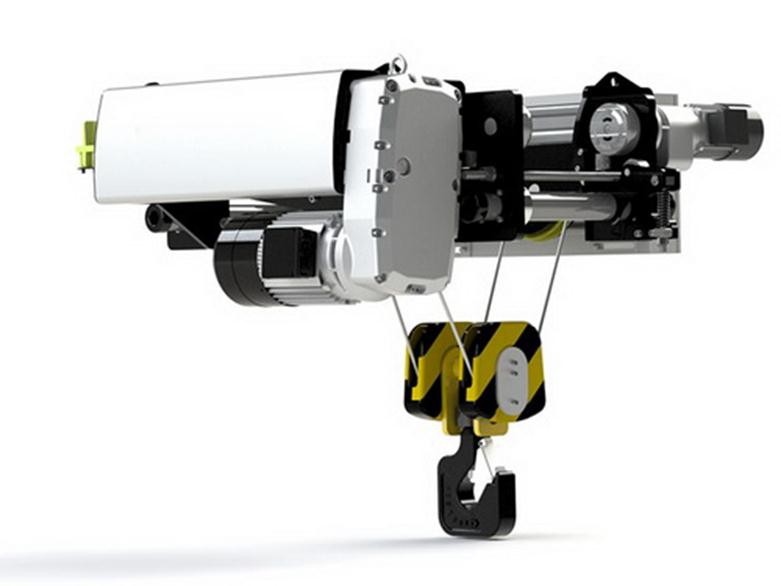
Hoist Unit: The motorized device that does the lifting and lowering. It can be either a chain hoist (more common for portable applications due to its compact size and durability) or a wire rope hoist (often used for higher speeds and greater lift heights).
Trolley: The assembly that carries the hoist along the length of the bridge girder. The operator pushes it manually (for lighter models) or it can be motorized (power-driven trolley) for precise positioning of heavy loads.
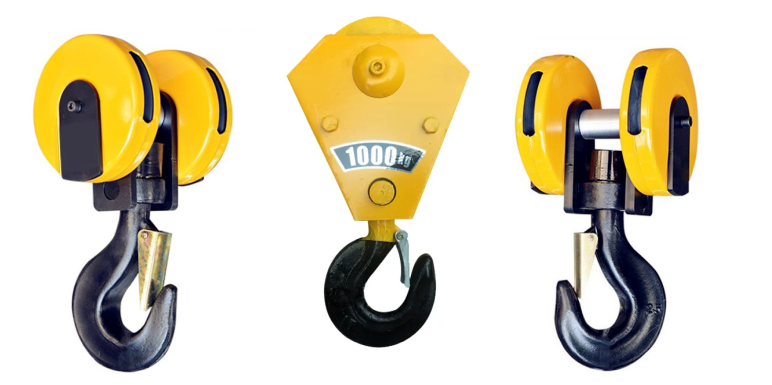
Hook: The final load-holding component, attached to the hoist's chain or wire rope. It is equipped with a safety latch to prevent the sling or load from accidentally slipping off.
 |
 |
4. Adjustment and Extension Systems
Key features that enhance the versatility of a portable gantry.
Height Adjustment: Allows the crane to adapt to different load heights and clearance requirements. This is usually done via pinned or screw-type mechanisms:
Pinned Holes: The leg sections have a series of holes; a pin is inserted at the desired height. Quick and secure, but offers fixed increments.
Screw Thread / Telescopic Legs: One section of the leg screws inside another, allowing for infinite height adjustment within its range.
Span / Width Adjustment: Allows the distance between the legs to be changed to accommodate wider loads. This is typically achieved by having a telescoping bridge girder or by using extension inserts that bolt onto the main beam.
5. Safety and Operational Components
Crucial for safe and efficient operation.
Safety Latch (Hook Latch): A spring-loaded gate on the hook that prevents slings from disengaging.
Overload Limit Switch (Optional on some models): An electrical safety device that automatically cuts power to the hoist if it attempts to lift beyond its rated capacity (5 tons).
Bumpers / End Stops: Physical stops at the ends of the bridge girder to prevent the trolley from running off the rails.
Manual Push Handles: Bars attached to the legs or base to allow an operator to safely push and maneuver the crane without putting themselves in a pinch point.


.
1. Sound and Light Alarm System (Travel Alarm)
This system provides active warnings before and during movement.
Purpose:
Personnel Safety: To alert anyone working in the vicinity that the crane is about to move or is moving. This is especially important for portable gantries as they are often used in shared or congested workshop spaces.
Asset Protection: To warn operators to clear obstacles from the crane's path.
How It Works:
Activation: The alarm is typically wired into the crane's travel motor circuit. It is automatically activated as soon as the operator engages the travel direction (e.g., pushes the button on the pendant for forward or reverse).
Components:
Beeper / Siren: Emits a loud, distinct, and intermittent beeping sound (e.g., 85-100 dB). The sound must be audible over background workshop noise.
Rotating Beacon or Strobe Light: A bright, usually amber or red, flashing light provides a clear visual warning, which is essential in noisy environments or for personnel wearing hearing protection.
Typical Operation Sequence:
Operator selects travel direction on the pendant.
First, the alarm sounds and the light flashes for a pre-set time (e.g., 2-5 seconds) before the crane wheels begin to turn.
The crane starts moving, and the alarm and light continue to operate until travel is stopped.
2. Limit Switches (Safety Limiters)
These are passive safety devices that automatically cut power to a motor to prevent over-travel. For a mobile gantry crane, the most critical limit switches are on the hoist unit itself.
Purpose:
To prevent the hoist from raising or lowering the hook block beyond its safe physical limits, protecting the equipment and load.
Types and Locations:
a) Upper Limit Switch (Hoist Up)
Function: This is the most important safety limit switch. It stops the hoist motor before the hook block or pulley makes contact with the drum or the body of the hoist (a dangerous condition called "two-blocking" or "over-hoisting").
How it Works: It is a mechanical or proximity switch positioned to be triggered by the ascending hook block. When activated, it immediately cuts power to the hoist-up function. The hoist should still be able to lower, allowing the operator to correct the situation.
b) Lower Limit Switch (Hoist Down)
Function: To prevent the hook assembly from being lowered to the point where the wire rope becomes completely unspooled from the drum, which can damage the rope and the drum's anchorage.
How it Works: Similar to the upper limit, it cuts power to the hoist-down function when triggered. It is often set to leave a minimum of 2-3 wraps of rope on the drum.
c) End Travel Limit Switches (Less Common on Basic Portable Gantries)
Function: On larger, motorized travelling gantries, you might find limit switches at the end of the beam to prevent the hoist trolley from crashing into the end stops. On mobile gantries, the travel movement is the whole crane moving on wheels, and end stops are usually manual (operator vigilance).
Integration and Best Practices for a 5-Ton Crane
Mandatory Safety Features: For a 5-ton capacity crane, these are not optional extras; they are mandatory safety requirements according to international standards like ISO, ASME B30, and OSHA regulations. A crane without them is unsafe and non-compliant.
Interlocks: The limit switches are wired in series with the control circuit for their respective functions. Breaking the circuit (by the switch triggering) is what stops the motor.
Bypassing: Limit switches should never be permanently bypassed. They are only bypassed temporarily for maintenance or testing by a qualified technician, and warning tags must be used.
Testing and Inspection:
Alarm System: Test the sound and light before each shift to ensure they are functional.
Limit Switches: Test the upper limit switch regularly (e.g., weekly) by slowly raising the hook to its limit and verifying that the hoist stops automatically. Do this with no load or a very light load.
Operator Training: Operators must be trained on what these alarms and limits mean and must never attempt to defeat them. If a limit switch stops operation, the operator must lower the load (in the case of an upper limit) and investigate the cause, not simply try to force movement in the opposite direction.

Safety Devices
I. Primary & Mandatory Safety Devices
These are non-negotiable and are typically required by safety standards like OSHA (Occupational Safety and Health Administration) and ANSI/ASME B30.
1. Overload Limit Switch / Load Limiter
Purpose: This is the most critical safety device. It prevents the crane from lifting a load heavier than its rated capacity (5 tons in this case).
How it Works: A sensor (often mechanical or electronic) measures the tension in the hoist line. If the load exceeds 105-110% of the rated capacity, the switch automatically cuts power to the hoist's up motion. The down motion usually remains operational to lower the load safely.
2. Upper Limit Switch / Hoist Limit Switch
Purpose: To prevent the hoist block, hook, or load from making contact with the crane's beam. This "over-hoisting" can cause catastrophic failure.
How it Works: A switch is positioned to be triggered when the hoist hook approaches the beam. It cuts power to the up motion, forcing the operator to lower the hook before proceeding.
3. Emergency Stop (E-Stop)
Purpose: To allow the operator to immediately cut all power to the crane's movements in case of an emergency or observed hazard.
How it Works: A prominently located, large, red button (often mushroom-shaped) on the pendant control. When pressed, it locks in the open position and must be manually reset (usually by twisting or pulling) to resume operation.
4. Load Hooks with Safety Latches
Purpose: To prevent the sling or chain from accidentally disengaging ("jumping off") the hook.
How it Works: A spring-loaded latch covers the throat opening of the hook. The latch should be mandatory for any lifting application.
5. Structural End Stops / Buffers
Purpose: To prevent the hoist trolley from running off the ends of the bridge beam.
How it Works: Physical blocks (often made of hardened rubber or metal) are bolted or welded to each end of the beam. The trolley cannot travel past these points.
II. Operational Safety Features
These are design features that contribute directly to safe operation.
1. Braking Systems
Hoist Brake: An automatic, fail-safe brake that holds the load when the hoist motor is not powered. It engages if there is a power failure.
Trolley & Gantry Brakes: On more advanced models, brakes may be present on the trolley travel and gantry travel motors to control movement, especially on slopes.
2. Pendant Control Station (if equipped)
Design: Should be durable, with clearly marked, intuitive controls for up/down, left/right, and forward/backward.
Low Voltage: For operator safety, pendant controls typically operate on a low voltage (e.g., 24V or 48V), which is transformed down from the main power supply, reducing the risk of electrocution.
3. Locking Casters / Wheels
Purpose: To immobilize the entire gantry crane once it is in position, preventing unintended movement during the lift.
How it Works: Most portable gantries have at least two swivel casters with brakes. The best practice is to have brakes on all four wheels.
III. Passive Safety & Design Features
These are built-in characteristics that enhance overall safety.
1. Rated Capacity / Data Plate
Purpose: Clearly communicates the safe working limits of the crane.
Details: Must be permanently marked and visible. It includes the SWL (Safe Working Load) of 5 tons, model number, serial number, and manufacturer details.
2. Welded Construction & Structural Integrity
While not a "device," the crane must be built from high-quality materials (typically steel) with certified welding procedures to handle not just the 5-ton load but the dynamic forces (shock loads) of lifting and moving.
3. Non-Conductive Nylon Wheels / Insulating Pad
Purpose: To protect the operator when lifting loads in environments with live electrical components or lines. They prevent the crane from becoming a path to ground.
Note: This is a specific feature for certain environments and may not be standard on all models.
4. Anti-Slip Walk Surfaces
Textured or grated surfaces on any standing areas (e.g., on a taller gantry's platform) to prevent slips and falls during inspection or operation.
Control Mode
1. Manual Control (Chain Hoist)
This is the simplest and most cost-effective method. The crane's travel (moving along the beam) and lifting functions are operated entirely by human force via chains.
Lifting: A manual chain hoist (e.g., a lever hoist or hand chain hoist) is hung from the trolley. The operator pulls a chain to lift and lower the load.
Trolley Travel: The trolley is moved along the bridge beam by pulling a separate chain.
Gantry Movement: The entire crane is moved by physically pushing or pulling the legs. Many models have casters that can be switched from fixed to swivel for easy maneuvering.
Typical Use Case: Ideal for small workshops, maintenance bays, or applications where lifts are infrequent and a power source is not readily available.
2. Push Button Pendant Control (Most Common for Electric Models)
This is the standard control mode for electric-powered 5-ton portable gantry cranes. All functions are motorized and controlled by an operator using a handheld control box (the pendant) connected to the crane via a cable.
Functions Controlled:
Hoist Up/Down: Controls the electric hoist.
Trolley Travel: Moves the hoist and trolley side-to-side along the bridge beam.
Bridge Travel: Moves the entire gantry crane forward and backward along the ground.
Safety Features: The pendant features an emergency stop (E-stop) button and requires the operator to continuously press the buttons for operation (a "deadman's switch" feature), enhancing safety.
Typical Use Case: The workhorse of manufacturing, assembly lines, and loading docks. It allows precise control while keeping the operator at a safe distance from the load.
3. Wireless Radio Remote Control
This is a premium feature that offers the greatest flexibility and safety for the operator. It functions exactly like the pendant control but without the physical cable tether.
How it Works: A battery-operated handheld transmitter sends signals to a receiver unit mounted on the crane.
Key Advantages:
Freedom of Movement: The operator can position themselves anywhere for the best view of the load and landing area, including walking alongside it.
Enhanced Safety: Eliminates the trip hazard of a pendant cable and allows operation from a safe distance, especially important if the load could shift or fall.
Ideal for Solo Operators: Provides unmatched visibility and control when no one is available to guide you.
Typical Use Case: Large assembly halls, steel fabrication shops, loading very large items where the operator's perspective is crucial, and any environment where a cable would be impractical or hazardous.
4. Cabin Control (Very Rare on Portable Models)
This involves an operator sitting in a dedicated cabin mounted on the gantry crane itself. Due to the portable and often lower-clearance nature of a 5-ton mobile gantry, this is extremely uncommon. It is almost exclusively found on very large, fixed, industrial gantry cranes with capacities far exceeding 5 tons.

12.Sketch

Main technical

Advantages
Core Advantages of a 5-Ton Mobile Portable Gantry Crane
1. Unmatched Portability and Mobility
Easy Relocation: Unlike fixed gantry or overhead bridge cranes, these cranes are designed to be moved easily. They are typically lightweight (relative to their capacity) and often feature swivel casters with brakes on all four legs. This allows a single operator to push the crane to wherever it's needed on a smooth floor.
No Permanent Installation: They require no costly and permanent foundation work, building modifications, or electrical installation to operate. You simply move it into place and it's ready to use.
Ideal for Multiple Sites: Perfect for job shops, warehouses with changing layouts, or facilities that need to serve multiple workstations with a single crane.
2. Superior Flexibility and Versatility
Workstation Freedom: The crane can be brought directly to the load, rather than having to bring the load to a fixed crane. This is invaluable for machine shops, fabrication areas, and assembly lines where the work location changes.
Adjustable Span: Most models allow users to adjust the width between the legs to accommodate different sizes of machinery, pallets, or work areas.
Adjustable Height: The beam height is often adjustable, providing the necessary clearance for specific tasks or for stacking loads.
Use Indoors and Outdoors: While best on a firm, level surface like concrete, they can be used in a yard or on a paved area for loading/unloading trucks or outdoor storage tasks.
3. Significant Cost-Effectiveness
Lower Initial Investment: They are significantly cheaper to purchase and install than a permanent overhead crane system or a large fixed gantry.
One Crane for Many Tasks: A single 5-ton mobile gantry can serve an entire workshop, eliminating the need for multiple fixed-location hoists or dedicated cranes at each station.
No Installation Costs: Savings on construction, electrical work, and engineering fees for permanent installations are substantial.
4. Enhanced Safety and Control
Stable and Robust: Designed for a 5-ton capacity, these cranes are built with a wide base and strong legs to provide excellent stability during lifts, reducing the risk of tipping.
Precise Load Handling: The operator has direct control over the movement, allowing for precise positioning of heavy parts onto machines, into fixtures, or onto trucks. This control minimizes the risk of damaging expensive equipment or the load itself.
Reduced Manual Handling: The primary advantage of any crane is the elimination of heavy manual lifting, drastically reducing the risk of worker strain, injury, and associated compensation claims.
5. Independence and Self-Contained Operation
No Power Required: Many are completely manual, relying on a push-style trolley and a hand chain hoist or lever hoist. This makes them usable in remote locations or areas without easy access to power.
Optional Power: For easier operation, powered trolleys and electric chain hoists can be added, but these typically run on rechargeable batteries, maintaining their mobility.
No Building Structure Support: The load is supported by the crane's own frame, not by the building's roof or support columns. This is crucial for older buildings or those with structural limitations.
6. Space Efficiency
Clear Floor Space: Unlike a jib crane that requires a fixed floor mount, a mobile gantry can be moved completely out of the way when not in use, freeing up valuable floor space for other operations. It can be stored against a wall or in a corner.
Application:
Primary Applications and Use Cases
1. Warehousing & Logistics
Loading/Unloading Trucks: Positioned directly at the dock or tailgate to lift heavy items on or off trucks without requiring a fixed dock crane.
Rearranging Inventory: Moving heavy pallets, machinery, or stored items within a warehouse aisle. Its mobility allows it to service multiple locations.
Order Picking: Precisely positioning heavy items for order assembly.
2. Manufacturing & Assembly Shops
Machine Installation & Maintenance: Lifting lathes, CNC machines, presses, and other heavy equipment onto foundations or for repair.
Positioning Workpieces: Moving heavy raw materials (steel plates, large castings) onto worktables, welding jigs, or machining centers.
Assembly Operations: Holding large components in place for welding, bolting, or fitting.
3. Construction Sites
Handling Materials: Moving construction supplies like bags of concrete, rebar cages, piping, and generators around the job site.
Staging Areas: Loading and unloading materials from delivery vehicles into a organized staging area.
Maintenance Work: Lifting heavy tools or equipment for repair and maintenance tasks on-site.
4. Metalworking and Fabrication Shops
Handling Sheet Metal & Beams: Lifting and maneuvering large, awkward sheets of metal or long structural beams (I-beams, channels) for cutting, bending, or welding.
Rotating Loads: Used in conjunction with a beam trolley to easily move loads along the beam's length, ideal for positioning in large work cells.
5. Maintenance, Repair, and Operations (MRO)
Equipment Repair: Lifting motors, pumps, gearboxes, and other components out of machinery for overhaul.
Plant Outages: Essential for planned maintenance shutdowns where fixed cranes may be unavailable or overloaded. Can be brought in temporarily to assist.
Engine Hoisting: A common use is lifting engines out of vehicles, boats, or industrial equipment.
6. Shipping and Receiving Departments
Inspecting Incoming Goods: Lifting heavy crates and shipments off pallets for quality control inspections.
Repackaging/Relabeling: Handling heavy products that need to be repalletized or prepared for outbound shipping.
7. Aerospace and Automotive Industries
Handling Components: Lifting and positioning sub-assemblies, jigs, tools, and parts like aircraft wings, fuselage sections, or vehicle chassis in R&D, repair, or custom build shops.
8. Event and Rigging Industries
Setting up Stages: Lifting heavy sound equipment, lighting rigs, and trusses into position for concerts, theaters, and conferences.
Crane production procedure
Phase 1: Engineering & Design
Objective: To create detailed design plans, calculations, and Bill of Materials (BOM) that meet specified requirements and international standards (e.g., ISO, ASME, CMAA).
Requirement Analysis:
Define key parameters: Capacity (5 ton), span, lifting height, mobility requirements (wheel type, surface), operational environment (indoor/outdoor).
Determine compliance standards (e.g., CMAA 74, OSHA).
Structural Design & Calculation:
CAD Modeling: Create 3D models of the entire crane structure (two legs, one or two beams, bracing, end trucks).
Finite Element Analysis (FEA): Perform structural simulation to analyze stress, deflection, and buckling under full load (5 ton) and side-pull conditions. Ensure deflection is within limits (typically Span/500 for bridge girders).
Load & Stability Calculation: Verify stability against tipping. Calculate the load on each wheel and select appropriate wheels/casters.
Lifting Lug Design: Design and calculate the load-bearing capacity of the top beam lifting lugs.
Mechanical & Electrical Design:
Hoist Selection: Specify a certified 5-ton capacity electric or manual chain hoist. Design the interface for mounting the hoist to the beam.
Electrical System (if applicable): Design the wiring diagram for the push-button pendant control for the hoist and trolley (if motorized).
Wheel & Axle Design: Design the axle mounting and braking system (if required).
Documentation:
Generate detailed manufacturing drawings for all components.
Create a comprehensive Bill of Materials (BOM) listing all raw materials, purchased parts (hoist, wheels, motors, electrical components), and fasteners.
Prepare assembly instructions and a test procedure.
Phase 2: Procurement & Material Preparation
Objective: To source all required materials and components.
Raw Material Procurement:
Order structural steel sections (typically I-Beams or box sections for the main beam, rectangular hollow sections for the legs) as per the BOM and cutting plan.
Purchased Components:
Order the 5-ton hoist unit, trolley (manual or motorized), polyurethane or nylon wheels with brakes, electrical components (cable, pendant station, contactors), and all necessary hardware.
Material Preparation:
Cutting: Cut steel beams and plates to required dimensions using CNC plasma cutters, band saws, or shears for high precision.
Surface Preparation: Shot blast cut pieces to remove mill scale and rust, providing a clean surface for welding and painting.
Phase 3: Fabrication & Machining
Objective: To manufacture all structural components.
Machining:
Machine the mating surfaces for the end trucks and leg hinges (if adjustable) to ensure a flat, square fit.
Sub-Assembly Fabrication:
Leg Assembly: Weld the leg sections, bracing, and footplates/wheel mounting plates. Ensure they are square and true.
End Truck / Cross Beam Assembly: Fabricate the assembly that holds the wheels and connects to the main beam.
Main Beam Fabrication: Weld the main beam, ensuring it is straight and has the correct camber (slight upward pre-bend to counteract deflection under load).
Quality Control (During Fabrication):
Inspect all welds visually and via Non-Destructive Testing (NDT) like Magnetic Particle Testing (MPT) if required by design.
Check critical dimensions against drawings.
Phase 4: Sub-Assembly & Pre-Painting
Objective: To assemble major components and prepare for painting.
Trial Fit-Up:
Assemble the main frame (beam bolted or pinned to the legs) to check for fit, alignment, and squareness.
Disassemble after successful fit-up.
Surface Preparation for Painting:
Mask any machined surfaces or areas that should not be painted (e.g., bolt holes, electrical contact points).
Apply a primer coat to all components to prevent corrosion.
Phase 5: Painting & Finishing
Objective: To apply a durable, protective, and aesthetic finish.
Paint Application:
Apply the specified topcoat paint (typically a high-quality industrial enamel or epoxy paint) in the customer's chosen color.
Apply using spray guns for an even, consistent finish.
Curing:
Allow paint to fully cure according to the paint manufacturer's specifications in a controlled environment.
Phase 6: Final Assembly
Objective: To assemble all components into the final product.
Mechanical Assembly:
Mount the wheels and axles to the end trucks.
Install the trolley track on the bottom flange of the main beam (if applicable).
Bolt or pin the main beam to the two leg assemblies. Install all locking pins and safety devices.
Install the hoist and trolley onto the beam.
Assemble any telescopic leg extensions and secure them with pins.
Electrical Assembly (if applicable):
Mount the electrical panel/control box.
Wire the pendant station to the hoist and trolley motors.
Perform continuity and functional checks on the electrical system.
Labeling:
Affix all necessary safety and warning labels.
Attach the Nameplate with critical information: Model, Serial Number, Capacity (5 ton), Span, Date of Manufacture, and Manufacturer.
Phase 7: Testing & Quality Assurance (QA)
Objective: To verify the crane operates safely and meets all design and performance criteria.
Visual & Dimensional Inspection:
Verify all parts are assembled correctly, pins are secure, and labels are affixed.
Check overall dimensions.
Functional Test:
Test the raising and lowering of the hoist through its full range.
Test the trolley movement along the beam.
Test the mobility of the crane (pushing, braking, steering).
Load Test (MANDATORY):
Proof Load Test: Lift a test weight equal to 125% of the rated capacity (6.25 tons). Hold the load for 10 minutes and inspect the entire structure for any deformation, cracks, or defects. Measure beam deflection to ensure it is within calculated limits.
Rated Load Test: Lift the full 5-ton capacity and perform all functional movements.
Documentation:
A formal test certificate is generated, documenting all test results and confirming the crane passed.
Phase 8: Packaging & Dispatch
Objective: To prepare the crane for safe shipping.
Disassembly (for shipping):
The crane is partially disassembled (legs detached from beam, hoist often separate) to create a compact, shippable package.
Packaging:
Components are wrapped in protective plastic or foam.
All parts are securely mounted to a wooden skid or pallet to prevent movement during transit.
All hardware, manuals, and test certificates are placed in a waterproof bag and attached to the shipment.
Dispatch:
The packaged product is shipped to the customer or distributor.

Workshop view:
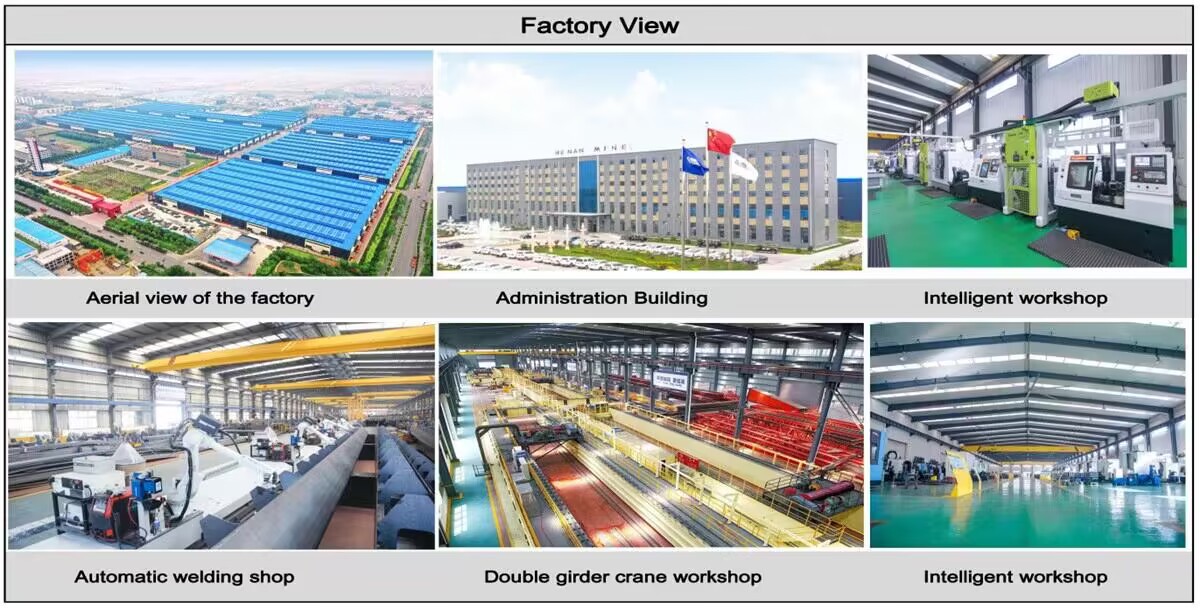
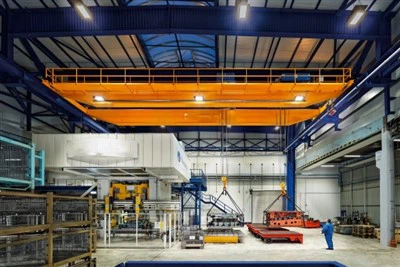
The company has installed an intelligent equipment management platform, and has installed 310 sets (sets) of handling and welding robots. After the completion of the plan, there will be more than 500 sets (sets), and the equipment networking rate will reach 95%. 32 welding lines have been put into use, 50 are planned to be installed, and the automation rate of the entire product line has reached 85%.


Hot Tags: 5 ton mobile portable gantry crane, China 5 ton mobile portable gantry crane manufacturers, suppliers, factory
You Might Also Like



Send Inquiry