










180 T Boat Hoist Crane
Products Description
Key Features and Components
Capacity (180 Metric Tons):
This is the maximum weight it can lift. It's crucial for handling large yachts, fishing vessels, patrol boats, small ferries, and commercial/workboats.
Important Note: The capacity is often dependent on the lift configuration (e.g., the distance of the load from the crane's center). The 180T rating is typically the maximum at the shortest possible boom radius.
Type of Crane:
Mobile Gantry Crane: This is the most common type for boat hoists. It runs on rails along a dock or pier. The vessel is positioned between the gantry's legs, and slings are passed under the hull for the lift.
Stiffleg or Portal Crane: A fixed-base crane often seen at the edge of a pier.
Travelift™ / Synchronous Hoist: This is a very popular brand of mobile gantry crane specifically for this purpose. A "180T Travelift" is a common sight in boatyards worldwide.
Lifting Mechanism:
Uses a spreader bar and multiple lifting slings (often 4 or more) to distribute the weight evenly and prevent damage to the boat's hull.
The hoist has multiple independent winches that can be synchronized to keep the boat level during the lift.
Mobility:
Runs on heavy-duty rubber tires (for Travelift-type cranes) or on fixed steel rails. Rail-mounted systems offer more precision but less flexibility in movement around the yard.
Control System:
Modern cranes feature sophisticated electronic controls, often from an elevated, air-conditioned cab that gives the operator a perfect view of the lift.
They include load moment indicators (LMI), anti-collision systems, and overload protection for safety.
Comparison with Other Boat Lifting Systems
| Feature | Gantry Boat Hoist | Marine Railway | Floating Dry Dock |
|---|---|---|---|
| Mobility | High (if rubber-tired) | Low (fixed track) | Low (water-dependent) |
| Max Capacity | 10–500+ tons | 50–5,000 tons | 1,000–100,000+ tons |
| Speed | Fast (minutes) | Slow (hours) | Moderate (hours) |
| Best For | Small to medium boats | Large ships | Massive vessels |
Comparison with Other Boat Lifting Systems
| Feature | Gantry Boat Hoist | Marine Railway | Floating Dry Dock |
|---|---|---|---|
| Mobility | ✅ High (if rubber-tired) | ❌ Fixed track | ❌ Water-dependent |
| Max Capacity | 10–500+ tons | 50–5,000 tons | 1,000–100,000+ tons |
| Speed | ⚡ Fast (minutes) | 🐢 Slow (hours) | 🕒 Moderate (hours) |
| Space Needed | Compact storage | Long track area | Large water area |
| Best For | Small-medium boats | Large ships | Massive vessels |
Lifting Capacity 180 tons
Span (Width) 3 - 12 meters (adjustable)
Lifting Height 3 - 10 meters
Working Class A3-A5 (light to medium duty)
Hoisting Speed 0.5 - 8 m/min (variable)
Main Beam Type Single/double girder (box-type)
Power Supply 220V/380V 3-phase or manual
Control Mode Pendant control/wireless remote
Hoist Type Electric chain hoist/wire rope hoist
Travel Drive Manual push or motorized
Corrosion Protection Hot-dip galvanized or marine-grade paint
Wind Resistance Up to Beaufort scale 6 (for outdoor use)
Operating Temp -20°C to +50°C

Pictures & Components
I. Structural System (The Frame & Support)
This is the physical backbone of the hoist.
Main Girders / Beams: The primary horizontal steel beams that span the width of the travel way. They carry the entire load from the lifting slings to the end trucks.
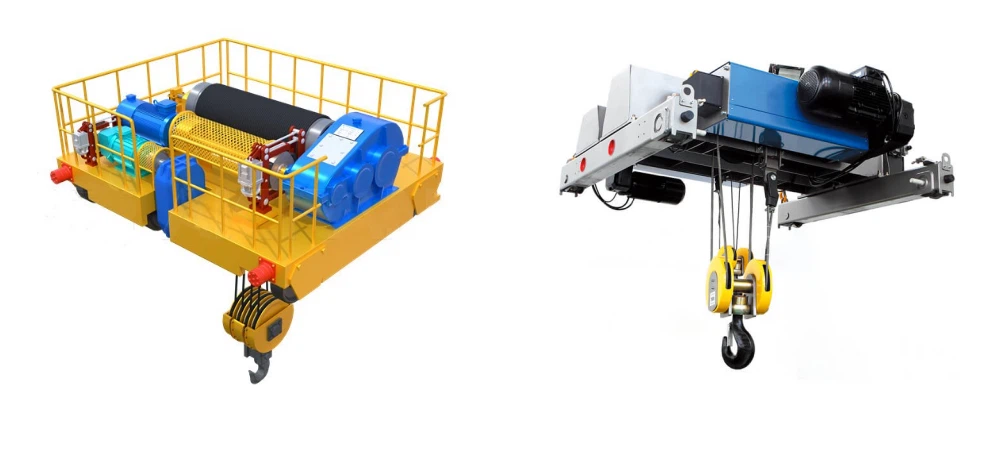
End Trucks (or Legs): The vertical or A-frame structures at each end of the crane that house the wheels and drive mechanisms. They transfer the load from the main girders to the runway rails.
Cross Braces & Diagonal Bracing: Steel members that connect the main girders and end trucks, providing critical rigidity and preventing twisting or racking under load.
Cantilever Arms (if applicable): Extensions beyond the end trucks that provide clearance for the vessel's superstructure (flybridge, radar arch, etc.) during lifting and moving.

II. Hoisting & Lifting System
This system does the actual work of raising and lowering the vessel.
Hoist Winches: The powerful electric or hydraulic motors, typically one per lifting point (e.g., 4, 6, or 8 winches for a 180T crane), that spool the wire rope. They are equipped with high-resolution encoders for precise synchronization.
Wire Rope (Cable): High-strength, galvanized steel cable that runs from the winches over the sheaves and down to the spreader bars.
Sheaves / Blocks: The grooved wheels mounted in assemblies that guide the wire rope, providing mechanical advantage and directing the force.
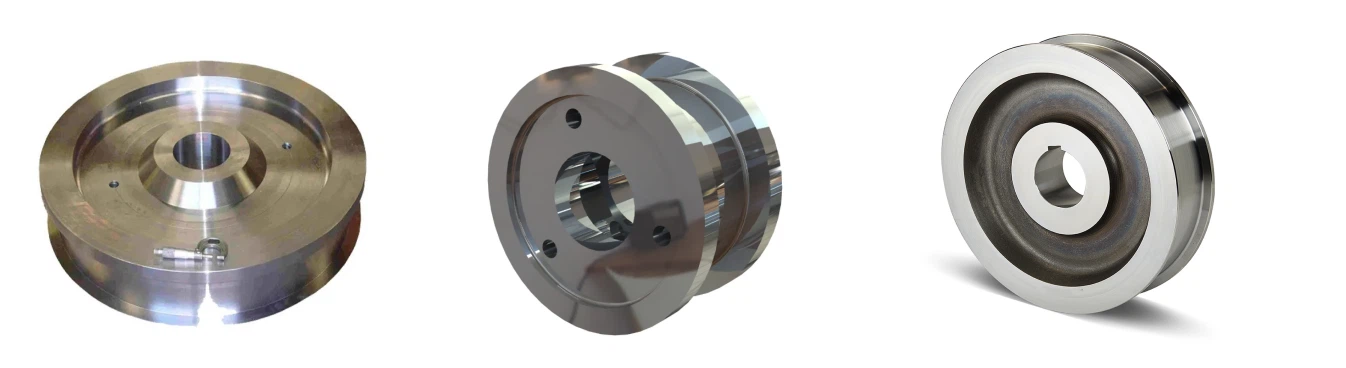
Hook Blocks: The assemblies at the end of the wire ropes that contain the hooks. They often have multiple sheaves to create a reeving system for increased lifting capacity.
Spreaders / Spreader Beams: Removable horizontal beams that connect to the hook blocks. Their primary function is to:
Spread the Load: Distribute the lifting force over a wider area of the vessel's hull.
Provide Attachment Points: Feature multiple lifting points for adjustable slings.
Protect the Hull: Prevent slings from pinching or damaging the hull.
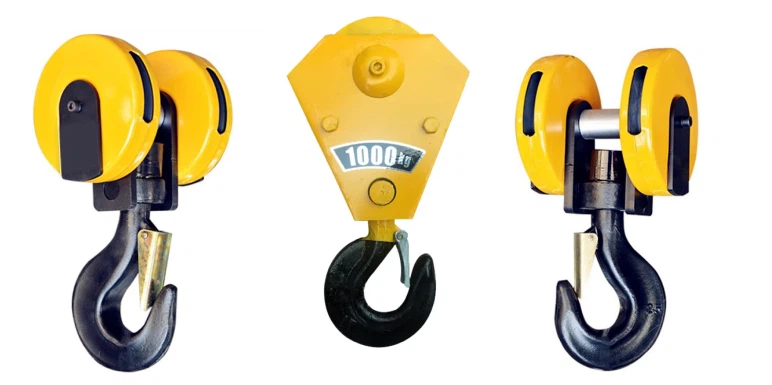
III. Traversing & Travel System
This system allows the entire crane to move along the dock.
Travel Wheels / Bogies: Heavy-duty, flanged wheels mounted on the end trucks that ride on the runway rails.
Travel Drive Motors: Electric or hydraulic motors that power the travel wheels.
Runway Rails: The heavy-duty steel rails embedded in the dock on which the crane travels. They must be precisely aligned and level.
Rail Clamps / Anchors: Safety devices that lock the crane securely in position when it is not moving, especially important in windy conditions.

IV. Slinging System
This is the interface between the crane and the vessel. It is often customized for different hull shapes.
Lifting Slings: Heavy-duty, padded straps (typically made from polyester or nylon) that cradle the hull. The padding is crucial to prevent damage to the boat's gel coat and structure.
Sling Adjusters: Mechanisms that allow for fine-tuning the length of each sling leg to ensure the vessel is lifted level and the weight is distributed correctly.
Quick-Release Hooks or Shackles: Secure but easily removable connectors between the slings and the spreader bars.

V. Power & Control System
The "brain and nervous system" of the hoist.
Power Unit: A central hydraulic power unit (HPU) with pumps, reservoirs, and filters, or a main electrical cabinet for electric-driven cranes.
Operator's Cabin: An enclosed, climate-controlled cabin suspended from the crane frame, giving the operator a clear view of the lifting operation.
Control System:
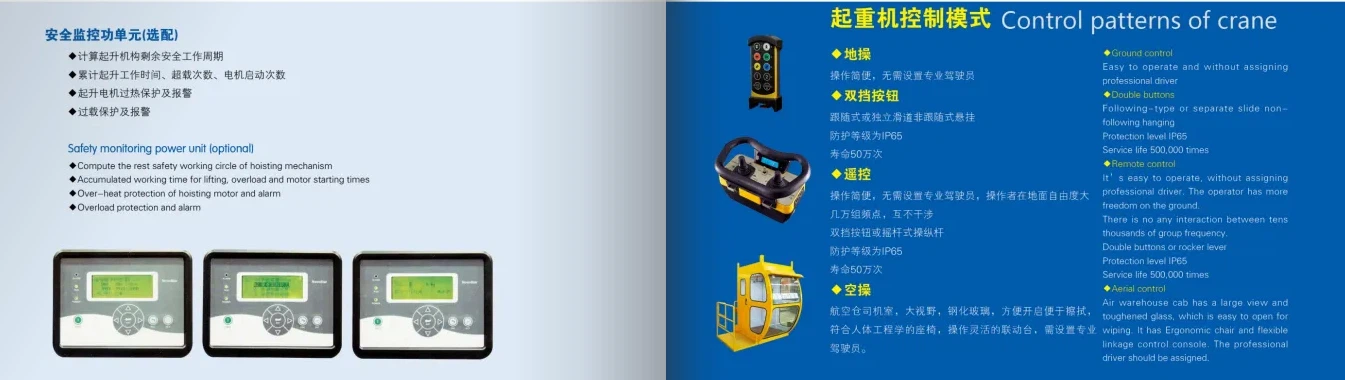
Main Control Console: Contains joysticks, switches, and touchscreens for operating the hoist, traverse, and all other functions.
Programmable Logic Controller (PLC): The computer that processes operator commands and manages critical functions like synchronization to keep all winches moving at the same speed and prevent the boat from tipping.
Load Moment Indicator (LMI) / Load Monitoring System: A critical safety system that uses sensors on each winch to display the weight on each lifting point and the total weight. It can warn the operator of an overload or unbalanced condition and may automatically shut down operations if safe limits are exceeded.
Remote Control (Optional): A wireless pendant that allows the operator to move with the vessel for better visibility during precise positioning.

VI. Safety Systems
Essential features to protect personnel, the vessel, and the equipment.
Overload Protection: Integrated with the LMI system to prevent the crane from lifting beyond its rated capacity.
Limit Switches: Devices that automatically cut power to prevent the hoist or traverse mechanisms from moving beyond their safe physical limits.
Emergency Stop (E-Stop) Buttons: Prominently placed buttons in the cabin and often on remote controls to halt all crane functions immediately.
Anti-Collision Systems: Sensors or laser scanners to prevent the crane from colliding with other dock structures or cranes.
Anemometer & Wind Alarm: Measures wind speed and alerts the operator when conditions become unsafe for lifting.
Fail-Safe Brakes: Multiple braking systems (mechanical, hydraulic, or electric) that engage automatically in the event of a power failure.
Applications of Each Component
| Component | Function |
|---|---|
| Gantry Frame | Supports entire structure |
| Winches & Slings | Lifts the boat |
| Trolley System | Positions boat over storage area |
| Steering Mechanism | Allows precise maneuvering |
| Load Sensors | Ensures safe lifting capacity |
SKETCH
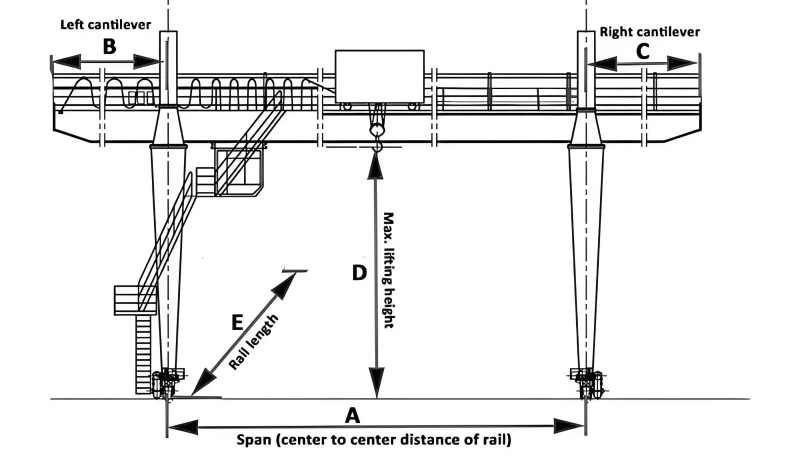
Main technical
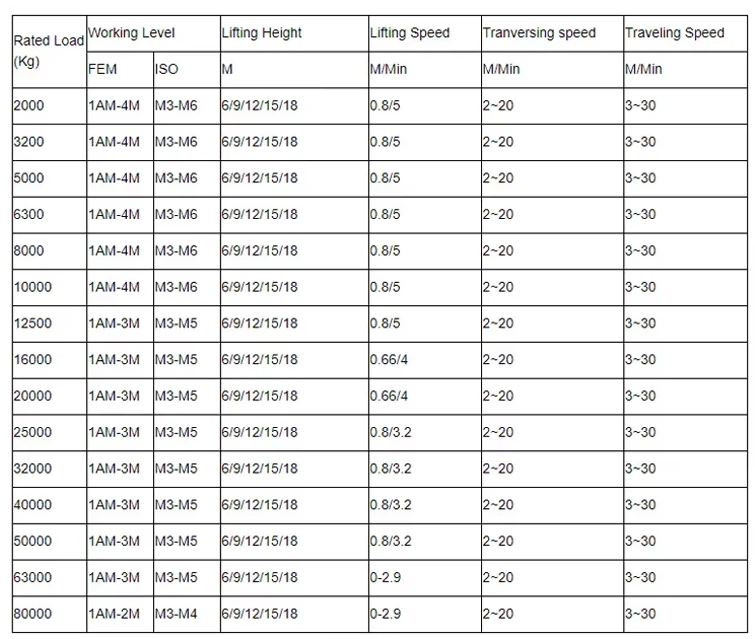
Advantages
1. Unmatched Lifting Capacity and Versatility
Handles Large Vessels: The primary advantage is its ability to lift very large and heavy boats, such as mega-yachts, commercial fishing vessels, small ferries, naval patrol boats, and large sailboats. This opens up business opportunities for a marina or yard.
Wide Range of Vessels: It's not just for one type of boat. It can service a diverse clientele, from luxury motor yachts to workboats, making the facility more resilient to market changes.
Future-Proofing: Investing in an 180-T capacity prepares a facility for the growing trend of larger private and commercial vessels.
2. Operational Efficiency and Speed
Rapid Launch and Haul-Out: Compared to traditional methods like railway systems or syncrolifts, a travel lift can pick up a vessel from the water and place it directly into its storage spot in a single, swift operation. This drastically reduces the time a valuable dock or slip is occupied.
Quick Turnarounds: For repair yards, this speed means more vessels can be serviced in a season, increasing revenue potential. A quick haul-out is also less disruptive for boat owners.
Mobility and Flexibility: The crane is mobile on its rubber tires, allowing it to move vessels around the yard efficiently and place them in precise locations. It doesn't require a fixed, dedicated path like a railway system.
3. Superior Vessel Safety and Integrity
Even Weight Distribution: Modern 180-T hoists use multiple slings (often 4 or more) that can be adjusted independently. This allows for a perfectly balanced lift, preventing hull distortion or "hogging" (sagging at the ends), which is a critical concern for large, heavy vessels.
Reduced Risk of Damage: The soft, wide nylon slings are far less likely to damage hull finishes compared to chains or cables from smaller, less sophisticated cranes.
Precision Placement: Operators have excellent control over the lift, lowering, and transport, allowing for careful maneuvering in tight spaces and safe placement on custom cradles or blocks.
4. Space and Infrastructure Advantages
Efficient Use of Land: Unlike a fixed dry dock or a long railway system, a travel lift does not require a massive, permanent land-based structure. The yard layout can be more flexible and efficient.
No Complex Civil Works: Installing a travel lift requires a strong paved or concrete yard surface, but it avoids the need for the deep pits, complex machinery, and significant shoreline modification required by a syncrolift.
Multi-Purpose Yard: The area used by the travel lift is only occupied during the actual movement of a vessel. The same space can be used for stationary storage at other times.
5. Economic and Business Benefits
Attracts High-Value Clients: The capability to handle 180-ton vessels makes a marina or boatyard a destination for owners of high-value yachts and commercial operators, who are often willing to pay a premium for quality service.
Competitive Advantage: Having one of the largest hoists in a region gives a facility a significant edge over competitors who cannot service such large boats.
Diversifies Revenue Streams: The yard can offer not just storage, but also repairs, refits, paint work, and surveys for a much larger class of vessel.
6. Specific Advantages Over Alternatives
Vs. Railway Systems: More flexible in yard layout, faster, and better for hulls with protruding keels or appendages.
Vs. Syncrolifts: Lower initial infrastructure cost, greater mobility for placed vessels, and often faster for individual boat movements.
Vs. Floating Dry Docks: Generally faster for quick in-and-out services, requires less maintenance of the floating structure itself, and is less susceptible to certain weather conditions.
Summary
In essence, the advantages of an 180-Ton Boat Hoist Crane boil down to power, precision, and profitability. It is a versatile workhorse that enables a marine facility to operate safely, efficiently, and competitively in the high-value, large-vessel market. It is an investment that significantly upgrades a facility's capabilities and market position.
Application
Major Component Groups and Their Application
1. Structural Framework
This is the "skeleton" of the crane, designed to handle immense 180-ton loads without flexing.
Main Girders / Boom: The massive horizontal beam(s) that span the width of the boat. In a travel lift, these are the two main beams that the hoist units traverse on.
Application: Provides the structural integrity to span over a wide boat (e.g., a 50-60 foot yacht) and support the entire load. Its high stiffness prevents sway and ensures precise positioning.
Legs / Uprights: The vertical columns that transfer the load from the girders to the ground. They are often adjustable in height.
Application: Allows the crane to accommodate boats with high freeboards (the height of the boat's sides). The legs must be tall enough to straddle the vessel comfortably.
End Trucks / Chassis: The base frame that connects the legs to the wheels and propulsion system.
Application: Houses the drivetrain and steering mechanisms, enabling the entire crane to move the lifted boat along the dock or yard.
2. Lifting and Hoisting Mechanism
The core system responsible for the actual vertical lifting.
Hoist Units (2 or 4): Each unit contains an electric or hydraulic motor, a gearbox, and a drum for the wire rope. On a 180 T crane, there are typically two independent hoists, each capable of lifting 90 T, working in synchrony.
Application: Provides the motive power for lifting and lowering. Having multiple synchronized hoists is critical for keeping the boat level and preventing dangerous structural stress on the hull.
Wire Ropes / Cables: High-strength, multi-strand steel cables wound on the hoist drums.
Application: Transmit the lifting force from the hoist to the spreader bar and slings. They are designed for flexibility and extreme tensile strength.
Sheaves / Pulleys: Large, grooved wheels that guide the wire ropes, often providing a mechanical advantage.
Application: Change the direction of the wire rope, allowing the hoist motor to be mounted on the girder while the load is suspended below.
3. Load Handling and Spreader System
This is the most critical and boat-specific component. It ensures the boat's hull is supported correctly and safely.
Spreaders / Spreader Beams: Long, strong horizontal beams that are suspended from the hoist hooks.
Application: Distributes the lifting force from the single point of the hook to two (or more) wider points, matching the sling positions on the boat. This prevents the slings from crushing the gunwales (the top edges of the boat's sides) and keeps them vertical.
Boat Slings / Straps: Wide, heavy-duty nylon or polyester straps. For a 180 T lift, these are extremely large and strong.
Application: Cradle the boat's hull. The wide, soft material distributes pressure evenly across the hull to prevent cracking, deforming, or damaging the gel coat. They are placed at structurally strong points on the hull, typically determined by the boat manufacturer.
Adjustable Lifting Hooks: Heavy-duty hooks with safety latches, connected to the spreader bars.
Application: Provide a quick and secure connection to the slings. The adjustability allows operators to fine-tune the balance of the boat.
4. Mobility and Propulsion System
Enables the crane to transport the boat from the water to a storage spot.
Wheels and Tires: Large, heavy-duty, pneumatic tires (often 8 or more).
Application: Support the total weight of the crane (which can be 100+ tons itself) plus the 180-ton boat. The pneumatic tires provide cushioning to absorb ground imperfections and protect the delicate boat from shock loads.
Drive Axles: Powered axles, usually all-wheel drive.
Application: Provide the traction needed to move the massive combined weight, especially on sometimes-slippery marina surfaces.
Steering System: Complex multi-wheel steering, often with crab steering capability.
Application: Allows for extreme maneuverability in tight marina spaces. Crab steering (all wheels turning in the same direction) lets the crane move diagonally, which is invaluable for aligning with a boat in a slip.
5. Control and Power Systems
The "brain and nervous system" of the crane.
Operator's Cabin: An elevated cabin on the crane structure or a remote control station.
Application: Gives the operator a clear, panoramic view of the boat and the surrounding area. Modern cranes often use wireless remote controls, allowing the operator to walk alongside the boat for the best visibility.
Power Unit: A large diesel engine or an electric motor drive system.
Application: Provides the primary power for the hoists, drives, and steering. Diesel is common for mobility, while electric is used in some yards for reduced noise and emissions.
Control System & PLC: A Programmable Logic Controller (PLC) is the computer that manages all crane functions.
Application: Crucially, it ensures synchronization between the multiple hoists. It prevents one hoist from lifting faster than the other, which could cause the boat to tip. It also monitors load, provides overload protection, and manages safety interlocks.
Crane production process
Phase 1: Engineering & Design
This is the most critical phase, where the crane's performance, safety, and functionality are defined.
Client Requirements & Site Analysis:
Understanding the client's specific needs: maximum boat weight (180T), boat dimensions, lifting speed, hoist well size, and control preferences.
Analyzing the installation site (quay wall strength, soil conditions, wind exposure, seismic factors, and corrosion environment).
Conceptual & Detailed Design:
Structural Design: Engineers use Finite Element Analysis (FEA) software to design the main structural components:
Girders/Main Beams: The primary horizontal beams that carry the load. They are designed to minimize deflection under full load.
End Carriages/Trucks: The structures at each end that house the wheels and travel motors for moving the crane along the rails.
Legs/Supports: The vertical members that transfer the load to the end carriages and down to the rails.
Mechanical Design:
Hoisting System: Selection and design of the wire rope, hoist drums, sheaves (pulleys), and the main hoist motor(s) and gearboxes. A 180T crane will likely use multiple hoisting units (e.g., 4 x 45T hoists) synchronized for a level lift.
Travel System: Design of the travel wheels, axles, bearings, drive motors, and gearboxes for smooth and safe longitudinal movement.
Electrical & Control System Design:
Power Supply: Designing the system for power collection (e.g., festoon systems, cable reels, or conductor bars).
Motor Control Centers (MCCs): Specifying Variable Frequency Drives (VFDs) for precise control of hoisting and travel motions, ensuring smooth acceleration and deceleration.
PLC & Synchronization: Programming a Programmable Logic Controller (PLC) to manage all crane functions. The synchronization of multiple hoists is critical to prevent dangerous load tilting.
Safety Systems: Designing critical safety features like overload limit switches, emergency stop circuits, anti-collision systems, anemometers (wind speed sensors), and limit switches for travel and hoisting.
Procurement of Major Components:
Long-lead items are ordered early, such as the hoist motors, gearboxes, VFDs, PLC, wire rope, and specialized forged steel wheels or bearings.
Phase 2: Manufacturing & Fabrication
This phase transforms the design into physical components.
Structural Fabrication:
Material Preparation: High-strength steel plates and sections (e.g., I-beams) are cut to size using CNC plasma or laser cutters for precision.
Sub-Assembly Welding: Smaller components are welded together. This is done using automated welding machines where possible to ensure consistent, high-quality welds.
Major Assembly Welding: The main girders, end carriages, and legs are assembled on large, flat fabrication beds to control welding distortion and ensure alignment.
Stress Relieving: Critical welded structures may be heat-treated in a large furnace to relieve internal stresses created during welding, which improves structural integrity.
Machining: Bearing housings, motor mounts, and other critical interfaces are machined to precise tolerances.
Mechanical Assembly:
The fabricated structures are moved to the assembly area.
Hoist Mechanism Installation: Hoist drums, gearboxes, and motors are mounted onto the main girder(s).
Travel Mechanism Installation: Wheels, axles, bearings, travel motors, and gearboxes are assembled into the end carriages.
Sheave Installation: The wire rope sheaves are installed at the ends of the girders.
Painting & Corrosion Protection:
The entire structure is shot-blasted to clean the steel and create a surface profile for paint adhesion.
A multi-layer paint system is applied, typically an epoxy primer and a polyurethane topcoat, chosen for excellent corrosion resistance in a harsh marine environment.
Phase 3: Shop Assembly & Testing (FAT - Factory Acceptance Test)
Before disassembly for shipment, the crane is often partially or fully assembled at the factory for testing.
Electrical Installation: All cabling, control panels, MCCs, and operator cabs are installed.
Functional Testing:
All motions (hoist up/down, travel left/right) are tested without load.
The synchronization of the multiple hoists is verified.
Load Testing:
Static Load Test: The crane is lifted with a test load greater than the rated capacity (typically 125% of 180T = 225 Tons) and held for a period to verify structural integrity and weld quality.
Dynamic Load Test: The crane is operated with a test load (typically 110% of 180T = 198 Tons) through all its functions (hoisting, traveling) to verify the performance of the mechanical and electrical systems under dynamic conditions.
Safety System Verification: Every safety device (limit switches, overload protection, E-stops) is rigorously tested to ensure it functions as designed.
Phase 4: Delivery, Site Installation & Commissioning (SAT - Site Acceptance Test)
Disassembly & Shipping: The crane is carefully disassembled into transportable modules, protected, and shipped to the customer's site.
Site Preparation: The customer prepares the site, including installing the crane rails to precise alignment and levelness.
Erection: The crane components are lifted into place by mobile cranes and bolted or welded together by a specialized erection team.
Re-commissioning:
All electrical connections are made.
The crane is aligned on the rails.
All functions and safety systems are tested again.
Site Acceptance Test (SAT):
The crane undergoes a final load test in the presence of the client and often a third-party certifying authority (e.g., Lloyd's, DNV).
Once all tests are passed and the client is satisfied, the crane is officially handed over.
Operator Training: The manufacturer provides comprehensive training for the client's operators and maintenance personnel.
Summary Flowchart of the Production Process:
Client Requirements → Detailed Engineering & Design → Procurement → Steel Fabrication & Welding → Mechanical Assembly → Painting → Factory Assembly & Testing (FAT) → Disassembly & Shipping → Site Erection → Site Commissioning & Testing (SAT) → Client Training & Handover
This structured, phased approach ensures that a complex and critical piece of equipment like a 180-Ton Boat Hoist Crane is built to the highest standards of safety, reliability, and performance.

Workshop view:
The company has installed an intelligent equipment management platform, and has installed 310 sets (sets) of handling and welding robots. After the completion of the plan, there will be more than 500 sets (sets), and the equipment networking rate will reach 95%. 32 welding lines have been put into use, 50 are planned to be installed, and the automation rate of the entire product line has reached 85%.




Hot Tags: 180 t boat hoist crane, China 180 t boat hoist crane manufacturers, suppliers, factory
You Might Also Like



Send Inquiry