








15Ton Single Beam Overhead Crane
Products Description
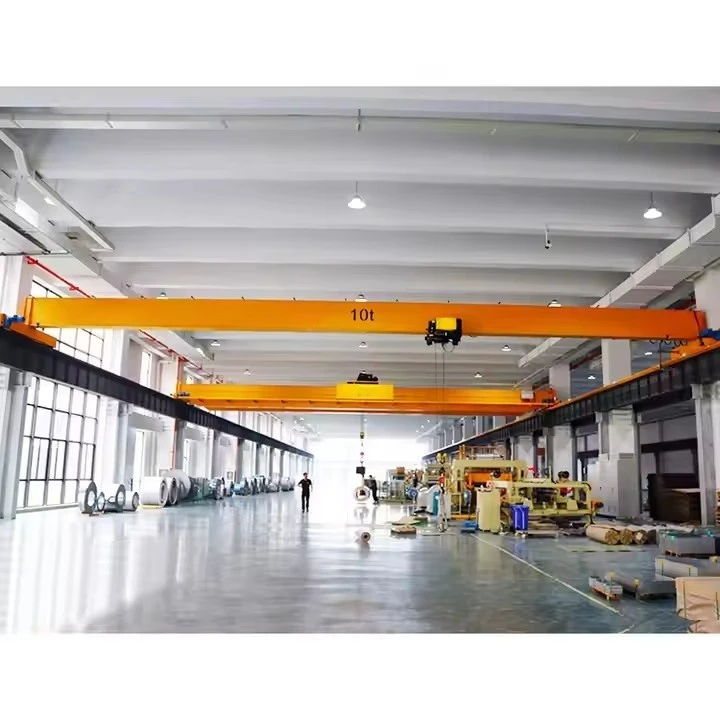
TA 15-ton single-girder overhead crane is a light-to-moderate duty lifting solution built around a single main bridge beam, with an electric wire rope hoist running along the bottom flange of that beam. It is designed for standard industrial material handling where maximum cost-efficiency and space savings matter more than continuous heavy-duty performance.

Pictures & Components
1.Main Girder
The primary load-bearing structure, typically an I-beam or box girder, supporting the entire lifting system.

 |
 |
Electric Hoist - The core lifting unit, commonly a CD1 or MD1 wire rope hoist. The CD1 offers single speed; the MD1 provides dual speed (fast/slow) for precise positioning. Key sub-components include the motor, reducer, grooved drum, wire rope, and hook.
 |
 |
Controls all crane motions (hoisting, trolley travel, bridge travel). Includes the control panel, pendant/remote, limit switches, and safety protections such as overload and phase-failure protection.


Hoisting Motor & Brake Configuration - On a 15-ton single-girder overhead crane, the hoisting motor and brake are typically integrated into a single unit rather than being separate external components. The specific configuration depends on the type of electric hoist used.

Control System Overview: The control system is the "brain" of the crane, governing hoisting, trolley travel, and bridge travel. For a 15-ton single-girder crane, the system typically consists of a main control panel, operating devices (pendant or remote), safety interlocks, and power supply components.

2. Trolley
Carries the hoist and travels laterally along the bottom flange of the main girder, enabling lateral load positioning.
3. Core Configuration: Separate Drive
Modern single-girder cranes typically use separate drives, where each end carriage has its own independent motor and gearbox. This eliminates the long intermediate shaft used in older centralized drives, reducing crane weight and simplifying installation and maintenance .
A typical 15-ton long travel mechanism consists of:
Two motors (one on each end carriage)
Two reducers/gearboxes
Four wheels in total (typically two driving wheels and two driven/idler wheels) mounted on the end carriages
4. Control System
For a 15-ton single-girder overhead crane, the control system typically consists of a pendant control station or wireless remote, a main control panel housing contactors and protection devices, and limit switches for safety. Variable Frequency Drive (VFD) is increasingly standard for smoother travel and hoisting.
Sketch

6. Control & Protection Panel
The main control panel (often rated NEMA 4/12 or IP55) houses the core switching and protective devices:
Mainline contactor & manual disconnect for safe power isolation.
Fuses and motor thermal overload relays to protect motors from overheating.
Variable Frequency Drives (VFDs) : Increasingly standard, VFDs provide controlled acceleration/deceleration, reducing load swing and extending drivetrain life. They are commonly used on bridge and trolley travel motions.
Phase-failure protection to prevent damage from incorrect power connection.
7. Operating & Safety Devices
Pendant Control Station: A pushbutton station suspended from the crane for floor-level operation, typically with plug-and-play connections.
Limit Switches: Geared upper/lower hoist limit switches prevent over-travel. Travel limit switches protect the bridge and trolley at runway ends.
Overload Protection: An overcapacity limit switch prevents the hoist from lifting excessive loads.
Emergency Stop: A dedicated button to cut power in an emergency.
Audible/Visual Alarm: Optional sound and light alarm devices for safety warnings.
Anti-collision Device: Optional wireless anti-collision system for cranes sharing the same runway.
8. Optional Accessories
Wireless Radio Remote Control: Allows the operator to work from a safer, more flexible position away from the load. Commonly available as an alternative or supplement to pendant control .
Cabin Control: An enclosed operator cabin for specialized or high-frequency applications where a fixed operating position is preferred .
Additional Pendant Buttons: Extra functions such as a horn activation button can often be easily added to the standard pendant station .
Main technical

Advantages
15 Ton Single Beam Overhead Crane - Advantages
Cost-Effective – Requires less steel and fewer components than a double-girder crane, resulting in a lower purchase price, reduced shipping cost, and cheaper installation.
Lighter Dead Weight – The lighter structure generates lower wheel loads on the runway beams and building columns, often eliminating the need for structural reinforcement in existing facilities.
Maximized Hook Height – When paired with a low-headroom electric hoist, the single-girder design minimizes the crane's own height, delivering greater effective lifting height-ideal for buildings with limited ceiling clearance.
Space-Saving Compact Design – The slim profile frees up valuable floor space and fits easily into narrow bays, low-ceiling workshops, or retrofit projects.
Flexible Operation – Available with pendant control or wireless remote control, allowing the operator to work from a safe distance and position loads precisely in congested areas.
Easy Installation & Maintenance – The simpler structure enables faster installation and provides straightforward access to the hoist and electrical components for routine servicing and spare-part replacement.
Lower Energy Consumption – The lighter trolley and bridge require less power to accelerate and travel, reducing operating energy costs over the crane's service life.
Wide Standard Availability – Standardized designs (GB, FEM/DIN) with common spans of 7.5–22.5 m and working classes A3–A5 make sourcing, customization, and spare-parts supply quick and straightforward.
Short Delivery Lead Time – Standardized modular production means shorter manufacturing and delivery cycles compared with customized double-girder systems.
Good Seismic & Wind Resistance (for outdoor versions) – The lighter, lower-profile structure performs well under lateral loads when configured for outdoor or semi-outdoor use.
Application
15 Ton Single Beam Overhead Crane - Applications
Warehouses & Logistics Centers
Used for loading and unloading trucks, moving palletized goods, and general storage handling. The crane's compact design helps free up floor space .
Workshops & Manufacturing Plants
Common in machine shops, metal fabricators, and light assembly lines for moving raw materials, semi-finished parts, and sub-assemblies between workstations . It is also widely used in machinery repair and maintenance bays for handling engines, pumps, and large components .
Low-Headroom Facilities
European-style or low-headroom variants are specifically chosen for existing buildings with limited ceiling clearance, where maximizing effective lifting height is critical .
Steel Service Centers (Moderate Use)
Suitable for handling bundles of bar stock or sheet metal, provided the operation is not continuous heavy-duty .
Crane Production Procedure
15 Ton Single Beam Overhead Crane - Production Procedure
1. Design & Engineering
The process begins with engineering based on the customer's specific requirements (span, lifting height, duty class). Modern manufacturers use 3D CAD and Finite Element Analysis (FEA) to simulate stress distribution and ensure structural integrity before any steel is cut .
2. Steel Plate Pretreatment
Raw steel plates undergo shot blasting to remove mill scale and rust, achieving a cleanliness grade of Sa2.5 and a surface roughness of 40–80μm. A protective primer is applied immediately after to prevent rust during fabrication .
3. Precision Cutting
Plates are cut using CNC plasma or flame cutting machines. This ensures high dimensional accuracy (with deviations often controlled within 1mm) and prepares the plates for welding with minimal deformation .
4. Welding & Fabrication (The Critical Phase)
This is where the main girder and end carriages take shape. The production line typically employs:
Robotic/Automatic Welding: Main girder box sections are welded using automatic double-sided intermittent welding and gantry submerged arc welding for longitudinal seams. This ensures consistent, high-quality weld penetration .
End Carriage Fabrication: End beams are welded using double-gun gantry submerged arc welding .
Stress Relief: Critical weldments (like the trolley frame and drum) may undergo annealing in a natural gas furnace to eliminate internal stresses and ensure machining accuracy later .
Quality Inspection: Welds on the main beam are often subject to radiographic (X-ray) and ultrasonic flaw detection to guarantee safety .
5. Post-Weld Machining & Surface Treatment
Machining: The welded bridge frame undergoes precision machining to ensure flatness and alignment. Wheel axles and bores are processed on CNC centers .
Shot Blasting & Painting: The completed structure is shot-blasted again to remove welding scale. It then moves to an automatic painting line for primer and topcoat application (e.g., epoxy zinc-rich paint) to achieve long-term corrosion protection .
6. Hoist & Component Assembly
The electric hoist (typically CD1/MD1 or a European-style unit) is assembled separately. This involves mounting the motor, gearbox, and rope drum, and wiring the control panel. The hoist is then mounted onto the trolley that runs along the bottom flange of the main girder .
7. Final Assembly & Testing
Mechanical Assembly: The main girder and end carriages are connected using high-strength bolts. The trolley, hoist, and electrical components are integrated .
Testing: Every hoist and trolley is individually powered and tested. The complete crane may undergo a full-system test to verify hoisting, travel, and safety functions (limit switches, overload protection). Electrical systems are checked for correct wiring and insulation .
8. Commissioning & Delivery
The crane is disassembled for transport. On-site, it is reassembled, and final commissioning is performed to ensure smooth operation before handover.

Workshop view:
High ceilings (often 15–30 m) with overhead crane runways along the full length.
Bright industrial lighting (LED high-bays) supplemented by task lighting at welding stations.
Ventilation and fume extraction ducting visible throughout.
Floor markings delineating walkways, material storage, and work zones.
Safety signage and PPE requirements posted at entrances.


Hot Tags: 15ton single beam overhead crane, China 15ton single beam overhead crane manufacturers, suppliers, factory
You Might Also Like


Send Inquiry