










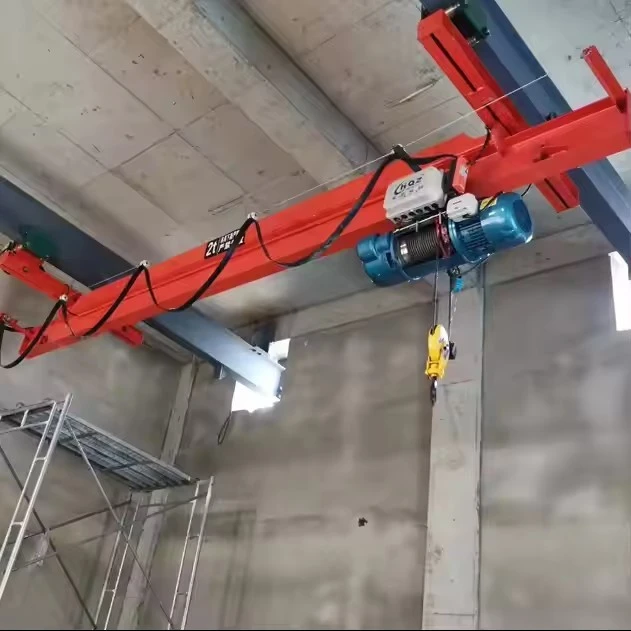

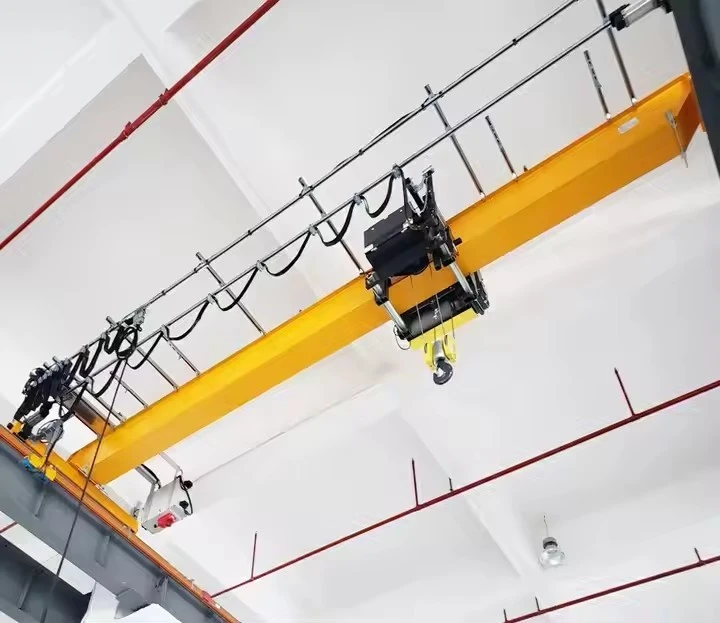
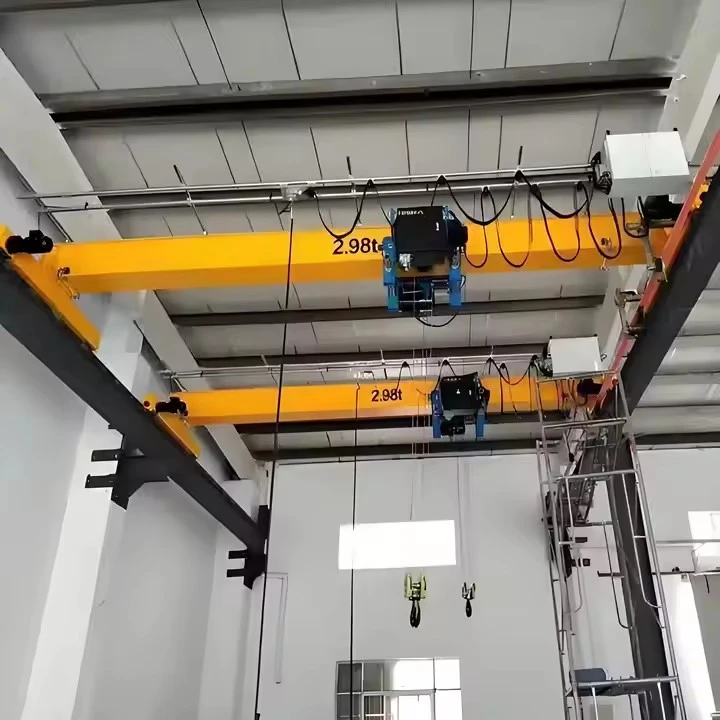
Electric Overhead Traveling Crane
Products Description
Types of EOT Cranes
A. Based on Girder Design
Single Girder EOT Crane
Uses one main beam (typically an I-beam or box girder).
Capacity: Up to 20 tons.
Advantages: Lower cost, easier installation, ideal for light to medium-duty work.
Double Girder EOT Crane
Uses two parallel girders for enhanced strength.
Capacity: 20 to 550+ tons.
Advantages: Higher lifting height, better stability for heavy loads.
B. Based on Operation
Pendant-Controlled Crane (Handheld remote).
Radio Remote-Controlled Crane (Wireless operation).
Cabin-Operated Crane (For high-precision or heavy-duty tasks).
C. Specialized EOT Cranes
Foundry Cranes (Heat-resistant, for steel mills).
Explosion-Proof Cranes (For hazardous environments).
Magnetic/Grab Cranes (For scrap, bulk materials).
EOT Crane vs. Other Cranes
| Feature | EOT Crane | Gantry Crane | Jib Crane |
|---|---|---|---|
| Mobility | Fixed on runway | Moves on ground | Fixed/Swinging |
| Coverage | Full workshop span | Limited by legs | Small area |
| Max Capacity | 550+ tons | 500 tons | 20 tons |
| Cost | Moderate | High (large models) | Low |
Lifting Capacity 1 – 20 tons (custom up to 50+ tons)
Span 5 – 30 meters
Lifting Height 3 – 30 meters
Lifting Speed 1 – 20 m/min (adjustable)
Trolley Speed 5 – 30 m/min
Crane Travel Speed 10 – 60 m/min
Power Supply 380V/415V, 50Hz (3-phase)
Duty Class FEM A3-A5 (Medium to Heavy Duty)

Pictures & Components
Core Components
Main Girder
Single I-beam or box-type steel construction
Typically spans 5-25 meters
Designed for capacities up to 20 tons

End Trucks
Wheeled assemblies at each end
Contain drive motors, gears, and wheels
Allow longitudinal movement along runway
Hoist Unit
Electric wire rope or chain hoist
Mounted on trolley for cross-travel
Includes motor, gearbox, drum, and brake
 |
 |
Trolley Assembly
Carries the hoist along girder
Manual or powered movement
Low-headroom designs available
Runway System
Supporting rails (PFC/CR/I-beam)
Properly aligned and leveled structure
Includes rail clamps and stops
 |
 |
Electrical Components
Power Supply System
Festoon system (most common)
Alternative: Conductor bars or cable reels
3-phase power (380V/415V/480V)

Control System
Pendant control (standard)
Optional radio remote control
Control panel with safety features
Safety Devices
Upper/lower limit switches
Overload protection
Emergency stop button
Warning buzzer/light

Motion Components
Bridge Drive
Dual motors (one per end truck)
Gear reducers (worm or helical)
Forged steel wheels with flanges

Trolley Drive (if powered)
Integrated with hoist package
Typical speed: 10-20 m/min
Hoist Mechanism
Lifting motor with brake
Wire rope/chain and drum
Hook block with safety latch
.
Optional Accessories
Crane scales
Anti-sway system
Variable frequency drives
Remote monitoring
Special hooks/magnets

Key Features
✔ Cost-effective design
✔ Lower headroom requirement
✔ Easier installation
✔ Energy efficient operation
✔ Suitable for light-medium duty

Sketch

Main technical

Advantages
Superior Lifting Capacity
Handle loads from 1 to 550+ tons
Outperform forklifts and manual hoists in heavy-duty applications
Full Workshop Coverage
Three-dimensional movement (up/down, left/right, forward/backward)
Access entire work area without floor obstructions
Enhanced Safety Features
Built-in overload protection
Emergency stop systems
Fail-safe brakes and limit switches
Reduced manual handling risks
Operational Efficiency
Faster load movement than alternatives
Precise positioning capability
Continuous operation with minimal fatigue
Space Optimization
Utilizes overhead space
Keeps floor area clear for other operations
Low headroom designs available
Cost Effectiveness
Lower long-term costs than mobile cranes
Reduced labor requirements
Minimal maintenance needs
Customization Options
Various control systems (pendant/remote/cabin)
Special attachments (magnets, grabs, etc.)
Explosion-proof or high-temperature versions
Application:
1. Manufacturing Facilities
Moving raw materials and finished products
Positioning heavy machinery
Assembly line operations
2. Steel & Metal Industries
Handling coils, plates, and ingots
Foundry operations (with heat-resistant models)
Scrap metal processing
3. Warehousing & Logistics
Loading/unloading trucks
High-bay storage operations
Container handling
4. Power Generation
Turbine maintenance
Transformer handling
Fuel rod management (nuclear)
5. Automotive Sector
Stamping press servicing
Engine assembly
Vehicle component handling
6. Construction Materials
Precast concrete handling
Steel beam installation
Building material distribution
7. Paper & Printing
Large paper roll handling
Printing press maintenance
Finished product storage
8. Mining & Bulk Handling
Ore processing
Coal/sand/aggregate movement
Using grab attachments
Crane production procedure
1. Design & Engineering
Requirement Analysis: Confirm load capacity, span, lift height, automation level, control mode, and safety features based on customer needs.
Structural Design: Design the single girder main beam, end carriages, trolley, and hoist assembly using CAD software.
Electrical & Control Design: Develop control system schematics including PLC programming, motor selection, VFDs, sensors, alarms, and safety interlocks.
Simulation & Validation: Use FEA (Finite Element Analysis) for structural integrity and dynamic simulation for motion control.
2. Material Procurement
Source high-quality steel (Q345B or equivalent) for main beam and components.
Acquire motors, hoists, VFDs, PLCs, limit switches, and alarm systems from trusted suppliers.
Ensure all components meet relevant certifications and standards (ISO, CE, GB).
3. Main Beam Fabrication
Cutting: Steel plates cut to size using CNC flame/plasma cutting machines.
Forming: Roll or shape plates into the I-beam or box girder profile.
Welding: Perform welding of flanges, web, and stiffeners following welding procedure specifications (WPS).
Heat Treatment: Stress relief if necessary to reduce welding deformation.
Machining: Drill holes for end carriage and trolley mounting; machine crane rails if integrated.
Inspection: Check weld quality (X-ray or ultrasonic), dimensions, and surface finish.
4. End Carriage & Trolley Assembly
Frame Fabrication: Cut and weld end carriage frames and trolley frames.
Wheel Assembly: Mount wheels and fit bearings; assemble drive motor and gearbox.
Installation: Attach wheels to frames and mount brakes and limit switches.
Testing: Static and dynamic tests on wheels and brakes for smooth rotation and load bearing.
5. Hoist Assembly
Assemble wire rope or chain hoist on the trolley.
Install hook block, safety latch, load limiter, and load sensors.
Connect hoist motor, gearbox, brake, and encoders.
Conduct functional tests on hoisting speed, lifting capacity, and braking.
6. Electrical Wiring & Control System
Install motor cables, control cables, and communication lines.
Mount PLC, VFDs, contactors, and safety relays in the control cabinet.
Wire limit switches, alarms, emergency stop, and sensors.
Program PLC with automated control logic, safety interlocks, and diagnostics.
7. Surface Treatment
Cleaning: Remove rust, oil, and debris from all steel parts.
Primer Coating: Apply anti-corrosion primer.
Final Paint: Spray high-durability industrial paint to protect against wear and corrosion.
Curing: Allow proper drying time to ensure finish quality.
8. Pre-Installation Testing
No-Load Tests: Run crane, trolley, and hoist without load to verify movement, speed, and control.
Load Test: Perform rated load test per standards to ensure lifting capacity and structural integrity.
Safety Device Check: Verify operation of overload limiter, limit switches, emergency stop, and alarms.
Automation Validation: Test automated sequences, positioning accuracy, and sensor feedback.
9. Packing & Shipping
Disassemble parts if necessary for transport.
Protect components with rust-proofing, padding, and secure packing.
Prepare documentation including user manuals, maintenance guides, and test certificates.
10. Installation & Commissioning (On-Site)
Reassemble crane components at customer site.
Align crane rails and secure runway structure.
Connect power and control wiring.
Calibrate sensors and test automated control functions.
Train operators and maintenance personnel.
Hand over documentation and certification.

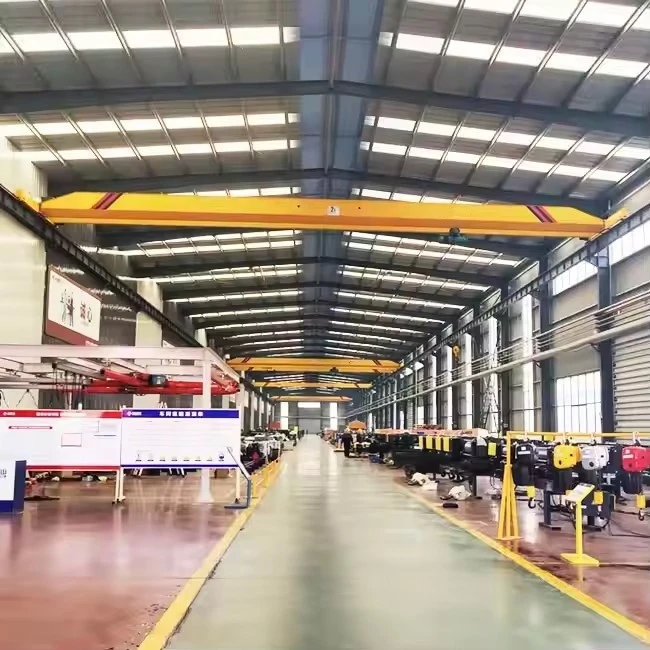
Workshop view:
The company has installed an intelligent equipment management platform, and has installed 310 sets (sets) of handling and welding robots. After the completion of the plan, there will be more than 500 sets (sets), and the equipment networking rate will reach 95%. 32 welding lines have been put into use, 50 are planned to be installed, and the automation rate of the entire product line has reached 85%.


Hot Tags: electric overhead traveling crane, China electric overhead traveling crane manufacturers, suppliers, factory, Single Girder Overhead Crane, Single Girder Overhead Travelling Crane
You Might Also Like


Send Inquiry