







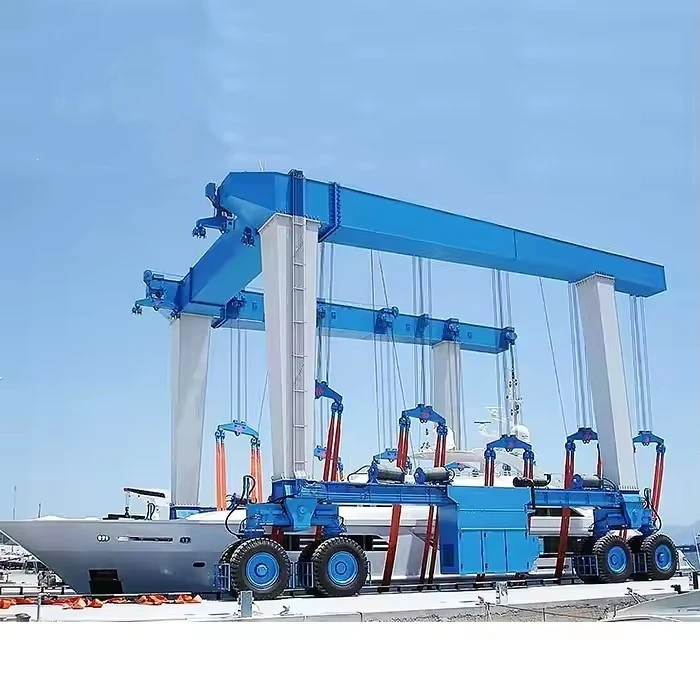
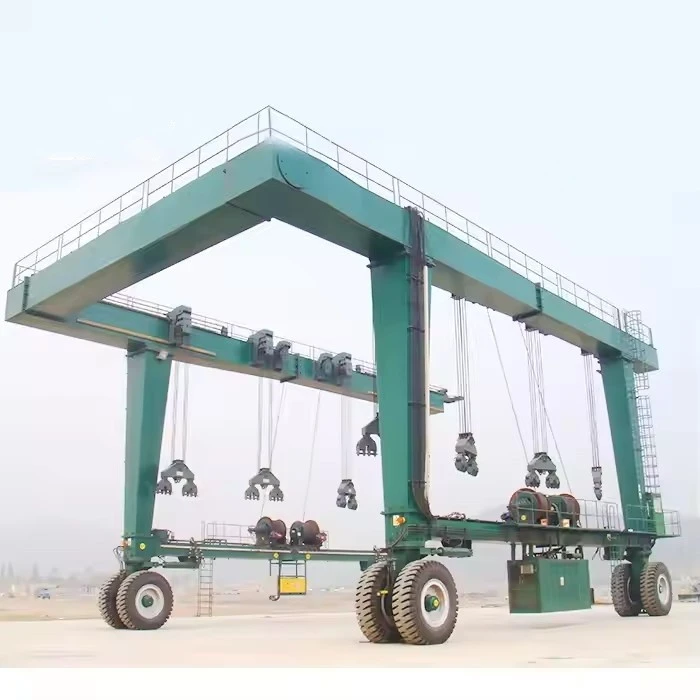

150tons Boat Hoist Crane
Products Description
Key Features and Components
Capacity (180 Metric Tons):
This is the maximum weight it can lift. It's crucial for handling large yachts, fishing vessels, patrol boats, small ferries, and commercial/workboats.
Important Note: The capacity is often dependent on the lift configuration (e.g., the distance of the load from the crane's center). The 180T rating is typically the maximum at the shortest possible boom radius.
Type of Crane:
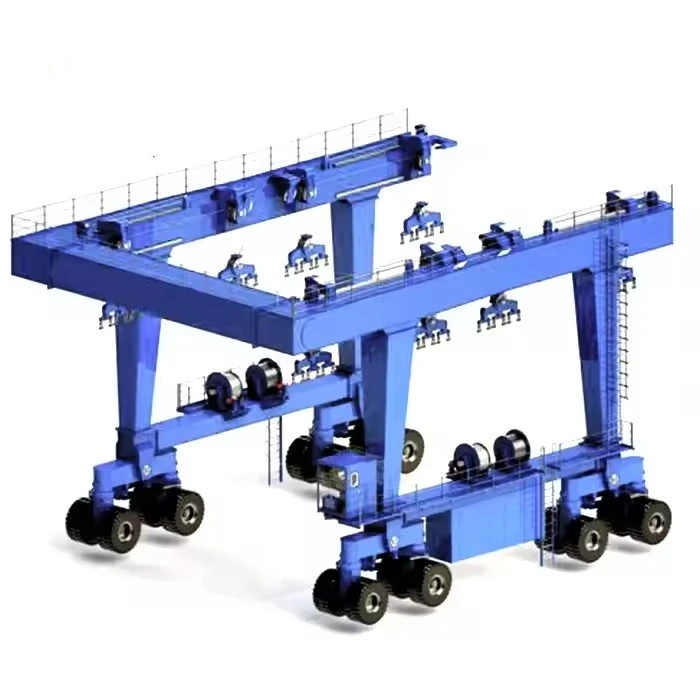
Mobile Gantry Crane: This is the most common type for boat hoists. It runs on rails along a dock or pier. The vessel is positioned between the gantry's legs, and slings are passed under the hull for the lift.
Stiffleg or Portal Crane: A fixed-base crane often seen at the edge of a pier.
Travelift™ / Synchronous Hoist: This is a very popular brand of mobile gantry crane specifically for this purpose. A "180T Travelift" is a common sight in boatyards worldwide.
Lifting Mechanism:
Uses a spreader bar and multiple lifting slings (often 4 or more) to distribute the weight evenly and prevent damage to the boat's hull.
The hoist has multiple independent winches that can be synchronized to keep the boat level during the lift.
Mobility:
Runs on heavy-duty rubber tires (for Travelift-type cranes) or on fixed steel rails. Rail-mounted systems offer more precision but less flexibility in movement around the yard.
Control System:
Modern cranes feature sophisticated electronic controls, often from an elevated, air-conditioned cab that gives the operator a perfect view of the lift.
They include load moment indicators (LMI), anti-collision systems, and overload protection for safety.
Comparison with Other Boat Lifting Systems
| Feature | Gantry Boat Hoist | Marine Railway | Floating Dry Dock |
|---|---|---|---|
| Mobility | High (if rubber-tired) | Low (fixed track) | Low (water-dependent) |
| Max Capacity | 10–500+ tons | 50–5,000 tons | 1,000–100,000+ tons |
| Speed | Fast (minutes) | Slow (hours) | Moderate (hours) |
| Best For | Small to medium boats | Large ships | Massive vessels |
Comparison with Other Boat Lifting Systems
| Feature | Gantry Boat Hoist | Marine Railway | Floating Dry Dock |
|---|---|---|---|
| Mobility | ✅ High (if rubber-tired) | ❌ Fixed track | ❌ Water-dependent |
| Max Capacity | 10–500+ tons | 50–5,000 tons | 1,000–100,000+ tons |
| Speed | ⚡ Fast (minutes) | 🐢 Slow (hours) | 🕒 Moderate (hours) |
| Space Needed | Compact storage | Long track area | Large water area |
| Best For | Small-medium boats | Large ships | Massive vessels |
Lifting Capacity 180 tons
Span (Width) 3 - 12 meters (adjustable)
Lifting Height 3 - 10 meters
Working Class A3-A5 (light to medium duty)
Hoisting Speed 0.5 - 8 m/min (variable)
Main Beam Type Single/double girder (box-type)
Power Supply 220V/380V 3-phase or manual
Control Mode Pendant control/wireless remote
Hoist Type Electric chain hoist/wire rope hoist
Travel Drive Manual push or motorized
Corrosion Protection Hot-dip galvanized or marine-grade paint
Wind Resistance Up to Beaufort scale 6 (for outdoor use)
Operating Temp -20°C to +50°C

Pictures & Components
1. Structural Components
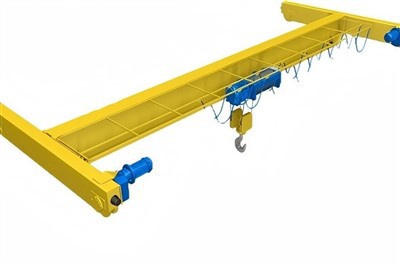
Main Gantry / Bridge Beam
The primary horizontal beam that spans the width of the vessel, carrying the hoisting mechanism. Designed for high bending and shear strength.
Legs / Uprights
Vertical columns (often 2 or 4) that support the bridge beam. May be fixed or adjustable in height/width. Equipped with stabilizing systems.
End Trucks / Carriages
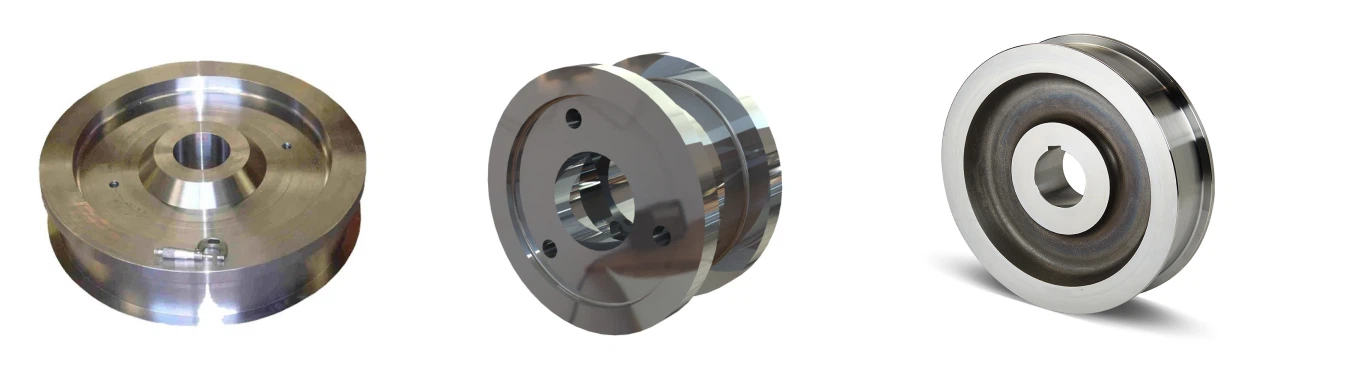
Wheeled assemblies at the base of each leg, allowing the crane to travel along rails or a paved surface.
Boat Cradles / Lift Straps / Spreaders
Adjustable lifting arms or slings that contact the hull. Often padded and shaped to distribute load and protect the vessel.

2. Hoisting & Drive Systems
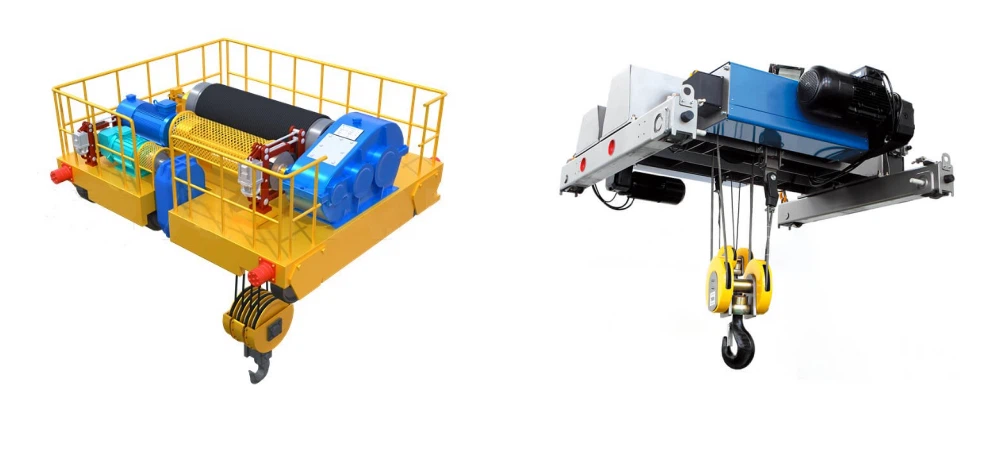
Hoist Units
Electric or hydraulic winches (typically 2 or 4) with 150+ ton total capacity. Each hoist is synchronized for level lifting.
Wire Ropes & Sheaves
High-strength steel cables running over pulleys, designed for marine environments (galvanized or stainless).
Synchronization System
Electronic or hydraulic control to keep all hoists operating at the same speed, preventing hull stress.
Travel Drives
Motors and gearboxes that move the entire crane along its runway (long travel) and adjust leg spacing (cross travel, if equipped).
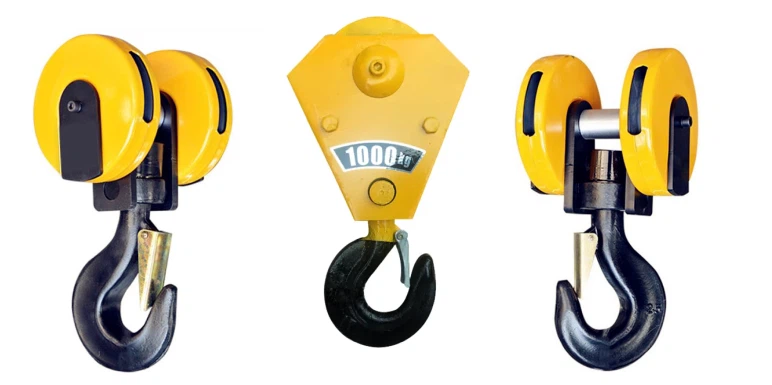
3. Power & Control System
Power Unit
Diesel engine or electric motor(s) driving hydraulic pumps or generators.
Control Panel / Operator Cabin
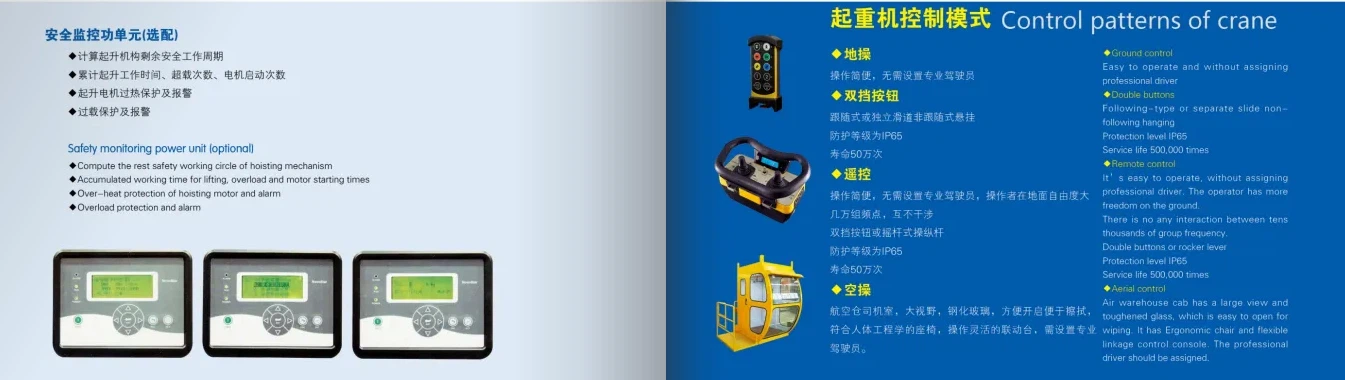
Pendant, remote radio control, or cabin with joysticks, load displays, and emergency stop.
PLC / Monitoring System
Programmable logic controller for motion control, synchronization, and safety interlocks.

4. Mobility & Support
Wheels / Tires or Rail System
Heavy-duty pneumatic tires (for travel lifts) or steel wheels on rails (for gantry cranes). May include steering capability.
Outriggers / Stabilizers
Hydraulic jacks deployed during lifting to increase stability.

5. Safety & Auxiliary Components
Load Cells & Weighing System
Sensors to measure and display lifted weight, prevent overload.
Limit Switches & Encoders
For hoist height limits, travel limits, and position feedback.
Braking Systems
Holding brakes on hoists and travel drives; emergency braking.
Anemometer / Wind Speed Indicator
Critical for outdoor operation with large windage area.
Hull Pressure Monitoring
On some cranes, sensors ensure even pressure on the boat hull.

6. Environmental Protection
Corrosion Protection
Coatings, galvanizing, or stainless components for saltwater resistance.
Weatherproofing
Sealed electricals, marine-grade wiring, and protective covers.
Applications of Each Component
| Component | Function |
|---|---|
| Gantry Frame | Supports entire structure |
| Winches & Slings | Lifts the boat |
| Trolley System | Positions boat over storage area |
| Steering Mechanism | Allows precise maneuvering |
| Load Sensors | Ensures safe lifting capacity |
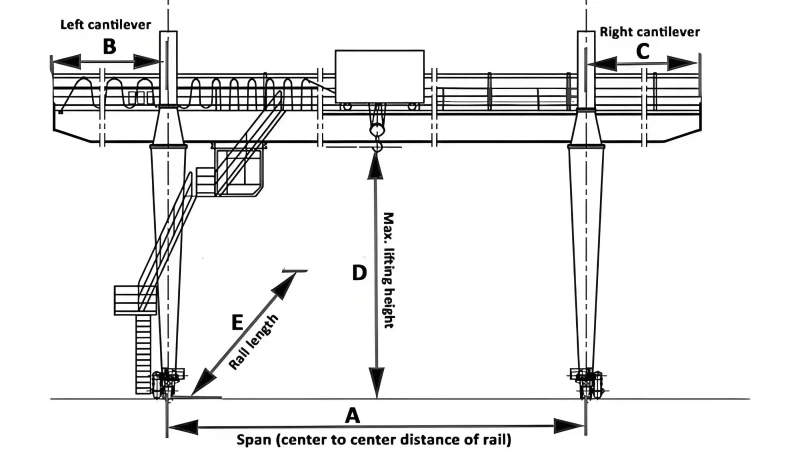
SKETCH
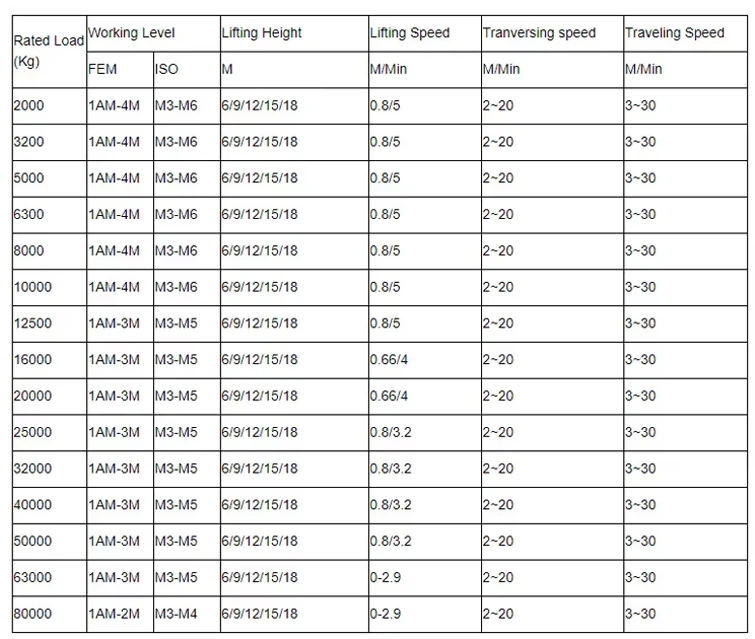
Main technical
Advantages
Here are the key advantages of a 150-ton boat hoist crane, broken down by category:
1. Operational Advantages
Unmatched Versatility: It can handle a wide range of vessels-from large yachts and commercial fishing boats to small passenger ferries and naval craft-up to its 150-ton capacity. Quick adjustment of sling positions accommodates different hull shapes and lengths.
High Speed & Efficiency: The process of lifting, transferring, and launching a vessel is much faster than synchronized railway systems. This allows a boatyard to service more vessels per day, increasing throughput and revenue.
Independent Mobility: As a self-propelled, rubber-tired machine, it can move freely around the yard. It picks up a boat from the water and transports it directly to a parking spot, workshop, or wash/launch area without needing a separate transporter.
Minimal Setup Time: Requires no permanent under-hull support structures (like railway cradles). The slings are adjusted, and the lift can begin almost immediately.
"Dry Sailing" Capability: Enables marinas to offer "dry stack" storage for very large yachts, allowing for secure, high-density land storage and quick launch-on-demand services.
2. Space and Infrastructure Advantages
Optimal Yard Space Utilization: Vessels can be parked closely together in neat rows, maximizing the number of boats stored on a given plot of land. There's no need for the fixed rails and trenches required by a railway system.
Reduced Civil Works: Installation does not require extensive dredging or construction of permanent inclined ramps or pits (compared to synchrolifts). The primary requirement is a strong, level paved area and a suitable quay wall.
Flexibility in Yard Layout: The travel path and storage areas can be easily reconfigured as needs change, unlike fixed systems.
3. Vessel Safety and Handling Advantages
Superior Hull Support: Modern hoists use computer-controlled, independently adjustable slings (4-point or more). This allows the slings to contour to the hull's shape, distributing weight evenly and minimizing stress points-critical for expensive modern hulls (e.g., fiberglass, composite).
Precise Control: Operators have excellent visibility and use precise joystick controls for smooth lifting, lowering, and maneuvering, reducing the risk of accidental contact.
Dry Work Environment: Once on land, the vessel is held securely in the air by the hoist's straps, or lowered onto keel blocks. This provides full, safe, and unobstructed 360-degree access to the hull for cleaning, surveying, painting, and repair.
Reduced Risk of Launching Damage: The gentle, controlled lowering into the water is safer than side-launching or complex railway operations, especially for delicate boats.
4. Economic and Business Advantages
Increased Revenue Potential: Faster turnaround times and higher storage density directly translate to the ability to service more customers.
Attracts Larger Vessels: The 150-ton capacity opens the market to superyachts (30-50 meters) and high-value commercial vessels, which are lucrative clients for repair and refit work.
Lower Long-Term Maintenance: While a significant capital investment, maintenance is primarily on the single machine (wheels, engines, hydraulics) rather than on extensive submerged railway tracks or syncrolift platforms, which are subject to corrosive marine environments.
Multi-Purpose Use: Can sometimes be used for other heavy lifting tasks around the yard, such as handling large engines, sections of dock, or containers.
5. Environmental Advantages
Containment of Activities: Hull cleaning, sanding, and painting can be done in a dedicated, contained area with proper filtration and runoff collection systems, preventing pollutants from entering the waterway.
Reduced Sediment Disturbance: Unlike railway systems that often require dredging along the track path, a hoift only needs sufficient water depth at the lift point.
Comparison to Alternatives:
vs. Railway Systems: More flexible, faster, and better hull support. Railways are often cheaper for very high-volume, similar-sized vessels but are slower and less versatile.
vs. Fixed Cranes: A mobile hoist combines the lifting and transport function. A fixed crane would require a separate trailer system and more space for maneuvering.
vs. Synchrolifts: A synchrolift (platform lift) is excellent for lifting many identical hulls simultaneously (like for a ferry fleet) but has higher initial construction costs and less flexibility for odd-sized vessels.
In summary, a 150-ton boat hoist crane is the workhorse of a modern, efficient boatyard. Its core advantages are flexibility, speed, superior vessel care, and optimal use of land, making it the preferred choice for facilities that handle a diverse mix of large and valuable vessels.
Application
Primary Application: Marine Travelift / Mobile Boat Hoist
This is the most common and critical use. A 150-ton mobile boat hoist (often on rubber tires) is the workhorse of boatyards, marinas, and shipyards for handling large vessels out of the water.
Key Uses:
Dry-Docking & Storage: Lifting vessels for winter storage, long-term dry berthing, or to free up wet slips. A 150-ton capacity can typically handle:
Large motor yachts (80-120 ft range)
Commercial fishing vessels
Small passenger ferries & tour boats
Patrol and research vessels
Naval and coast guard small craft
Mega-catamarans and sailing yachts (due to wide spreader bars)
Maintenance & Repair: Essential for access to hulls, propellers, rudders, thrusters, and through-hull fittings.
Hull inspection, cleaning, painting, and repair.
Propeller and shaft work.
Emergency repairs (e.g., after grounding).
Launching & Retrieval: The daily or seasonal cycle of moving boats between the water and land, especially in regions with freezing winters or for scheduled maintenance cycles.
Yard Management & Transportation: Moving vessels around the yard on land, positioning them in storage racks (for smaller vessels lifted in batches) or transporting them to a work shed.
Specific Industry & Scenario Applications
Marinas & Yacht Clubs: For seasonal haul-outs, commissioning/decommissioning, and member services.
Boatyards & Repair Facilities: The core tool for all dry work, enabling multiple parallel projects.
Shipyards (Small to Medium): For new construction (lifting hull modules, installing engines), as well as repair of smaller ships in a larger fleet.
Commercial Fishing Ports: Hauling fishing trawlers, purse seiners, and longliners for mandatory safety inspections, refits, and repairs.
Government & Military: Handling patrol boats, rescue craft, landing craft, and other support vessels for maintenance and deployment.
Ferry & Transportation Operators: Maintaining small passenger ferries and water taxis.
Research Institutions: Launching and retrieving specialized research vessels, submersible support craft, and buoy handling.
Marine Construction: Can be used to place or remove large prefabricated dock sections, pontoons, or small caissons (though this is a more specialized application).
Crane production process
Phase 1: Engineering & Design
This is the most critical phase, where the crane's performance, safety, and functionality are defined.
Client Requirements & Site Analysis:
Understanding the client's specific needs: maximum boat weight (180T), boat dimensions, lifting speed, hoist well size, and control preferences.
Analyzing the installation site (quay wall strength, soil conditions, wind exposure, seismic factors, and corrosion environment).
Conceptual & Detailed Design:
Structural Design: Engineers use Finite Element Analysis (FEA) software to design the main structural components:
Girders/Main Beams: The primary horizontal beams that carry the load. They are designed to minimize deflection under full load.
End Carriages/Trucks: The structures at each end that house the wheels and travel motors for moving the crane along the rails.
Legs/Supports: The vertical members that transfer the load to the end carriages and down to the rails.
Mechanical Design:
Hoisting System: Selection and design of the wire rope, hoist drums, sheaves (pulleys), and the main hoist motor(s) and gearboxes. A 180T crane will likely use multiple hoisting units (e.g., 4 x 45T hoists) synchronized for a level lift.
Travel System: Design of the travel wheels, axles, bearings, drive motors, and gearboxes for smooth and safe longitudinal movement.
Electrical & Control System Design:
Power Supply: Designing the system for power collection (e.g., festoon systems, cable reels, or conductor bars).
Motor Control Centers (MCCs): Specifying Variable Frequency Drives (VFDs) for precise control of hoisting and travel motions, ensuring smooth acceleration and deceleration.
PLC & Synchronization: Programming a Programmable Logic Controller (PLC) to manage all crane functions. The synchronization of multiple hoists is critical to prevent dangerous load tilting.
Safety Systems: Designing critical safety features like overload limit switches, emergency stop circuits, anti-collision systems, anemometers (wind speed sensors), and limit switches for travel and hoisting.
Procurement of Major Components:
Long-lead items are ordered early, such as the hoist motors, gearboxes, VFDs, PLC, wire rope, and specialized forged steel wheels or bearings.
Phase 2: Manufacturing & Fabrication
This phase transforms the design into physical components.
Structural Fabrication:
Material Preparation: High-strength steel plates and sections (e.g., I-beams) are cut to size using CNC plasma or laser cutters for precision.
Sub-Assembly Welding: Smaller components are welded together. This is done using automated welding machines where possible to ensure consistent, high-quality welds.
Major Assembly Welding: The main girders, end carriages, and legs are assembled on large, flat fabrication beds to control welding distortion and ensure alignment.
Stress Relieving: Critical welded structures may be heat-treated in a large furnace to relieve internal stresses created during welding, which improves structural integrity.
Machining: Bearing housings, motor mounts, and other critical interfaces are machined to precise tolerances.
Mechanical Assembly:
The fabricated structures are moved to the assembly area.
Hoist Mechanism Installation: Hoist drums, gearboxes, and motors are mounted onto the main girder(s).
Travel Mechanism Installation: Wheels, axles, bearings, travel motors, and gearboxes are assembled into the end carriages.
Sheave Installation: The wire rope sheaves are installed at the ends of the girders.
Painting & Corrosion Protection:
The entire structure is shot-blasted to clean the steel and create a surface profile for paint adhesion.
A multi-layer paint system is applied, typically an epoxy primer and a polyurethane topcoat, chosen for excellent corrosion resistance in a harsh marine environment.
Phase 3: Shop Assembly & Testing (FAT - Factory Acceptance Test)
Before disassembly for shipment, the crane is often partially or fully assembled at the factory for testing.
Electrical Installation: All cabling, control panels, MCCs, and operator cabs are installed.
Functional Testing:
All motions (hoist up/down, travel left/right) are tested without load.
The synchronization of the multiple hoists is verified.
Load Testing:
Static Load Test: The crane is lifted with a test load greater than the rated capacity (typically 125% of 180T = 225 Tons) and held for a period to verify structural integrity and weld quality.
Dynamic Load Test: The crane is operated with a test load (typically 110% of 180T = 198 Tons) through all its functions (hoisting, traveling) to verify the performance of the mechanical and electrical systems under dynamic conditions.
Safety System Verification: Every safety device (limit switches, overload protection, E-stops) is rigorously tested to ensure it functions as designed.
Phase 4: Delivery, Site Installation & Commissioning (SAT - Site Acceptance Test)
Disassembly & Shipping: The crane is carefully disassembled into transportable modules, protected, and shipped to the customer's site.
Site Preparation: The customer prepares the site, including installing the crane rails to precise alignment and levelness.
Erection: The crane components are lifted into place by mobile cranes and bolted or welded together by a specialized erection team.
Re-commissioning:
All electrical connections are made.
The crane is aligned on the rails.
All functions and safety systems are tested again.
Site Acceptance Test (SAT):
The crane undergoes a final load test in the presence of the client and often a third-party certifying authority (e.g., Lloyd's, DNV).
Once all tests are passed and the client is satisfied, the crane is officially handed over.
Operator Training: The manufacturer provides comprehensive training for the client's operators and maintenance personnel.
Summary Flowchart of the Production Process:
Client Requirements → Detailed Engineering & Design → Procurement → Steel Fabrication & Welding → Mechanical Assembly → Painting → Factory Assembly & Testing (FAT) → Disassembly & Shipping → Site Erection → Site Commissioning & Testing (SAT) → Client Training & Handover
This structured, phased approach ensures that a complex and critical piece of equipment like a 180-Ton Boat Hoist Crane is built to the highest standards of safety, reliability, and performance.

Workshop view:
The company has installed an intelligent equipment management platform, and has installed 310 sets (sets) of handling and welding robots. After the completion of the plan, there will be more than 500 sets (sets), and the equipment networking rate will reach 95%. 32 welding lines have been put into use, 50 are planned to be installed, and the automation rate of the entire product line has reached 85%.




Hot Tags: 150tons boat hoist crane, China 150tons boat hoist crane manufacturers, suppliers, factory
You Might Also Like




Send Inquiry