











Hanging Single Girder Bridge Crane
Products Description
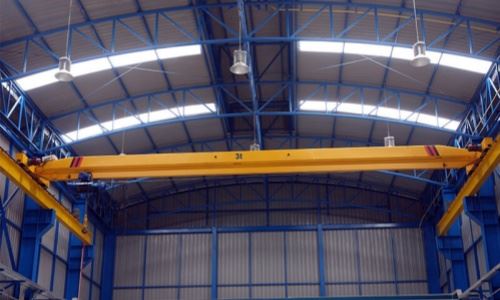
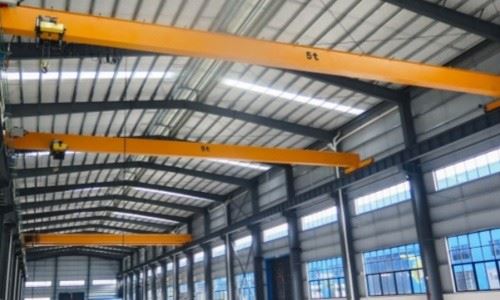
A Hanging Single Girder Bridge Crane (also known as a Underhung Single Girder Bridge Crane) is a type of overhead crane where the main beam (girder) is suspended from the ceiling or roof structure using end trucks that run along the bottom flange of runway beams. This makes it different from top-running cranes, where the bridge travels on top of the runway.
Key Features:
Structure: Single girder (one main beam)
Mounting: Suspended from the ceiling or roof structure
Runway: Runs on the bottom flange of I-beam or runway beam (underhung)
Trolley & Hoist: Travels along the bottom of the girder
Capacity: Typically used for lighter loads (commonly 1–10 tons, but can go higher depending on design)
Span: Varies by application and facility
Core Components: Gearbox, Motor, Gear
Place of Origin: Henan, China
Warranty: 1 Year
Weight (KG): 10000 kg
Video outgoing-inspection: Provided
Machinery Test Report: Provided
Selling Units: Single item
Single package size: 600X300X300 cm
Single gross weight: 200.000 kg
Pictures & Components
1.Main beam
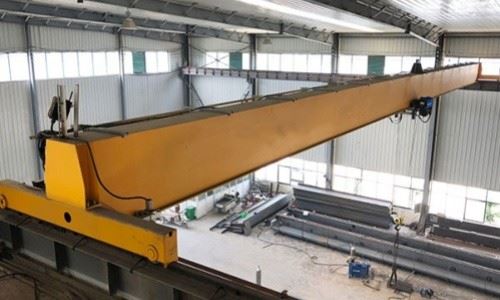
The main beam of a Hanging Single Girder Bridge Crane (also called an underhung single girder crane) is the primary horizontal structural element that:
Supports the hoist and trolley, which run along the bottom flange of the beam.
Is suspended (not supported from below) and connected at both ends to end trucks, which in turn ride on runway beams mounted to the building's ceiling or overhead structure.
2.Lifting System
1)Electric Hoist
Type: Most commonly a wire rope hoist or electric chain hoist.
Function: Lifts and lowers the load using a motor-driven drum or chain mechanism.
Lifting Capacity: Ranges from 0.5 tons up to around 10 tons (or more with custom design).
Lifting Height: Typically customizable based on application (e.g., 6m, 9m, 12m, etc.).
Lifting Speed: Often two-speed or variable frequency drive (VFD) controlled for smooth handling.
2)Trolley (Hoist Trolley)
Mounting: Attached to the hoist, running on wheels along the bottom flange of the main beam.
Movement: Motorized or manual. Enables horizontal travel of the hoist across the span of the crane.
Travel Speed: Typically controlled via inverter (VFD) for precision.
3)Hook & Hook Block
The actual component that attaches to the load via slings, chains, or lifting devices.
Equipped with a safety latch to prevent load slippage.
4)Limit Switches
Installed to prevent over-travel in lifting (up/down) and trolley movement (left/right).
Ensures safety and protects the motor from damage.
5)Control System
Pendant Control: Wired remote control hanging from the crane.
Wireless Remote: Optional for operator convenience and safety.
Cabin Control: Rare in underhung cranes due to lower capacities.
 |
 |
3.End carriage
The end carriage of a Hanging Single Girder Bridge Crane (also known as the end truck) is a critical structural and mechanical component that supports the main beam and enables the crane to travel along the runway beams.
In a hanging (underhung) configuration, the end carriage is suspended from the ceiling-mounted runway beams and runs along the bottom flange of these beams.
Structure & Mounting:
Made of steel plates and profiles welded or bolted into a rigid frame.
Bolted or welded to both ends of the main beam (girder).
Suspended from runway beams, meaning it travels below the beams.
 |
 |
4.Crane travelling mechanism
The crane traveling system of a Hanging Single Girder Bridge Crane (also known as the long travel mechanism) is the part of the crane that allows the entire crane structure (main beam + hoist + end carriages) to move longitudinally along the runway beams mounted to the ceiling or roof of the building.
5.Trolley travelling mechanism
The trolley traveling system of a Hanging Single Girder Bridge Crane is the mechanism that allows the hoist and trolley to move horizontally along the main beam (girder), enabling side-to-side (cross-travel) movement of the load. This is essential for precise positioning and handling within the crane's working span.
6.Crane wheel
The wheels of a Hanging Single Girder Bridge Crane play a crucial role in enabling the movement of both the crane itself (long travel) and the trolley/hoist (cross travel). Because it's a hanging (underhung) crane, the wheels operate on the bottom flange of the overhead runway beams (for crane travel) and the main beam (for trolley travel).

7.Crane Hook
The hook of a Hanging Single Girder Bridge Crane is the final load-handling device that connects the crane's lifting mechanism (hoist) to the object being lifted. It is a critical safety component designed to support the full rated load of the crane and to securely engage lifting slings, chains, or other lifting devices.

8.Motor
The motor of a Hanging Single Girder Bridge Crane is a key component that powers the movement of the crane, including the lifting, trolley travel, and crane (long) travel functions. These motors are specially designed for heavy-duty, high-torque, and frequent start/stop industrial operations.

.
9.Sound and light alarm system & limit switch
The Sound and Light Alarm System and Limit Switches are essential safety and control components in a Hanging Single Girder Bridge Crane. They help prevent accidents, protect equipment, and ensure safe operation of the crane.
1)Sound and Light Alarm System
Purpose:
Alerts workers to crane operation, movement, or faults
Increases workplace safety by warning personnel of:
Crane travel
Hoisting operations
Emergency or overload conditions
2)Limit Switches
Purpose:
Automatically stop or limit crane/trolley/hoist motion when a preset travel or lift limit is reached
Prevents over-travel, collision, or mechanical overrun

10.Safety Devices
1)Limit Switches
Prevent over-travel of crane, trolley, and hoist.
Types: travel limit switches (longitudinal and cross), hoist upper/lower limit switches.
Automatically cut off power when limits reached.
2)Overload Protection Device
Monitors lifting load via load cell or current sensor.
Prevents lifting beyond rated capacity by stopping hoist motor.
Avoids structural damage and accidents caused by overloading.
3)Emergency Stop Button (E-Stop)
Located on crane pendant and remote control.
Immediately cuts power to all crane functions when pressed.
Provides instant manual shutdown in emergencies.
4)Anti-collision Devices
Used in multi-crane setups on the same runway.
Prevent cranes from colliding by detecting proximity and stopping motion.
Can be ultrasonic, infrared, or radar-based sensors.
5)Crane Traveling and Trolley Traveling Limiters
Mechanical or electronic devices to stop motion near runway or girder ends.
Prevent mechanical damage due to impact.
11.Control Mode
1)Pendant Control (Wired Control)
Description: A handheld control box connected to the crane by a cable.
2)Wireless Remote Control
Description: A radio-controlled handheld transmitter communicates wirelessly with the crane receiver.
3)Cabin Control (Operator Cabin)
Description: Operator sits inside a cabin mounted on the crane or nearby platform.
4)Semi-Automatic and Automatic Control
Description: Incorporates programmable logic controllers (PLC) or computerized systems for automated crane operation.
5)Touchscreen or Panel Controls
Modern cranes may integrate touchscreen panels for easy operation, diagnostics, and system monitoring.
Often combined with wireless or wired controls.

Sketch

Main technical

Advantages
1. Space-saving Design
The crane is suspended from the runway beam rather than running on floor-level rails, so it doesn't occupy valuable floor space.
Ideal for facilities with limited floor space or where the floor needs to remain clear for other equipment or operations.
2. Lightweight Structure
Uses a single girder (main beam), making the crane lighter than double girder types.
Easier and cheaper to install and maintain.
Less structural load on the building and runway system.
3. Cost-Effective
Lower material and installation costs compared to double girder or top-running bridge cranes.
Reduced foundation and runway structure requirements.
Simplified design leads to lower manufacturing and maintenance expenses.
4. Versatile and Flexible
Suitable for small to medium load capacities (typically up to about 10 tons).
Can be customized for various spans and working environments.
Easy to retrofit or upgrade existing installations.
5. Improved Safety
Suspended design minimizes ground-level hazards for workers.
Equipped with standard safety devices (limit switches, alarms, overload protection).
6. Good Accessibility
Operator or automated systems have better visibility and access for lifting operations.
Easier to maneuver loads in tight or confined spaces.
Application:
1. Manufacturing Workshops & Assembly Lines
Ideal for lifting and moving parts and assemblies in production.
Supports machining, welding, and assembly operations.
Helps improve workflow by providing quick, flexible load handling.
2. Warehouses & Storage Facilities
Efficiently handles loading/unloading and material placement.
Saves floor space, allowing more storage capacity.
Suitable for palletized goods, bulky items, and packaged materials.
3. Automotive Industry
Used in small to medium scale automotive assembly plants.
Lifts engines, chassis parts, and components safely and efficiently.
4. Electronics & Electrical Equipment Manufacturing
Delicate handling of sensitive components.
Suitable for cleanroom environments (with modifications).
5. Food & Beverage Industry
Handling raw materials, packaging, and heavy equipment.
Can be adapted for hygienic standards (stainless steel components, special coatings).
6. Textile & Garment Factories
Moving rolls of fabric and heavy equipment.
Supports production lines without occupying floor space.
7. Maintenance and Repair Workshops
Facilitates lifting of heavy machinery parts or tools.
Used in shipyards, vehicle repair shops, and machine maintenance areas.
8. Light Construction & Fabrication
Assists in moving steel structures, tools, and equipment.
Helps in precise positioning during fabrication.
Crane production procedure
1. Requirement Analysis & Design
Gather client requirements: lifting capacity, span, working environment, control mode, etc.
Conduct engineering design:
Structural design of main beam (girder), end carriages.
Hoist selection and integration.
Mechanical and electrical system design.
Perform stress calculations and safety factor checks.
Prepare detailed drawings (CAD/3D models).
2. Material Procurement
Source high-quality steel plates, profiles, and mechanical parts.
Select motors, brakes, electrical components, limit switches, and control devices.
Verify certifications and quality standards for materials.
3. Fabrication of Components
Cutting & Shaping: Use CNC cutting machines, plasma cutters, or shearing for steel plates.
Welding: Weld the main girder, end carriages, and support frames following strict procedures.
Machining: Machine wheel seats, gearboxes, and other precision parts.
Surface Treatment: Remove burrs and rust; apply anti-corrosion treatment (sandblasting, priming).
4. Assembly of Mechanical Parts
Assemble wheels, end carriages, and trolley frames.
Install hoist and gearbox on the girder.
Fit motors, brakes, and brakes.
Install limit switches and safety devices.
5. Electrical System Installation
Wire motors, control panels, and alarm systems.
Mount pendant control or wireless receiver.
Connect power supply and control circuits.
Test electrical insulation and continuity.
6. Painting and Finishing
Apply primer coating.
Finish with durable industrial paint (usually bright colors for visibility).
Dry and cure paint as per specifications.
7. Testing and Quality Inspection
Load Test: Test lifting capacity with test weights (typically 125% of rated load).
Functional Test: Check hoist, trolley, and crane travel functions.
Safety Checks: Verify operation of limit switches, alarms, brakes, and emergency stop.
Dimensional Inspection: Confirm compliance with design specs.
8. Packing and Delivery
Protect the crane components with packaging materials.
Arrange transportation (container or truck).
Provide installation and operation manuals.
9. Installation and Commissioning (optional, often done on-site)
Supervise or perform crane installation at customer site.
Conduct on-site testing and adjustments.
Train customer personnel on safe operation and maintenance.

Workshop view:
The company has installed an intelligent equipment management platform, and has installed 310 sets (sets) of handling and welding robots. After the completion of the plan, there will be more than 500 sets (sets), and the equipment networking rate will reach 95%. 32 welding lines have been put into use, 50 are planned to be installed, and the automation rate of the entire product line has reached 85%.


Hot Tags: hanging single girder bridge crane, China hanging single girder bridge crane manufacturers, suppliers, factory, Single Girder Overhead Crane, Single Girder Overhead Travelling Crane
You Might Also Like




Send Inquiry