







120T Bridge Launching Girder For Erecting Concrete Girders manufacturers

120T Bridge Launching Girder For Erecting Concrete Girders suppliers

120T Bridge Launching Girder For Erecting Concrete Girders factory

120T Bridge Launching Girder For Erecting Concrete Girders best

120T Bridge Launching Girder For Erecting Concrete Girders high quality
120T Bridge Launching Girder For Erecting Concrete Girders
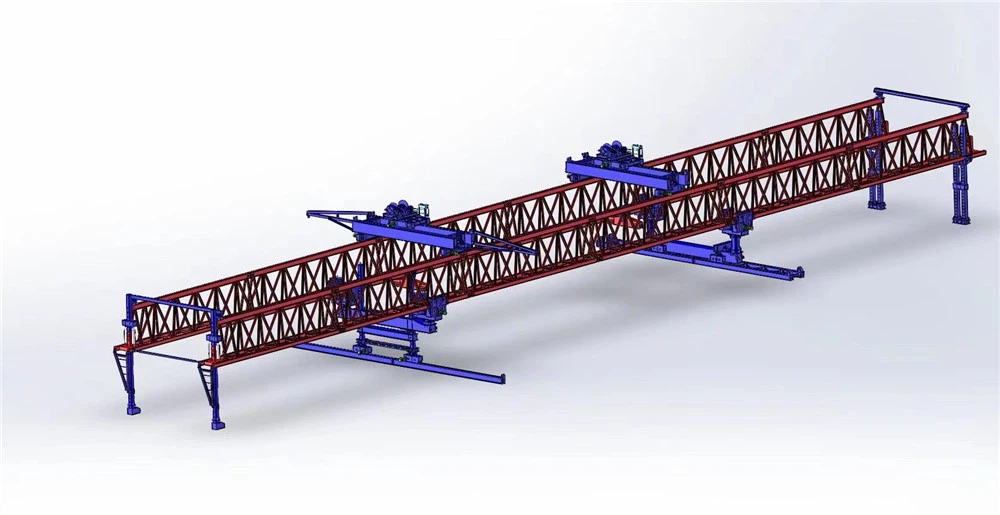
A 120T Bridge Launching Girder (often called a launching gantry or bridge girder launcher) is a specialized piece of heavy construction equipment used to erect precast concrete girders-typically in highway, railway, or metro bridge projects.

Core Function
The primary purpose of a 180ton bridge launcher is to lift, transport, and precisely place heavy prefabricated concrete or steel bridge components, typically weighing up to 180 tons (metric tons, ~165 US tons), during the construction of viaducts, overpasses, and highway bridges.
Key Design Parameters & Performance Specifications
| Parameter | Specification |
|---|---|
| Lifting Capacity (per girder) | 120 Metric Tons |
| Maximum Span (Pier to Pier) | 50 meters (Typical), customizable up to 60m |
| Minimum Curve Radius | 2,000 meters (can be designed for tighter radii) |
| Maximum Supported Grade | ±4% |
| Lifting Hoists | 2 x Main Hoists (typically 120-ton capacity each) |
| Hoist Lifting Speed | 0-5 m/min (variable speed control) |
| Trolley Traversing Speed | 0-10 m/min (variable speed control) |
| Main Beam Launching Speed | 0-5 m/min (variable speed control) |
| Machine Self-Propelling Speed | 0-5 m/min (variable speed control) |
| Control System | Centralized PLC with frequency control for all motions. Remote control operation. |
| Power Supply | 380V / 50Hz / 3 Phase (or as per project requirement) |

Pictures & Components
🏗️ 1. Main Girder / Truss Structure
The primary load-bearing frame
Spans between bridge piers
Usually a steel truss or box girder
Supports all lifting and moving equipment
🦵 2. Support Legs (Front, Middle, Rear)
Temporary supports resting on piers or completed spans
Types:
Front leg – positioned on the next pier
Rear leg – sits on the completed span
Middle leg (sometimes included) – adds stability
Carry vertical loads and stabilize the machine during operation
🛠️ 3. Hoisting System
Lifts the concrete girders (up to 120 tons)
Includes:
Winches or hoists
Wire ropes
Hooks or lifting beams
Often has dual lifting points for balance and safety
🚋 4. Trolley / Crab Mechanism
Moves along rails on the main girder
Carries the hoisting system
Enables:
Longitudinal movement (along bridge axis)
Precise positioning of girders
↔️ 5. Transverse Moving System
Allows side-to-side (left/right) movement
Ensures accurate placement onto bearings
Usually rail-mounted or hydraulic-guided
🚀 6. Launching Mechanism
Moves the entire girder forward from one span to the next
Components:
Hydraulic jacks
Rollers or sliding shoes
Launching nose (a lighter front extension for balance)
🧱 7. Launching Nose (Front Nose)
A lightweight extension at the front
Reduces bending moment during forward launching
Helps reach the next pier before full load transfer
⚡ 8. Hydraulic System
Powers:
Lifting
Launching
Leg adjustments
Includes pumps, cylinders, valves, and pipelines
🎮 9. Electrical & Control System
Central control panel (manual or automated)
Synchronizes lifting and movement
Includes:
Sensors (load, position, limit switches)
Emergency stop systems
🛞 10. Traveling System
Wheels or rollers that move along rails
Used for:
Forward launching
Adjustments during operation
🔒 11. Safety Systems
Overload protection
Wind alarms
Anti-fall devices
Limit switches and interlocks
🧩 12. Bearing Placement Aids
Guides or alignment tools
Ensure girders sit correctly on bridge bearings

Sketch

Advantages
🚀 Faster Construction Speed
Enables span-by-span erection without waiting for large cranes
Can install multiple girders in a single cycle
Ideal for projects with tight deadlines (e.g., highways, metro viaducts)
🏙️ Minimal Ground Disruption
Operates above the bridge piers, not from the ground
No need for heavy crane setup on roads, rivers, or railways
Reduces:
Traffic interruption
Land usage
Environmental impact
🎯 High Precision Placement
Built-in alignment and controlled lifting systems
Ensures girders are placed accurately on bearings
Reduces rework and alignment errors
💰 Cost Efficiency (for Repetitive Spans)
High initial investment, but:
Lower crane rental costs
Reduced labor requirements
Faster project completion = lower overall cost
Becomes very economical for long viaducts or multiple spans
🔒 Improved Safety
Less reliance on ground-based lifting in risky environments
Stable, controlled operations using synchronized systems
Reduces risks associated with:
Heavy crane lifting
Working over traffic or water
🌉 Suitable for Difficult Terrain
Works well over:
Rivers
Valleys
Existing roads or railways
No need for temporary access roads or scaffolding
🔁 Reusability
Can be dismantled and reused for other projects
Valuable asset for contractors handling multiple bridge jobs
⚙️ Handles Heavy Loads Efficiently
Specifically designed for large precast girders (up to 120T)
Maintains stability and control even with heavy segments
📐 Adaptability
Can be customized for:
Different span lengths
Curved alignments
Various girder types (I-girder, box girder, U-girder)
🧠 Bottom Line
A launching girder is most advantageous when:
You have many similar spans
Ground access is restricted or unsafe
Speed, safety, and precision are critical

Application
🌉 Highway & Expressway Bridges
Widely used for elevated highways and flyovers
Ideal for long viaducts with repeated spans
Allows erection without blocking traffic below
👉 Common for urban expressways and bypasses
🚆 Railway Bridges
Used in conventional and high-speed rail projects
Suitable for:
Precast I-girders
Box girders
Ensures precise alignment, which is critical for rail tracks
🚇 Metro & LRT Viaducts
One of the most common applications
Used in elevated metro systems in dense cities
Enables construction above busy roads with minimal disruption
👉 Frequently used in large metro projects across Asia and Europe
🌊 Bridges Over Rivers & Water Bodies
Eliminates need for barges or temporary supports
Works efficiently where:
Water depth is high
Flow conditions are difficult
🏞️ Valley & Mountain Bridges
Suitable for inaccessible or uneven terrain
Avoids the need for ground-based heavy lifting equipment
Reduces environmental disturbance in sensitive areas
🏗️ Precast Segmental Bridge Construction
Used for segmental box girder bridges
Can handle both:
Full-span girders
Segment-by-segment erection (in some configurations)
🔁 Repetitive Span Projects
Best suited for projects with:
Uniform span lengths
Large number of girders
Maximizes efficiency and cost-effectiveness
🏢 Urban Infrastructure Projects
Flyovers and interchanges in congested cities
Projects where:
Space is limited
Traffic cannot be stopped

Production Procedure
The production (or fabrication and preparation) procedure of a 120T Bridge Launching Girder involves several stages-from design to site commissioning. It's not just "manufactured," but engineered, fabricated, assembled, and tested before use.
Here's a clear step-by-step outline:
🧠 1. Design & Engineering
Define:
Lifting capacity (120T)
Span length
Girder type (I, box, U)
Perform:
Structural analysis (loads, bending, stability)
Checks for wind, seismic, and dynamic effects
Prepare detailed drawings and fabrication plans
🏭 2. Material Procurement
High-strength structural steel plates and sections
Components:
Motors, gearboxes
Wire ropes, pulleys
Hydraulic systems
Ensure materials meet standards (e.g., ASTM, EN)
🔩 3. Fabrication of Steel Structure
Cutting (CNC plasma/laser cutting)
Welding of:
Main girder/truss segments
Support frames
Assembly of sub-components in workshop
Quality checks:
Weld inspection (UT, radiography)
Dimensional accuracy
🧱 4. Machining & Component Manufacturing
Fabrication of:
Wheels/rollers
Trolley frames
Bearing housings
Precision machining for moving parts
⚙️ 5. Assembly of Mechanical Systems
Install:
Hoisting winches
Trolley mechanisms
Traveling systems
Fit wire ropes and pulley blocks
⚡ 6. Electrical & Hydraulic Installation
Electrical:
Control panels
Motors and cabling
Sensors and limit switches
Hydraulic:
Pumps and cylinders
Piping and valves
🧪 7. Factory Testing (Pre-Dispatch)
No-load testing (movement, controls)
Load testing (trial lifts up to rated capacity)
Safety system checks:
Emergency stop
Overload protection
🚚 8. Transportation to Site
Dismantled into transportable segments
Delivered via trucks or trailers
Requires logistics planning due to large size
🏗️ 9. Site Assembly
Reassembly of:
Main girder
Support legs
Trolley and hoisting systems
Alignment and positioning on initial piers
🔧 10. Site Commissioning
Calibration of:
Lifting systems
Movement controls
Trial operations:
Dummy lifts
Full operational checks
🧪 11. Load Testing & Certification
Proof load test (usually 125% of rated capacity)
Inspection by engineers / third-party authority
Certification before actual use
🚀 12. Ready for Operation
Begins girder erection span-by-span
Continuous monitoring during use


Workshop View
The company has installed an intelligent equipment management platform, and has installed 310 sets (sets) of handling and welding robots. After the completion of the plan, there will be more than 500 sets (sets), and the equipment networking rate will reach 95%. 32 welding lines have been put into use, 50 are planned to be installed, and the automation rate of the entire product line has reached 85%.


Hot Tags: 120t bridge launching girder for erecting concrete girders, China 120t bridge launching girder for erecting concrete girders manufacturers, suppliers, factory
You Might Also Like


Send Inquiry