










Double Girder Bridge Crane Near Me
Products Description
A Double Girder Bridge Crane is a powerful overhead lifting solution designed for heavy-duty material handling in industrial environments. It features two parallel bridge girders that support the crane trolley and hoist, enabling higher lifting capacities and spans than single girder models.
Core Components:Bearing, Gearbox, Motor, Pump
Place of Origin:Henan, China
Warranty:1 Year
Weight (KG):2000 kg
Video outgoing-inspection:Provided
Machinery Test Report:Provided
Design:Double beam
Effectiveness:high efficiency
Operating speed:High speed operation
Stability:Anti-swing function
Color:Optional
Power Source:110V/220V/230V/380V/440V,customized
Span:7.5-31.5m
Pictures & Components
1.Main beam
1)Double Beam Design
Two parallel girders are used to increase structural integrity and load capacity.
The trolley runs on top of the girders, providing higher lifting height and better weight distribution.
2)Material & Construction
Made from high-strength structural steel (typically Q235B/Q345B or equivalent).
Welded box-type or I-beam structure for high rigidity and minimal deflection.
Precision-welded with advanced techniques (e.g., submerged arc welding) to ensure strong joints.
3)Connection with End Carriages
Main beams are bolted or welded to end trucks/carriages, which contain the travel wheels and support the crane's horizontal movement on the runway beams.
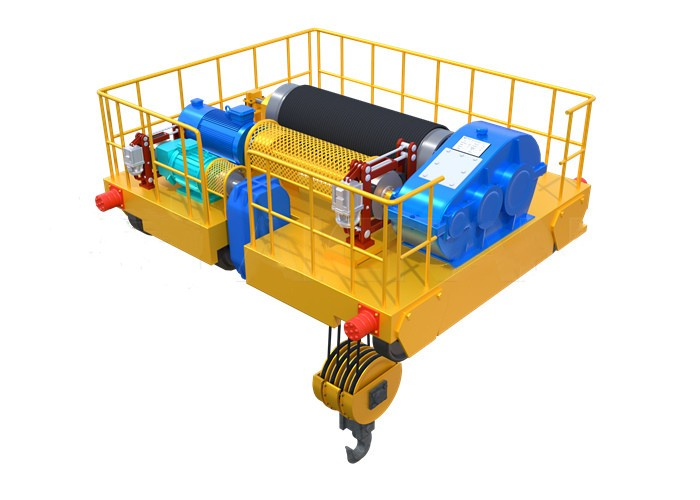
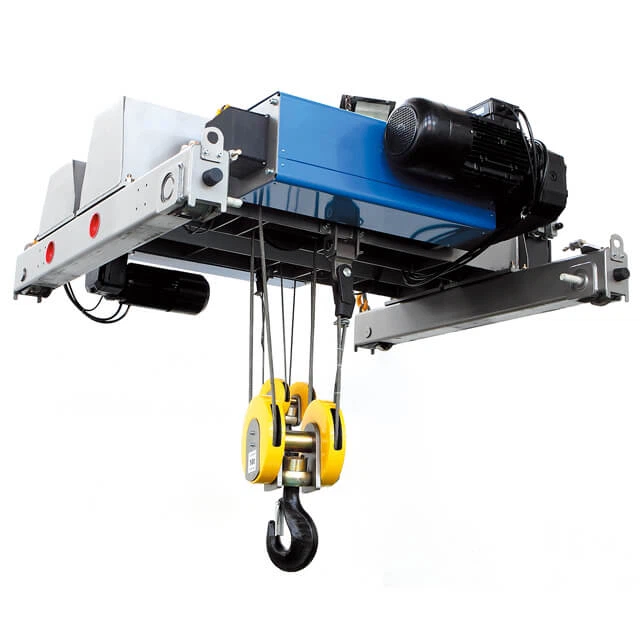
2.Lifting System
1)Electric Hoist or Winch Trolley
Usually a customized hoisting trolley with a wire rope hoist or open winch.
Mounted on top of the two girders for maximum lifting height.
Equipped with lifting motor, drum, rope guide, brake, and gearbox.
2)Lifting Motor
High-power three-phase electric motor, often with:
Variable Frequency Drive (VFD) for speed control.
Overheating and overload protection.
Power ranges from 15 kW to 75 kW+, depending on capacity.
3)Wire Rope Drum
Grooved drum ensures smooth winding of the wire rope.
Engineered to avoid overlapping and to reduce wear.
4)Wire Rope
Heavy-duty steel wire rope, anti-twist and abrasion-resistant.
Breaking load is typically 5–7 times greater than the rated lifting load.
5)Hook Block
Swivel or fixed hook block depending on load movement requirements.
Includes safety latch, and sometimes rotator or weighing device.
6)Brake System
Electromagnetic or hydraulic brake.
Automatically engages in the event of power failure.
 |
 |
3.End carriage
The end carriage is a critical structural and mechanical component of a double girder bridge crane, responsible for supporting the bridge girders and enabling horizontal movement of the entire crane along the runway rails.
Key Functions
Supports the two main beams (girders) at each end.
Houses the travel wheels and drive mechanism for crane movement.
Ensures smooth and aligned travel along the runway rails.
 |
 |
4.Crane travelling mechanism
1)End Carriages
Located at both ends of the bridge girders.
House travel wheels, drive motors, and gearboxes.
Connected to the bridge structure via bolted or welded joints.
2)Travel Wheels
Usually four or eight solid steel wheels (depending on crane span and load).
Double-flanged or flat-tread, depending on rail design.
Made of forged alloy steel with heat treatment for wear resistance.
3)Drive Motors
Typically two motors, one per end carriage.
High-torque three-phase motors, often paired with frequency inverters (VFDs) for:
Smooth start/stop
Adjustable travel speed
Energy efficiency
4)Gearbox
Helical or planetary gear reducers to match motor output to wheel torque.
Compact design for efficient power transmission and minimal maintenance.
5)Control System
Movement controlled via:
Pendant control (wired)
Radio remote control
Cabin control (for high-capacity cranes)
Integrated with limit switches and travel buffers for safety.
6)Runway Rails
Installed on runway beams attached to building columns or structures.
Typically use standard rail sections (e.g., QU80, QU100).
5.Trolley travelling mechanism
1)Trolley Frame
A rigid steel structure that houses the hoist, lifting motor, drum, and hook assembly.
Mounted on travel wheels that run on top of the two bridge girders.
2)Travel Wheels
Usually four steel wheels (or more for large capacities).
Forged or cast steel with heat-treated surfaces.
Designed to run on rails mounted on the girders (often square bar rail or P-section steel).
3)Drive Motor and Gearbox
Equipped with a dedicated travel motor (typically SEW, NORD, or ABB brands).
Includes a helical or planetary gearbox for smooth torque transmission.
Often fitted with variable frequency drives (VFDs) for:
Adjustable speed
Smooth acceleration/deceleration
Reduced mechanical wear
4)Guide Rollers
Prevent the trolley from deviating or skewing while moving.
Help ensure stable travel under dynamic load conditions.
5)Travel Rails
Installed on top of the double girders.
Usually made from round bar steel or specialized rail tracks.
6)Control Integration
Movement is controlled along with hoisting and crane travel via:
Pendant control
Radio remote
Operator cabin (for large capacity cranes)
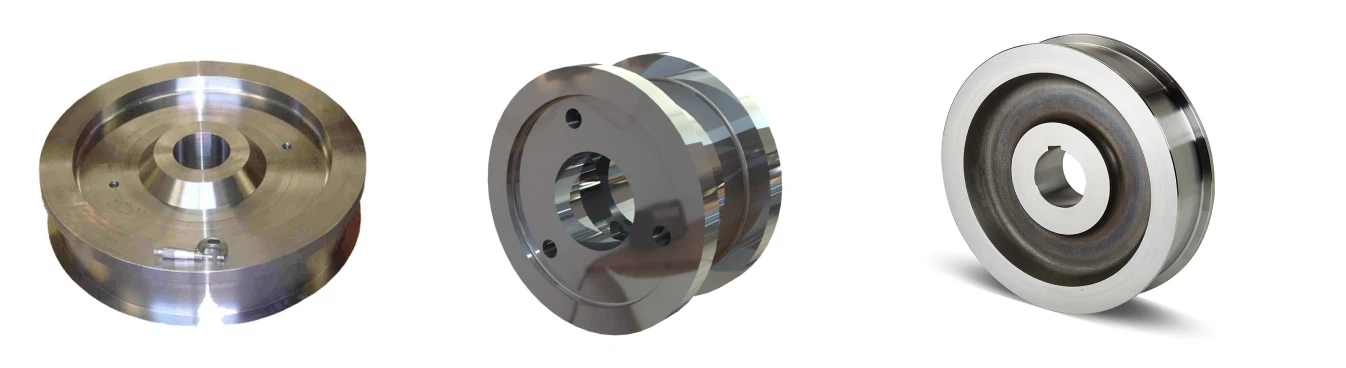
6.Crane wheel
1)Crane Traveling Wheels
Mounted on the end carriages
Run along the runway rails (building-mounted)
2)Trolley Traveling Wheels
Mounted on the trolley frame
Travel along the rails on top of the main girders
7.Crane Hook
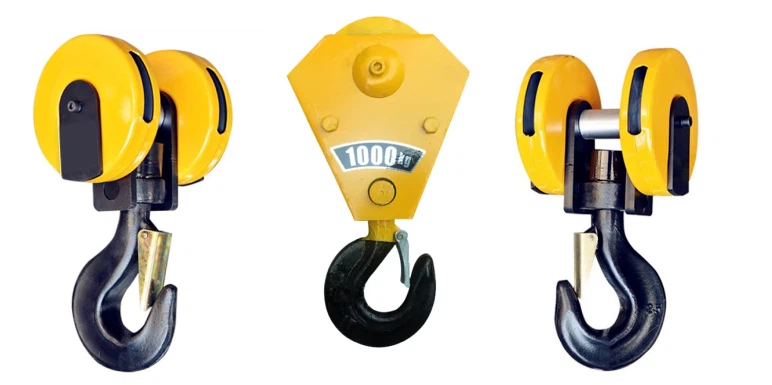
1)Hook Block
Contains the pulley sheaves, hook, bearing, and frame.
Guides the wire rope and transmits lifting force.
2)Hook
Forged or laminated steel construction.
Swivel or fixed depending on application.
3)Safety Latch
Prevents accidental unhooking of the load.
Standard on most industrial crane hooks.
4)Bearings & Swivel Mechanism
Allows 360° rotation of the hook (if rotatable type).
Reduces twisting of the wire rope during lifting.
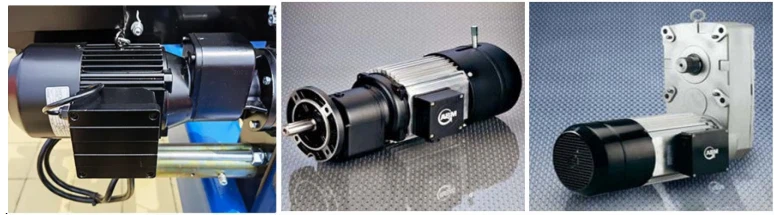
8.Motor
1)Hoisting Motor
Powers the lifting mechanism to raise and lower loads.
2)Trolley Traveling Motor
Moves the trolley horizontally across the main girders.
3)Crane Traveling Motor
Drives the entire crane along the runway rails.

.
9.Sound and light alarm system & limit switch
1)Sound and Light Alarm System
Purpose:
To warn workers in the crane operating area of crane movements, especially hoisting, traveling, or trolley motion.
Enhance safety by alerting nearby personnel to potential hazards.
2)Limit Switches
Purpose:
To prevent overtravel or over-hoisting by mechanically or electrically stopping crane/trolley/hoist movement beyond safe limits.
Protect the crane structure, load, and personnel from accidents.

10.Safety Devices
1)Overload Protection Device
Prevents the crane from lifting loads beyond its rated capacity.
Uses load cells, strain gauges, or limit switches integrated with the control system.
Automatically stops hoisting or triggers alarms if overload occurs.
2)Anti-collision Device
Detects and prevents collisions between cranes operating on the same runway.
Uses sensors (ultrasonic, infrared) or RFID to monitor proximity.
Automatically slows down or stops the crane to avoid accidents.
3)Upper and Lower Limit Switches
Limit hoisting travel to prevent the hook from moving too high or too low.
Mechanical or electronic switches stop the hoist motor to avoid cable damage or hook hitting the beam.
4)End Travel Limit Switches
Prevent the crane or trolley from traveling beyond safe runway or girder limits.
Avoids derailment and structural damage.
5)Emergency Stop Button
Located on the control pendant, cabin, and remote control.
Instantly cuts power to all crane movements in emergencies.
6)Brake System
Electromagnetic or mechanical brakes on hoisting and travel motors.
Provide secure holding of loads during pauses or power loss.
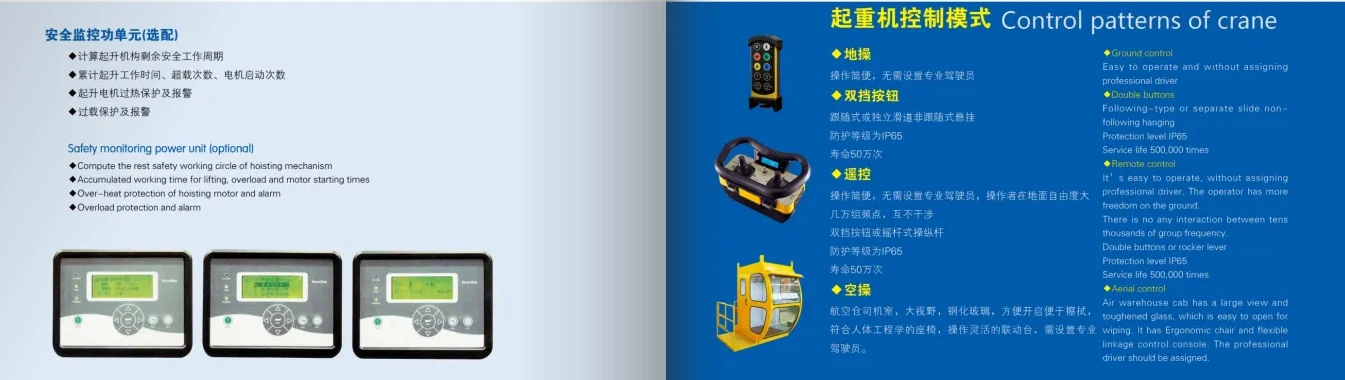
11.Control Mode
1)Pendant Control (Wired Control)
A handheld control station connected by a cable to the crane.
Equipped with push buttons or joysticks for:
Hoist up/down
Trolley left/right
Crane forward/backward
Reliable and safe for precise control.
Limited by cable length and mobility.
2)Radio Remote Control (Wireless Control)
Operator controls the crane wirelessly via a handheld transmitter.
Allows the operator to move freely around the crane workspace.
Equipped with safety features like emergency stop and deadman switch.
Uses RF signals, typically in 2.4 GHz or UHF bands.
Widely used in outdoor or large workshops.
3)Cabin Control
An operator cabin mounted on the crane bridge or runway beam.
Provides panoramic view and ergonomic controls (joystick, pedals).
Used for heavy, large-span cranes or precise load placement.
Includes air conditioning, soundproofing, and safety glass.
4)Automatic or Semi-Automatic Control
Integrates PLC or computer systems for pre-programmed crane operations.
Enables repetitive tasks, load positioning, or integration with production lines.
Includes sensors and cameras for safety and precision.
Often used in modern factories and warehouses.
12.Sketch

Main technical

Advantages
1. Higher Load Capacity
Supports heavier loads compared to single girder cranes.
Typically used for capacities from 10 tons up to 100 tons or more.
Ideal for heavy machinery, steel mills, shipyards, and large warehouses.
2. Greater Span and Lifting Height
Allows for longer spans between runway rails without compromising stability.
Higher lifting height thanks to the hoist traveling on top of the girders.
Provides more vertical clearance, maximizing workspace underneath.
3. Stronger and More Durable Structure
Two girders distribute load evenly, reducing stress on components.
Designed for heavy-duty operation and continuous use.
Enhanced resistance to bending and twisting under load.
4. Better Load Stability and Safety
Dual girders offer improved balance and rigidity.
Less sway and vibration during lifting and traveling.
Safer operation in demanding or dynamic environments.
5. Flexible Trolley and Hoisting Options
Can accommodate larger and heavier hoists or special lifting attachments.
Suitable for various lifting devices like hooks, magnets, grabs, or clamps.
Trolley can travel on top of the girders, allowing for compact design and better load control.
6. Longer Service Life
Heavier construction and quality materials result in extended durability.
Less maintenance needed due to robust design.
Suitable for harsh industrial environments (steel mills, foundries, heavy fabrication).
7. Customization and Automation Friendly
Easier integration with automation systems, PLC controls, and safety devices.
Adaptable to specific industry needs and custom lifting tasks.
Application:
1. Heavy Manufacturing and Fabrication Plants
Handling heavy machinery parts and assemblies.
Moving large steel components, molds, and dies.
Facilitating welding, cutting, and assembly processes.
2. Steel Mills and Metal Foundries
Transporting steel coils, billets, slabs, and castings.
Loading and unloading raw materials and finished products.
Working in harsh environments with high temperature and dust.
3. Shipbuilding and Repair Yards
Lifting large ship parts like hull sections, engines, and propellers.
Assembling heavy ship components with precision.
Handling heavy cargo and equipment.
4. Power Plants and Heavy Equipment Maintenance
Installing and maintaining turbines, generators, and large components.
Handling transformers and heavy electrical equipment.
Used in hydroelectric, thermal, and nuclear power stations.
5. Large Warehouses and Distribution Centers
Moving heavy pallets, containers, and bulk materials.
Loading and unloading trucks or railcars.
Supporting automated material handling systems.
6. Automotive and Aerospace Industries
Assembly line support with heavy parts handling.
Transporting engines, chassis, and large aerospace components.
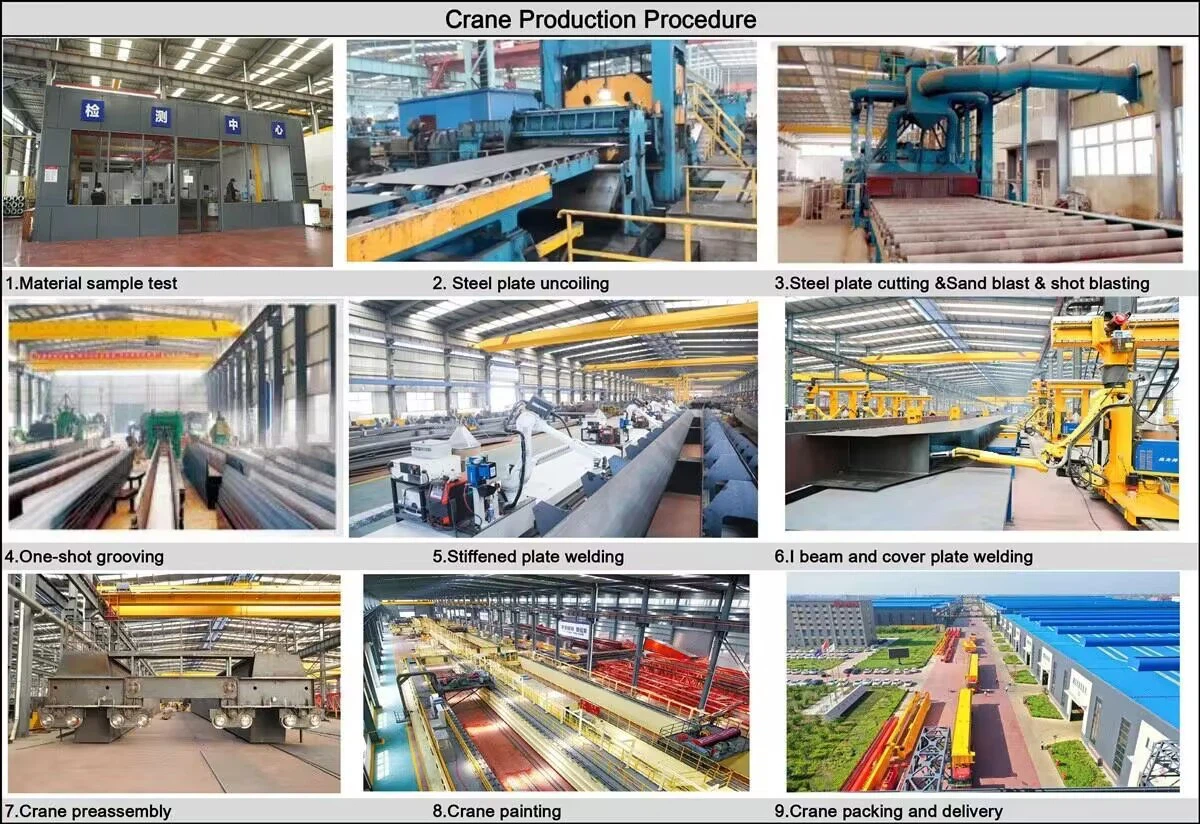
Crane production procedure
1)Design & Engineering
Requirement analysis: Load capacity, span, lifting height, working environment.
Structural design: Main beam, end carriages, trolley, and hoist.
Electrical & control design: Motors, wiring, control modes, safety devices.
Use of CAD software for detailed drawings and simulations.
2)Material Procurement
Source high-quality steel (Q235, Q345, or equivalent) for beams and components.
Acquire motors, gearboxes, control units, limit switches, and other electrical parts.
Purchase wire ropes, hooks, brakes, and safety devices from certified suppliers.
3)Cutting and Machining
Steel plates and profiles cut to size using CNC machines or plasma cutters.
Machining of critical components like wheel hubs, shaft holes, and bearing seats.
Ensures precise dimensions and tight tolerances.
4)Welding and Assembly of Main Beams
Welding of girders using automatic or semi-automatic welding machines.
Use of jig fixtures to maintain straightness and alignment.
Stress relieving heat treatment after welding to prevent deformation.
5)Fabrication of End Carriages and Trolley
Assemble end carriages with wheels, motors, brakes, and gearboxes.
Trolley frame fabrication and installation of hoisting mechanism.
Pre-assembly of control and safety devices.
6)Surface Treatment
Sandblasting to clean steel surfaces.
Application of primer and industrial paint for corrosion resistance.
Optional powder coating for enhanced finish.
7)Electrical Installation
Wiring of motors, control panels, limit switches, alarms, and remote controls.
Installation of Variable Frequency Drives (VFD) if applicable.
Integration of safety devices and sensors.
8)Testing and Quality Inspection
Static load test to verify structural integrity.
Dynamic load test to check hoisting, traveling, and trolley functions.
Safety device functional tests (limit switches, alarms, brakes).
Inspection against design specifications and standards (ISO, FEM).
9)Packing and Shipping
Disassembly if necessary for transportation.
Protective packaging to prevent damage during shipping.
Delivery and installation guidance.
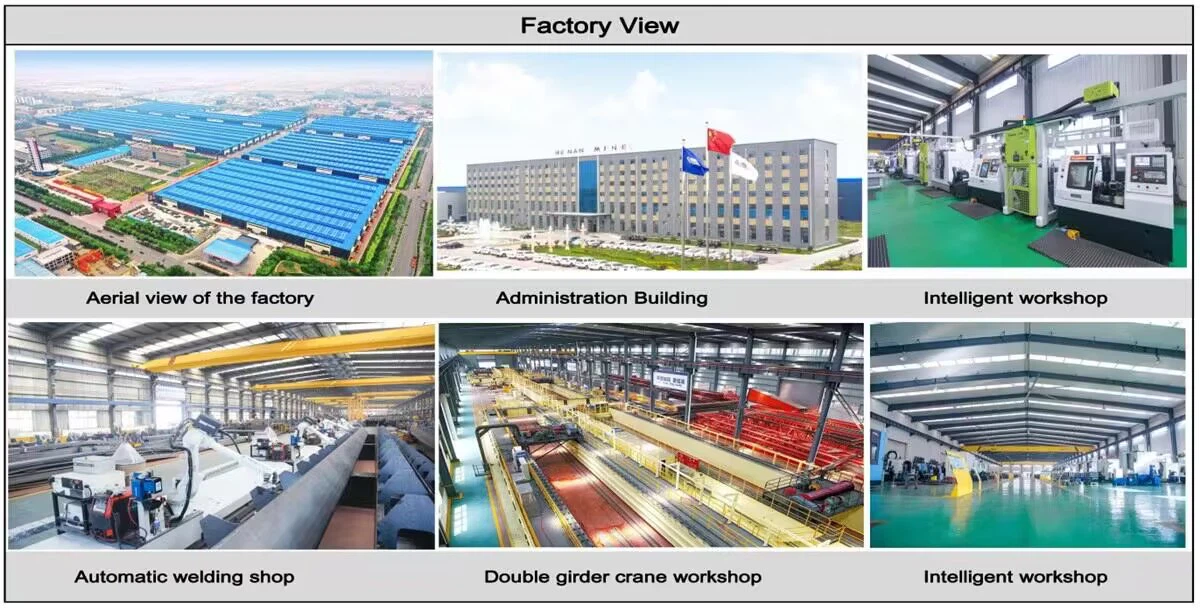
Workshop view:
The company has installed an intelligent equipment management platform, and has installed 310 sets (sets) of handling and welding robots. After the completion of the plan, there will be more than 500 sets (sets), and the equipment networking rate will reach 95%. 32 welding lines have been put into use, 50 are planned to be installed, and the automation rate of the entire product line has reached 85%.


Hot Tags: double girder bridge crane near me, China double girder bridge crane near me manufacturers, suppliers, factory, Double Girder Overhead Travelling Crane, Double Girder Overhead Crane
You Might Also Like


Send Inquiry