










120T Self-balancing Bridge Launching Girder For Erecting Concrete Girders manufacturers

120T Self-balancing Bridge Launching Girder For Erecting Concrete Girders suppliers

120T Self-balancing Bridge Launching Girder For Erecting Concrete Girders factory

120T Self-balancing Bridge Launching Girder For Erecting Concrete Girders best

120T Self-balancing Bridge Launching Girder For Erecting Concrete Girders high quality
120T Self-balancing Bridge Launching Girder For Erecting Concrete Girders
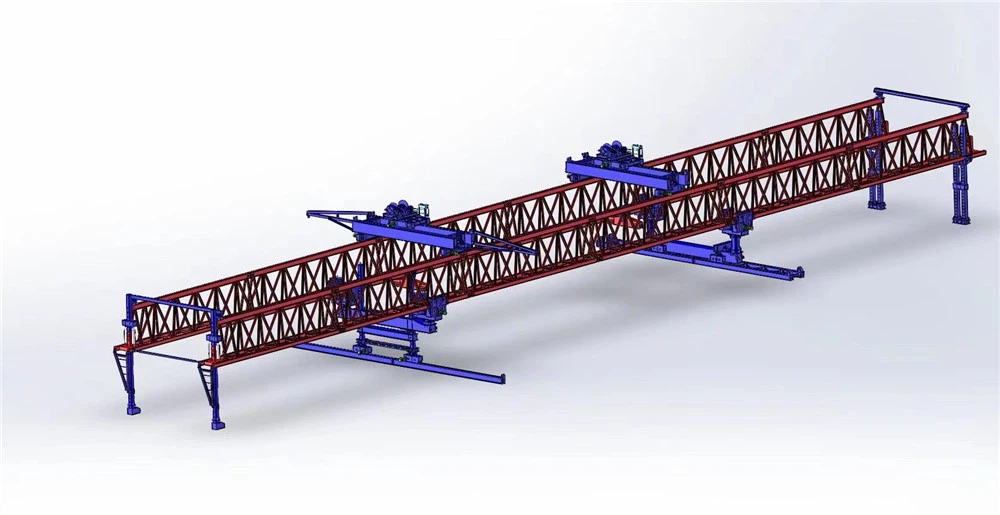
A 120T Self-balancing Bridge Launching Girder (also called a launching gantry or bridge erecting machine) is a specialized heavy construction machine used to install large precast concrete bridge beams or girders-typically weighing up to 120 tons-during bridge construction.

Core Function
The primary purpose of a 180ton bridge launcher is to lift, transport, and precisely place heavy prefabricated concrete or steel bridge components, typically weighing up to 180 tons (metric tons, ~165 US tons), during the construction of viaducts, overpasses, and highway bridges.
Key Design Parameters & Performance Specifications
| Parameter | Specification |
|---|---|
| Lifting Capacity (per girder) | 120 Metric Tons |
| Maximum Span (Pier to Pier) | 50 meters (Typical), customizable up to 60m |
| Minimum Curve Radius | 2,000 meters (can be designed for tighter radii) |
| Maximum Supported Grade | ±4% |
| Lifting Hoists | 2 x Main Hoists (typically 120-ton capacity each) |
| Hoist Lifting Speed | 0-5 m/min (variable speed control) |
| Trolley Traversing Speed | 0-10 m/min (variable speed control) |
| Main Beam Launching Speed | 0-5 m/min (variable speed control) |
| Machine Self-Propelling Speed | 0-5 m/min (variable speed control) |
| Control System | Centralized PLC with frequency control for all motions. Remote control operation. |
| Power Supply | 380V / 50Hz / 3 Phase (or as per project requirement) |

Pictures & Components
🏗️ 1. Main Girder (Main Beam / Truss)
The primary structural backbone of the machine
Spans across bridge piers
Carries all loads (machine + concrete girders)
Usually designed as a steel truss or box girder for strength and reduced weight
🧱 2. Front Support Leg (Front Pier Support)
Positioned on the next pier ahead
Helps stabilize the machine during girder placement
Often adjustable in height for alignment
🧱 3. Rear Support Leg (Rear Pier Support)
Located on the completed bridge deck or previous pier
Anchors the system and provides counterbalance
Critical for the "self-balancing" function
⚖️ 4. Self-Balancing / Counterweight System
Maintains stability without large external weights
Uses:
Structural positioning
Load distribution
Sometimes movable counterweights or anchoring devices
🚋 5. Lifting Trolleys (Hoisting Trolleys)
Travel along the main girder
Equipped with hoists or winches
Lift and carry the precast concrete girders
Usually two trolleys for synchronized lifting
🪝 6. Hoisting System
Includes:
Wire ropes
Winches
Hooks or lifting frames
Responsible for raising and lowering heavy girders (up to 120T)
🔩 7. Girder Handling Device (Beam Carrier / Spreader Beam)
Connects the hoist to the concrete girder
Ensures even load distribution
Prevents damage to the girder during lifting
🚶 8. Launching Mechanism (Traveling System)
Allows the entire machine to move forward span-by-span
Includes:
Rollers or wheels
Rail tracks or sliding shoes
Hydraulic pushing system
🧰 9. Hydraulic System
Powers:
Lifting adjustments
Leg height changes
Forward launching movement
Provides fine control and high force output
🎮 10. Electrical & Control System
Operator cabin or remote control
Synchronizes lifting, moving, and balancing
Includes safety systems like:
Overload protection
Emergency stop
Alignment sensors
📏 11. Temporary Supports / Bracing
Additional stabilizing structures
Used during:
Initial setup
Special lifting conditions
Improves safety in complex spans
🧗 12. Maintenance Platforms & Access Systems
Walkways, ladders, and railings
Allow workers to safely inspect and maintain equipment

Sketch

Advantages
Here are the key advantages of a 120T self-balancing bridge launching girder, explained in practical, site-focused terms:
🚀 Faster Construction
Enables span-by-span erection without waiting for ground-based equipment
Can install multiple girders in a day (depending on site conditions)
Reduces overall project timeline significantly
🌉 No Need for Ground Support
Operates entirely from the bridge structure itself
Ideal for:
Rivers
Deep valleys
Busy highways or railways
This avoids costly and time-consuming scaffolding or temporary supports below.
⚖️ Self-Balancing Stability
Built-in balance system reduces reliance on external counterweights
Provides stable lifting even with heavy loads (up to 120T)
Improves safety during girder placement
🎯 High Precision Placement
Advanced control systems allow accurate alignment of girders
Minimizes installation errors
Important for long-span and high-speed rail bridges
👷 Improved Safety
Less need for workers at dangerous heights or below lifting zones
Controlled lifting and movement reduces accident risk
Includes safety systems like overload protection and synchronized lifting
💰 Cost Efficiency (Long-Term)
Lower need for:
Large crawler cranes
Temporary falsework
Extensive labor below the bridge
While initial investment is high, it reduces total construction cost on large projects.
🔄 Adaptability to Difficult Terrain
Works well in:
Mountainous areas
Urban environments
Water crossings
Where traditional cranes would be difficult or impossible to use.
🔧 Reusability
Can be dismantled and reused on other projects
Makes it economical for contractors handling multiple bridge jobs
📦 Efficient Precast Construction
Perfect for precast concrete girder systems
Supports industrialized, repeatable construction processes
Improves quality consistency
🧠 Bottom line
A 120T self-balancing launching girder is valuable because it builds bridges faster, safer, and in places where conventional equipment simply can't operate efficiently.

Application
🌉 Highway Bridge Construction
Widely used for precast concrete girder bridges on highways
Ideal for repetitive spans and long viaducts
Enables construction without interrupting traffic below
🚄 Railway & High-Speed Rail Bridges
Essential for railway viaducts, especially high-speed rail
Provides the precision alignment required for rail tracks
Common in large rail projects across Asia and Europe
🏙️ Urban Elevated Structures
Used for:
Metro systems
Elevated roadways
Flyovers
Works efficiently in dense cities where space is limited and ground cranes are impractical.
🌊 Bridges Over Water
Suitable for:
Rivers
Lakes
Coastal crossings
Eliminates the need for:
Temporary supports in water
Barges or floating cranes
⛰️ Mountain & Valley Bridges
Perfect for difficult terrain such as:
Deep valleys
Steep slopes
Avoids building access roads for heavy cranes
🛣️ Long Viaduct Projects
Best suited for multi-span, repetitive structures
Can move span-by-span efficiently over long distances
Common in expressways and rail corridors
🔄 Precast Segmental Bridge Construction
Used where girders or segments are prefabricated off-site
Ensures:
Faster installation
Better quality control
🚧 Bridge Widening or Parallel Bridge Construction
Can be adapted for:
Adding new lanes
Building adjacent bridge structures
Works alongside existing infrastructure with minimal disruption
🧠 When it's most suitable
A 120T self-balancing launching girder is the best choice when:
Girders are heavy (up to ~120 tons)
Spans are repetitive and standardized
Ground access is limited or unsafe
High precision and speed are required
❗ When it's less suitable
Short bridges with only a few spans
Highly irregular bridge geometry
Very light girders where simpler cranes are enough
🧩 Bottom line
This machine is mainly applied in large-scale, repetitive bridge projects where efficiency, safety, and the ability to work without ground support are critical.

Production Procedure
The production procedure of a 120T self-balancing bridge launching girder follows a structured industrial workflow, since it's a large, high-precision steel machine. Here's how it's typically manufactured step by step:
🧠 1. Design & Engineering
Define:
Lifting capacity (120 tons)
Span length and working conditions
Perform:
Structural calculations (load, stress, deflection)
Stability analysis for self-balancing behavior
Create detailed:
3D models
Fabrication drawings
📐 2. Material Procurement
High-strength structural steel (plates, sections, pipes)
Hydraulic components (cylinders, pumps)
Electrical systems (motors, control panels, sensors)
Hoisting equipment (wire ropes, winches)
All materials must meet strict standards for heavy machinery.
🔩 3. Cutting & Preparation
Steel plates and sections are:
CNC flame cut / plasma cut
Edge-prepared for welding
Marking and numbering for assembly sequence
🔧 4. Fabrication of Main Structures
This is the most critical stage:
Main Girder / Truss
Sections are:
Welded into large truss or box segments
Reinforced at high-stress zones
Support Legs
Fabricated with:
Adjustable mechanisms
Load-bearing joints
Trolleys & Frames
Built for:
Load movement
Hoisting integration
🔥 5. Welding & Heat Treatment
Heavy-duty welding (MIG, submerged arc, etc.)
Critical welds undergo:
Stress relief (heat treatment)
Non-destructive testing (NDT):
Ultrasonic testing
Magnetic particle inspection
⚙️ 6. Machining & Finishing
Precision machining of:
Bearing seats
Wheel assemblies
Connection interfaces
Ensures accurate alignment during operation
🧰 7. Assembly (Factory Pre-Assembly)
Major components are:
Trial-assembled in المصنع
Checked for fit, alignment, and tolerance
Includes:
Main girder segments
Trolley installation
Support leg integration
🔌 8. Installation of Systems
Hydraulic System
Cylinders, hoses, pumps installed
Pressure and movement tested
Electrical & Control System
Motors, control panels, sensors
PLC or remote-control integration
🎨 9. Surface Treatment & Painting
Sandblasting to remove rust and impurities
Anti-corrosion coating applied
Final painting for:
Weather resistance
Long service life
🧪 10. Testing & Quality Inspection
Load testing (often simulated or partial)
Functional tests:
Lifting
Traveling
Balancing
Safety checks:
Overload protection
Emergency systems
📦 11. Disassembly & Transportation
Machine is broken down into transportable sections
Packed and shipped to project site
🏗️ 12. On-Site Installation & Commissioning
Reassembled at the bridge site
Final calibration and testing
Trial operation before actual girder erection


Workshop View
The company has installed an intelligent equipment management platform, and has installed 310 sets (sets) of handling and welding robots. After the completion of the plan, there will be more than 500 sets (sets), and the equipment networking rate will reach 95%. 32 welding lines have been put into use, 50 are planned to be installed, and the automation rate of the entire product line has reached 85%.


Hot Tags: 120t self-balancing bridge launching girder for erecting concrete girders, China 120t self-balancing bridge launching girder for erecting concrete girders manufacturers, suppliers, factory
You Might Also Like


Send Inquiry