










100 Ton Heavy-duty Boat Hoist Crane
Products Description
Key Characteristics
High Lifting Capacity: The primary feature is its ability to lift 100 tons (approximately 90,700 kg). This capacity is carefully calculated to include not just the dry weight of the vessel, but also the weight of water, fuel, mud, and equipment trapped onboard (known as the "lifted load").
Wide Spans: These cranes are designed with a wide beam (the distance between the legs) to accommodate the beam (width) of large boats. Spans of 10 to 20 meters (30 to 65 feet) are common.
Lifting Height: They provide sufficient height to lift a boat's keel clear of the ground, dock, or a transport trailer. This can range from 6 to 15 meters (20 to 50 feet) or more.
Durability & Corrosion Resistance: Built from high-strength steel (often Grade S355 or higher) and feature extensive corrosion protection, including specialized marine-grade paint systems, galvanization, or sacrificial anodes to withstand the harsh saltwater environment.
Comparison with Other Boat Lifting Systems
| Feature | Gantry Boat Hoist | Marine Railway | Floating Dry Dock |
|---|---|---|---|
| Mobility | High (if rubber-tired) | Low (fixed track) | Low (water-dependent) |
| Max Capacity | 10–500+ tons | 50–5,000 tons | 1,000–100,000+ tons |
| Speed | Fast (minutes) | Slow (hours) | Moderate (hours) |
| Best For | Small to medium boats | Large ships | Massive vessels |
Comparison with Other Boat Lifting Systems
| Feature | Gantry Boat Hoist | Marine Railway | Floating Dry Dock |
|---|---|---|---|
| Mobility | ✅ High (if rubber-tired) | ❌ Fixed track | ❌ Water-dependent |
| Max Capacity | 10–500+ tons | 50–5,000 tons | 1,000–100,000+ tons |
| Speed | ⚡ Fast (minutes) | 🐢 Slow (hours) | 🕒 Moderate (hours) |
| Space Needed | Compact storage | Long track area | Large water area |
| Best For | Small-medium boats | Large ships | Massive vessels |
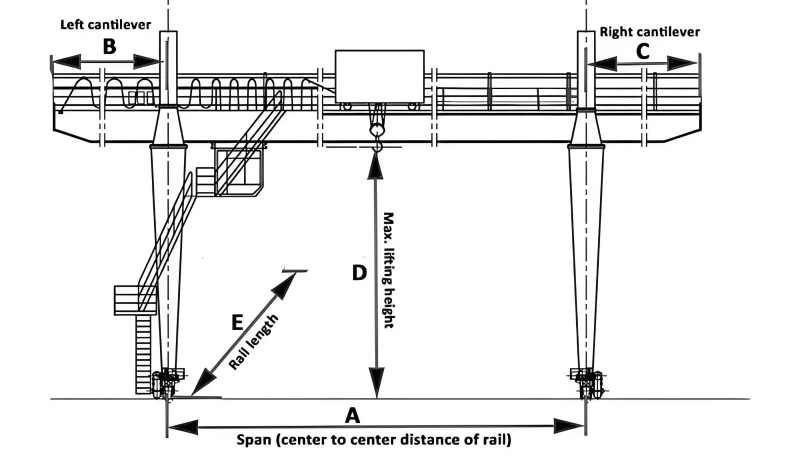
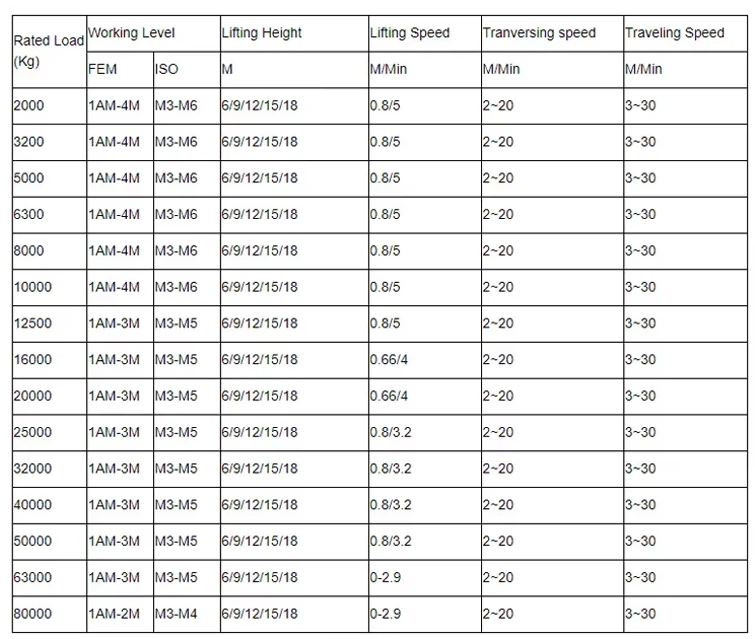
Lifting Capacity 120 tons
Span (Width) 3 - 12 meters (adjustable)
Lifting Height 3 - 10 meters
Working Class A3-A5 (light to medium duty)
Hoisting Speed 0.5 - 8 m/min (variable)
Main Beam Type Single/double girder (box-type)
Power Supply 220V/380V 3-phase or manual
Control Mode Pendant control/wireless remote
Hoist Type Electric chain hoist/wire rope hoist
Travel Drive Manual push or motorized
Corrosion Protection Hot-dip galvanized or marine-grade paint
Wind Resistance Up to Beaufort scale 6 (for outdoor use)
Operating Temp -20°C to +50°C

Pictures & Components
1. Structural System (The Skeleton)
This system bears the entire load and provides the crane's framework.
Main Girders / Bridge Beams: These are the primary horizontal beams that span the width of the dry dock or railway. For a 100-ton capacity, these are massive, box-shaped (box girder) or I-beam sections designed for extreme stiffness and minimal deflection.
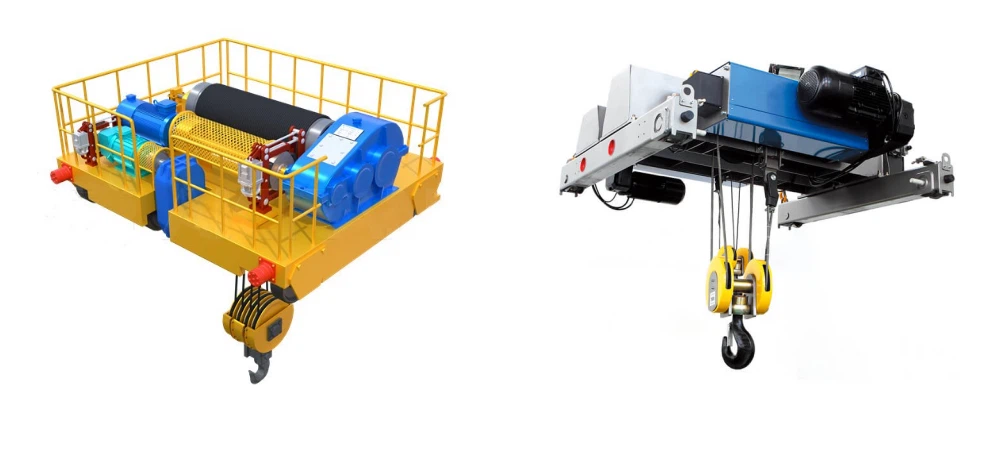
End Trucks / Legs: The vertical structures at each end of the bridge girders. They house the wheels and drive mechanisms for moving the entire crane along the dock.
Trolley Frame: The robust frame that runs along the top of the main girders. It carries the hoisting machinery and moves the load from side to side across the width of the vessel.

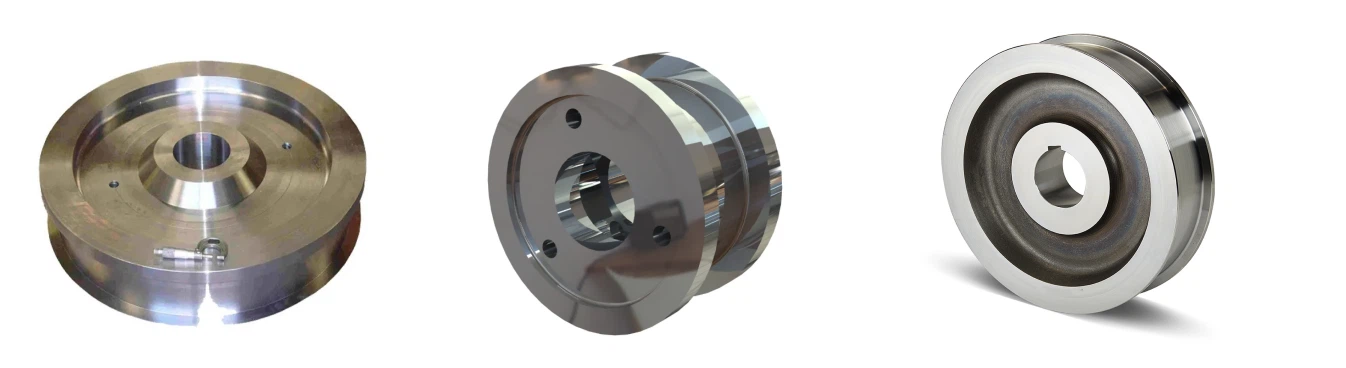
Bogies & Wheels: The assemblies at the base of the end trucks. They distribute the massive weight onto the crane rails. A 100-ton crane will have multiple wheels per leg to handle the load.
Crane Rails and Runway: The heavy-duty steel rails installed on the dock, upon which the crane travels. The integrity of this runway is critical for safe operation.
2. Lifting and Hoisting System (The Muscles)
This system is responsible for the actual lifting, lowering, and precise positioning of the boat.
Hoist Unit: The core lifting mechanism. It consists of:
Hoist Motor: A high-torque, electric motor (often AC with variable frequency drive for smooth control).
Gearbox: Reduces the motor's high speed to a usable torque for lifting heavy loads slowly and powerfully.
Drum: A large, spool-like cylinder around which the wire rope is wound.
Brakes: Multiple, redundant fail-safe brakes. The primary brake is usually on the motor shaft, and a secondary emergency mechanical brake engages automatically in case of power failure.
Wire Rope: Extremely high-strength, multi-strand steel cable. The diameter and construction are specified to handle the 100-ton load with a significant safety factor (usually 5:1 or higher).
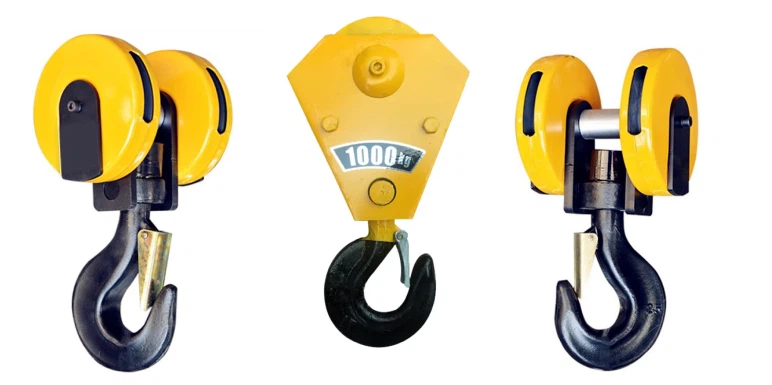
Sheaves / Blocks: The grooved pulleys that guide and route the wire rope. The "block" is the assembly containing the sheaves. A 100-ton crane will use a multiple-part "reeving" system to multiply lifting force and provide redundancy.
Hook Block: The assembly that connects to the boat's lifting slings. It contains multiple sheaves and a large, forged steel safety latch hook. The block itself can weigh several hundred kilograms.
Lifting Spreader Bar / Beam: A crucial component for boat lifting. It's a rigid beam that connects to the hook block and has multiple attachment points for slings. Its purpose is to distribute the load evenly across the boat's hull, preventing damage and ensuring a stable, level lift.


3. Power, Control, and Safety Systems (The Nerves and Brain)
This system powers the crane and allows the operator to control it safely and precisely.
Power Delivery System:
Cable Reel / Conductor Bar: Delivers electricity to the moving crane. A large motorized cable reel manages the heavy power cable, or the crane uses a rigid conductor bar system that runs parallel to the track.
Control System:

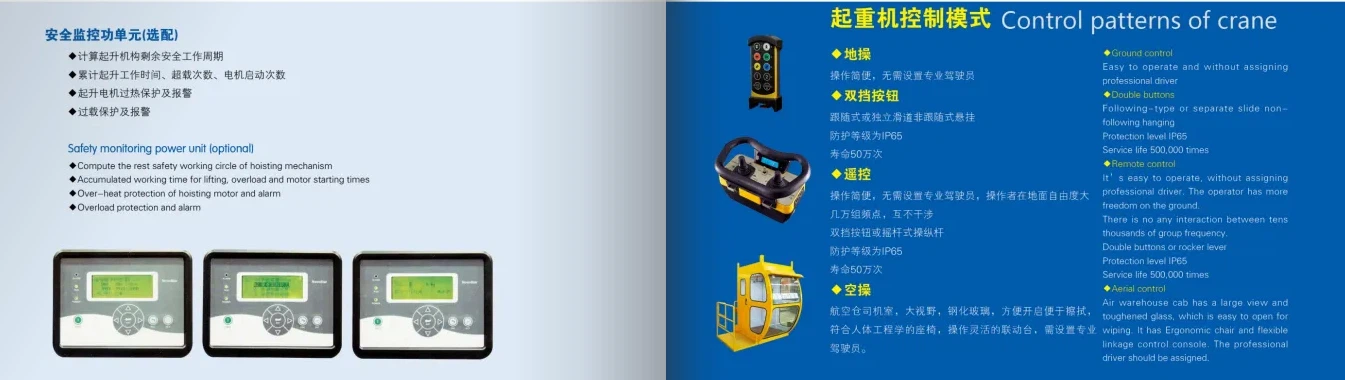
Operator's Cabin: An enclosed, climate-controlled cabin suspended from the crane structure, giving the operator a clear view of the lift. Alternatively, it can be a Remote Control System where the operator uses a wireless pendant to control the crane from the ground, offering better visibility and safety.
Control Panel & PLC: The "brain" of the crane. A Programmable Logic Controller (PLC) manages all crane functions, provides smooth acceleration/deceleration, and monitors safety devices.
Critical Safety Components:
Load Moment Indicator (LMI): The most important safety device. It constantly monitors the load weight (via strain gauges) and the crane's configuration. It will warn the operator and stop dangerous operations if an overload or instability is detected.
Limit Switches: These automatically cut power to prevent the hoist from over-traveling (up or down), the trolley from going too far, or the crane from hitting the end of its runway.
Anti-Collision Systems: Sensors or lasers that prevent two cranes operating on the same runway from colliding.
Anemometer: A wind speed sensor. Lifting a large boat is highly sensitive to wind; the LMI system will warn the operator or disable crane movement if wind speeds exceed safe limits.
Emergency Stop (E-Stop): Prominently placed red buttons that cut all power to crane motors in an emergency.
Load Blocks & Hooks with Safety Latches: Prevent the slings from accidentally slipping off the hook.
Applications of Each Component
| Component | Function |
|---|---|
| Gantry Frame | Supports entire structure |
| Winches & Slings | Lifts the boat |
| Trolley System | Positions boat over storage area |
| Steering Mechanism | Allows precise maneuvering |
| Load Sensors | Ensures safe lifting capacity |
SKETCH
Main technical
Advantages
Key Advantages of a 100-Ton Heavy-Duty Boat Hoist Crane
1. Unmatched Lifting Capacity and Versatility
Handles a Wide Range of Vessels: The primary advantage is the ability to lift vessels up to 100 tons. This opens the market to larger, more profitable clients, including mega-yachts (30-40 meters), small commercial ships, military patrol boats, and large fishing trawlers.
Future-Proofing Your Business: Investing in a 100-ton capacity prepares your facility for the trend of increasingly larger recreational and commercial vessels.
Multi-Hull Lifting: It can efficiently lift catamarans and trimarans, which can be challenging for some other lifting systems due to their wide beam.
2. Superior Operational Efficiency and Speed
Rapid Launch and Haul-Out: The process of lifting a vessel from the water and moving it to a storage stand (and vice-versa) is significantly faster than with syncrolifts or marine railways. This allows you to service more clients per day, especially during peak seasons.
Direct Transfer and Spotting: The crane can pick up a vessel and transport it directly to its parking spot without intermediate steps. This "one-step" operation saves considerable time and labor.
High Maneuverability: Modern heavy-duty boat hoists are often rubber-tired and self-propelled, allowing for excellent maneuverability in crowded yards. They can place vessels in tight spots with precision.
3. Enhanced Safety and Control
Synchronized Lifting System: Advanced models feature computer-controlled, fully synchronized hoists on each leg. This ensures the load remains level and stable during lifting, transferring, and lowering, drastically reducing the risk of hull stress, damage, or a capsizing incident.
Fail-Safe Braking Systems: These cranes are equipped with multiple redundant braking systems (mechanical, electrical, and regenerative) to hold the load securely, even in the event of a power failure.
Precise Load Management: Operators have fine control over the lifting and lowering speeds, allowing for gentle placement on blocks and cradles, which is crucial for expensive hulls.
4. Maximized Yard Space and Storage Density
High-Density Storage: By lifting vessels high enough, you can stack them two or even three high in designated storage areas. This multiplies your yard's capacity without needing to acquire more land.
Flexible Layout: Unlike a fixed syncrolift or railway, a mobile crane does not require a dedicated, obstructed pathway. This allows for a more flexible and efficient use of the entire yard space.
5. Reduced Hull Damage Risk
Wide and Customizable Spreader Bars/Lifting Straps: The load is distributed evenly across a wide area of the vessel's hull using long, reinforced spreader bars and wide, padded slings. This prevents point-loading and potential damage to the hull structure, gelcoat, or appendages like keels and rudders.
Gentle Handling: The controlled, hydraulic motion of a modern hoist is far gentler on a vessel's structure than the jerking or uneven lifting that can occur with less sophisticated systems.
6. Economic Advantages and Return on Investment (ROI)
Attract High-Value Clients: The ability to service large yachts and commercial vessels commands higher service rates and attracts a more affluent clientele.
Lower Labor Costs: Automation and efficiency reduce the number of personnel and the man-hours required for each haul-out operation.
Reduced Ground Bearing Pressure: The weight of the crane and its load is distributed over multiple large, rubber-tired wheels, minimizing the need for exceptionally thick and expensive concrete pads compared to some other heavy-lift options.
Multi-Purpose Potential: While specialized for boats, the crane can also be used for other heavy lifts within the yard, such as moving large engines, sections of dry docks, or other heavy machinery.
Application
Primary Applications
Boat/Yacht Launching and Retrieval:
Purpose: The most fundamental application. Moving vessels from the water onto dry land (retrieval) and back into the water (launching).
Vessels Served: Large motor yachts (30-50 meters+), commercial fishing vessels, small passenger ferries, patrol boats, naval auxiliary vessels, and large sailing yachts with fixed keels.
Dry Dock Maintenance and Repair:
Purpose: Lifting vessels out of the water to place them in a dedicated work area for hull inspections, cleaning, painting, and mechanical repairs.
Specific Tasks:
Hull Cleaning & Painting: Removal of marine growth (biofouling) and application of anti-fouling paint.
Propeller and Rudder Servicing: Inspection and repair of propulsion systems.
Through-Hull Fitting Repairs: Replacing seacocks, transducers, and anodes.
Structural Inspections: Checking for hull damage, corrosion, or delamination.
Winter Storage and "Stacking":
Purpose: In seasonal climates, these cranes are used to efficiently place a large number of vessels into high-density storage yards for the off-season.
Method: The crane works in conjunction with specialized transport trailers. It lifts the boat from the water, places it on a trailer, and can also stack boats multiple rows high in a storage yard, maximizing space.
New Vessel Commissioning and Fit-Out:
Purpose: At shipyards and boat builders, the crane is used to lift newly constructed hulls from the construction shed and place them in the water for the first time. It is also used to move hulls between different stages of the fit-out process.
Emergency Salvage and Relocation:
Purpose: Quickly lifting vessels that are sinking, partially submerged, or damaged to prevent total loss or to clear a channel. It is also crucial for moving vessels to safer locations ahead of severe weather like hurricanes.
Transport and Positioning:
Purpose: Moving vessels around a shipyard, from one work bay to another, or positioning them for specific tasks like mast-stepping on large sailboats.
Crane production process
Phase 1: Engineering & Design
This is the most critical phase, where the crane's performance and safety are defined.
Client Requirements & Site Analysis: Engineers gather data: maximum capacity (100 tons), span, lift height, operating environment (corrosive marine), duty cycle (CMMS Class D or E for heavy-duty), and power supply.
Structural Design & Calculations:
CAD Modeling: 3D models of the entire crane structure (bridge girders, end trucks, trolley, hoist) are created.
FEA (Finite Element Analysis): Software simulates loads, stresses, and deflections to ensure the structure can handle 100 tons with a significant safety factor (often 25-30% above rated load). This identifies high-stress areas for reinforcement.
Load Testing Simulation: The virtual crane undergoes simulated dynamic and static load tests.
Mechanical & Electrical System Design:
Selection of hoist mechanism (gearbox, drum, wire rope), trolley drive, and bridge drive systems.
Design of the power transmission system (motors, brakes, couplings).
Creation of electrical schematics for the control system, variable frequency drives (VFDs for smooth operation), and safety circuits.
Regulatory Compliance: Designs are checked against international standards like ISO, FEM, CMAA (Crane Manufacturers Association of America), and DNV/GL for marine applications.
Phase 2: Material Procurement & Preparation
Raw Materials: Ordering high-quality, certified steel plates (e.g., ASTM A572 Grade 50), rolled sections (I-beams, channels), and forgings for critical components like hooks, shafts, and wheels.
Components Sourcing: Procurement of standardized parts: motors, gearboxes, brakes, bearings, wire rope, sheaves, electrical panels, VFDs, and push-button pendants or radio remote controls.
Phase 3: Fabrication & Machining
This is the hands-on manufacturing of the crane's major components.
Bridge Girder Fabrication:
Cutting: Steel plates are cut to size using CNC plasma or oxy-fuel cutting machines for precision.
Welding: Sub-assemblies are welded. The main girders are fabricated using automated submerged arc welding (SAW) for deep, consistent, and high-strength welds. Pre-heating and post-weld heat treatment (PWHT) may be used to relieve stresses.
Quality Check: Weld seams are inspected visually and via Non-Destructive Testing (NDT) like Ultrasonic Testing (UT) or Magnetic Particle Inspection (MPI).
End Truck Fabrication:
The end trucks (end carriages) are fabricated, which house the bridge drive motors, gearboxes, and wheels.
Wheel shafts and bearings are fitted into precision-machined housings.
Trolley Frame Fabrication:
The frame that carries the hoist unit is built. It must be robust to handle the 100-ton load and the forces during travel.
Components like the drum, motor, gearbox, and sheaves are trial-fitted.
Machining of Critical Parts:
Key components like wheel treads, shaft journals, and coupling interfaces are machined on lathes and milling machines to achieve precise tolerances and surface finishes.
Phase 4: Sub-Assembly & Surface Treatment
Sub-Assembly:
The drive systems are assembled. For example, the motor, gearbox, coupling, and wheel are assembled into a single "drive assembly" for the bridge and trolley.
The hoist unit-comprising the motor, brake, gearbox, drum, and rope guide-is assembled and tested as a unit.
Surface Preparation & Painting:
All steel components are grit-blasted (abrasive blasting) to remove mill scale and rust, creating a clean, profiled surface for paint adhesion.
A multi-layer paint system is applied, typically:
Primer: Zinc-rich epoxy primer for superior corrosion protection.
Intermediate Coat: Epoxy build-coat.
Top Coat: Polyurethane finish in the client's specified color. This system is essential for withstanding the harsh marine environment.
Phase 5: Final Assembly & Erection
This can be done at the manufacturer's facility for smaller cranes or, more commonly for large 100-ton cranes, on the client's site.
On-Site Preparation: The runway beams are surveyed to ensure they are level, parallel, and capable of supporting the crane loads.
Erection of Main Bridge:
The end trucks are connected to the main girders using high-strength bolts, forming the complete bridge.
The entire bridge structure is lifted onto the runway rails, often using a mobile crane.
Installation of Trolley & Hoist: The pre-assembled trolley, with the hoist unit, is lifted and placed onto the bridge rails.
Mechanical & Electrical Integration:
Installation of the bridge and trolley drive assemblies.
Cable Reeling System: Installation of a cable reel or conductor bar system to deliver power along the crane's length.
Wiring: Electricians wire all motors, sensors, and safety devices back to the main control panel.
Phase 6: Commissioning, Testing & Certification
This is the final validation that the crane is safe and operational.
Pre-Functional Checks: Visual inspection, verification of bolt torques, electrical continuity, and safety device functionality (limit switches, emergency stop).
No-Load Test: The crane and trolley are run along their full travel lengths at various speeds without a load to check for smooth operation, alignment, and strange noises.
Load Testing (The Most Critical Step):
Static Load Test: The hoist is lifted to a safe height, and a test load 25% greater than the rated capacity (125 tons) is applied and held for a period. The structure is inspected for permanent deflection.
Dynamic Load Test: A test load 10% greater than the rated capacity (110 tons) is lifted, moved, and stopped throughout the crane's full range of motion. This tests the brakes, drives, and controls under dynamic conditions.
Safety System Verification: All limit switches (hook upper/lower, end-of-travel for trolley and bridge), overload protection, and emergency stops are tested and confirmed to be operational.
Operator Training & Documentation: The client's operators are trained on the crane's safe use. All documentation, including design calculations, test reports, and manuals, is handed over.
Final Certification: A third-party surveyor or the manufacturer's lead engineer issues a Certificate of Conformance and Test, verifying the crane meets all design and regulatory standards.
Only after successfully completing all these phases is the 100-ton boat hoist crane officially handed over to the client for service. The entire process, from design to delivery, can take several months.

Workshop view:
The company has installed an intelligent equipment management platform, and has installed 310 sets (sets) of handling and welding robots. After the completion of the plan, there will be more than 500 sets (sets), and the equipment networking rate will reach 95%. 32 welding lines have been put into use, 50 are planned to be installed, and the automation rate of the entire product line has reached 85%.




Hot Tags: 100 ton heavy-duty boat hoist crane, China 100 ton heavy-duty boat hoist crane manufacturers, suppliers, factory
You Might Also Like



Send Inquiry