










5 Ton Single Girder Overhead Crane With Hoist
Products Description
Key Features:
Capacity: 5 tons (can be designed with a 25% overload capacity).
Span: Typically 7.5m to 28m (adjustable based on workshop width).
Lifting Speed: ~8 m/min (standard), dual-speed options available.
Traveling Speed: ~20 m/min (crane motion), ~30 m/min (hoist trolley motion).
Power Supply: 380V/50Hz (3-phase) or customized voltage.
Duty Class: Usually FEM 1Am, ISO M4, or A3 (moderate duty).
Safety Features:
Overload limiter.
Emergency stop.
Limit switches for hoisting and travel.
Insulated live parts for electrical safety.
Lifting Capacity 1 – 20 tons (custom up to 50+ tons)
Span 5 – 30 meters
Lifting Height 3 – 30 meters
Lifting Speed 1 – 20 m/min (adjustable)
Trolley Speed 5 – 30 m/min
Crane Travel Speed 10 – 60 m/min
Power Supply 380V/415V, 50Hz (3-phase)
Duty Class FEM A3-A5 (Medium to Heavy Duty)

Pictures & Components
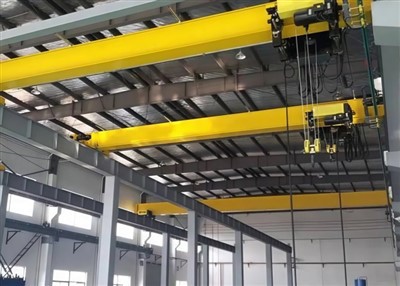
A 5-ton single girder overhead crane with hoist is a common material-handling solution used in workshops, warehouses, and industrial facilities. Its main components include:
1. Bridge Girder (Main Beam)
The primary load-bearing structure, typically a single I-beam or box girder.
Supports the hoist and trolley, spanning the width of the bay.
 |
 |
2. End Trucks (End Carriages)
Located at both ends of the bridge girder, housing the wheels.
Equipped with wheel assemblies for movement along the runway rails.
 |
 |
3. Hoist Unit
The lifting mechanism, usually an electric wire rope hoist or chain hoist.
Includes:
Motor (for lifting/lowering)
Drum or Chain Sprocket (for rope/chain winding)
Brake System (for load safety)
Hook Block (for attaching loads)

4. Trolley
The assembly that carries the hoist along the length of the bridge girder.
May have a separate motor for trolley travel (cross travel).

5. Runway System
Consists of runway rails (mounted on building columns or freestanding supports).
Supports the crane's movement along the length of the bay (long travel).

6. Electrical System & Controls
Power supply (typically via festoon system or conductor bars).
Control pendant (pendant station) or radio remote control for operation.
Limit switches (to prevent over-travel).
.
7. Bumpers & Buffers
Absorb impact at the ends of the crane's travel to prevent damage.

8. Optional Accessories
Crane scale (for weighing loads).
Anti-sway system (for precise load positioning).
Variable frequency drive (VFD) for smoother operation.

Sketch

Main technical

Advantages
A 5-ton single girder overhead crane with hoist is a versatile and cost-effective lifting solution widely used in workshops, warehouses, and manufacturing facilities. Here are its main advantages:
1. Cost-Effective Solution
Lower initial cost compared to double girder cranes.
Reduced installation and maintenance expenses.
Ideal for light to medium-duty lifting (up to 5 tons).
2. Space-Saving Design
Compact structure with a single girder, requiring less headroom.
Suitable for facilities with limited space.
3. Easy Installation & Maintenance
Simple structure with fewer components, making installation quicker.
Hoist and trolley system is easy to inspect and maintain.
4. High Efficiency & Smooth Operation
Electric hoist ensures precise load handling.
Smooth travel along the runway beam for accurate positioning.
Available in manual (hand-pushed) or motorized trolley options.
5. Versatile Applications
Used in workshops, warehouses, assembly lines, and material handling.
Compatible with wire rope hoists or chain hoists depending on lifting needs.
6. Customizable Options
Adjustable span, lifting height, and speed.
Can be operated via pendant control, remote control, or cabin.
7. Reliable Safety Features
Equipped with overload protection, limit switches, and emergency stop.
Sturdy construction ensures stable and safe lifting operations.
8. Energy-Efficient & Low Noise
Modern hoists consume less power and operate quietly.
Application:
A 5-ton single girder overhead crane with hoist is a versatile lifting solution widely used in various industries for material handling. Its compact design, cost-effectiveness, and efficient operation make it suitable for medium-duty applications. Below are the main applications:
1. Manufacturing & Assembly Lines
Used for lifting and moving raw materials, machinery parts, and finished products.
Common in automotive, steel, and machinery manufacturing plants.
2. Warehousing & Logistics
Efficiently loads/unloads goods, pallets, and heavy packages.
Ideal for distribution centers and storage facilities.
3. Construction & Building Material Handling
Transports steel beams, concrete blocks, and construction materials.
Helps in prefabricated structure assembly.
4. Power Plants & Energy Sector
Handles generators, turbines, and heavy electrical components.
Used in maintenance and installation work.
5. Metal & Mining Industry
Moves metal sheets, coils, and mining equipment.
Supports foundries and metal processing units.
6. Paper & Printing Industry
Lifts heavy paper rolls and printing machinery.
7. Aviation & Shipbuilding
Assembles aircraft parts and ship components.
Crane production procedure
The production procedure for a 5-ton single girder overhead crane with hoist involves several key stages, from design and material procurement to assembly and testing. Below is a step-by-step outline of the typical manufacturing process:
1. Design & Engineering
Customer Requirements Analysis: Determine span, lifting height, duty class (FEM/ISO), power supply, and operational environment.
CAD Design: Create 3D models and technical drawings (girder, end carriages, hoist, electrical system).
Structural Calculations: Verify load capacity, deflection, and stress analysis for the girder and supporting structures.
Regulatory Compliance: Ensure adherence to standards (ISO, DIN, FEM, ASME, or local codes).
2. Material Procurement
Main Girder: Steel plates (typically Q235B or Q345B for Chinese standards; ASTM A36/A572 internationally).
End Carriages: Box-section or fabricated steel with wheels, buffers, and drive mechanisms.
Hoist Unit: Procure or manufacture a 5-ton electric wire rope/chain hoist (brands like KONE, Demag, or custom-built).
Electrical Components: Motors, control panels, pendant/radio remote, limit switches, and cables.
3. Fabrication of Main Components
A. Main Girder Fabrication
Cutting: Steel plates are cut via CNC plasma/oxy-fuel cutting to required dimensions.
Welding:
Assembly of web and flange plates into I-beam or box-girder structure.
Automated submerged arc welding (SAW) for high-strength, distortion-free seams.
Straightening: Heat treatment or hydraulic pressing to correct welding distortions.
Drilling: Holes for connections (end carriages, hoist trolley rails).
B. End Carriages
Fabricate wheel blocks, frames, and drives (motor, gearbox, brakes).
Assemble wheels (for bridge travel) with anti-derailment guards.
C. Hoist Trolley
Fabricate trolley frame to mount the hoist on the girder's lower flange.
Install trolley wheels, motor, and gearbox for transverse movement.
4. Surface Treatment & Painting
Shot Blasting: Clean surfaces to remove rust and improve paint adhesion.
Priming: Apply anti-corrosion primer (e.g., epoxy zinc-rich).
Top Coating: Industrial enamel paint (color per customer specs).
5. Electrical System Assembly
Install bridge/trolley travel motors, hoist motor, and control panel.
Wire limit switches, emergency stop, and power supply (sliding cable reels or festoon systems).
Test electrical safety features (overload protection, phase sequence).
6. Final Assembly & Testing
A. Mechanical Assembly
Mount end carriages onto the main girder.
Install the hoist and trolley on the girder.
Attach runway rails (if supplied) and align for smooth travel.
B. Functional Tests
No-Load Test: Run crane in all directions (hoisting, trolley, bridge travel).
Load Test:
Static Test: Lift 1.25× rated load (6.25 tons) for 10 mins; check deflection.
Dynamic Test: Operate at 1.1× rated load (5.5 tons) through all motions.
Safety Checks: Verify brakes, limit switches, and emergency stops.
7. Documentation & Delivery
Prepare manuals (operation, maintenance, parts list).
Issue test certificates (factory acceptance test, FAT).
Pack and ship (knocked-down or assembled, depending on logistics).

Workshop view:
The company has installed an intelligent equipment management platform, and has installed 310 sets (sets) of handling and welding robots. After the completion of the plan, there will be more than 500 sets (sets), and the equipment networking rate will reach 95%. 32 welding lines have been put into use, 50 are planned to be installed, and the automation rate of the entire product line has reached 85%.


Hot Tags: 5 ton single girder overhead crane with hoist, China 5 ton single girder overhead crane with hoist manufacturers, suppliers, factory, Single Girder Overhead Crane, Single Girder Overhead Travelling Crane
You Might Also Like



Send Inquiry