










Girder Bridge Crane
Products Description
Girder Bridge Crane is a kind of lifting machinery, named because its structure is similar to a bridge. It consists of a single linear bridge capable of longitudinal movement along a track to cover the work area below for material handling. The crane's bridge is usually supported on elevated rails on both sides, and the space under the bridge is open, allowing the crane to operate without being hindered by ground equipment. This structural design is both simple and practical, which is an important reason for its wide application.

Warranty:1 Year
Weight (KG):3000 kg
Feature:Bridge Crane
Condition:New
Color:Customized
Pictures & Components
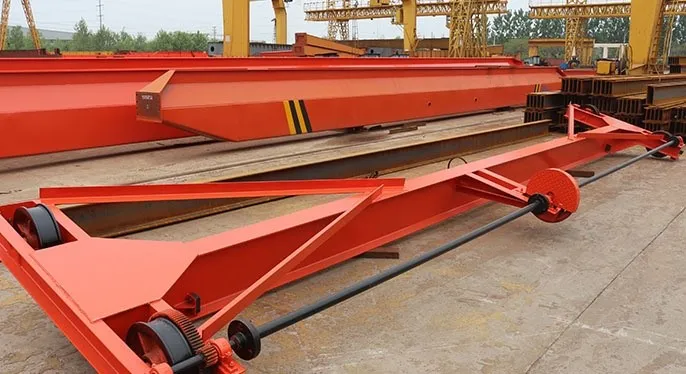
Main beam: The main beam is the main load-bearing component of the crane bridge, usually in the form of box, I-shaped or round tube structure. It spans over the workshop or warehouse, and is connected to the end beams at both ends to form a complete bridge structure. The main beam bears all the load from the lifting trolley and the items it lifts, and transfers it to the end beam and lower support structure.
Wire rope electric hoist: including trolley operating mechanism, lifting mechanism and related electrical systems. The electric hoist is suspended under the bridge and can move laterally along the main beam. The electric hoist lifts items through its lifting mechanism and can move along the main beam direction to achieve precise placement and handling of items.

Remote control: The remote control of a Girder Bridge Craneis mainly used to remotely control the lifting equipment to improve operational convenience and safety. The use of the remote control allows the operator to operate from a location far away from the hoisted objects, reducing accidental injuries that may be caused to the operator during the hoisting process.

Crane operating mechanism: including drive motor, reducer, transmission shaft, wheels, brakes and other components. This mechanism is responsible for the longitudinal movement of the entire crane bridge along the elevated track. The wheels are driven to rotate by a motor and a reducer, allowing the crane to move along the track and cover the lifting operations of the working area below.

Sketch:


Main technical data


Advantages

Simple design: Girder Bridge Cranes usually consist of one main girder and two end beams, forming a simple linear bridge structure. This design not only simplifies the manufacturing process but also reduces material and labor costs.
Large space coverage: The bridge of the Girder Bridge Crane runs longitudinally along the elevated track and can cover most of the space in the workshop or warehouse, making the lifting operation more flexible.
Easy maintenance: Due to its simple structure and fewer wearing parts, the Girder Bridge Crane reduces the frequency of replacement and the workload of maintenance. Routine maintenance and inspection work becomes easier to perform due to the simplicity of the structure, without the need for complex equipment or large amounts of manpower.
Applicable to multiple industries: Girder Bridge Cranes are widely used in indoor and outdoor industrial and mining enterprises, steel and chemical industries, railway transportation, ports and terminals, and logistics turnover and other fields. Whether it is manufacturing or logistics, it can provide efficient lifting solutions.
Application:

Industrial and mining enterprises: In the production workshops of various industrial and mining enterprises, Girder Bridge Cranes are mainly used for the input of raw materials and the output of finished products, as well as for the transfer and assembly of materials between various links in the production line. This application improves production efficiency and reduces labor costs.
Steel and chemical industry: In the steel industry, Girder Bridge Cranes are widely used for hoisting and handling heavy steel products such as steel plates and steel coils. They can work stably in high temperature and dusty environments to meet the needs of steel production.
Railway transportation: In railway freight yards, Girder Bridge Cranes are used for loading and unloading containers and bulk cargo. They can efficiently complete the transfer of goods between railways and roads and speed up logistics.
Logistics turnover: In modern logistics warehouses, Girder Bridge Cranes are used to store and retrieve various goods. They can move flexibly between elevated shelves to achieve precise access to goods and improve warehouse operation efficiency.
GlobalMarket

Crane production procedure

Workshop view
Material Inspection
Quality Inspection: Strict quality inspection is carried out on the purchased raw materials to ensure that they meet the design requirements and national standards.
Material Storage: Qualified materials are stored according to classification to prevent corrosion or damage.
Cutting and Forming
Steel Cutting: Use plasma cutting, laser cutting or flame cutting and other technologies to cut the steel according to the size of the design drawing.
Forming Processing: Form the steel plate through bending, rolling, welding and other processes to manufacture the main beam, end beam and other structural parts.
Welding
Component Welding: The cut and formed steel parts are welded into the main structures such as the main beam, end beam and trolley. The welding process needs to be strictly controlled to ensure the structural strength and welding quality.
Weld Inspection: Use non-destructive testing technology (such as ultrasonic testing, radiographic testing) to inspect the welds to ensure that there are no cracks or other defects.
Machining
Precision Machining: Precision machining is performed on the key components of the crane, such as wheel sets, bearing seats, pulleys, etc., to ensure their dimensional accuracy and surface quality.
Assembly of the whole machine
General assembly: On the basis of pre-assembly, the overall assembly of the crane is carried out, including the final installation of the main beam, end beam, lifting mechanism, walking mechanism, etc.
Commissioning and testing
Under dynamic conditions, the operating performance of the crane is tested, including the testing of lifting, walking, steering and other functions. The overall size of the assembled bridge crane is checked to ensure that all dimensions meet the design requirements.
Spraying and anti-corrosion treatment
Surface treatment Rust removal: Rust removal on the surface of the crane, common methods include sandblasting, pickling, etc. Primer spraying: Spray anti-corrosion primer on the treated surface to prevent metal oxidation and corrosion. Topcoat spraying Color spraying: Spray topcoat according to customer requirements or industry standards to give the crane a protective and decorative effect. Marking: After spraying, mark the crane's identification information in accordance with the specifications, such as model, rated load, etc.
Factory and installation
Packaging and transportation
Packaging protection: Protectively package the key components of the crane to prevent damage during transportation. Transportation arrangement: According to the equipment size and transportation conditions, select a suitable transportation method to transport the crane to the customer's site.
Acceptance and delivery
Customer acceptance
On-site acceptance: The customer conducts on-site acceptance of the crane according to the contract requirements and technical specifications to check the performance and quality of the equipment.
Problem rectification: If any problems are found, the manufacturer needs to rectify them in time to ensure that the equipment fully meets the customer's requirements. Delivery and use Operation training: The manufacturer usually trains the customer's operators to ensure that they can operate the crane correctly and safely.


Hot Tags: girder bridge crane, China girder bridge crane manufacturers, suppliers, factory, Bridge Crane, Double Girder Bridge Crane with Electric Hoist
Previous
Single Beam Bridge CraneYou Might Also Like




Send Inquiry