








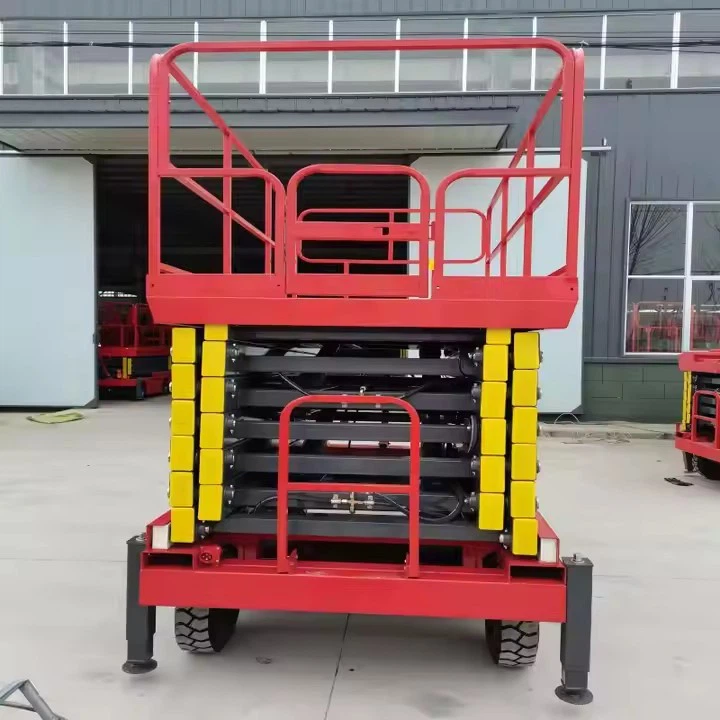

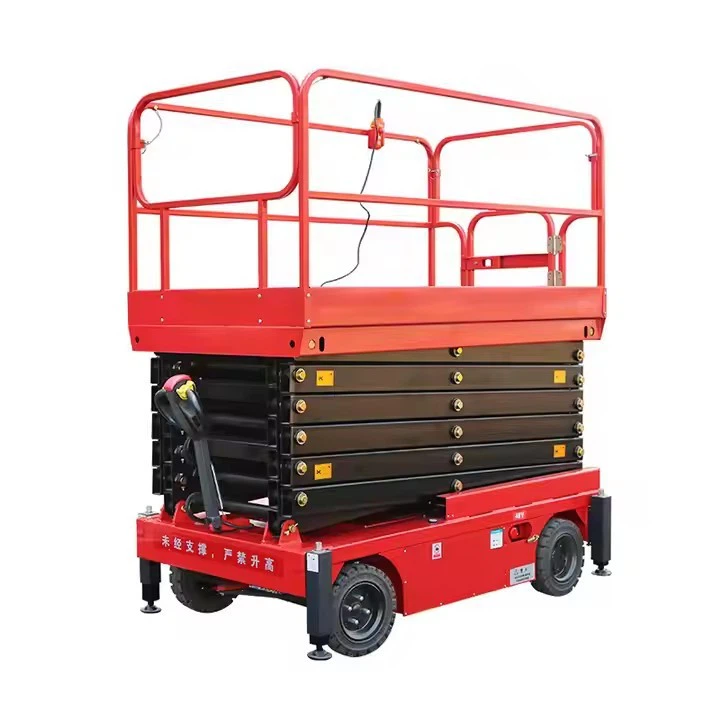

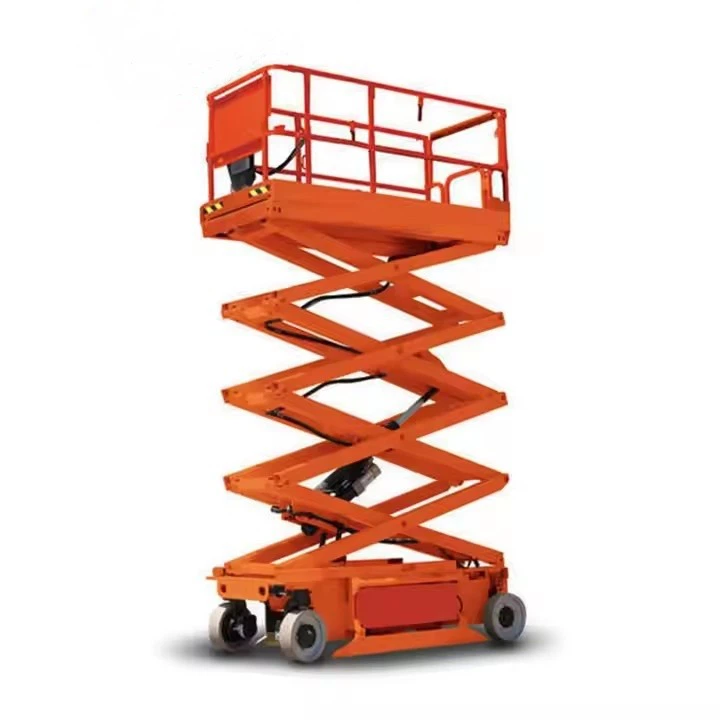

16m Hydraulic Scissor Lift Platform
Products Description
A 16m Hydraulic Scissor Lift Platform is a heavy-duty, vertically elevating work platform designed to provide stable, high-level access for personnel, tools, and materials. The "16m" refers to its maximum working height (platform height), which is typically achieved through a system of interconnected, folding scissor arms powered by hydraulic cylinders.
Key Components
A lift of this height is a substantial piece of industrial equipment, requiring robust design for stability and safety.
1. Structural System
This forms the backbone of the lift.
Platform Deck: The working surface. For a 16m lift, it's typically a large, steel diamond-plate deck with high side curbs and a hinged gate. May include fold-down extensions to increase work area.
Scissor Arms (Lifting Mechanisms): Multiple sets of criss-crossed, high-tensile steel arms. A 16m lift will have multiple stages (e.g., 3 or 4 sets of arms) to achieve the height. Pivot points (bosses) house heavy-duty pins and bushings.
Base Frame (Chassis): A rigid, welded steel frame that supports all other components. It houses the hydraulic power unit, actuators, and often the batteries. Must be exceptionally stable.
Guardrails & Toeboards: Full perimeter guardrails on the platform (often with mid-rails and kickplates) to prevent falls, compliant with OSHA/EN standards.
2. Lifting & Power System
The components that generate and transmit the lifting force.
Hydraulic Cylinder(s): One or more large, single or double-acting steel cylinders. On a tall lift, the cylinder may be mounted horizontally, pushing on the scissor arms through a mechanical linkage or directly.
Hydraulic Power Unit (HPU): Consists of:
Electric Motor: Powers the hydraulic pump (often 24V, 48V, or 480V AC depending on power source).
Hydraulic Pump: Creates the fluid pressure.
Fluid Reservoir: Holds hydraulic oil.
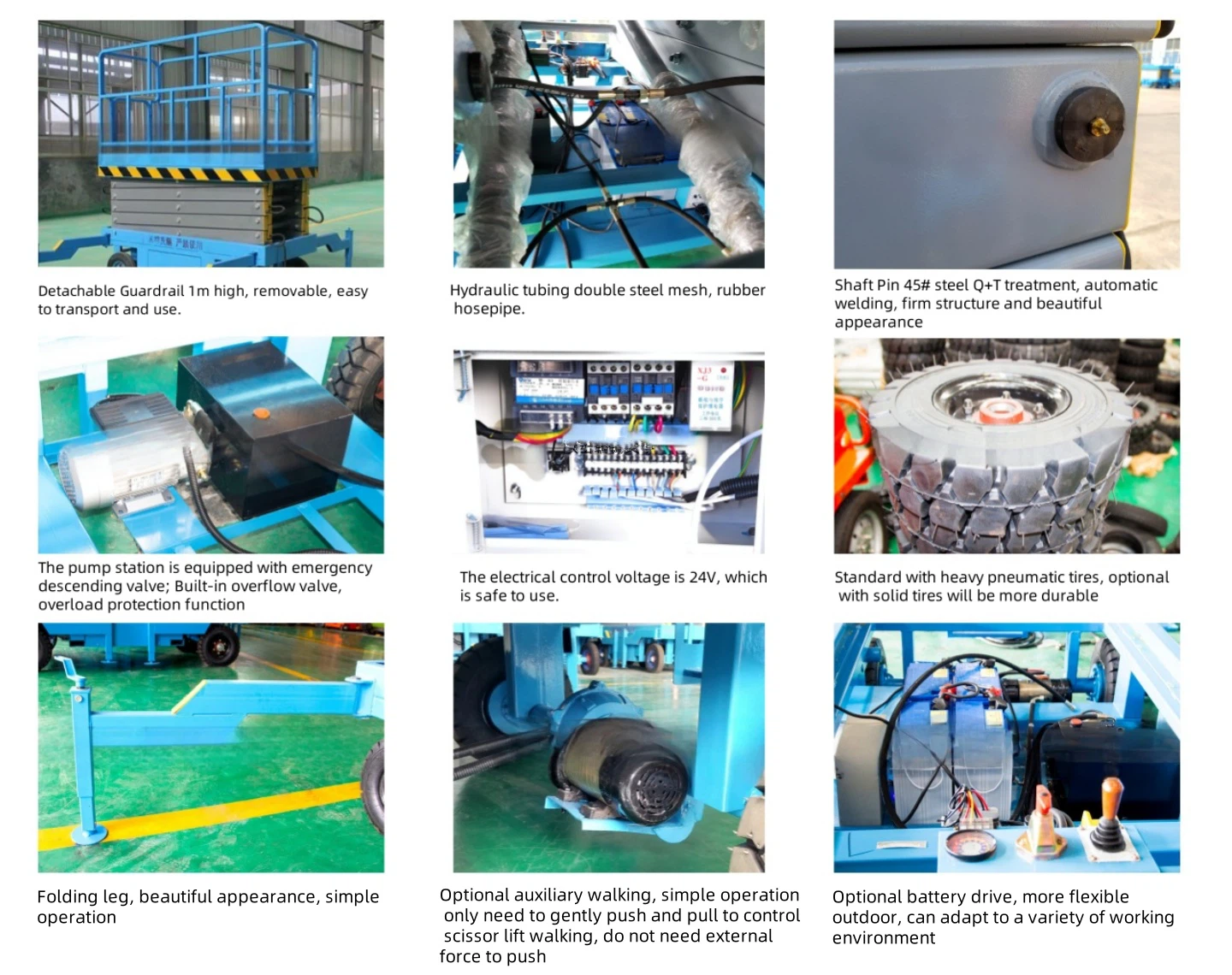
Control Valves: The most critical is the Lowering Valve (a counterbalance or pilot-operated check valve). It prevents descent until the operator commands it, ensuring safe, controlled lowering even if a hose bursts.
Hoses & Fittings: High-pressure hydraulic lines that connect the HPU to the cylinder(s).
3. Control & Electrical System
The nerve center for operation and safety.
Control Box/Enclosure: Houses electrical components like contactors, controllers, and circuit breakers.
Control Stations:
Platform Controls: A pendant or panel with Up/Down buttons, emergency stop, and often drive controls (if mobile). Allows the operator to control the lift from the platform.
Ground Controls: A key-operated or secure panel on the base for raising the platform in an emergency or for initial setup. Prevents unauthorized use.
Battery Pack & Charger: For mobile electric lifts, a large bank of deep-cycle industrial batteries (e.g., 4x 12V) provides power. A built-in charger is included.
Sensors & Switches: Limit switches (top and bottom) to stop travel automatically, tilt sensors to prevent operation on unsafe slopes, and platform pressure mats are common safety options.
4. Mobility & Stability System
Drive System (if mobile):
Drive Motors & Wheels: Usually two powered and driven wheels, often with separate motors for each wheel for maneuvering.
Steering: Can be front-wheel steer, rear-wheel steer, or coordinated "crabbing" via the control system.
Traction/Brake System: Automatic brakes engage when the drive control is released.
Outriggers/Stabilizers: Crucial for a 16m lift. Extendable (manual or hydraulic) legs with large pads that extend outward from the base frame to create a larger, more stable footprint before lifting. Operating at full height without proper outriggers is extremely dangerous.
5. Safety System (Redundant & Critical)
Mechanical Safety Locks (Secondary Holding Device): The most important safety feature. These are physical steel bars or hooks that automatically engage into the scissor arms at regular intervals. They prevent catastrophic collapse if the hydraulic system fails. They disengage sequentially during controlled lowering.
Emergency Descent System: A manual pump or battery-backup system to lower the platform in case of main power failure.
Pothole Protection: Covers or plates that prevent the outrigger feet from sinking into soft surfaces like asphalt.
Audible/Visual Alarms: A rotating beacon and buzzer that activate during lift movement to alert people nearby.
Emergency Stop Buttons: Located at both platform and ground controls.
Key features
Core Performance & Specifications
Working Height: Approximately 16-17 meters (52.5 - 56 ft), allowing access to high ceilings, structural elements, and multi-story facades.
Platform Height: The maximum height the platform floor reaches.
Lift Capacity: Typically ranges from 300 kg to 500 kg (660 lbs to 1,100 lbs), allowing multiple workers with tools and materials.
Platform Size: Generous deck, often around 2.5m x 0.8m (8.2ft x 2.6ft) or larger, providing stable workspace.
Drive System: Electric or rough-terrain diesel/hybrid options. Electric models are for indoor/smooth surfaces (zero emissions, quiet). Diesel are for outdoor, uneven sites.
Stowed Height: Compact, usually under 2 meters (6.5 ft), for easy transport through standard doorways.
Travel Speed: Typically 3-5 km/h (2-3 mph) for efficient repositioning.
Safety Features (Critical)
Tilt/Incline Alarm: Warns operators if used on excessive slopes.
Pothole Protection: Guards on the scissor arms prevent catastrophic failure if a wheel drops into a hole.
Dual-Function Controls: Ground controls and platform controls with key switches. Platform controls override ground controls for safety.
Emergency Descent System: Manual hydraulic lowering in case of power failure.
Guardrails & Toeboards: Fully enclosed platform with a mid-rail and toe board to prevent falls and tool drops.
Safety Brakes: Automatic braking system when the drive is disengaged or on an incline.
Overload Sensor: Prevents operation if the platform is overloaded.
Operational & Design Features
Non-marking Tires: For indoor use to protect floor surfaces.
Rough Terrain Package (Optional): Larger pneumatic tires, 4x4 drive, and higher ground clearance for outdoor sites.
Proportional Drive & Steer: Provides smooth, precise control for positioning.
Self-leveling Platform: Ensures the platform stays level automatically throughout the lift cycle.
Extended/Long Deck (Optional): A platform that can extend outward to reach over obstacles.
Battery Power: For electric models, long-lasting battery with indicator. Often 24V or 48V systems.
key applications
Primary Advantages for These Applications:
Large, Stable Platform: Allows multiple workers (2-4) with tools and materials.
Vertical Reach: Ideal for multi-story buildings, high warehouses, and large structures.
Heavy Capacity: Typically 500kg (1,100 lbs) or more, suitable for heavy loads.
Indoor/Outdoor Use: Often has rough-terrain capabilities (pothole protection, larger tires) for construction sites.
Key Applications by Industry
1. Construction & Building Maintenance
Exterior Façade Work: Installing windows, cladding, insulation, and sealing on buildings up to 4-5 stories.
Structural Steel & Concrete: Welding, bolting, formwork, and inspection on frameworks.
Roof Access & Parapet Work: Safe access to roof edges for installation, repair, and maintenance.
Signage & Lighting Installation: Mounting large exterior signs, billboards, and high-bay lighting.
New Build Finishing: Painting, glazing, and final fittings on the upper levels of mid-rise structures.
2. Industrial & Warehouse
High Bay Maintenance: Replacing light fixtures, cleaning skylights, servicing sprinkler heads, and working on HVAC ductwork in warehouses with ceilings over 40 feet.
Storage Rack Installation & Repair: Installing, adjusting, and safely repairing the highest levels of pallet racking.
Inventory Management & Inspection: Accessing top shelves for stock checks in very high storage facilities.
Plant & Factory Maintenance: Servicing overhead cranes, conveyor systems, piping, and large machinery.
3. Facility Management & Utilities
Airport & Stadium Maintenance: Changing bulbs in field lights, cleaning canopy glass, servicing scoreboards, and maintaining concession stand equipment.
Shopping Malls & Atriums: Decorating, cleaning, and maintaining lighting and decorations in vast interior spaces.
Utility Installation & Repair: Working on overhead power lines (with proper training/insulation), telecommunication infrastructure, and station lighting.
4. Logistics & Shipping
Port & Shipyard Operations: Container inspection, ship-side maintenance, and cargo hold work.
Freight Terminal Maintenance: Servicing dock levelers, door systems, and building exteriors.
5. Signage & Telecommunications
Cell Tower & Antenna Maintenance: Ideal for working on the lower to mid-sections of towers or for rooftop antenna installations.
Broadcast & Satellite Equipment: Installing and servicing dishes and transmission gear on building rooftops.
Advantages
Of course. A 16-meter (approximately 52.5-foot) hydraulic scissor lift platform is a common and versatile model for industrial and construction applications. Here are its key advantages, broken down by category:
1. Reach & Capacity
Substantial Working Height: A 16m lift provides a platform height of ~16m, allowing for a working height of ~18-20m when including a person's reach.** This is ideal for tasks like warehouse lighting, steel erection, ceiling installation, and exterior building maintenance on multi-story structures.
High Load Capacity: These lifts are typically rated for 500-1000 lbs (230-450 kg) or more, allowing them to carry multiple workers, tools, and materials (e.g., bundles of conduit, panels, HVAC units) safely and efficiently.
2. Stability & Safety
Superior Stability: The wide, heavy base and the scissor mechanism provide an exceptionally stable platform, especially at full height compared to some articulating or telescopic booms. This minimizes sway, which is crucial for precision work.
Large Platform Area: Offers a spacious, enclosed work platform with toe-guards and midrails, giving workers a secure "workshop in the sky." This reduces the risk of falls and allows for organized tool placement.
Fail-Safe Hydraulics: The system typically uses gravity to lower, with holding valves to prevent catastrophic drops in case of a hose failure. Most have emergency lowering systems.
Compliance with Standards: When properly maintained and used, they meet strict occupational safety standards (like OSHA, CE).
3. Efficiency & Productivity
Vertical-Rise Only Movement: For tasks directly above the base location, no time is wasted maneuvering a boom. It provides the fastest, most direct access to the overhead work area.
Dual-Hand Controls: Requires intentional operation from the platform, enhancing safety and control during positioning.
Smooth, Precise Control: Hydraulic systems allow for fine, controlled movements for delicate alignment and installation work.
Reduced Setup Time: No outriggers are required for most models on firm, level surfaces, allowing for quick relocation and setup.
4. Versatility & Site Access
Indoor/Outdoor Use: Many 16m models are available in rough-terrain variants with large pneumatic tires and 4x4 drive for outdoor, uneven job sites, or electric models for quiet, zero-emission indoor use.
Excellent Maneuverability: Compact chassis and often crab steer or tight turning radius allow them to navigate through standard doorways, around warehouse racks, and in congested industrial areas.
Multiple Power Options: Can be powered by diesel, electric/battery, or hybrid systems, making them suitable for various environments from sensitive indoor facilities to remote construction sites.
5. Cost-Effectiveness
Lower Initial Cost: Generally, a scissor lift has a lower purchase/rental cost than an articulating or telescopic boom of similar height.
Reduced Training Complexity: Often considered easier to operate than complex boom lifts, though formal training is still mandatory.
High Uptime & Durability: The hydraulic scissor mechanism is mechanically simple and robust, leading to reliability and easier maintenance.
Parameters table

Pictures


Parts Details

Product production process
The production process of a 15-ton hydraulic scissor lift platform involves several key stages, from design and material selection to assembly and testing. Below is a detailed breakdown of the manufacturing process:
1. Design & Engineering
Conceptualization: Define specifications (load capacity, lift height, platform size, power source, etc.).
CAD Modeling: Use 3D design software (SolidWorks, AutoCAD) to create detailed schematics.
Structural Analysis: Finite Element Analysis (FEA) to ensure strength and stability under load.
Hydraulic System Design: Calculate cylinder size, pump capacity, and valve requirements.
2. Material Procurement
Steel Selection: High-grade steel (Q235B/Q345B) for the scissor arms, platform, and base.
Hydraulic Components: Pumps, cylinders, hoses, and valves from certified suppliers.
Electrical Components: Motors, control panels, sensors, and wiring.
Other Materials: Polyurethane or rubber wheels, safety rails, and non-slip decking.
3. Cutting & Fabrication
Laser/Plasma Cutting: Precision cutting of steel plates for scissor arms, platform, and base.
Bending & Welding:
Scissor arms are bent and welded into X-shaped linkages.
Platform and base frames are welded for structural integrity.
Surface Treatment:
Sandblasting to remove rust and impurities.
Primer and paint coating (powder coating for durability).
4. Hydraulic System Assembly
Cylinder Installation: Mount hydraulic cylinders to the scissor mechanism.
Pump & Motor Setup: Install hydraulic pump, electric/diesel power unit, and hoses.
Valve & Control Integration: Fit control valves, pressure relief valves, and manifolds.
5. Electrical & Control System Installation
Wiring: Connect motors, limit switches, and emergency stop buttons.
Control Panel: Install push-button or remote controls for lifting/lowering.
Safety Devices: Add overload sensors, tilt alarms, and emergency descent valves.
6. Mechanical Assembly
Scissor Mechanism Assembly: Connect scissor arms with pivot bolts and bearings.
Platform Mounting: Secure the platform to the top of the scissor structure.
Outriggers/Stabilizers: Attach if required for additional stability.
7. Testing & Quality Control
Load Testing: Verify 15-ton capacity with incremental weights (125% overload test).
Hydraulic Pressure Test: Check for leaks and system stability.
Cycle Testing: Repeated lifting/lowering to ensure smooth operation.
Safety Checks: Verify emergency stop, tilt sensors, and manual lowering function.
8. Finishing & Packaging
Final Paint Touch-Up: Ensure corrosion resistance.
Labeling & Branding: Add safety labels, capacity plates, and logos.
Packaging: Protect with plastic wrap or wooden crates for shipping.
9. Certification & Documentation
Compliance: Ensure adherence to ANSI, OSHA, or CE standards.
User Manuals: Provide operation and maintenance guides.
Warranty & Support: Finalize after-sales service terms.
Workshop view:
The company has installed an intelligent equipment management platform, and has installed 310 sets (sets) of handling and welding robots. After the completion of the plan, there will be more than 500 sets (sets), and the equipment networking rate will reach 95%. 32 welding lines have been put into use, 50 are planned to be installed, and the automation rate of the entire product line has reached 85%.


Hot Tags: 16m hydraulic scissor lift platform, China 16m hydraulic scissor lift platform manufacturers, suppliers, factory
You Might Also Like


Send Inquiry