







5ton Hydraulic Scissor Lift Platform
Products Description
Core Characteristics & Typical Uses
Capacity: 5 Tons - Suitable for heavy machinery, pallets of dense materials, multiple workers with tools, or large assemblies.
Power Source: Typically Electric (3-phase or single-phase) for indoor use, or Diesel for rough outdoor terrain. Some models are Dual-Powered (electric with emergency battery) or Hybrid.
Drive: Can be Non-Driven (stationary, moved by forklift) or Self-Propelled (with a drive system for moving while elevated, crucial for efficient large-area work).
Platform Size: Varies, but common sizes range from 6' x 10' to 8' x 20' (1.8m x 3m to 2.4m x 6m) or larger. Custom sizes are available.
Lift Height: Usually between 10 to 30 feet (3 to 9 meters). The Maximum Working Height will be the lift height plus an average person's reach (~6 ft / 1.8m).
Key Components
I. Structural & Platform System
This forms the core frame and work surface.
Scissor Arms (Legs): The crossed, hinged steel arms that provide the lifting motion. They are typically made of high-tensile steel plate and are the most recognizable part of the lift.
Platform (Deck): The work surface. It often has a diamond-pattern steel plate for slip resistance and may include:
Toe Guards: Vertical barriers around the perimeter to prevent tools/feet from going over the edge.
Gate or Safety Chain: A removable entry barrier.
Base Frame (Chassis): The bottom frame that rests on the floor, housing the power unit, cylinders, and providing mounting points for wheels and outriggers.
Outriggers (Stabilizers): Extendable legs (manual or hydraulic) that widen the lift's footprint for increased stability, especially when loaded and elevated. Crucial for a 5-ton capacity lift.
II. Hydraulic Power System
Provides the controlled lifting force.
Hydraulic Cylinder(s): One or more single or double-acting cylinders. On a 5-ton lift, these are substantial. They push against the scissor arms to raise the platform.
Hydraulic Pump / Power Unit: Generates hydraulic pressure. Can be:
Electric: AC or DC (battery) powered. Common for indoor use.
Engine-Driven: Gas, diesel, or LPG powered for outdoor/rough terrain use.
Hydraulic Fluid & Reservoir: Stores the hydraulic oil and feeds the pump.
Control Valves:
Directional Control Valve: (Often a solenoid valve) Directs fluid to the cylinder to raise the platform. Typically a "momentary contact" type for safety.
Lowering Valve / Flow Control Valve: A manually or solenoid-operated valve that allows controlled descent by metering fluid out of the cylinder.
Hoses, Fittings, & Manifold: High-pressure lines and blocks that connect all hydraulic components.
III. Control & Electrical System
The user interface and safety circuitry.
Control Box / Panel: Houses electrical components. May have keyed main power switches.
Actuation Controls:
Platform Controls: Push-button station(s) on the platform for raising/lowering. Connected by a trailing cable or radio control.
Ground (Base) Controls: A secondary control station on the base frame for ground-level operation, often with a safety key.
Remote Control: (Optional) Wireless radio control for operation from a distance.
Battery & Charger: For DC electric models. A 5-ton lift will have a large battery bank.
Wiring Harness & Safety Switches: Connects all electrical components and includes limit switches, etc.
IV. Mobility System
Wheels & Casters: A combination of:
Steer Wheels: Typically at one end, often with a tow ring.
Drive Wheels: (If self-propelled) Powered by electric drive motors.
Rigid Casters: For simple rolling.
Drive System (for Self-Propelled Models):
Drive Motors: Electric motors powered by the battery.
Travel Control(s): Joystick or buttons for directional movement and speed.
Brakes: Often automatic fail-safe brakes that engage when the drive control is released.
V. Safety System (Extremely Important for 5-Ton Capacity)
Mechanical Safety Locks (Shear Bar / Bar Locks): The primary fail-safe. Automatically engages between scissor arms if hydraulic pressure is lost, preventing catastrophic descent.
Lowering Valves (Redundant): Manually operated backup valves (like a foot pump or hand lever) to lower the platform in case of main system failure or power loss.
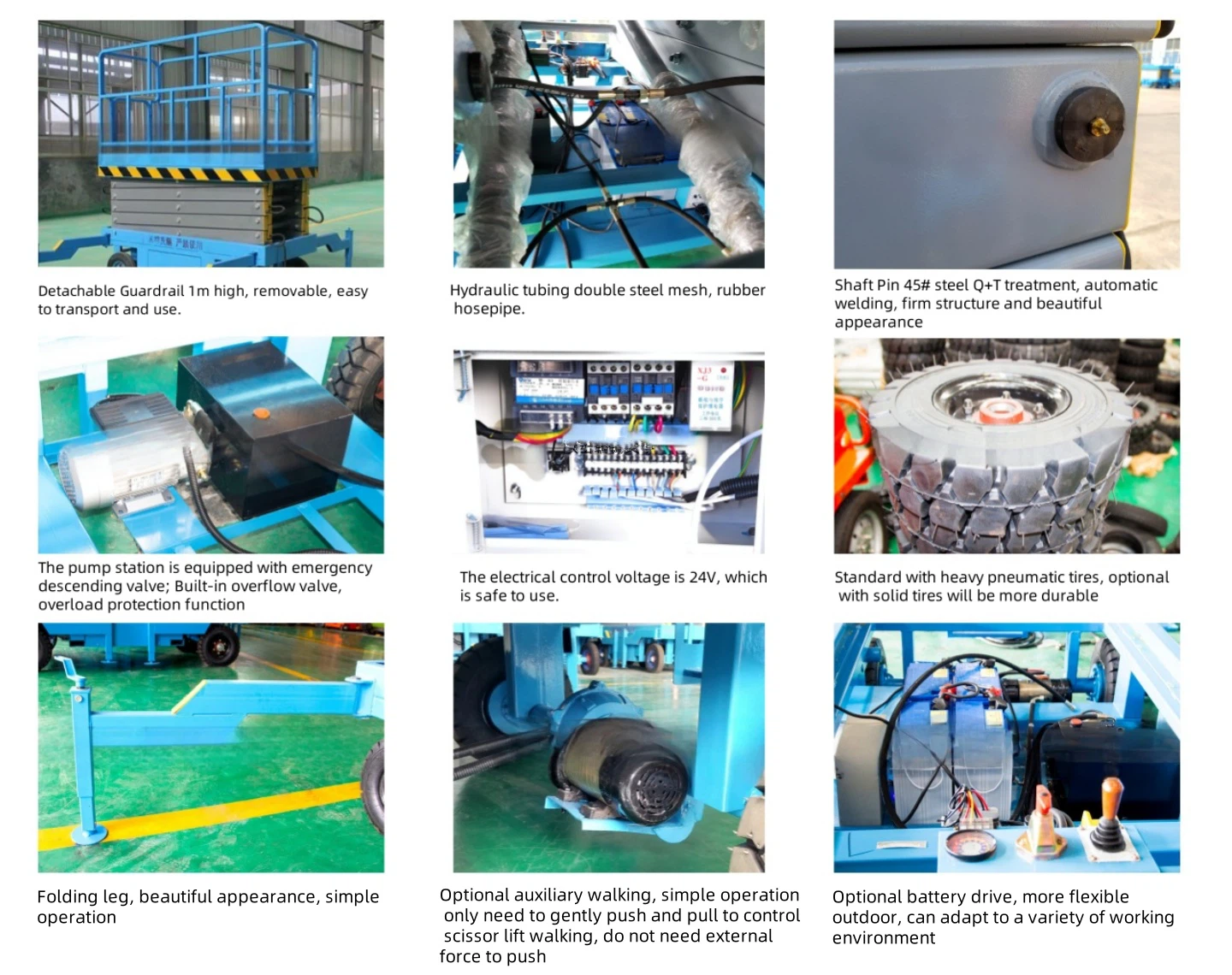
Overload (Pressure Relief) Valve: Built into the hydraulic system to prevent lifting beyond its safe capacity.
Pothole Protection (Optional on some models): Covers over wheel areas to prevent the lift from being lowered into floor obstructions.
Emergency Stop (E-Stop): Mushroom-button(s) on control stations to cut all power.
Tilt/Incline Alarm: Sensor that warns if the lift is on an unsafe slope.
Safety Wheels & Covers: To protect toes and prevent crushing hazards.
VI. Optional Components
Pothole Guards: As mentioned above.
Platform Extensions: Manually flip-out or sliding deck extensions to increase work area.
Tool Trays / Material Holders: Attachments on the platform.
Extra Outlets: 110V or 12V power outlets on the platform.
Hydraulic Tool Circuits: Auxiliary hydraulic ports to power tools.
Lights: For platform or ground illumination.
Enclosures: Wind/weather guards or custom railings.
Key features
Structural & Mechanical Features
Heavy-Duty Construction:
Platform Deck: Made of steel diamond plate or tread plate for superior traction and durability. May have a beveled front edge (lip) for safety.
Scissor Arms: Fabricated from high-tensile steel plate, often with reinforced pivot points for maximum strength and longevity.
Base Frame: Robust, welded steel frame to support the entire load and provide stability.
Hydraulic Power System:
Electric/Hydraulic Power Unit: A reliable electric motor-driven pump powers a double-acting hydraulic cylinder(s) for smooth, controlled lifting.
Safety Valves: Integral hydraulic safety valves prevent uncontrolled descent in case of a hose failure.
Manual Lowering Option: A backup hand pump or release valve allows for safe lowering during a power outage.
Drive System (for Mobile Models):
Powered Travel: Equipped with electric drive motors (often 24V or 36V) for moving the loaded platform.
Steering: Can be pedal-steer (self-propelled) or have a dedicated walking operator's control panel.
Tires: Solid polyurethane or semi-pneumatic tires to handle industrial floor conditions.
Safety & Operational Features
Primary Safety Devices:
Mechanical Safety Locks (Shear Bars): Automatically engage at regular intervals to physically prevent collapse, even if hydraulics fail.
Platform Guardrails: Removable or foldable guardrails (typically 42" high) with a mid-rail and toe guard.
Lower Controls: A pendant or panel with emergency stop, up/down buttons, and sometimes drive controls, keeping the operator clear of the lift.
Upper Controls: A duplicate set of controls on the platform for operator convenience.
Pothole Protection: Extendable legs or flange plates that deploy to protect the scissor mechanism if the lift rolls over a floor opening.
Load & Stability Features:
Excess Load Valve: Prevents lifting if the load exceeds ~110% of rated capacity.
Tilt/Angle Sensors: (On advanced models) Monitor for instability on uneven surfaces and may halt operation.
Outriggers (Optional): Extendable stabilizers for use on uneven ground or at maximum height with full load.
Operational Enhancements:
Anti-Collapse System: A secondary hydraulic or mechanical backup to the main cylinder.
Platform Extension (Optional): A manual or hydraulic slide extension to increase deck length for oversized loads.
Access Ramps: Bolt-on or flip-up ramps for wheeled equipment loading.
Dock Leveler Integration: Can be built into the platform to function as a heavy-duty mobile dock leveler.
key applications
1. Warehousing & Logistics
Loading/Unloading Trucks – Reaching bed heights of trucks and shipping containers
Order Picking – Accessing high shelves in distribution centers
Pallet Handling – Moving heavy palletized goods between levels
Inventory Management – Accessing storage racks up to 6-7 meters high
2. Manufacturing & Industrial
Equipment Installation – Positioning heavy machinery
Assembly Lines – Working on large product assemblies
Maintenance – Servicing overhead cranes, lighting, and HVAC systems
Material Handling – Transporting materials between production floors
3. Construction & Building Maintenance
Electrical Installation – Installing wiring, conduits, and lighting
HVAC Work – Installing and servicing ductwork and units
Painting & Finishing – Interior/exterior painting of high walls/ceilings
Cladding & Glazing – Installing windows, panels, and façade elements
4. Automotive & Aviation
Vehicle Servicing – Accessing top of buses, trucks, or aircraft interiors
Aircraft Maintenance – Working on wing surfaces and tail sections
Body Repair – For large vehicles and transport equipment
5. Retail & Commercial
Store Maintenance – Changing lights, signage, and security cameras
Display Setup – Installing seasonal decorations and high displays
Stockroom Access – In large-format retail stores
6. Specialized Applications
Stage & Event Production – Rigging lighting and sound equipment
Film/Theater – Setting up scenery and equipment
Shipping Ports – Container inspection and minor repairs
Foundries – Furnace maintenance and repair
Advantages
Here are the key advantages of a 5-ton hydraulic scissor lift platform:
1. Exceptional Load Capacity & Stability
Heavy-Duty Performance: The primary advantage is its ability to safely and steadily lift 10,000 lbs of concentrated weight. This makes it ideal for moving heavy machinery, pallets of material, multiple workers with equipment, or large fabricated parts.
Inherent Stability: The scissor mechanism and wide platform base provide a very stable, non-pendulous lifting motion. This is crucial when handling heavy, unbalanced, or delicate loads.
2. Safety & Reliability
Fail-Safe Hydraulic System: Hydraulic cylinders provide smooth, controlled lifting and lowering. In the unlikely event of a power or pump failure, the platform will descend slowly and controllably via pressure release valves, rather than free-falling.
Integrated Safety Features: Standard models include:
Manual Lowering Valve: For safe descent during power outages.
Platform Guardrails & Toe Boards: To prevent falls and contain tools/parts.
Pothole Protection: Legs designed to prevent collapse if rolling over a floor irregularity.
Overload Protection: Systems that prevent operation or trigger an alarm if capacity is exceeded.
3. Versatility & Application Flexibility
Wide Range of Industries: Essential in manufacturing, warehousing, construction, aerospace, heavy equipment repair, and staging.
Multiple Configurations: Available in various forms to suit different needs:
Mobile (Self-Propelled or Towable): For moving loads around a facility. Often have rough-terrain capabilities.
Stationary (Fixed or Pit-Mounted): For repetitive lifting tasks in a specific location (e.g., loading docks, assembly lines).
Electric, Diesel, or Hybrid Power: Options for indoor/outdoor use.
4. Efficiency & Productivity Gains
Eliminates Double-Handling: Moves heavy items vertically in a single cycle, reducing the need for cranes or forklifts for secondary lifting.
Creates an Elevated Work Platform: Provides a large, stable area for workers and tools at height for assembly, maintenance, or installation.
Ergonomic Benefits: Reduces worker strain and injury risk by bringing the work to a comfortable height, minimizing bending and lifting.
5. Durability & Low Maintenance
Robust Construction: Built with heavy-gauge steel to withstand industrial environments.
Simple Mechanism: The hydraulic scissor design has fewer complex components compared to articulated or telescopic booms, leading to lower long-term maintenance costs and easier servicing.
6. Cost-Effectiveness
High Return on Investment (ROI): By improving safety, speeding up material handling, and reducing reliance on more expensive equipment (like large forklifts or cranes), it often pays for itself quickly.
Reduced Labor Costs: Accomplishes tasks with fewer workers and in less time.
Parameters table

Pictures


Parts Details

Product production process
The production process of a 15-ton hydraulic scissor lift platform involves several key stages, from design and material selection to assembly and testing. Below is a detailed breakdown of the manufacturing process:
1. Design & Engineering
Conceptualization: Define specifications (load capacity, lift height, platform size, power source, etc.).
CAD Modeling: Use 3D design software (SolidWorks, AutoCAD) to create detailed schematics.
Structural Analysis: Finite Element Analysis (FEA) to ensure strength and stability under load.
Hydraulic System Design: Calculate cylinder size, pump capacity, and valve requirements.
2. Material Procurement
Steel Selection: High-grade steel (Q235B/Q345B) for the scissor arms, platform, and base.
Hydraulic Components: Pumps, cylinders, hoses, and valves from certified suppliers.
Electrical Components: Motors, control panels, sensors, and wiring.
Other Materials: Polyurethane or rubber wheels, safety rails, and non-slip decking.
3. Cutting & Fabrication
Laser/Plasma Cutting: Precision cutting of steel plates for scissor arms, platform, and base.
Bending & Welding:
Scissor arms are bent and welded into X-shaped linkages.
Platform and base frames are welded for structural integrity.
Surface Treatment:
Sandblasting to remove rust and impurities.
Primer and paint coating (powder coating for durability).
4. Hydraulic System Assembly
Cylinder Installation: Mount hydraulic cylinders to the scissor mechanism.
Pump & Motor Setup: Install hydraulic pump, electric/diesel power unit, and hoses.
Valve & Control Integration: Fit control valves, pressure relief valves, and manifolds.
5. Electrical & Control System Installation
Wiring: Connect motors, limit switches, and emergency stop buttons.
Control Panel: Install push-button or remote controls for lifting/lowering.
Safety Devices: Add overload sensors, tilt alarms, and emergency descent valves.
6. Mechanical Assembly
Scissor Mechanism Assembly: Connect scissor arms with pivot bolts and bearings.
Platform Mounting: Secure the platform to the top of the scissor structure.
Outriggers/Stabilizers: Attach if required for additional stability.
7. Testing & Quality Control
Load Testing: Verify 15-ton capacity with incremental weights (125% overload test).
Hydraulic Pressure Test: Check for leaks and system stability.
Cycle Testing: Repeated lifting/lowering to ensure smooth operation.
Safety Checks: Verify emergency stop, tilt sensors, and manual lowering function.
8. Finishing & Packaging
Final Paint Touch-Up: Ensure corrosion resistance.
Labeling & Branding: Add safety labels, capacity plates, and logos.
Packaging: Protect with plastic wrap or wooden crates for shipping.
9. Certification & Documentation
Compliance: Ensure adherence to ANSI, OSHA, or CE standards.
User Manuals: Provide operation and maintenance guides.
Warranty & Support: Finalize after-sales service terms.
Workshop view:
The company has installed an intelligent equipment management platform, and has installed 310 sets (sets) of handling and welding robots. After the completion of the plan, there will be more than 500 sets (sets), and the equipment networking rate will reach 95%. 32 welding lines have been put into use, 50 are planned to be installed, and the automation rate of the entire product line has reached 85%.


Hot Tags: 5ton hydraulic scissor lift platform, China 5ton hydraulic scissor lift platform manufacturers, suppliers, factory
You Might Also Like


Send Inquiry