










Outdoor Gantry Crane
Products Description
The outdoor gantry crane is a versatile and robust lifting solution designed for outdoor use in various industries, including construction, shipping, and manufacturing.It is engineered to handle heavy loads safely and efficiently, this outdoor gantry crane is ideal for tasks such as loading and unloading materials, moving equipment, and facilitating construction activities.T he Outdoor gantry cranes are used for lifting and moving heavy materials, such as steel beams, precast concrete and heavy machinery. It is very suitable for the construction, manufacturing, logistics and shipbuilding industries.
The outdoor gantry crane is made from high-strength materials to withstand harsh weather conditions.It adopts the method of corrosion-resistant coating to prolong the service life.The outdoor gantry crane is suitable for various applications, including construction sites,shipyards, and manufacturing facilities.It Can be customized in size and lifting capacity to meet specific project requirements.
The outdoor grantry crane is customizable for height and span configurations to suit different operational needs and space constraints.It is capable of lifting considerable weights, with options ranging from a few tons to over 100 tons, depending on the model.
4)The outdoor grantry crane is available in fixed and portable designs, with wheel options for easy movement across job sites. It is also equipped with user-friendly controls, including remote operation options, to enhance safety and efficiency. Integrated safety mechanisms such as overload protection, emergency stop button and warning lights ensure safe operation.
Core Components:Engine, Bearing, Motor
Place of Origin:Henan, China
Warranty:1 Year
Video outgoing-inspection:Provided
Machinery Test Report:Provided
Application:workshop & warehouse
Design:Double beam
Safety:maintenance-free design.

Pictures & Components
1.Main beam
1) The main beam of the outdoor gantry crane is a critical component, typically designed to support the load being lifted. It's usually made from high-strength steel to provide the necessary strength and stability.It's typically made from robust materials like steel to ensure strength and durability, especially since it will be exposed to outdoor conditions. The design usually involves a box or I-beam structure to provide the necessary rigidity while minimizing weight.
The main beam is usually made of high-strength steel with excellent mechanical properties and good fatigue resistance. The selection of materials should take into account the stress and load changes that the main beam will bear during long-term work, including the weight of the crane itself and any additional loads during operation, to ensure the safety and durability of the double-beam gantry crane. Commonly used steels include high-quality low-carbon steel or alloy steel such as Q235 and Q345, which have good weldability and processability.
3) The main beam of the outdoor gantry crane has secure connection points for other components and is welded using an automatic or semi-automatic welding process to ensure the quality and strength of the welds. The main beam and other parts also need to be inspected to ensure that there are no cracks or defects inside. The size, length and shape of the main beam must be very precise. The length of the beam affects its structural integrity and ability to support loads without excessive deflection. Strict dimensional measurements and controls are carried out during the manufacturing process to ensure the straightness and lateral rigidity of the main beam, thereby ensuring the smooth installation and operation of the crane.

Lifting System
Motor: The outdoor gantry crane typically uses a motor to drive its lifting mechanism. The motor can be electric or diesel-powered, depending on the crane's design and application.The motor accurately controls the lifting speed of the cargo through the control system.
Reducer: The outdoor gantry crane reducer is a mechanical component that reduces the speed of the motor's output while increasing its torque. This is crucial for lifting heavy loads safely and efficiently.The reducer must be rated for the maximum load the crane will handle, ensuring reliable performance under heavy conditions. Since these cranes are used outdoors, reducers often come with protective coatings or enclosures to resist corrosion and weather-related damage.Regular maintenance is essential to ensure the reducer operates smoothly. This may involve lubrication, checking for wear and tear, and replacing any worn components.
Drum: The drum is used to wind and unwind a wire rope or cable, allowing for vertical movement of the load. It retracts and releases the wire rope by rotating to directly control the lifting and lowering of the hook or other slings. The size and material of the drum need to be designed according to the lifting weight and the specifications of the wire rope.
Wire rope: Wire rope is made from multiple strands of steel wire twisted together, providing high tensile strength.The construction allows the rope to bend and move easily, which is necessary for lifting and lowering loads.Wire ropes are designed to resist abrasion, corrosion, and fatigue, making them suitable for outdoor environments. Regular inspection and maintenance of wire ropes are crucial to ensure safe operation and prevent accidents.
Pulley block: The pulley block is a crucial component of the crane's lifting mechanism, allowing for the efficient transfer of loads by redirecting the lifting force.
Lifting device: The lifting device is the part that comes into direct contact with the goods, usually a hook or electromagnetic suction cup, grab, etc. Designed for outdoor use, these lifting devices allow for mobility and versatility in a variety of applications, such as shipping yards, construction sites, and warehouses.
 |
 |
3.End carriage
1) The end beam is usually a box-type structure or an I-beam structure with high strength and rigidity. The box-type end beam is welded from steel plates and can effectively resist the torque and bending moment generated during the operation of the crane. A wheel set is installed on the end beam, which consists of a driving wheel and a driven wheel, responsible for the longitudinal movement of the crane along the track. The wheels are usually made of wear-resistant alloy steel or cast steel, with high load-bearing capacity and wear resistance.
2) The end beam is connected to the main beam by bolts or welding to form a complete bridge structure to ensure overall stability. The connection between the end beam and the main beam requires high precision to ensure the smooth operation of the crane and the integrity of the structure. The end beam is mainly used to carry the weight of the crane bridge and transfer it to the track on the ground through the wheels. At the same time, it also supports and stabilizes the main beam so that it can withstand various forces during the lifting process.
3) The driving wheel on the end beam is responsible for the travel of the bridge, pushing the crane to move forward and backward on the track to realize material transportation in space. The drive system can be equipped with a variable frequency speed regulation device to accurately control the movement speed of the crane. By installing limit switches or sensors, the end beam can automatically stop when the crane reaches a predetermined position to prevent collision or deviation from the track.
 |
 |
4.Crane travelling mechanism
1) Working principle
Power transmission: The motor transmits power to the wheel set through the reducer, and the wheels roll on the track to achieve the forward and backward movement of the crane. The design of the reducer allows the crane to run smoothly under low speed and high torque conditions.
Control system: The crane traveling mechanism of modern cranes is usually equipped with advanced control systems, including frequency converters, PLCs, etc., to achieve precise speed regulation and position control.
2) Functions of the crane operating mechanism
Horizontal movement: The crane operating mechanism is responsible for the horizontal movement of the crane in the working area and supports the operation of the lifting crane on the main beam.
Load distribution: Through the configuration of multiple wheels, the load can be evenly distributed on the track, reducing the pressure of the unit track and reducing track deformation and wear.
Positioning accuracy: The crane traveling mechanism can accurately stop at the specified position to ensure the safety and accuracy of the lifting operation.
5.Trolley travelling mechanism
1) Structural composition
The trolley itself is a structure that holds the hoisting mechanism and can move horizontally along the beam.The trolley is equipped with wheels that run on rails mounted on the outdoor gantry crane's beams. The wheels can be designed for easy rolling, often using ball bearings to reduce friction.The trolley is usually powered by an electric motor or sometimes a manual system. The motor drives the wheels, enabling the trolley to travel back and forth along the crane's beam.
2) Function of the trolley operating mechanism
The main function of the trolley operating mechanism is to enable the lifting trolley to move laterally on the main beam, thereby achieving accurate positioning and handling of the goods.The operator controls the travelling mechanism through a remote control or a cabin on the crane.
6.Crane wheel
Wheels are typically designed to roll smoothly on tracks, with features that minimize friction and allow for easy maneuvering. They are usually made of durable materials, such as steel or high-strength composites, to withstand heavy loads and environmental wear. The size of the wheel affects the stability and load capacity of the crane. Larger wheels distribute weight more efficiently. Larger wheels distribute weight more efficiently. Crane wheels use high-quality bearings to ensure smooth operation and reduce maintenance requirements. The wheels of outdoor cranes should be designed to resist rust, corrosion, and other environmental factors.

7.Crane Hook
1) The crane hook of an outdoor gantry crane is a critical component designed to lift and maneuver heavy loads. It is typically made of high-strength steel to withstand significant weight and stress. The hook is often equipped with safety features, such as a latch or locking mechanism, to prevent accidental release of the load.Outdoor gantry cranes may have different types of hooks depending on their specific application.
2) The main function of the hook is to safely grab and lift various materials and ensure that the material does not fall off during movement. The design of the hook allows quick and easy connection with different types of hoists (such as lifting rings, grabs, magnets, etc.), improving the flexibility of the operation.

Motor
The Motor's production of outdoor gantry cranes involves designing and manufacturing cranes that are specifically built for outdoor use. These cranes typically feature a robust structure to withstand various weather conditions and can handle heavy loads.
The motor powers the hoist, which raises and lowers the load. It typically drives a drum or a set of pulleys that wind or unwind a cable or chain connected to the load. The motor facilitates the lateral movement of the gantry crane along its rails. This allows the crane to position itself over the load and transport it horizontally.In some designs, a motor may also be responsible for rotating the hoist or the crane's superstructure, enabling precise placement of the load.Motors can be equipped with variable speed drives to allow operators to control the speed of lifting and traveling, enhancing safety and efficiency. Modern motors often come with built-in safety features, such as overload protection and emergency stop functions, to prevent accidents and equipment damage.
3) The motor of outdoor grantry crane is responsible for driving the operation of the trolley and the car, enabling the crane to move on the track for lifting and positioning of materials. The motor lifts the heavy objects to the required height through the lifting mechanism (such as the winch) to meet the requirements of different operations.

.
Sound and light alarm system & limit switch
1) Sound and light alarm system
The outdoor gantry crane alarm system typically includes both sound and light components to alert operators and nearby personnel of various conditions.
Sound Alarm:Horns or Sirens: These emit loud noises to warn of hazards or operational changes. Different tones can indicate different alerts (e.g., warning vs. emergency).Volume Control: Adjustable volume settings to ensure the alarm is audible over other environmental noises.
Light Alarm: Flashing Lights: LED or strobe lights that flash to draw attention. Colors can signify different alerts (e.g., red for danger, yellow for caution).Visibility: Lights should be bright and visible from a distance, especially in low-light conditions.
Control Panel: A centralized unit that allows operators to activate or deactivate alarms, adjust settings, and monitor system status.Alarms can be triggered automatically based on sensor inputs (e.g., if a load is too heavy or if someone enters a danger zone). Operators can activate alarms manually in specific situations (e.g., during maintenance or emergencies).
2) Limit switch
Limit switches on outdoor gantry cranes are crucial for safety and operational efficiency. They are used to prevent the crane from moving beyond its designated limits, which helps avoid collisions and accidents.
Functions: The Limit switches detect the position of the crane's moving parts, such as the trolley or the hoist. When the crane reaches a predetermined position, the limit switch activates, stopping the movement.
Types: There are various types of limit switches, including mechanical, proximity, and photoelectric switches. The choice depends on the specific application and environment.

10.Safety Devices
1) Outdoor gantry cranes are equipped with several safety devices to ensure safe operation.
2) Limit Switches: They are used to stop the crane's motion when it reaches the end of its travel path, preventing mechanical damage and accidents.
3) Overload Protection: These devices prevent the crane from lifting loads that exceed its rated capacity, often using load sensors or limit switches.
4) Emergency Stop Button: Located in accessible areas, this button allows operators to quickly shut down the crane in case of an emergency.
5) Anti-Two-Block Device: This prevents the hook from coming into contact with the boom or other structures, which could cause damage.
6)Operator Training Systems: Ensuring operators are well-trained in safety procedures and the proper use of the crane is crucial.
11.Control Mode
1) Manual Control: Operators control the crane using physical controls, such as joysticks or buttons, often located in a cabin or on a remote control.
2) Remote Control: The crane can be operated from a distance using a handheld remote, providing flexibility and safety for the operator.
3) Automated Control: Some gantry cranes can be programmed for automated operation, following predetermined paths and tasks, which can enhance efficiency and reduce the need for constant human oversight.
4Semi-Automatic Control: This mode allows the operator to intervene and control the crane manually while also benefiting from automated features for specific tasks.
Computerized Control: Advanced systems integrate with software to provide precise control, real-time monitoring, and data logging for operations and maintenance.
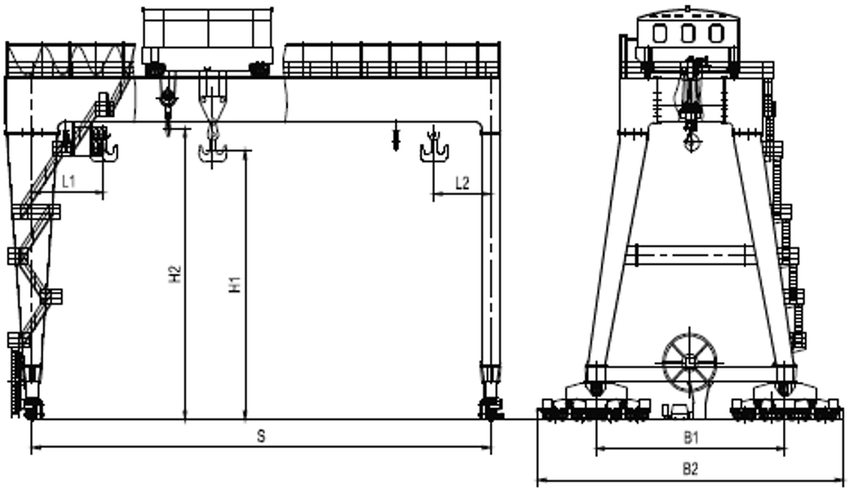
Sketch
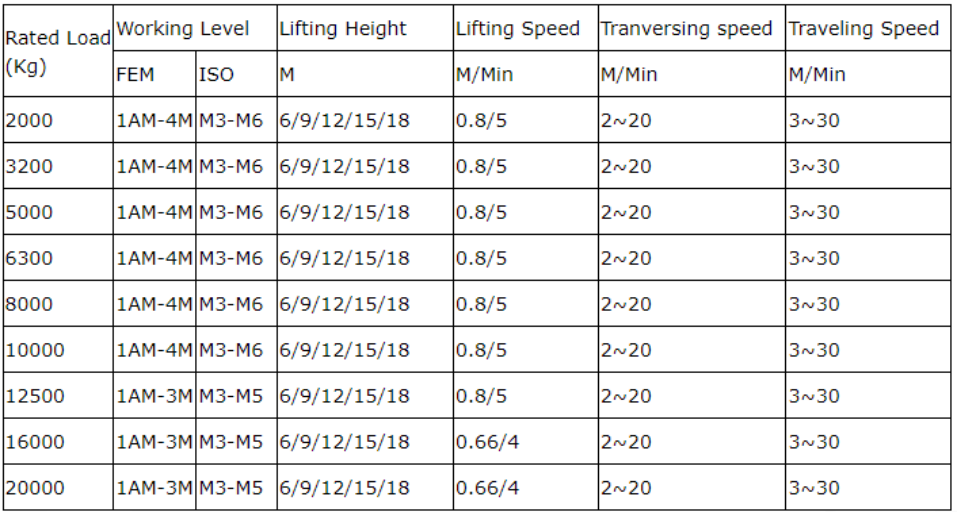
Main technical
Advantages
1)Versatility: They can handle a wide range of materials and are suitable for various industries, from shipping to construction.
2)Space Efficiency: Designed to operate in open spaces, they can be used in locations where traditional overhead cranes might not fit.
3)Mobility: Many outdoor gantry cranes are portable, allowing them to be moved to different job sites as needed.
4)Cost-Effective: Generally, they are less expensive to install and maintain than fixed overhead cranes.
5)Increased Productivity: They can speed up loading and unloading processes, improving overall efficiency in material handling.
6)Heavy Load Capacity: Capable of lifting substantial weights, they are ideal for heavy-duty tasks.
Weather Resistance: Many outdoor gantry cranes are designed to withstand outdoor elements, making them reliable for year-round use.
Flexibility in Design: They can be customized in size and capacity to meet specific project requirements.
Application:
1)Construction Sites: They are used for lifting heavy materials like steel beams, concrete blocks, and machinery.
2)Shipping and Ports: In shipping yards, gantry cranes handle containers and bulk materials, facilitating loading and unloading.
3)Manufacturing: They assist in moving heavy components during production, assembly, or maintenance processes.
4)Warehousing: Used for transferring goods between storage areas, especially in outdoor warehouses.
5)Shipbuilding and Repair: They help in lifting large sections of ships or boats during construction and maintenance.
6)Railway Maintenance: Used for lifting and positioning heavy rail components or machinery.
7)Automotive Industry: They assist in moving large automotive parts in assembly lines or during repairs.
8)Wind Energy: Used for assembling and maintaining wind turbine components at height.
Crane production procedure
1. Design and Engineering
First, requirements gathering is carried out to understand the load capacity, span, height and application environment. Then detailed engineering drawings and specifications are created, taking into account factors such as wind loads, seismic conditions and material selection. Finally, 3D modeling is carried out, using CAD software to create a 3D model of the crane for better visualization and planning.
2. Material Selection
Choose the right material (such as steel or aluminum) based on the strength, durability, and weight requirements. Procure materials from reliable suppliers.
3. Manufacturing Components
Cut, shape, and weld materials to engineering specifications. Machine components such as wheels, cranes, and other parts to precise dimensions. Apply protective coatings (such as galvanizing or painting) to increase durability and corrosion resistance.
4. Assembly
Assemble individual components (such as gantry, outriggers and hoist) in a controlled environment.
Final assembly brings all sub-assemblies together to build the complete crane. Ensure all parts align and fit.
5. Quality Control
Conduct inspections at various stages of production to ensure compliance with standards and specifications. Perform load testing and safety checks to ensure the crane can handle the intended loads safely.
6. Documentation
Prepare user manuals, maintenance guides, and compliance documentation.Obtain necessary certifications for safety and compliance with local regulations.
7. Delivery and Installation
Deliver the crane to the installation site using appropriate logistics. Assemble and erect the crane on-site, ensuring it is securely anchored and operational.
8. Training and Maintenance
Provide training for operators on how to use the crane safely.Establish a maintenance schedule for regular inspections and servicing.

Workshop view:
The company has installed an intelligent equipment management platform, and has installed 310 sets (sets) of handling and welding robots. After the completion of the plan, there will be more than 500 sets (sets), and the equipment networking rate will reach 95%. 32 welding lines have been put into use, 50 are planned to be installed, and the automation rate of the entire product line has reached 85%.


Hot Tags: outdoor gantry crane, China outdoor gantry crane manufacturers, suppliers, factory
Previous
Best Gantry CraneYou Might Also Like


Send Inquiry