










Automated Rail Mounted Gantry Crane
Products Description
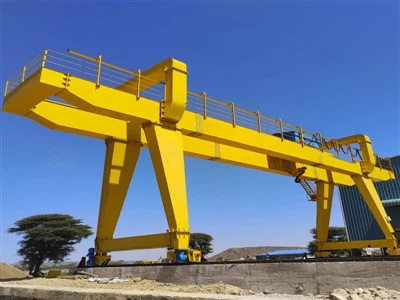
1. The automated rail-mounted gantry crane is a device designed for heavy-duty handling and is widely used in manufacturing, logistics warehousing, ports and other fields. It combines the stability of the gantry crane with automated control technology to improve operational efficiency and safety.
2. It supports remote operation and automatic scheduling, and has real-time monitoring and fault diagnosis functions. It can carry several tons to tens of tons of heavy objects according to demand. It is equipped with multiple safety devices, including overload protection, emergency stop switch, etc.
3. The lifting height is designed according to specific needs and is usually adjustable. The span can be customized according to the needs of the workplace. The commonly used voltage is 380V/50Hz, and the power supply can be adjusted according to customer needs. Wireless remote control or wired control is usually used.
4. It has a wide range of application scenarios and can be used for the handling of heavy machinery and equipment, loading and unloading containers, and improving the storage and retrieval efficiency of goods.
Warranty: 1 years
Weight (KG):20000 kg
Feature:Gantry Crane
Application :Outdoor, Warehouse, Indoor
Power source: 3Ph 380V 50Hz or on request
Delivery inspection :Available
GB/T 19001-2000 Idt 9001:2000: Passed
Working class: A3-A5
Girder structure:Box type
Painting colour:According to your request
Voltage lower protector:Include
Current overload protection function:Include
Double limit switch:Include

Pictures & Components
1.Main beam
1. The main beam of the automated rail-mounted gantry crane is mainly responsible for lifting and moving loads. It is usually made of high-strength steel, such as Q235B or Q345B, to ensure its load-bearing capacity and durability. Common shapes include box-type and I-shaped. The box-type main beam performs better in terms of load-bearing capacity and stability.
2. The main beam design meets the rated load requirements of the equipment to ensure that it can safely and stably carry heavy objects during work, and has sufficient rigidity to prevent deformation or bending during lifting.
3. The welding process of the main beam meets the relevant standards to ensure the strength and quality of the weld. In order to prevent rust, the surface of the main beam is usually painted or hot-dip galvanized.
4. The overload protection device should be considered when designing the main beam to prevent accidents when the load exceeds the rated value. And finite element analysis is performed to ensure the safety of the main beam under various working conditions.

Lifting System
The lifting system of the automated rail-mounted gantry crane is responsible for lifting and lowering heavy objects.
1. Main components
Electric hoist: As a lifting device, the electric hoist provides the necessary power and adopts variable frequency drive technology to achieve smooth lifting and lowering.
Lifting rope or chain: Connects the heavy objects and is responsible for transmitting power. The rope or chain has high strength and wear resistance.
Pulley system: Change the direction of force through the pulley, reduce the required lifting force, and improve efficiency.
2. Control system: PLC or other automatic control systems are used to achieve precise lifting height and speed control. Sensors are also equipped to monitor load, lifting height and other safety parameters to ensure safe operation of the equipment.
3. Safety: The lifting system is equipped with overload protection to prevent safety accidents caused by excessive load.
And an emergency stop device is installed to quickly stop the lifting operation in an emergency to ensure the safety of the operator.
 |
 |
3.End carriage
1. The end beams of automated rail-mounted gantry cranes are usually made of high-strength steel to ensure strength and durability. The end beams are generally box-shaped or I-shaped, with high rigidity and stability.
2. The end beams connect the main beam and the support column, providing stable support to ensure the balance and stability of the entire machine. And during the lifting and moving process, the end beams can effectively carry lateral loads and prevent deformation and tilting. The end beams are also responsible for transmitting the force generated by the main beam and the lifting device to the supporting structure to achieve safe lifting and moving.
 |
 |
4.Crane travelling mechanism
1. The trolley operation system of the automated rail-mounted gantry crane is responsible for the horizontal movement of the trolley on the main beam to accurately position and carry heavy objects. The installed operation system can evenly distribute the load, reduce the pressure on the track, and increase the service life.
2. Mainly composed of trolley frame: made of high-strength steel, carrying the lifting device and providing the necessary structural rigidity. Wheels and tracks: The wheels of the trolley slide along the track of the main beam, and rollers or steel wheels are often used to ensure smooth movement. Motor: Provides power, usually variable frequency motors, to achieve smooth acceleration and deceleration.
3. It has two control modes: intelligent control and remote control operation: Integrated PLC or other control systems to achieve precise control of trolley movement, including speed, position and direction adjustment.
Remote control operation: The operator can control it through a remote control or operation panel, which is convenient for real-time adjustment.
5.Trolley travelling mechanism
The trolley running system of the automated rail-mounted gantry crane is one of the core parts of the crane, responsible for longitudinal movement on the main beam to ensure accurate positioning and handling of heavy objects.
1. Main components
Trolley frame: carries the lifting equipment, usually made of high-strength steel to ensure strength and stability.
Wheels and tracks: The wheels of the trolley run along the tracks of the main beam, usually made of high-strength alloy materials to ensure good load-bearing capacity and wear resistance.
Motor and drive system: provides power, usually using variable frequency motors to achieve smooth acceleration and deceleration control.
2. Function
Longitudinal movement: The trolley running system allows the trolley to move forward and backward on the main beam to achieve accurate positioning of heavy objects.
Load distribution: Reasonable design can evenly distribute the load and reduce wear on the track and the trolley itself.
3. Control system
Intelligent control: Integrated PLC or other control systems to achieve accurate control of the trolley movement, including speed, direction and position.
Remote control operation: The operator can easily operate the trolley through a remote control or control panel to improve operational flexibility.
4. Performance optimization
High efficiency: The trolley design is optimized to increase the moving speed and flexibility, improving the overall working efficiency.
Low noise: The modern design focuses on reducing the operating noise and improving the working environment.
6.Crane wheel
1. The wheels of the trolley are usually made of high-strength alloy steel or cast steel, with good load-bearing capacity and wear resistance. The design of the wheel takes into account load distribution and rolling friction, with a round or tapered shape to ensure good contact with the track. The matching design between the wheel and the track prevents derailment during operation.
2. The wheel supports the trolley and its load, ensuring stability and safety during operation. The matching between the wheel and the track guides the trolley to move smoothly along the main beam to prevent deviation from the track. The wheel needs to match the type of main beam track to ensure compatibility and stability.
3. Check the wear of the wheel regularly to ensure that there are no cracks or deformations to maintain normal operation.
Lubrication: Wheel bearings need to be lubricated regularly to reduce friction and extend service life.

7.Crane Hook
1) The hook of an automated rail-mounted gantry crane is a key lifting component responsible for connecting and carrying heavy objects. It is usually made of high-strength steel to ensure strength and durability under high load conditions. The hook is directly connected to the heavy object and carries the load that the crane needs to lift during operation. It is equipped with an overload indicator to remind the operator if the load exceeds the rated value. It is equipped with a locking mechanism to prevent the heavy object from accidentally falling off.

Motor
1. The motor of the automated rail-mounted gantry crane is an important part of the drive system, responsible for providing power to realize the various functions of the crane. Provide power to drive the movement of the trolley and the car to realize the horizontal and longitudinal transportation of heavy objects. Control the electric hoist of the lifting device to realize the lifting and lowering of heavy objects. Through the frequency converter or control system, the motor speed can be smoothly adjusted to ensure the flexibility and safety of operation. When the load exceeds the set value, the motor can stop automatically to prevent equipment damage and safety accidents. Combined with the automated control system, it supports remote control operation and realizes convenient remote monitoring and management.
2. The characteristics of the motor of the automated rail-mounted gantry crane include the following parts, high efficiency: adopt high-efficiency design to reduce energy consumption and improve overall work efficiency. Strong load capacity: according to the needs of the crane, provide sufficient power and torque to cope with the lifting and movement of heavy objects. Precise control: integrated frequency converter or intelligent control system to achieve precise speed and direction adjustment, improve operational flexibility. Durability: using high-quality materials and structural design, with good anti-vibration and wear resistance, suitable for harsh working environment. Safety protection: Equipped with safety features such as overload protection and temperature monitoring to ensure that the motor automatically shuts down under abnormal conditions. Low-noise operation: Modern motor design focuses on reducing noise and improving the comfort of the working environment. Easy maintenance: The simple structure makes it easy to maintain and maintain, and usually requires regular inspection and lubrication.

.

Sound and light alarm system & limit switch
The sound and light alarm system and limit switch of the automated rail-mounted gantry crane are important components to ensure the safe operation of the equipment.
1. Function of the sound and light alarm system:
Warning function: During the operation of the equipment, the sound and light alarm system is used to sound an alarm to alert the operator to potential dangers or faults. Working status indication: Different sound and light signals are used to indicate the working status of the crane, such as start, stop, fault, etc. Bright LED lights and loud alarm sounds are usually used to ensure that they can be clearly heard and seen in a noisy environment. The volume and light color of the alarm can be adjusted as needed to adapt to different working occasions.
2. Function of the limit switch:
Prevent excessive movement: The limit switch is used to limit the movement range of the trolley, car and lifting device to prevent it from exceeding the safe working area and avoiding equipment damage. Automatic stop: When the trolley or car approaches the set limit position, the limit switch will automatically cut off the power supply and stop the motor. The limit switch is made of durable materials and precision design to ensure stable performance in long-term use. The limit position can be flexibly adjusted according to specific working conditions and needs.

10.Safety Devices
1. limit switches :to prevent the trolley and carriage from exceeding the set range of motion to avoid equipment damage.
2.Overload protection device to monitor the load and automatically cut off the power supply when overloaded to prevent the equipment from being damaged due to excessive load.
3.Emergency stop button: in an emergency, the operator can quickly press the button to immediately stop all movements to ensure safety.
4.Sound and light alarm system: emits alarm sounds and flashes lights to remind operators to pay attention to equipment status or potential dangers.
5.Safety locking device to prevent the equipment from being misoperated in a non-working state to ensure safety.
6.Anti-tilt device: monitors the tilt of the crane to prevent tipping over due to imbalance.
7.Guardrails and shields: set guardrails in dangerous areas to protect operators from potential injuries.
11.Control Mode
The control modes of automated rail-mounted gantry cranes mainly include the following:
1. Manual control: The operator directly operates the various functions of the crane, including lifting, moving and stopping, through a manual control panel or remote control.
2. Automatic control: The PLC (Programmable Logic Controller) system is used to achieve automatic control, and the lifting and moving tasks are automatically performed according to the preset program.
3. Semi-automatic control: The operator can set the program for automatic operation, but can intervene manually at critical moments to improve flexibility and safety.
4. Remote control: The crane can be remotely operated through a wireless remote control or computer control, which is suitable for use in hazardous environments.
5. Intelligent control: Integrated sensors and monitoring systems can realize real-time monitoring of load, position and status, automatically adjust operating parameters, and improve operating accuracy and safety.
6. Mobile application control: Control using an application on a mobile phone or tablet, providing a more convenient operation method.

12.Sketch

Main technical

Advantages
1. Strong carrying capacity
Double-beam gantry crane adopts double-beam structure, which can bear large loads and is suitable for heavy and super-heavy lifting operations, and is suitable for the handling of large equipment and heavy objects.
2. High stability
The double-beam design makes the overall structure of the crane more stable, improves the stability of the equipment under high load conditions, and reduces the risk of overturning and shaking.
3. Wide applicability
Double-beam gantry cranes can be used in various industrial sites, such as factories, warehouses, ports, etc., and are suitable for a variety of lifting operations, including material handling, assembly and maintenance.
4. Smooth operation
Equipped with high-performance motors and inverter control systems, the crane runs smoothly during lifting, lowering and moving, reducing the impact on equipment and goods.
5. Flexible operation
Double-beam gantry cranes can achieve a variety of movement modes (lifting, moving, rotating), adapt to complex operation requirements, and operators can flexibly adjust according to specific circumstances.
6. Convenient maintenance
Due to its structural design, the various components of the double-beam gantry crane are relatively easy to approach and inspect, and maintenance and maintenance work are relatively simple, reducing downtime.
7. High safety
Usually equipped with a variety of safety devices, such as overload limiter, limit switch, sound and light alarm system, etc., to ensure safety during operation and effectively prevent accidents.
Application:
1. Manufacturing
Heavy equipment handling: used to handle large machinery and equipment, such as milling machines, lathes, etc., to ensure the safe lifting and moving of heavy objects.
Assembly work: on the production line, assist in the assembly of heavy products or components.
2. Construction site
Lifting of building materials: used to lift building materials such as concrete and steel structures, especially in large construction projects.
Equipment installation: help install large equipment and electromechanical systems, such as air conditioning equipment and elevators.
3. Warehousing and logistics
Cargo loading and unloading: at ports, docks and warehouses, assist in loading and unloading containers, goods and raw materials to improve work efficiency.
Warehousing management: in automated warehouses, carry out the handling and storage of goods.
4. Metallurgical industry
Raw material handling: used to handle metal raw materials and finished products, such as steel, aluminum, etc., suitable for high temperature and heavy load environments.
Handling of furnaces and furnace charges: help handle materials in furnaces to ensure the smooth progress of production processes.
5. Shipbuilding industry
Hull and equipment lifting: used for ship assembly and installation of large equipment, adapting to the complex operating environment of shipyards.
Handling: Used to carry heavy laboratory equipment and materials to ensure the safety and efficient operation of the laboratory.
Crane production procedure
1. Design and Planning
Demand Analysis: According to customer needs and usage scenarios, a detailed demand analysis is carried out to determine the specifications, load, span, lifting height, etc. of the crane.
Engineering Design: Engineers use CAD and other design software to carry out detailed design, including structural, mechanical, electrical and other aspects to ensure that the design meets relevant standards and specifications.
2. Material Procurement
Material Selection: Select appropriate steel, motors, control systems and other components according to design requirements.
Supplier Screening: Screen suppliers of materials and components to ensure the quality and reliability of materials.
3. Processing and Manufacturing
Cutting and Forming: Cut, weld, bend and other processes on steel to form main beams, end beams and other structural components.
Machining: Precision machining of key components, such as turning, milling, drilling, etc., to ensure that the size and accuracy meet the design requirements.
Surface Treatment: Spray, galvanize or rust-proof metal parts to enhance corrosion resistance and aesthetics.
4. Assembly
Component Assembly: Assemble the main beam, end beam, trolley, lifting mechanism and other components to form a complete crane structure.
Installation of electrical system: Install electrical equipment such as motors, control cabinets, sensors, limit switches, etc. to ensure the normal operation of the electrical system.
5. Debugging and testing
Preliminary debugging: Carry out preliminary debugging of the crane to check the coordination and operation of each component.
Load test: Carry out load test to ensure the safety and stability of the crane under rated load, and test the functions of safety devices such as overload protection and limit switches.
Performance test: Test the performance indicators of the crane such as lifting speed, running speed, braking effect, etc. to ensure that they meet the design requirements.
6. Quality inspection
Quality inspection: Carry out a comprehensive quality inspection of the crane, including appearance, size, performance, etc., to ensure compliance with relevant standards.
Safety assessment: Carry out safety assessment to ensure the normal operation of all safety devices and systems.
7. Delivery and installation
Packaging and transportation: Pack qualified cranes and prepare them for transportation to the customer site.
On-site installation: Carry out on-site installation according to customer requirements, including basic production and equipment debugging.
Training and handover: Train operators to ensure that they master the operation methods and safety precautions of the equipment and complete the handover work.


Workshop view
Material Inspection
Quality Inspection: Strict quality inspection is carried out on the purchased raw materials to ensure that they meet the design requirements and national standards.
Material Storage: Qualified materials are stored according to classification to prevent corrosion or damage.
Cutting and Forming
Steel Cutting: Use plasma cutting, laser cutting or flame cutting and other technologies to cut the steel according to the size of the design drawing.
Forming Processing: Form the steel plate through bending, rolling, welding and other processes to manufacture the main beam, end beam and other structural parts.
Welding
Component Welding: The cut and formed steel parts are welded into the main structures such as the main beam, end beam and trolley. The welding process needs to be strictly controlled to ensure the structural strength and welding quality.
Weld Inspection: Use non-destructive testing technology (such as ultrasonic testing, radiographic testing) to inspect the welds to ensure that there are no cracks or other defects.
Machining
Precision Machining: Precision machining is performed on the key components of the crane, such as wheel sets, bearing seats, pulleys, etc., to ensure their dimensional accuracy and surface quality.
Assembly of the whole machine
General assembly: On the basis of pre-assembly, the overall assembly of the crane is carried out, including the final installation of the main beam, end beam, lifting mechanism, walking mechanism, etc.
Commissioning and testing
Under dynamic conditions, the operating performance of the crane is tested, including the testing of lifting, walking, steering and other functions. The overall size of the assembled bridge crane is checked to ensure that all dimensions meet the design requirements.
Spraying and anti-corrosion treatment
Surface treatment Rust removal: Rust removal on the surface of the crane, common methods include sandblasting, pickling, etc. Primer spraying: Spray anti-corrosion primer on the treated surface to prevent metal oxidation and corrosion. Topcoat spraying Color spraying: Spray topcoat according to customer requirements or industry standards to give the crane a protective and decorative effect. Marking: After spraying, mark the crane's identification information in accordance with the specifications, such as model, rated load, etc.
Factory and installation
Packaging and transportation
Packaging protection: Protectively package the key components of the crane to prevent damage during transportation. Transportation arrangement: According to the equipment size and transportation conditions, select a suitable transportation method to transport the crane to the customer's site.
Acceptance and delivery
Customer acceptance
On-site acceptance: The customer conducts on-site acceptance of the crane according to the contract requirements and technical specifications to check the performance and quality of the equipment.
Problem rectification: If any problems are found, the manufacturer needs to rectify them in time to ensure that the equipment fully meets the customer's requirements. Delivery and use Operation training: The manufacturer usually trains the customer's operators to ensure that they can operate the crane correctly and safely.


Hot Tags: automated rail mounted gantry crane, China automated rail mounted gantry crane manufacturers, suppliers, factory
Previous
Ship Manufacture Gantry CraneYou Might Also Like



Send Inquiry