










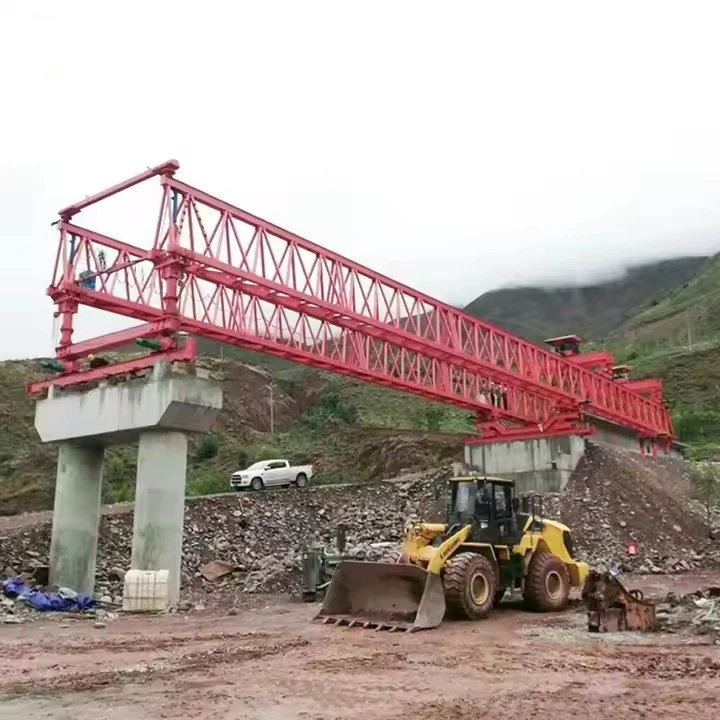
Bridge Girder Launcher For Bridge Construction
Types of Bridge Girder Launchers
Underslung Girder Launcher (UGL)
Moves beneath the bridge deck, lifting and placing girders from below.
Suitable for balanced cantilever construction.
Overhead Girder Launcher (OGL)
Operates on top of the bridge deck, placing girders ahead.
Often used in span-by-span construction.
Self-Launching Gantry (SLG) / Launching Gantry
A movable gantry system that spans multiple piers.
Can handle heavy and long girders in high-rise or long-span bridges.
Crane-Based Launchers
Uses heavy-duty cranes (such as crawler or tower cranes) for girder placement.
Key Features
A Bridge Girder Launcher is a specialized machine used in bridge construction to place precast girders or segments onto piers or supports. Here are its key features:
1. High Load Capacity
Designed to handle heavy precast concrete or steel girders (ranging from 100 to 1000+ tons).
Supports various girder types (I-beams, U-beams, box girders, etc.).
2. Modular & Adjustable Design
Adjustable span length to accommodate different bridge widths.
Modular components for easy assembly and disassembly.
3. Self-Launching & Self-Propelled
Moves forward automatically after girder placement without requiring a separate crane.
Uses hydraulic jacks or winches for propulsion.
4. Precision Placement System
Hydraulic lifting and lowering mechanisms for accurate girder positioning.
Computer-controlled alignment for high precision (±5mm tolerance).
5. Stability & Safety Features
Outriggers or support legs for stability during operation.
Anti-slip and anti-tilt mechanisms.
Emergency braking and overload protection.
6. Adaptability to Different Bridge Types
Works for viaducts, highway bridges, railway bridges, and curved bridges.
Can be used for both simply supported and continuous girder bridges.
7. Remote Control & Automation
Operator-controlled via remote or cabin for safety and efficiency.
Automated sensors for real-time monitoring of load and alignment.
8. Fast Erection Speed
Reduces construction time compared to traditional crane methods.
Can place multiple girders per day (depending on project conditions).
9. Minimal Ground Support Needed
Operates with minimal ground preparation, reducing environmental impact.
Suitable for difficult terrains (rivers, valleys, urban areas).
10. Cost-Effective & Efficient
Lowers labor and equipment costs compared to multiple cranes.
Reduces traffic disruption in urban bridge projects.
Specification
Parameter Specification Range
Maximum Span Capacity 30m – 60m (adjustable)
Lifting Capacity 50 – 500 tons
Launching Speed 3 – 10 m/min
Power Source Diesel/Hydraulic/Electric
Operating Width 8 – 20 m (adjustable)
Control System PLC/Automatic/Manual
Traveling Mechanism Rail/Wheel/Track-based
Max Wind Resistance Up to 20 m/s (72 km/h)
Working Temperature -20°C to +50°C

Pictures & Components
A Bridge Girder Launcher is a specialized piece of equipment used in bridge construction to place precast concrete or steel girders onto piers or abutments. It is essential for constructing viaducts, overpasses, and long-span bridges efficiently and safely.
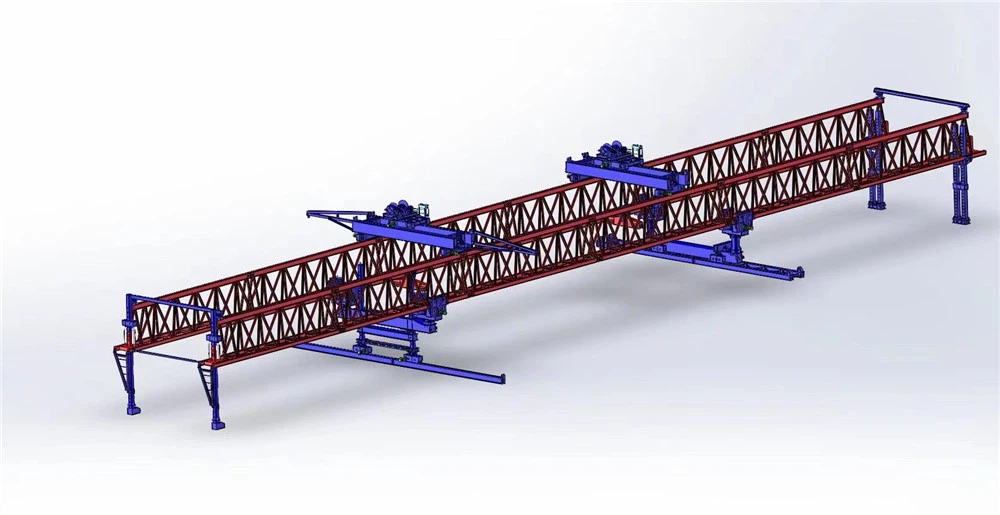
Key Components of a Bridge Girder Launcher:
Main Beam (Launching Nose/Gantry Beam)
The primary structural component that spans between piers.
Supports the girder during launching and placement.
Often made of high-strength steel for durability.
Launching Gantry (Front & Rear Supports)
Provides stability during girder launching.
Adjustable legs or supports to accommodate varying pier heights.
May include hydraulic jacks for precise alignment.

Hoisting System (Lifting Mechanism)
Comprises winches, cables, and spreader beams.
Used to lift and position girders onto piers.
May be electrically or hydraulically powered.
Trolley System (Traversing Mechanism)
Moves the girder longitudinally and transversely.
Ensures accurate placement over piers.
Can be rail-mounted or use rubber tires for mobility.
Hydraulic System
Powers lifting, lowering, and adjustment operations.
Controls the extension and retraction of supports.
Ensures smooth and precise movements.
Control Cabin & Operator Console
Houses the control system for the launcher.
Equipped with joysticks, monitors, and safety controls.
Allows operators to manage lifting and positioning.
Outriggers & Stabilizers
Provide additional stability during operations.
Prevent tilting or shifting during girder placement.
Often hydraulically extendable.
Power Unit (Generator or Electric Supply)
Supplies energy to the hydraulic and electrical systems.
Can be diesel-powered or connected to an external power source.
Safety Systems
Load limiters to prevent overloading.
Emergency stop buttons and alarms.
Anti-sway mechanisms for girder stability.
Transportation System (Self-Propelled or Crawler)
Allows the launcher to move along the bridge deck or ground.
May use tracks or wheels for mobility.
Some models can launch girders while moving forward (incremental launching).
Sketch

Advantages
Advantages of Bridge Girder Launchers in Bridge Construction
Bridge girder launchers are specialized machines used to place precast concrete or steel girders during bridge construction. They offer several advantages over traditional methods like cranes or falsework systems:
1. Enhanced Safety
Reduces the need for workers to operate at heights.
Minimizes risks associated with crane operations (e.g., instability, load swinging).
Controlled and precise girder placement reduces accidents.
2. Increased Efficiency & Speed
Faster installation of girders compared to conventional crane lifting.
Continuous operation without frequent repositioning of cranes.
Ideal for long-span bridges and viaducts, reducing project timelines.
3. Cost-Effectiveness
Lower labor costs due to automation and reduced manual handling.
Less reliance on multiple cranes and support equipment.
Minimizes the need for temporary supports (falsework), saving material costs.
4. High Precision & Control
Ensures accurate girder alignment and placement.
Adjustable mechanisms allow for smooth positioning even in complex geometries (e.g., curved bridges).
5. Adaptability to Challenging Terrains
Suitable for bridges over rivers, valleys, highways, and urban areas where crane access is limited.
Can operate in confined spaces with minimal ground disruption.
6. Reduced Environmental Impact
Less ground disturbance compared to traditional falsework methods.
Lower noise and vibration pollution compared to heavy crane operations.
7. Improved Structural Integrity
Minimizes stress on girders during installation.
Ensures uniform load distribution during placement.
Conclusion
Bridge girder launchers are a highly efficient, safe, and economical solution for modern bridge construction, especially for long-span and elevated structures. Their ability to speed up construction, enhance precision, and reduce risks makes them a preferred choice in large-scale infrastructure projects.

Application
A Bridge Girder Launcher is a specialized piece of construction equipment used to install precast concrete or steel girders during bridge construction. It plays a crucial role in accelerating the erection process, especially for long-span bridges, viaducts, and elevated highways.
Key Applications in Bridge Construction:
Precast Girder Installation
Used to lift and place precast concrete girders (I-beams, U-beams, box girders) or steel girders onto piers and abutments.
Ensures precise alignment and reduces manual labor.
Segmental Bridge Construction
Facilitates the launching of precast segments in balanced cantilever or span-by-span methods.
Rail & Road Bridges
Commonly used in highway flyovers, railway bridges, and urban viaducts.
Launching Over Obstacles
Ideal for constructing bridges over rivers, valleys, highways, or existing infrastructure where cranes cannot operate efficiently.
High-Speed Bridge Construction
Speeds up construction by minimizing reliance on heavy cranes and temporary supports

Production Procedure
A Bridge Girder Launcher is a specialized machine used in bridge construction to install precast girders or segments efficiently. It plays a crucial role in accelerating construction, especially for long-span bridges, viaducts, and elevated highways. Below is a detailed production procedure for bridge construction using a girder launcher:
1. Pre-Construction Planning
Design Review: Ensure girder dimensions, load capacity, and launching sequence align with the bridge design.
Site Survey: Check ground conditions, alignment, and obstacles.
Launcher Selection: Choose an appropriate launcher (underslung, overhead, or self-launching) based on span length, girder weight, and site constraints.
2. Foundation & Support Preparation
Piers & Abutments: Construct and reinforce bridge piers/abutments to support girders.
Temporary Supports: Install temporary piers or falsework if needed for long spans.
Launching Path Clearance: Ensure the path is free of obstructions.
3. Girder Fabrication & Transport
Precast Girder Production: Cast girders (I-beams, U-beams, or box girders) in a yard under controlled conditions.
Quality Checks: Verify strength, dimensions, and reinforcement before transport.
Transportation: Use trailers or barges to move girders to the launch site.
4. Girder Launcher Setup
Assembly: Erect the launcher on the bridge deck or ground (depending on type).
Testing: Conduct load tests and trial runs to ensure stability.
Alignment: Adjust launcher rails/beams to match girder placement positions.
5. Launching Procedure
Step 1: Girder Loading
Lift girders using cranes and place them onto the launcher's feeding platform.
Secure girders with clamps or brackets.
Step 2: Forward Launching
The launcher moves the girder horizontally along the bridge axis using hydraulic jacks or winches.
For span-by-span construction, the launcher advances incrementally.
Step 3: Positioning & Lowering
Align the girder precisely over bearings/piers.
Lower the girder onto permanent supports using synchronized jacks.
Step 4: Launcher Propulsion
After girder placement, the launcher moves forward to the next span (self-propelled or pushed by auxiliary equipment).
6. Post-Launching Activities
Grouting: Fill gaps between girders and bearings with high-strength mortar.
Deck Installation: Pour the bridge deck or install precast slabs.
Quality Control: Check alignment, levelness, and structural integrity.
7. Launcher Dismantling & Relocation
Disassemble the launcher after completing all spans.
Transport to the next construction site if reusable.


Workshop View
The company has installed an intelligent equipment management platform, and has installed 310 sets (sets) of handling and welding robots. After the completion of the plan, there will be more than 500 sets (sets), and the equipment networking rate will reach 95%. 32 welding lines have been put into use, 50 are planned to be installed, and the automation rate of the entire product line has reached 85%.


Hot Tags: bridge girder launcher for bridge construction, China bridge girder launcher for bridge construction manufacturers, suppliers, factory
You Might Also Like


Send Inquiry