



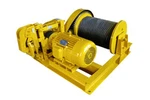




20T Desiel Winch
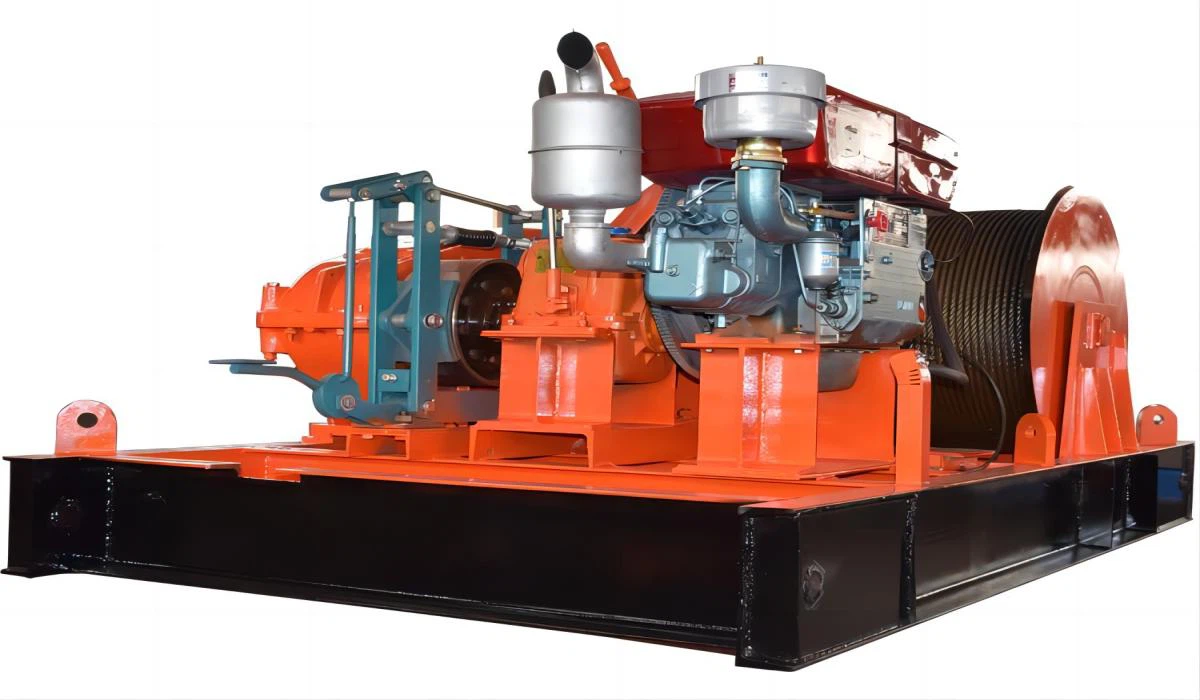
A 20-ton diesel winch is a heavy-duty pulling and lifting machine powered by a diesel engine, designed for rugged industrial, construction, marine, and off-road applications. It provides reliable performance in remote or harsh environments where electricity is unavailable.
Key Features
1. Power & Performance
Engine: High-torque diesel engine (e.g., Cummins, Deutz, or Yanmar)
Horsepower (HP): Typically 80–150 HP (depends on model)
Pulling Capacity: 20 metric tons (20,000 kg / 44,000 lbs)
Line Speed: Adjustable, usually 0–15 m/min (hydraulic control)
Drum Capacity: Holds 100–200 meters of steel wire rope (e.g., 28–32mm diameter)
2. Winch Mechanism
Drum Type: Single or double drum (for multiple cable operations)
Braking System: Automatic fail-safe brake + manual emergency brake
Control System: Hydraulic or mechanical, with remote control option
Clutch: Engages/disengages drum for smooth operation
3. Durability & Safety
Frame: Reinforced steel construction for heavy loads
Overload Protection: Prevents damage from excessive tension
Weather Resistance: Corrosion-proof coating for marine/mining use
4. Mounting & Mobility
Installation Options:
Skid-mounted (for temporary setups)
Truck/trailer-mounted (for mobile operations)
Fixed on platforms (marine, oil rigs)

Pictures & Components
1. Diesel Engine
Function: Provides mechanical power to drive the winch.
Common Brands: Cummins, Deutz, Yanmar, or Yuchai.
HP Range: Typically 80–150 HP (depending on load requirements).
Features:
Air-cooled or water-cooled.
Electric or manual start.
Fuel-efficient with high torque for heavy loads.
2. Winch Drum
Function: Stores and releases the wire rope/cable.
Types:
Single Drum – Standard for most applications.
Double Drum – Allows multiple cable operations (e.g., simultaneous lifting/pulling).
Capacity: Holds 100–200 meters of steel wire rope (usually 28–32mm diameter).
Material: High-strength steel with wear-resistant coating.
3. Wire Rope (Cable)
Material: High-tensile steel (e.g., galvanized or ungalvanized).
Diameter: 28–32mm (varies based on load capacity).
Lay Type: Usually 6x36 or 6x19 IWRC (independent wire rope core for strength).
Safety Factor: Minimum 5:1 (rated for 20T but can handle higher dynamic loads).
4. Gearbox & Transmission
Function: Converts engine power into controlled pulling force.
Types:
Planetary Gearbox – Compact, high torque.
Worm Gearbox – Self-locking, good for heavy loads.
Gear Ratio: Typically 150:1 to 300:1 (for high pulling power).
5. Hydraulic System (If Hydraulic Winch)
Components:
Hydraulic pump (driven by diesel engine).
Hydraulic motor (converts fluid power into rotation).
Control valves (regulate speed and direction).
Advantages: Smooth operation, variable speed control, overload protection.
6. Braking System
Types:
Automatic Fail-Safe Brake – Engages if power is lost.
Mechanical Band Brake – Manual emergency brake.
Dynamic Braking – Slows drum rotation during release.
Safety Feature: Prevents uncontrolled cable release.
7. Clutch Mechanism
Function: Engages/disengages the drum from the drive system.
Types:
Manual Clutch – Lever-operated.
Pneumatic or Hydraulic Clutch – Remote-controlled.
8. Control System
Options:
Manual Lever Control – Simple, reliable.
Hydraulic Control Valve – For variable speed.
Wireless Remote Control – Safe operation from a distance.
9. Frame & Mounting Structure
Material: Heavy-duty steel construction.
Mounting Types:
Skid-mounted (portable).
Truck/trailer-mounted (mobile).
Fixed base (for permanent installations).
10. Optional Accessories
Fairlead (Roller or Hawse): Guides the wire rope smoothly.
Snatch Block: Increases pulling capacity via pulley systems.
Load Monitoring System: Digital readout for tension control.
Cable Guide: Prevents rope tangling.

Sketch

Main Technical Parameter

Advantages
1. High Torque & Power
Diesel engines deliver strong, consistent torque, making them ideal for heavy loads (20T+).
Better suited for continuous operation without overheating (unlike electric winches).
No dependency on external power-works in remote or off-grid locations.
2. Fuel Efficiency & Long Runtime
Diesel fuel is energy-dense, providing longer runtime than gasoline or battery-powered alternatives.
Lower fuel consumption under heavy loads compared to hydraulic systems.
Ideal for prolonged operations (e.g., mining, marine, oilfield work).
3. Durability in Harsh Conditions
Weather-resistant – Works in rain, snow, or extreme temperatures.
Dust & debris resistant – Better than electric motors in dirty environments (e.g., construction, mining).
Corrosion-resistant options available for marine/saltwater use.
4. Versatile Mounting & Mobility
Can be truck-mounted, skid-mounted, or trailer-mounted for portability.
No need for external power sources-operates independently.
Easily relocated compared to fixed electric winches.
5. Stronger & More Reliable Than Electric Winches
No voltage drops (unlike electric winches that lose power with long cables).
No battery drain issues-critical for recovery operations.
Handles shock loads better (e.g., sudden jerks in recovery or towing).
6. Lower Maintenance Than Hydraulic Winches
Simpler mechanics compared to hydraulic systems (no pumps/hoses to leak).
Easier to service-diesel engines are widely understood by mechanics.
Fewer failure points than complex hydraulic setups.
7. Cost-Effective for Heavy-Duty Use
Lower long-term costs than electric or hydraulic winches in industrial settings.
Longer lifespan-diesel engines are built for heavy, continuous use.
Higher resale value due to durability.

Application
1. Construction & Heavy Engineering
Steel & Concrete Handling – Lifting and positioning heavy beams, precast slabs, and construction materials.
Piling & Foundation Work – Pulling sheet piles, drilling rigs, and caissons.
Tower Crane Assembly – Assisting in erecting and dismantling large cranes.
2. Mining & Quarrying
Dragline Operations – Moving large rocks, ore, and overburden.
Heavy Equipment Recovery – Extracting stuck dump trucks, excavators, or drilling rigs.
Material Handling – Loading/unloading heavy mining machinery.
3. Marine & Offshore Operations
Ship Mooring & Anchor Handling – Positioning vessels in ports or offshore rigs.
Salvage & Wreck Recovery – Raising sunken boats or submerged equipment.
Dredging Support – Pulling dredge pipes and anchors.
4. Oil & Gas Industry
Pipeline Pulling – Laying and tensioning heavy pipelines.
Well Servicing – Handling blowout preventers (BOPs) and drilling equipment.
Rigging & Heavy Lifting – Installing refinery components.
5. Forestry & Agriculture
Log Skidding & Timber Extraction – Dragging felled trees to loading areas.
Land Clearing – Removing stumps, boulders, and debris.
Heavy Farm Equipment Recovery – Towing stuck tractors or harvesters.
6. Heavy Vehicle & Equipment Recovery
Truck & Trailer Towing – Recovering overturned or bogged-down trucks.
Military & Tank Recovery – Used by armed forces for tank extractions.
7. Utility & Civil Works
Power Line Installation – Pulling transmission cables over long distances.
Bridge & Dam Construction – Tensioning cables and lifting segments.
Tunnel Boring Machine (TBM) Support – Handling heavy tunnel segments.
Production Procedure
1. Design & Engineering
CAD Modeling – Engineers create 3D designs with specifications for load capacity, drum size, gear ratios, and mounting.
Stress Analysis – Finite Element Analysis (FEA) tests structural integrity under maximum load.
Material Selection – High-grade steel, hardened gears, and corrosion-resistant coatings are chosen.
2. Component Manufacturing
A. Diesel Engine Assembly
Engine Block Machining – Cylinder boring, crankshaft fitting.
Fuel System Installation – Injectors, pumps, and filters.
Cooling & Lubrication Systems – Radiators, oil pumps, and pipes.
B. Winch Drum & Frame Fabrication
Steel Cutting & Shaping – Laser/plasma cutting for drum and frame parts.
Welding & Reinforcement – MIG/TIG welding for high-strength joints.
Surface Treatment – Sandblasting, galvanizing, or powder coating for rust resistance.
C. Gearbox & Transmission
Gear Machining – CNC milling for precise planetary/worm gears.
Bearing & Shaft Assembly – High-load bearings fitted for smooth rotation.
Lubrication System Integration – Oil channels and seals installed.
D. Hydraulic System (If Applicable)
Pump & Motor Assembly – Hydraulic components pressure-tested.
Valve & Hose Installation – Leak-proof connections secured.
E. Wire Rope & Accessories
Cable Selection – High-tensile steel wire rope (28–32mm diameter).
Termination & Splicing – Thimbles, sockets, and swaging applied.
3. Assembly Process
Step 1: Base Frame & Mounting
The welded frame is bolted onto a skid or truck-mounting bracket.
Step 2: Drum & Brake Installation
The drum is mounted on heavy-duty bearings.
Fail-safe brakes (mechanical/hydraulic) are installed.
Step 3: Gearbox & Clutch Integration
The gearbox is connected to the drum and diesel engine.
The clutch (manual/pneumatic) is fitted for engagement control.
Step 4: Engine & Power Transmission
The diesel engine is mounted and linked to the gearbox via a driveshaft.
Belts/pulleys or direct coupling ensures power transfer.
Step 5: Hydraulic/Control System Setup
If hydraulic, pumps and valves are connected.
Control levers or wireless remotes are installed.
Step 6: Wire Rope Loading & Fairlead Attachment
The cable is spooled onto the drum.
Roller or hawse fairleads are fixed for smooth rope guidance.
4. Quality Testing & Inspection
✔ Load Testing – Winch is tested at 125% capacity (25T) for safety.
✔ Brake Test – Emergency braking under full load.
✔ Durability Run – Continuous operation for 8+ hours to check overheating.
✔ Leak & Vibration Check – Hydraulic systems and gearboxes inspected.
5. Painting & Final Finishing
Anti-corrosion primer and industrial-grade paint applied.
Safety labels and operation manuals attached.
6. Packaging & Shipping
Wooden crates or steel frames for export protection.
Forklift slots for easy loading.
Key Quality Control Measures
ISO 9001 compliance for manufacturing standards.
NDT (Non-Destructive Testing) for weld integrity.
Dyno Testing to measure torque and RPM under load.

Workshop View
The company has installed an intelligent equipment management platform, and has installed 310 sets (sets) of handling and welding robots. After the completion of the plan, there will be more than 500 sets (sets), and the equipment networking rate will reach 95%. 32 welding lines have been put into use, 50 are planned to be installed, and the automation rate of the entire product line has reached.


Hot Tags: 20t desiel winch, China 20t desiel winch manufacturers, suppliers, factory
Previous
15T Diesel WinchesYou Might Also Like


Send Inquiry