



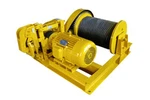




Diesel Powered Winch
Diesel Powered Winch is an essential tool for industries requiring reliable, portable, and powerful lifting or pulling capabilities. Its rugged design, high load capacity, and fuel efficiency make it an indispensable asset in remote or demanding environments.
Key Features
Powerful Diesel Engine: The winch is driven by a high-performance diesel engine, providing sufficient power for lifting and pulling heavy loads in various industries like construction, marine, oil & gas, and mining.
High Load Capacity: Diesel-powered winches are capable of handling heavy loads ranging from several tons to hundreds of tons, depending on the specifications. This makes them ideal for large-scale operations.
Durable Construction: Built to withstand harsh working conditions, the winch is made of corrosion-resistant materials and heavy-duty components to ensure durability and long operational life.
Versatility: Suitable for a wide range of applications such as towing, construction lifting, pulling cables, ship anchoring, and more. They can be used both on land and in marine environments.
Fuel Efficiency: Diesel engines are known for their fuel efficiency, offering extended operational time and reducing the frequency of refueling, which is crucial for remote locations or continuous operation.
Compact Design: Despite their power, diesel-powered winches are designed to be compact and easily transportable, making them ideal for use in tight or confined spaces.
Safety Features: The winch includes safety features like emergency stops, overload protection, and automatic braking systems to ensure secure and safe operation even in high-stress scenarios.
Remote Control: Many diesel-powered winches come equipped with remote control systems, allowing operators to control the winch from a distance, improving operational efficiency and safety.

Pictures & Components
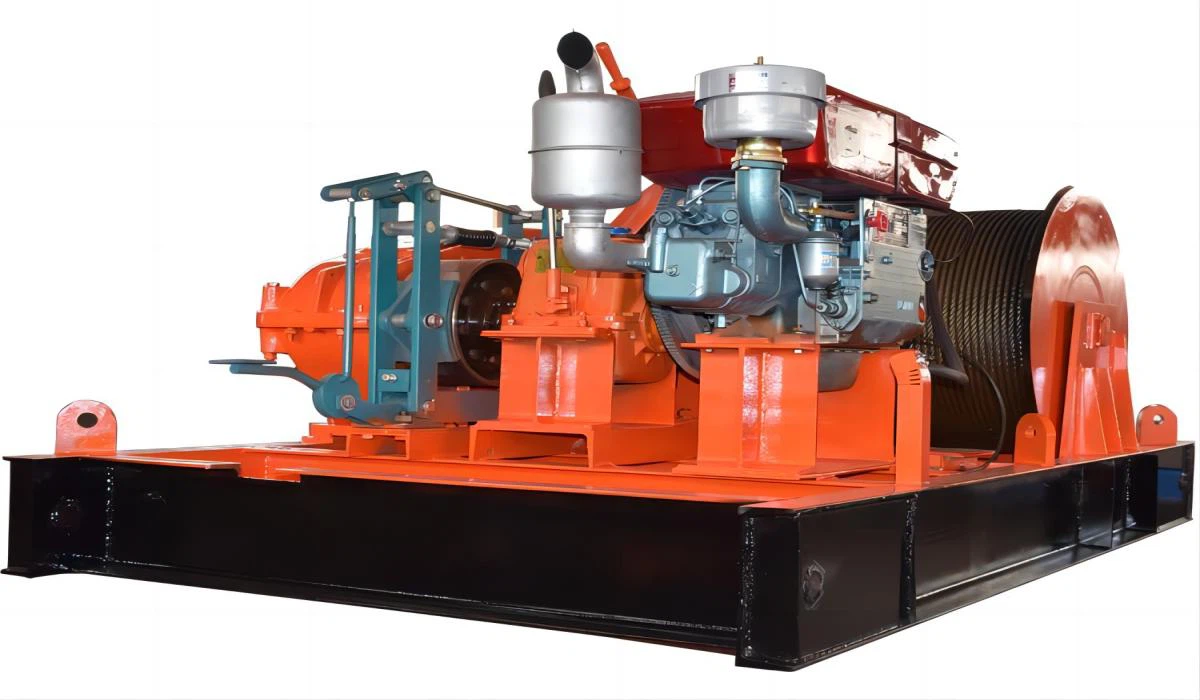
Diesel Powered Winch is a mechanical device that uses a diesel engine as its power source to pull or lift heavy loads. Here are the typical components that make up a diesel-powered winch system:
1. Diesel Engine
The primary power source that drives the winch.
Provides high torque and is suitable for heavy-duty applications.
2. Winch Drum
A cylindrical spool where the wire rope or cable is wound.
Comes with flanges on either side to keep the rope aligned.
3. Wire Rope / Cable
Heavy-duty steel cable or synthetic rope used for pulling or lifting loads.
The size and length depend on the application.
4. Gearbox / Transmission System
Connects the diesel engine to the winch drum.
Reduces the engine's speed and increases torque for effective pulling power.
5. Clutch System
Engages or disengages the drum from the engine and gearbox.
Allows the operator to control when the drum is powered or free-spooling.
6. Brake System
Prevents the drum from turning unintentionally when under load.
Common types include band brakes, disc brakes, or automatic safety brakes.
7. Control Panel / Levers
Manual or remote controls for operating the winch.
Includes throttle control, clutch engagement, brake release, and emergency stop.
8. Frame / Base
Heavy-duty steel structure that supports the entire winch assembly.
Designed to withstand the stresses of pulling heavy loads.
9. Fuel Tank
Supplies diesel fuel to the engine.
Size varies depending on the expected duration of operation.
10. Cooling System
Keeps the diesel engine and sometimes the gearbox from overheating.
Can be air-cooled or liquid-cooled.
11. Exhaust System
Directs exhaust gases away from the machine and operator.
Often includes a muffler to reduce noise levels.
12. Safety Guards & Shields
Protective covers over moving parts like the drum, gears, and belts.
Ensures operator safety.
13. Mounting Skid or Trolley (optional)
Some diesel winches are mounted on skids or trolleys for portability.
May include lifting points or wheels.

Sketch

Main Technical Parameter

advantages
Diesel Powered Winchs are widely used in industrial, construction, marine, and off-road applications. Here are some key advantages of diesel-powered winches:
1. High Power Output
Diesel engines provide high torque at low RPM, making them ideal for heavy-duty lifting and pulling tasks.
Suitable for moving very large or heavy loads that electric or hydraulic winches may struggle with.
2. Independence from Electrical Supply
Unlike electric winches, diesel winches don't rely on external power sources.
Useful in remote areas or off-grid locations where electricity is not available.
3. Durability and Longevity
Diesel engines are typically built for tough conditions and long operational life.
Can operate for extended periods under heavy loads without overheating, unlike some electric models.
4. Fuel Efficiency
Diesel engines are generally more fuel-efficient than gasoline engines, especially under load.
Lower fuel consumption means lower operational costs over time.
5. Versatility
Can be used in a wide range of environments (construction sites, mining, forestry, marine).
Many models are portable and can be relocated easily depending on the job.
6. Heavy-Duty Applications
Ideal for industrial applications such as pipeline construction, logging, towing, or shipyard operations.
Capable of handling rugged environments where durability and strength are essential.
7. Better Performance in Harsh Conditions
Diesel engines often perform better in extreme weather conditions compared to gasoline engines.
More reliable in cold climates due to their combustion characteristics.
8. Lower Maintenance in Certain Applications
Diesel engines don't have spark plugs or distributors, which reduces the number of components that require frequent maintenance compared to gasoline engines.

Application
Diesel Powered Winch is a versatile piece of equipment used in many industries due to its strength, mobility, and ability to work independently of electrical power. Here are some common applications of diesel-powered winches:
1. Construction Industry
Lifting and pulling heavy materials such as steel beams, concrete slabs, and machinery.
Tensioning cables and repositioning equipment on job sites where electricity may not be available.
2. Oil & Gas Industry
Used on drilling rigs for hoisting and pulling heavy drill pipes or casing.
Assisting in the positioning of large equipment in remote areas.
3. Forestry and Logging
Skidding logs out of dense forests.
Pulling felled trees to a landing area for further processing.
4. Marine and Offshore
Mooring operations, towing ships, or moving heavy loads on docks and platforms.
Launch and recovery of boats or equipment in areas without electric power.
5. Mining Industry
Hauling and lowering equipment and materials into mine shafts.
Recovery of stuck vehicles or machinery underground.
6. Infrastructure & Utilities
Used by utility companies for stringing and tensioning power lines.
Pipeline laying and maintenance.
7. Rescue and Recovery
Vehicle recovery in off-road or remote locations.
Assisting in disaster relief operations for clearing debris or moving heavy objects.
Production Procedure
The production procedure for diesel powered winch involves several stages, from design and engineering to manufacturing, assembly, and quality control. Here is a general outline of the production procedure for a diesel engine winch:
1. Design & Engineering
Requirement Analysis: Define specifications such as pulling capacity, rope speed, drum size, and application (e.g., marine, construction).
CAD Design: Create detailed 3D models and engineering drawings of the winch, including the drum, frame, gearbox, diesel engine, and control system.
Stress Analysis: Perform FEA (Finite Element Analysis) on key components like the drum, base frame, and load-bearing parts.
2. Material Procurement
Order Raw Materials: Purchase steel plates, rods, shafts, and other materials as per the Bill of Materials (BOM).
Source Components: Procure off-the-shelf components like the diesel engine, hydraulic pump (if hydraulic-assisted), bearings, gears, and control panels.
3. Fabrication
Frame Construction:
Cut and weld steel plates to build the base frame and support structures.
Apply machining to critical mounting surfaces.
Drum & Shaft Manufacturing:
Machine the drum body and shaft according to design.
Weld or bolt flanges, grooves, or ribs as per load requirements.
Gearbox Assembly:
Machine gears and casings.
Assemble the gear system, ensuring proper alignment and backlash adjustments.
4. Diesel Engine Integration
Engine Mounting:
Install the diesel engine on anti-vibration mounts onto the frame.
Align the engine shaft with the gearbox or hydraulic pump.
Power Transmission:
Connect via direct coupling or belts/pulleys, depending on the design.
For hydraulic systems, connect the engine to a hydraulic pump to power a hydraulic motor that drives the drum.
5. Winch Assembly
Main Assembly:
Mount drum and shaft onto the frame with bearings.
Install gearbox to the frame and couple it to the drum shaft.
Attach braking system (mechanical or hydraulic disc brake).
Control System:
Install diesel throttle controls, winch clutch, brake levers, or hydraulic control valves.
Wire up engine controls and safety cut-offs.
6. Testing & Inspection
Static Testing:
Check alignment, fasteners, clearances, and lubrication points.
Dynamic Testing:
Run the engine and operate the winch under load.
Perform load tests to verify pulling capacity and brake holding capacity.
Check for vibrations, noise, and thermal performance.
7. Surface Treatment
Cleaning & Coating:
Sandblast all fabricated parts.
Apply primer and final coat (usually marine-grade or industrial paint).
Corrosion Protection:
Galvanize or epoxy coat critical parts if needed for harsh environments.
8. Final Assembly & Quality Control
Final torque checks, safety labeling, and protective covers installation.
Conduct final QA inspection according to ISO or company standards.
Prepare operation and maintenance manual.
9. Packaging & Shipping
Packing:
Secure the winch to a wooden or steel skid.
Apply rust protection to exposed parts.
Shipping:
Load for domestic or international transport based on customer location.

Workshop View
The company has installed an intelligent equipment management platform, and has installed 310 sets (sets) of handling and welding robots. After the completion of the plan, there will be more than 500 sets (sets), and the equipment networking rate will reach 95%. 32 welding lines have been put into use, 50 are planned to be installed, and the automation rate of the entire product line has reached.


Hot Tags: diesel powered winch, China diesel powered winch manufacturers, suppliers, factory
Previous
20T Desiel WinchNext
Winch DieselYou Might Also Like




Send Inquiry