










Ladle Pouring Molten Metal Overhead Crane
A Ladle Pouring Molten Metal Overhead Crane is a specialized heavy-duty crane used in steel mills and foundries for handling molten metal safely and efficiently. These cranes are crucial in the steel production process, especially in continuous casting and smelting operations.
Key Features
- High Heat Resistance – Designed with heat-resistant components to withstand extreme temperatures near molten metal.
- Heavy Load Capacity – Can handle ladles filled with molten metal, often weighing hundreds of tons.
- Precise Control System – Includes variable frequency drives (VFDs) for smooth and accurate ladle positioning.
- Double Girder Overhead Design – Ensures high stability and strength for safe pouring and transportation.
- Safety Features – Equipped with redundant braking systems, emergency stop mechanisms, and special heat-resistant cables.
- Automatic or Semi-Automatic Operation – Some advanced models feature automated ladle tilting and pouring for improved efficiency.
- Ladle Hook or Special Gripper – Designed to securely hold and tilt the ladle for controlled molten metal pouring.
- Capacity: 5-500ton
- Span length: 4-35m
- Lifting height: 3-50m
- Work duty: A4, A5, A6,A7
- Raged voltage: 220V~690V, 50-60Hz, 3ph AC
- Work environment temperature: -25℃~+50℃, relative humidity ≤85%
- Crane control mode: Floor control / Remote control / Cabin room

Pictures & Components
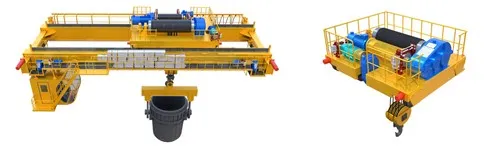
1. Whole set crane
A Ladle Foundry Overhead Crane is a specialized type of overhead crane used in steel mills and foundries for handling molten metal in ladles. These cranes are designed to withstand high temperatures, heavy loads, and harsh working conditions.
Main Components of a Ladle Foundry Overhead Crane
A whole set crane typically consists of:
Bridge – The main structure that spans across the workshop and supports the entire crane system.
Trolley & Hoisting Mechanism – Moves along the bridge and carries the ladle with molten metal. Often includes:
Main hoist (for lifting the ladle)
Auxiliary hoist (for tilting the ladle or secondary operations)
Ladle Hook or Special Lifting Device – Designed to securely hold and transport the ladle.
End Carriages – Supports the bridge and allows crane movement along the rails.
Electrical Control System – Includes PLC, remote control, or cabin operation for safe and precise movement.
Safety Systems – Includes emergency brakes, overload protection, heat shielding, and anti-sway control.

2. Main girder
The main girder of a ladle pouring molten metal overhead crane is a crucial structural component that supports the entire lifting mechanism. Here are its key aspects:
1. Function & Importance
Supports the trolley and hoist system, ensuring safe movement of the ladle.
Bears extreme loads, including the ladle filled with molten metal.
Designed to withstand high temperatures and dynamic forces in steel plants and foundries.
2. Design & Structure
Material: High-strength, heat-resistant steel to endure harsh working conditions.
Configuration: Typically box-type or reinforced girder to prevent deformation under heavy loads.
Load-bearing capacity: Engineered to handle weights ranging from several tons to over 500 tons.
3. Safety Features
Heat insulation to protect from molten metal splashes.
Structural reinforcements to withstand thermal expansion and contraction.
Rigorous stress testing to ensure operational safety.

3. Lifting System
The Lifting System of a Ladle Pouring Overhead Crane is a critical component designed to safely and efficiently handle molten metal in steel plants and foundries. This system ensures precise lifting, tilting, and pouring of the ladle to transfer molten metal to molds or furnaces.
1. Key Components of the Lifting System
The lifting system of a ladle pouring molten metal overhead crane is critical for safe and efficient handling of molten metal in steel mills and foundries. The key components of this lifting system include:
1. Main Hoisting Mechanism
Hoist Motor: Provides the power needed to lift and lower the ladle.
Gearbox & Reducers: Adjust speed and torque for precise lifting operations.
Wire Rope / Chains: Strong, heat-resistant cables or chains used to support the ladle.
Drum & Pulleys: Ensure smooth movement of the wire rope during lifting and lowering.
2. Ladle Hook or Lifting Beam
Forged Ladle Hook: Specialized hooks designed to handle high-temperature ladles safely.
Lifting Beam / Spreader Beam: Distributes the weight evenly to prevent instability.
3. Trolley System
Trolley Frame: Houses the hoisting mechanism and moves horizontally along the crane bridge.
Wheels & Rails: Ensure smooth and controlled movement of the trolley.
4. Control System
Cabin / Remote Control: Operators use a cabin or remote control for precise maneuvering.
Variable Frequency Drive (VFD): Allows smooth speed control and prevents jerky movements.
Limit Switches & Sensors: Ensure safe lifting by preventing over-travel and overloading.
5. Braking System
Electromagnetic or Hydraulic Brakes: Prevent unwanted movement of the ladle.
Safety Brake on Hoist Drum: Acts as an emergency brake in case of failure.
6. Heat-Resistant Components
Thermal Protection Shields: Protects critical parts from extreme heat exposure.
Insulated Cables & Fireproof Materials: Prevent damage from molten metal splashes.
2. Working Principles
(1) Lifting Process
The motor-driven hoisting mechanism rotates the drum, winding or unwinding the wire rope.
The ladle, filled with molten metal, is lifted by the hook or specialized ladle hanger.
A variable frequency drive (VFD) or other control system regulates the speed and smoothness of lifting.
Safety devices such as overload sensors prevent excessive loads that may cause mechanical failure.
(2) Transporting the Ladle
The crane moves along overhead rails, positioning the ladle at the desired pouring location.
The lifting system keeps the ladle stable to avoid dangerous swaying of molten metal.
Some advanced systems use anti-sway technology for smoother handling.
(3) Pouring the Molten Metal
The auxiliary hoisting mechanism or a separate tilting device enables the ladle to tilt gradually.
The controlled pouring of molten metal ensures precision in filling molds or furnaces.
The system allows fine adjustments for different pouring speeds.
(4) Lowering and Resetting
After pouring, the lifting mechanism carefully lowers the empty ladle.
The brake system prevents sudden drops.
The ladle is prepared for the next cycle.
The lifting system in a ladle pouring overhead crane combines precision engineering, safety mechanisms, and automated controls to ensure smooth, controlled handling of molten metal. Proper maintenance and monitoring of this system are crucial to prevent accidents and enhance operational efficiency.

4. End Carriages
End carriages of a ladle pouring molten metal overhead crane are critical components that support and enable the movement of the crane along the runway beams. These end carriages house the wheels and drive mechanisms, ensuring smooth and precise movement for the crane system.
Key Features of End Carriages for Ladle Pouring Cranes
Heavy-Duty Construction – Made of high-strength steel to withstand high temperatures, heavy loads, and harsh operating conditions.
High-Temperature Resistance – Designed to endure extreme heat from molten metal ladles. Special heat shields and coatings may be applied.
Precision Machined Wheels – Equipped with hardened steel wheels that run on crane rails, ensuring stable and smooth motion.
Driven & Idle Wheels – Typically, one end carriage has a drive system (motor + gearbox), while the other has free-rolling wheels.
Anti-Skid & Safety Features – Includes wheel flanges, rail clamps, and braking systems to prevent derailment and ensure safety.
Robust Bearings & Gearboxes – Bearings and gearboxes are heat-resistant and sealed for protection against dust and debris.
Maintenance Accessibility – Designed for easy access to motors, gears, and bearings for routine maintenance and repair.
5. Crane traveling mechanism
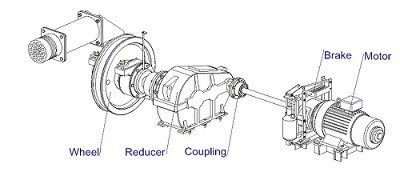
The crane traveling mechanism of a ladle pouring molten metal overhead crane is a critical component designed to ensure stable and precise movement of the crane along the runway beams in a steel mill or foundry environment. This mechanism consists of several key parts that enable smooth and controlled longitudinal movement.
Main Components of the Traveling Mechanism
Crane Wheels & Wheel Assembly
The crane travels on steel rails installed on the crane runway.
Typically, there are four to eight wheels (depending on the crane's capacity), with two drive wheels powered by motors and the rest acting as idlers.
Traveling Motor & Gearbox
The mechanism is powered by electric motors (usually AC motors with frequency control).
Gearboxes reduce motor speed to provide high torque and smooth acceleration.
Variable frequency drives (VFDs) allow speed control, preventing sudden starts and stops.
Couplings & Drive Shaft
Connects the motor to the wheel assembly.
Ensures even power distribution to the drive wheels.
Common types include gear couplings or flexible couplings to absorb shock loads.
Braking System
Hydraulic or electromagnetic brakes provide controlled stopping and emergency braking.
Helps in maintaining safety, especially when handling molten metal.
Rail and Guide System
The crane moves on precisely aligned crane rails mounted on girders.
Guide rollers prevent lateral movement and ensure stable tracking.
End Carriages
Support the wheels and house the drive mechanism.
Heavy-duty welded steel structure to withstand high temperatures and dynamic loads.
6. Trolley traversing mechanism
The trolley traversing mechanism of a ladle pouring molten metal overhead crane is a crucial component that enables precise movement and positioning of the ladle for safe and efficient metal pouring. Here's an overview of its key aspects:
1. Function:
The trolley mechanism allows the ladle to move horizontally along the bridge of the overhead crane.
It ensures smooth and controlled positioning of the molten metal for accurate pouring into molds or furnaces.
2. Components of the Trolley Traversing Mechanism:
(a) Trolley Frame:
A robust, heat-resistant steel structure that supports all trolley components.
(b) Traveling Wheels & Rails:
The trolley moves on hardened steel wheels running on rails mounted on the crane bridge.
Some cranes use dual-motor drive systems for smooth acceleration and deceleration.
(c) Drive System:
Motors & Gearboxes: Electric motors (often with variable frequency drives, VFDs) power the trolley movement.
Brakes: Electromagnetic or hydraulic brakes provide stopping control.
Couplings & Shafts: Transmit motion from the motor to the wheels.
(d) Guide Rollers & Buffers:
Maintain alignment and reduce lateral movement.
Buffers absorb impact forces at travel limits.
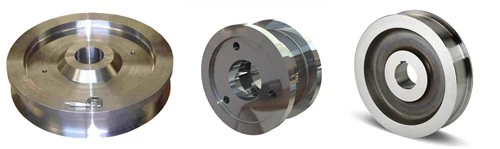
7. Crane wheel
The crane wheel of a ladle pouring molten metal in an overhead crane system is an essential component in the industrial setup for transporting and handling molten metal in foundries, steel mills, or other metal-processing facilities.
The crane wheel typically refers to the wheel or set of wheels that are part of the trolley or hoist mechanism of an overhead crane. This system is designed to move the ladle - a large container used for holding molten metal - safely and efficiently from one station to another, particularly during the pouring of molten metal into molds or into other containers.
8. Crane hook
A crane hook for ladle pouring molten metal is typically designed for overhead cranes used in steel mills, foundries, or metal processing plants. This hook is attached to the crane to lift and transport the ladle, which contains molten metal. It is specially designed for the heavy and high-temperature conditions of molten metal handling.
High Heat Resistance: The hook and other components are made from heat-resistant materials to withstand the extreme temperatures of molten metal (often above 1500°C or 2732°F).
Heavy Duty Construction: The hook is designed to carry extremely heavy loads, with the weight of a ladle of molten metal ranging from several tons to tens of tons.
Safety Features: It may include safety mechanisms like anti-sway devices, load sensors, or hooks with automatic locking mechanisms to prevent accidental drops.
Material: Typically made from alloy steels or other heat-resistant alloys, which are strong enough to handle both the heavy load and the heat generated by molten metal.
Crane Hook Shape: The hook is often specifically shaped to securely lift ladles, sometimes with a specialized attachment or a custom lifting device to prevent spillage or accidents during transport.

9. Motor
The motor for a ladle pouring molten metal overhead crane typically needs to be robust and able to handle heavy loads while maintaining precise control over the ladle's movement. The crane motor is generally designed for high torque and reliability, as it must safely lift, move, and pour molten metal, which is hazardous and requires accurate positioning.
Type of Motor:
AC motors (often squirrel-cage induction motors) are used for general hoisting and movement functions.
DC motors may be used for more precise speed control in some applications.
Power Requirements:
High power output to handle the weight of the ladle and molten metal, sometimes in the range of 50 HP or more, depending on the capacity and weight of the ladle.
Variable Frequency Drive (VFD):
VFDs are commonly used to control the speed and torque of the crane motor. This allows for smooth acceleration, deceleration, and precise speed control, which is crucial when handling molten metal.
Safety Features:
Explosion-Proof or Flameproof motors are often required to prevent any accidents in environments where molten metal and high temperatures are involved.
Overload protection, emergency stop mechanisms, and thermal protection are critical to prevent motor failure.
Construction:
Motors are usually enclosed to protect against dust, heat, and molten metal splashes.
High-grade materials like stainless steel or special alloys may be used for better resistance to heat and corrosion.

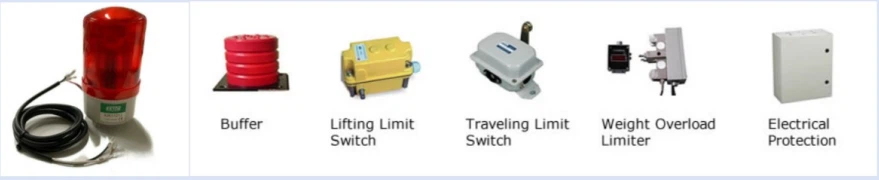
10. Sound and light alarm system & limit switch
1. Sound and Light Alarm System:
Purpose: This system is designed to alert operators and personnel of any abnormal or hazardous conditions related to the crane operation.
Function:
Sound: Provides an audible alert (such as a siren, horn, or bell) to notify workers about critical situations, such as the crane's movement, load positioning, or if the crane is nearing a dangerous area.
Light: Visual signals like flashing lights or beacons are used to supplement the sound alarm, particularly in noisy environments where the audible alarm might not be heard. These signals are often color-coded to indicate different types of warnings or status:
Green: Safe operation
Yellow: Caution or preparation for a load movement
Red: Emergency or hazardous condition requiring immediate attention.
Safety: The combination of both sound and light ensures maximum awareness for operators and nearby personnel, reducing the risk of accidents or injury in a potentially dangerous work environment.
2. Limit Switch:
Purpose: A limit switch is used to stop or control the crane's movement, ensuring the crane doesn't exceed preset safety limits.
Function:
Overtravel Prevention: Prevents the crane from traveling beyond its designated range, preventing damage to the crane, the ladle, or the surrounding area.
Load Positioning Control: Stops the crane at the right position when transferring the molten metal ladle to avoid spilling or overloading.
Emergency Safety Stop: If a critical situation occurs, limit switches can be integrated into the crane's safety system to instantly halt operations.
Types:
Mechanical Limit Switches: Typically used to physically control the movement of parts of the crane.
Electronic Limit Switches: Use sensors to detect the position of the crane and its load.
Integration with Other Systems: The limit switches often work together with safety controls, sensors, and alarms to ensure the crane operates within safe limits.
11. Safety Devices
Safety devices for ladle pouring molten metal overhead cranes are critical to prevent accidents and ensure the safe operation of these heavy-duty cranes in high-temperature environments. These devices are designed to protect both the operators and the equipment. Some common safety devices used in these systems include:
Overload Protection:
Overload sensors and limiters are used to prevent the crane from lifting loads that exceed its capacity. This helps avoid the risk of equipment failure or catastrophic accidents.
Load Cell Systems:
These systems monitor the weight of the molten metal in the ladle. If the weight exceeds a predefined limit, the crane will automatically stop or alert the operator.
Emergency Stop Button:
Emergency stop buttons are installed on the crane control panel and at key locations around the crane to quickly stop operations in case of an emergency.
Anti-Sway Control:
Anti-sway systems reduce the oscillation of the ladle, providing more stability when lifting and moving molten metal. This helps prevent spills and accidents.
Safety Barriers and Guards:
These physical barriers are installed around the crane's operational area to prevent personnel from entering dangerous zones. They help protect workers from falling molten metal and other hazards.
Crane Motion Limit Switches:
These switches limit the crane's motion in certain directions to ensure it does not move beyond safe operational limits.
Tilt Control:
Some ladles are equipped with tilt control mechanisms that can be activated to safely pour molten metal. This ensures precise control over the tilt angle, reducing the risk of accidental spillage.
Temperature Sensors:
These sensors monitor the temperature of the molten metal in the ladle. If the temperature exceeds a safe threshold, the crane's operation may be stopped or the system may alert the operator.
Collision Avoidance Systems:
These systems use sensors to detect nearby objects and avoid collisions with other equipment, structures, or personnel, reducing the risk of accidents.
Remote Monitoring and Control Systems:
Operators can use remote control systems to monitor and control the crane from a safe distance, reducing the risk of exposure to heat and molten metal.
Redundant Safety Systems:
These are backup systems in place to ensure the crane will still operate safely if the primary system fails. Redundancy is important for high-risk operations like molten metal handling.
Automatic Locking Mechanisms:
These mechanisms lock the ladle in place to prevent accidental movements when the ladle is being positioned for pouring.
Warning Lights and Audible Alarms:
Warning systems, such as flashing lights or sirens, are used to alert workers when the crane is in operation or when a hazardous condition is detected.
Personnel Safety Training:
Regular training programs for operators and workers on how to safely use the crane, including emergency procedures, are essential to ensure safety.
12. Control Mode
The control mode of a ladle pouring molten metal with an overhead crane typically involves several key control systems to ensure safe and efficient operation. Here's an overview of how it works:
Manual Control Mode:
In this mode, the operator directly controls the crane, ladle, and pouring process through joysticks, buttons, and levers.
The operator has full control over the crane's movements, including lifting, positioning, and pouring the molten metal.
This mode is used for precise, hands-on operations where the operator can make immediate adjustments.
Automatic Control Mode:
The crane and ladle are controlled by an automated system, which follows predefined settings or programmable logic for consistent pouring operations.
The system can include sensors to monitor the ladle's position, tilt angle, and molten metal flow, making adjustments as needed.
This mode ensures smoother and more consistent pouring, reducing human error.
Semi-Automatic Control Mode:
This mode combines manual and automatic control. The operator can manually control certain movements, like positioning the ladle, while the automated system manages the pouring process.
It's often used when flexibility is required, but with the safety and efficiency provided by automation.
Safety Systems:
Overhead cranes in molten metal operations are equipped with multiple safety features, such as overload protection, emergency stop buttons, temperature sensors, and monitoring systems.
In some setups, the crane may include automatic cutoffs to prevent molten metal spills or other safety hazards.
Tilt Control:
In ladle pouring, the tilt control is vital to ensure that the molten metal flows at the right rate.
The crane's system includes a tilt mechanism to adjust the angle of the ladle, which is controlled either manually or automatically.
Integration with Furnace Control:
The overhead crane may be integrated with the furnace's control system to ensure that the ladle is aligned with the furnace or casting station for pouring.
This integration ensures that the molten metal is poured at the correct time, temperature, and volume.

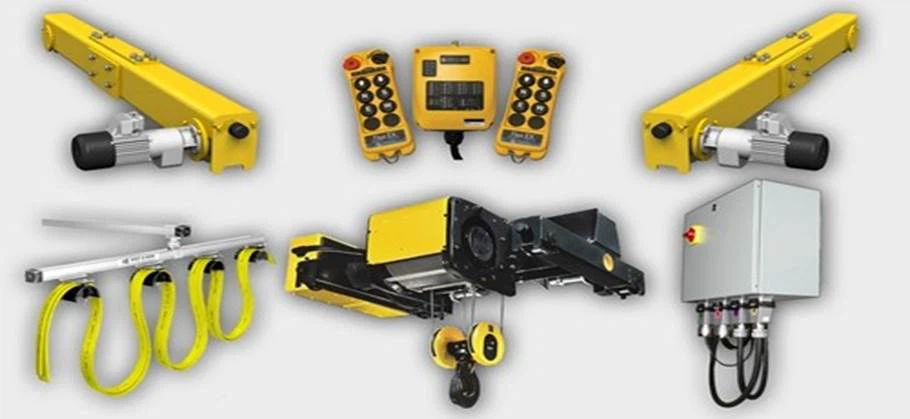
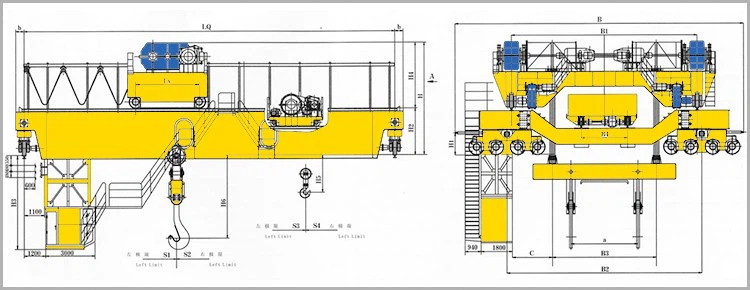
13. Sketch
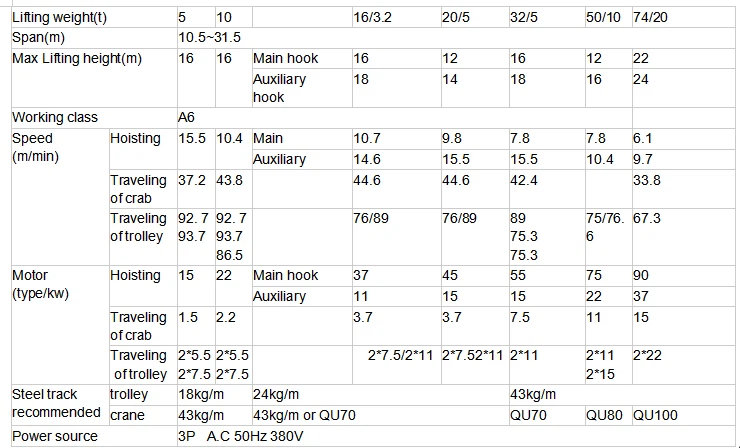
Main Technical Data
Advantages
- Improved Safety: Overhead cranes keep operators away from the hazardous molten metal, reducing the risk of burns, spills, or accidents. The crane provides a safe distance, and controlled movement of the ladle reduces human exposure to dangerous materials.
- Precision and Control: Cranes can be precisely controlled, allowing for accurate positioning of the ladle above molds or casting areas. This ensures consistent pouring and minimizes the risk of spillage or improper distribution of molten metal.
- Efficient Handling: The overhead crane can lift and move heavy ladles efficiently, eliminating the need for manual labor and reducing fatigue or injury risks for workers. This also speeds up the pouring process, improving overall plant productivity.
- Flexibility and Reach: Overhead cranes can move the ladle across a wide area, allowing for more flexibility in pouring molten metal into different parts of the facility, such as molds, ingot molds, or casting machines, without needing additional equipment.
- Space Utilization: The crane operates in the overhead space, freeing up valuable floor space for other operations. This vertical utilization of space helps optimize plant layout, especially in facilities with limited floor space.
- Reduced Handling Time: The crane system can quickly move ladles to and from pouring stations, reducing the downtime between pours. This increases the throughput and efficiency of the production line.
- Automation and Integration: Overhead cranes can be automated and integrated into a plant's overall control system, enabling the automation of the entire pouring process. This leads to greater consistency and efficiency, as well as reduced labor costs.
- Minimized Spillage: The use of overhead cranes with ladles reduces the likelihood of spillage by providing controlled pouring angles and speeds, which leads to less waste and more efficient metal usage.
- Adaptability: Overhead cranes can be adapted to handle different sizes and types of ladles and molten metal. Whether the metal is in a large or small ladle, the crane can adjust to ensure efficient pouring.
Application
- Molten Metal Transportation: These cranes are used to transport ladles filled with molten metal from one part of the foundry to another, such as from the furnace to the pouring station or mold.
- Metal Pouring: Overhead cranes equipped with ladle tippers or pouring mechanisms enable the controlled pouring of molten metal into molds, which is a delicate task that requires high accuracy to avoid spillage or improper distribution.
- Safety and Hazard Management: Given the high temperatures and potential risks associated with molten metal, these cranes are designed to minimize human exposure to hazards. Operators can control the crane remotely from a safe distance, ensuring safety during the pouring process.
- Precise Handling of Heavy Loads: Molten metal ladles are heavy, often weighing several tons. Overhead cranes are designed to handle these heavy loads efficiently while ensuring stability during transportation and pouring.
- Integration with Automation: In modern foundries, ladle pouring cranes can be automated for increased efficiency. This includes automated ladle tilting, pouring rates, and movement control, reducing the need for manual labor and improving consistency.
- Temperature Control: The design of ladle pouring cranes ensures that molten metal is kept at the required temperature throughout transportation and pouring, preventing solidification before reaching the mold.
- Customization for Specific Applications: These cranes can be customized to meet specific operational needs, such as controlling the pouring rate for different types of metals (e.g., steel, aluminum, etc.), and optimizing the positioning for accurate and uniform metal distribution.
Crane Production Procedure
The production procedure for a ladle pouring molten metal overhead crane typically involves several key steps to ensure safety, precision, and efficiency in handling molten metal. Here's a general overview of the process:
1. Preparation and Inspection:
Crane Inspection: Ensure the overhead crane is in good working condition, with particular attention to the lifting mechanism, hook, cables, and safety features.
Ladle Inspection: Check the ladle for integrity and cleanliness. Make sure it is free of any cracks, debris, or contaminants that could compromise the quality of the molten metal.
Safety Checks: Ensure all safety equipment (e.g., fire-resistant gloves, goggles, protective clothing) is in place for operators and surrounding workers.
2. Positioning the Ladle:
Ladle Placement: The ladle, which holds the molten metal, is positioned under the crane's lifting hook using a forklift or crane.
Secure the Ladle: Attach the crane's lifting hook or a specially designed ladle lifting device to the ladle's lifting ears or other lifting points.
Safety Check: Ensure that the ladle is securely fastened to prevent any slippage during operation.
3. Lifting the Ladle:
Controlled Lifting: The overhead crane lifts the ladle using precise movements. The crane operator needs to move the ladle slowly to avoid swinging and spillage of molten metal.
Monitor Load: Continuous monitoring of the weight and balance is essential to prevent overloading or uneven lifting.
Preliminary Elevation: Raise the ladle to the desired height, ensuring no obstacles in the crane's path.
4. Transporting the Ladle:
Movement to Pouring Station: The crane moves the ladle to the designated pouring station. This station is often located over a mold or a pouring pit where the molten metal will be directed.
Control of Swing: Crane operators must ensure there is minimal swinging of the ladle during transportation to prevent accidents.
5. Pouring Molten Metal:
Positioning for Pouring: Once over the target pouring area, the crane operator carefully tilts the ladle to pour the molten metal into molds, casting stations, or other required areas.
Controlled Pour: The pouring speed must be controlled to prevent overflow, spillage, or uneven distribution of molten metal.
Monitoring Temperature: Temperature sensors on the ladle help monitor and control the temperature of the molten metal to ensure consistent quality.
6. Ladling Completion:
Ladle Return: After pouring, the crane returns the ladle to a safe area or ladle recharging station for refilling or cooling, depending on the next steps in the production cycle.
Cleaning: If necessary, the ladle is cleaned to remove any residue of metal before the next use.
7. Post-Pouring Checks:
Inspection of Crane and Ladle: After the operation, the crane and ladle should be inspected for any wear or damage during the process.
Safety Review: Conduct a post-operation review to ensure all safety protocols were followed.

Workshop View
The company has installed an intelligent equipment management platform, and has installed 310 sets (sets) of handling and welding robots. After the completion of the plan, there will be more than 500 sets (sets), and the equipment networking rate will reach 95%. 32 welding lines have been put into use, 50 are planned to be installed, and the automation rate of the entire product line has reached 85%.


Hot Tags: ladle pouring molten metal overhead crane, China ladle pouring molten metal overhead crane manufacturers, suppliers, factory, Ladle Foundry Bridge Crane, Ladle Foundry and Casting Steel Mill Overhead Crane, Steel Factory Overhead Crane, Steel Mill Overhead Cranes, Rolling Mill Overhead Crane, Casting Steel Overhead Crane
You Might Also Like


Send Inquiry