









Ladle Overhead Crane
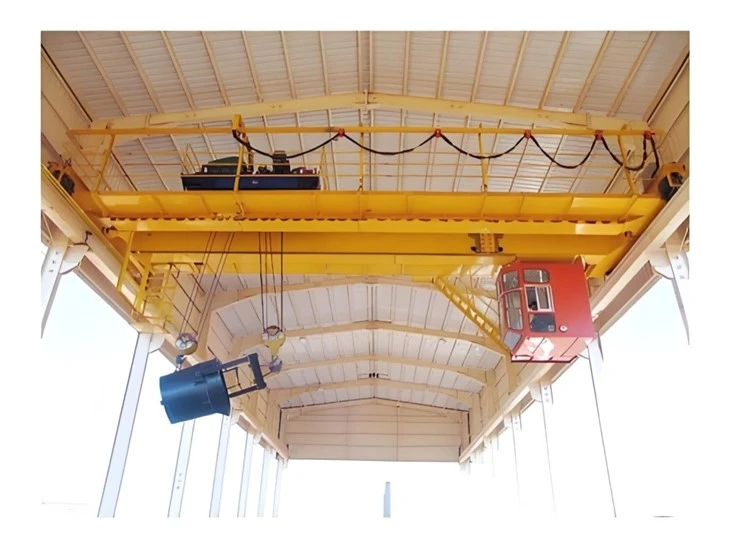
A Ladle Overhead Crane is a type of heavy-duty crane used primarily in steel mills and other industries dealing with molten metal. It is designed specifically for lifting and moving ladles that carry molten metal, often from the furnace to casting areas. These cranes are built with safety, durability, and precision in mind, as they handle extremely high temperatures and heavy loads.
Key Features:
Heavy Load Capacity: Ladle overhead cranes are designed to handle very heavy loads, typically ranging from several tons up to 600 tons, depending on the crane's design and the size of the ladle.
High Temperature Resistance: These cranes are made from materials and equipped with features that can withstand the extreme heat generated by molten metal. They have heat-resistant components to prevent any damage from high temperatures.
Precision Control: The crane comes with advanced control systems to ensure precise movement, especially when dealing with molten metal. This is crucial for maintaining safety and accuracy in the operation.
Safety Features: The crane is equipped with safety features such as overload protection, emergency stop systems, anti-sway mechanisms, and flameproof electrical components to reduce the risk of accidents.
Specialized Hook Design: The hook and lifting mechanism are specially designed to safely grip and lift ladles, ensuring stability while moving molten metal.
Durability and Strength: Ladle overhead cranes are built for heavy-duty, continuous operation in harsh environments, ensuring long service life.
Automated Options: Many modern ladle overhead cranes offer automation features, including remote control operation, integrated sensors, and automatic positioning for increased efficiency and safety.
- Capacity: 5-500ton
- Span length: 4-35m
- Lifting height: 3-50m
- Work duty: A4, A5, A6,A7
- Raged voltage: 220V~690V, 50-60Hz, 3ph AC
- Work environment temperature: -25℃~+50℃, relative humidity ≤85%
- Crane control mode: Floor control / Remote control / Cabin room

Pictures & Components
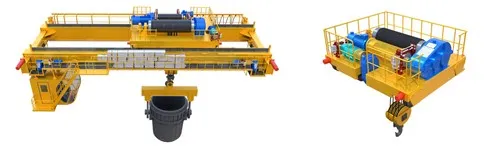
1. Whole set crane
A whole set of ladle overhead crane typically consists of several key components designed to safely lift and move ladles filled with molten metal in steel mills or other industrial settings. Here's a breakdown of the key components:
Bridge (Main Beam): The bridge is the main structural component that spans the entire width of the bay or workshop where the crane operates. It supports the trolley and hoist system and moves along rails fixed to the building structure.
Trolley: This is a movable component that runs along the bridge. The trolley supports the hoist and is responsible for moving the load horizontally across the crane's span.
Hoist: The hoist mechanism is responsible for lifting and lowering the ladle. It includes the motor, drum, wire rope, and hook. The hoist must be robust to handle the high temperatures and heavy weights typical of molten metal ladles.
Ladle Hook or Grabs: The hook or specialized grab is designed to securely hold the ladle. It can be custom-designed based on the ladle's shape and weight to ensure safe handling.
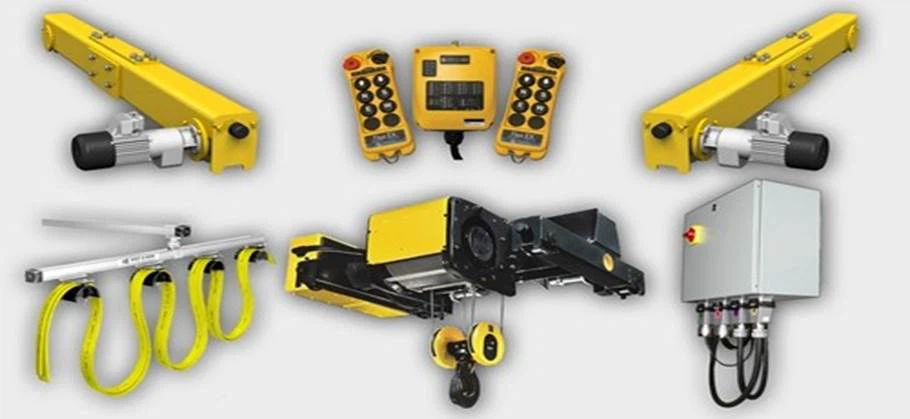
Motor and Electrical System: Motors power the crane's movement (both for the bridge and the trolley). These motors are controlled by an electrical system that provides speed control and safety features such as overload protection.
Control System: Operators typically control the crane from a remote station. The control system may include pendant controls, wireless controllers, or cab-mounted controls.
Safety Features:
Limit Switches: To prevent over-travel of the crane components.
Overload Protection: Ensures that the crane does not lift loads that exceed its rated capacity.
Brakes: Both mechanical and electrical brakes to safely stop the crane's movement.
Rails: The crane moves on a set of rails fixed to the building structure. These rails must be properly aligned and maintained to ensure smooth movement.
Steel Structure & Supports: The crane is typically mounted on a steel framework that supports its weight and the load it carries.
Auxiliary Systems: These may include cooling systems for the hoist or electrical components, especially since the environment around ladles is high-temperature, and it is critical to ensure that the crane's components are protected from heat.

2. Main girder
The main girder of a ladle overhead crane is a critical structural component that supports the weight of the ladle (used in steel mills for handling molten metal) and all associated lifting operations. It serves as the primary horizontal beam of the crane and runs across the entire span of the crane's rail system.
Here are the key features and functions of the main girder:
Structural Design: The main girder is typically made from high-strength steel and designed to withstand heavy loads, including the weight of the ladle and molten metal. It usually comes in two configurations:
Single Girder: Used for lighter loads and more compact operations.
Double Girder: More common for ladle cranes, as it provides additional support for heavier loads and greater stability.
Function: The main girder serves as the foundation for other components like the trolley (which holds the lifting mechanism), hoisting drum, and hooks. It distributes the forces generated by the load evenly to prevent structural failure.
Dimensions and Load Capacity: The size and capacity of the main girder are determined by the maximum load it needs to carry, which includes the ladle's weight plus safety margins. For ladle cranes, these can often be in the range of several hundred tons.
Safety Considerations: Given that ladle overhead cranes operate in high-temperature environments (due to molten metal), the girder must be designed to handle thermal expansion and ensure stability under extreme conditions.
Rail Track and Wheels: The girder is mounted on a rail track system, with wheels that allow it to move along the length of the crane structure.

3. Lifting System
1. Hoist Mechanism
The hoist mechanism is responsible for raising and lowering the ladle. It typically consists of:
Motor: A powerful electric motor drives the hoist, providing the necessary force to lift heavy ladles.
Gearbox: The motor is connected to a gearbox that reduces the speed and increases torque, allowing for safe and controlled lifting of heavy loads.
Wire Rope or Chain: The hoist uses strong wire ropes or chains to lift the ladle. The wire rope or chain is wound around a drum, which allows the hoist to raise and lower the ladle.
Drum or Sheave: This component holds and guides the wire rope or chain.
2. Ladle Hook and Trolley
Ladle Hook: The ladle hook is a specially designed lifting hook that attaches to the ladle, often using an adapter or a lifting device like a hook clamp. It is designed to safely handle the load of molten metal.
Trolley: The trolley moves along the bridge beam of the crane. It is mounted on rails and is driven by a motor, allowing for horizontal movement of the ladle.
3. Bridge and Crane Structure
Bridge: The bridge spans the width of the crane bay and allows for movement of the trolley along the length of the crane. It is supported by two end trucks that move along fixed rails.
Crane Frame: The crane frame supports the entire lifting system, including the hoist, trolley, and bridge. It is made of high-strength steel to handle heavy loads.
4. Control System
The crane uses a control system that allows for precise operation, often including:
Operator Controls: These include joysticks, buttons, or even automated systems that allow operators to lift, lower, and move the ladle with precision.
Safety Features: Modern ladle overhead cranes are equipped with safety features like overload sensors, emergency stop systems, and anti-sway technology to ensure safe handling of molten metal.
Automation and Sensors: In some plants, the cranes are automated with sensors for load monitoring, position tracking, and precise ladle control.
5. Safety Mechanisms
Overload Protection: The crane system includes sensors to prevent lifting loads that exceed the crane's rated capacity.
Limit Switches: Limit switches are installed to prevent the hoist from lifting the ladle beyond a certain height or moving it too far in any direction.
Anti-Sway Systems: These systems help prevent the swinging of the ladle during lifting or transportation, ensuring stability and safety.
In summary, the lifting system of a ladle overhead crane is designed for the heavy-duty task of handling molten metal, with an emphasis on safety, precision, and efficiency. The system includes a hoist mechanism, ladle hook, trolley, bridge, and control mechanisms, all of which work in tandem to lift and transport the ladle safely.

4. End Carriages
End carriages of a foundry bridge crane are crucial components that support and move the entire crane structure along the runway beams. They house the wheels, bearings, and drive mechanisms necessary for smooth and efficient crane movement.
Key Features of End Carriages for Foundry Bridge Cranes
Heavy-Duty Construction – Designed to withstand extreme heat and heavy loads typical in foundries.
High-Temperature Resistance – Equipped with special materials and heat shields to endure foundry conditions.
Precision Machining – Ensures smooth and stable movement along the tracks.
High-Performance Wheels – Hardened steel or alloy wheels with high load-bearing capacity.
Durable Bearings & Gears – Reduce wear and extend service life.
Motorized Drive System – Integrated with high-power motors for smooth acceleration and deceleration.
Safety Features – Includes limit switches, buffers, and overload protection.
5.Crane traveling mechanism
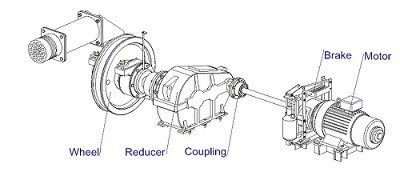
1. Components of the Traveling Mechanism
The traveling mechanism consists of:
End Carriages: Support the bridge and house the traveling wheels.
Driving Units: Motorized system for crane movement.
Wheels: Made of forged steel, running on the rails.
Gearbox & Couplings: Transmit power from the motor to the wheels.
Brakes: Ensure safety by stopping the crane movement when required.
Buffers & Anti-collision Devices: Protect against impact.
2. Working Principle
The crane moves longitudinally along the rails on end carriages.
Each end carriage has one or two drive units, depending on the load capacity.
Motors drive the wheels through gear reducers and couplings.
Variable frequency drives (VFDs) ensure smooth acceleration and deceleration to prevent ladle swinging.
3. Types of Traveling Mechanisms
Single Motor Drive: Used for smaller ladle cranes.
Double Motor Drive: More common in large ladle cranes for balanced movement.
Four-Motor Drive: Used for ultra-heavy-duty ladle cranes for enhanced stability and safety.
4. Features for Heavy-Duty Operations
High-temperature-resistant components (motors, cables, and bearings).
Synchronized motion control to reduce ladle swaying.
Heavy-duty wheels to handle extreme loads.
Anti-skid and anti-slip technology for smooth movement.
Emergency stop system to prevent accidents.
5. Maintenance Considerations
Regular wheel and rail inspections to avoid misalignment.
Monitoring motor temperature and lubrication levels.
Checking brake and gear systems for wear and tear.
6. Trolley traversing mechanism
Key Components of the Trolley Traversing Mechanism
Trolley Frame – A rigid structure housing the lifting mechanism and supporting components.
Traverse Motor – Provides power to move the trolley along the bridge girders. Typically, it is an AC or DC motor with variable frequency drive (VFD) for controlled acceleration and deceleration.
Gearbox & Transmission System – Reduces speed and increases torque for smooth movement.
Wheels & Rails – The trolley runs on hardened steel wheels along the crane's bridge rails. Guide rollers may be used to prevent derailment.
Braking System – Electromagnetic or hydraulic brakes ensure precise stopping and safety during operations.
Electrical Control System – Includes sensors, limit switches, and encoders to regulate movement and ensure positioning accuracy.
Working Principle
When the operator activates the controls, the traverse motor drives the gearbox, which transmits power to the trolley wheels via shafts or chains.
The trolley moves along the bridge rails, guided by limit switches and positioning sensors.
Brakes are applied when stopping, and safety interlocks prevent sudden movements or over-travel.
Special Features for Ladle Cranes
Heat-Resistant Components – Designed to withstand high temperatures in steel mills.
Redundant Safety Systems – Dual brakes, emergency stop functions, and overload protection to prevent accidents.
Precision Control – VFD and automation systems enable smooth and accurate trolley movement for precise ladle handling.
7. Crane wheel
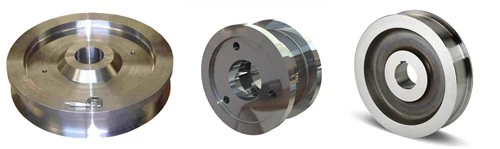
The crane wheel of a ladle overhead crane is a crucial component that supports and moves the crane along the runway rails. Since ladle cranes operate in high-temperature and heavy-load environments, their wheels must be made of high-strength materials with excellent wear resistance.
Key Features of Crane Wheels for Ladle Overhead Cranes:
Material:
Typically made of forged steel (e.g., 42CrMo, 65Mn, or AISI4140) to ensure durability and high load capacity.
Heat-treated for improved hardness and resistance to wear.
Design:
Available in single-flange, double-flange, or flangeless designs depending on the rail system.
Precision-machined tread surface for smooth rolling and minimal friction.
Heat Resistance:
Ladle cranes work in steel mills, where extreme temperatures are common.
The wheels must withstand high temperatures without deforming or losing hardness.
Load-Bearing Capacity:
Designed to support extremely heavy loads, often ranging from 100 to 500+ tons.
Engineered to distribute weight efficiently and prevent excessive rail wear.
Common Issues & Solutions:
Wear and Tear: Regular maintenance and lubrication reduce wear.
Flange Cracking: Using high-quality alloy steel and proper heat treatment minimizes flange failures.
Rail Misalignment: Ensuring proper rail installation and alignment prevents uneven wheel wear.
8. Crane hook
The crane hook of a ladle overhead crane is a critical lifting component designed to handle molten metal in steel mills and foundries. It is a specialized type of forged hook that must withstand high temperatures, heavy loads, and harsh working environments.
Key Features of Ladle Crane Hooks
Material: Typically made of high-strength forged steel (e.g., 34CrMo4, 42CrMo).
Load Capacity: Designed for extremely heavy loads, often 50 to 500 tons or more.
High-Temperature Resistance: Some hooks have heat-resistant coatings or water-cooling systems to withstand extreme heat from molten metal.
Double Hook or Rotating Hook: Many ladle cranes use double hooks for better stability and control. Some feature 360° rotation for precise positioning.
Safety Mechanisms: Hooks often have latches, locking mechanisms, or hydraulic clamps to prevent accidental load release.
Types of Crane Hooks for Ladle Cranes
Single Hook: Used for lower capacity ladle cranes.
Double Hook: Provides more stability and is common in high-capacity ladle cranes.
C-hook: Used for handling coils or slabs in steel plants.
Tongs (Ladle Hook Tongs): Designed specifically for gripping ladles securely.

9. Motor
Types of Motors in a Ladle Overhead Crane
A ladle crane typically consists of multiple motors for different functions:
Hoisting Motor (Main Lifting Motor)
Function: Lifts and lowers the ladle carrying molten metal.
Type: Usually a high-torque, heavy-duty AC or DC motor.
Power: Ranges from 75 kW to 500 kW, depending on load capacity.
Speed: Typically low-speed with a high torque output for safety and precision.
Braking System: Equipped with fail-safe brakes to prevent load drops.
Trolley Travel Motor
Function: Moves the trolley carrying the hoist across the bridge.
Type: AC squirrel cage induction motor or wound rotor motor.
Power: Usually 15 kW to 75 kW.
Speed: Medium-speed operation with smooth acceleration.
Bridge Travel Motor
Function: Moves the entire crane along the runway.
Type: Three-phase AC motor with variable frequency drive (VFD).
Power: Usually between 20 kW and 150 kW.
Control: Equipped with soft-start or VFD control for smooth movement.
Key Features of Motors in Ladle Overhead Cranes
High Heat Resistance: The motors are designed to withstand high temperatures in steel plants.
Heavy-Duty Operation: Capable of continuous duty cycles under extreme loads.
Variable Frequency Drive (VFD) Control: Used for smooth speed control and energy efficiency.
Redundant Safety Features: Includes braking systems, overload protection, and emergency stop mechanisms.

10. Sound and light alarm system & limit switch
1. Sound and Light Alarm System
This system is designed to alert workers about the crane's movement, ensuring workplace safety.
Functions:
Warning Signal: Alerts workers when the crane is in operation to avoid accidents.
Emergency Indication: Indicates malfunctions or unsafe conditions.
Automatic Activation: Typically linked to the crane's movement or hoisting action.
Components:
Audible Alarm (Buzzer or Siren): Produces loud sounds to warn personnel.
Visual Alarm (Flashing Light or Beacon): Provides a visible warning, especially in noisy environments.
Control System: Integrates with crane operations to activate alarms automatically.
2. Limit Switch of Ladle Overhead Crane
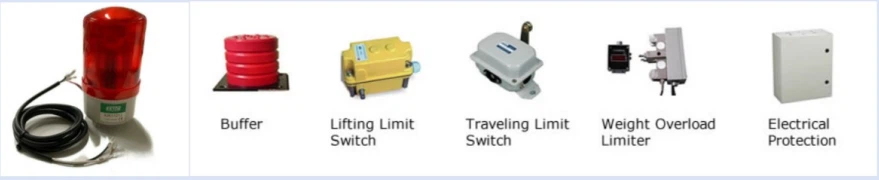
Limit switches are safety devices that prevent the crane from exceeding safe operating limits.
Types of Limit Switches:
Hoisting Limit Switch: Prevents over-lifting or over-lowering of the ladle.
Travel Limit Switch: Stops the crane from moving beyond preset boundaries.
Swing Limit Switch: Controls the rotation of the ladle carrier to avoid excessive swinging.
Overload Limit Switch: Prevents lifting loads beyond the crane's rated capacity.
11. Safety Devices
1. Mechanical Safety Devices
Overload Limiter: Prevents the crane from lifting loads beyond its capacity, reducing the risk of structural failure.
Limit Switches:
Lifting Height Limit Switch: Prevents the hook from exceeding safe lifting heights.
Travel Limit Switch: Stops the crane if it moves beyond its designated range.
Swing Limiter: Reduces load sway and stabilizes movements.
Emergency Stop System: Allows immediate shutdown of the crane in case of an emergency.
Buffer & Anti-Collision System: Protects against collisions by absorbing shock forces and stopping operations if another crane is too close.
Heat-Resistant Insulation: Protects electrical and mechanical components from extreme heat exposure.
Ladle Hook Safety Device: Ensures the ladle is securely held, reducing the risk of accidental detachment.
2. Electrical Safety Devices
Short Circuit & Overload Protection: Protects the electrical system from power surges and prevents motor burnout.
Voltage Loss & Phase Failure Protection: Ensures stable electrical power supply and prevents motor damage due to unbalanced voltage.
Grounding Protection: Prevents electric shocks to operators and equipment damage.
3. Operational & Monitoring Safety Features
CCTV Monitoring System: Provides real-time surveillance for remote operation and safety monitoring.
Temperature Sensors: Detect overheating in motors or electrical components to prevent failures.
Weighing System: Measures load weight in real time to prevent overloading.
Automatic Control & Anti-Sway System: Enhances precision and safety by reducing load swing.
4. Fire & Emergency Protection
Heat Shields & Cooling System: Protects the crane from extreme temperatures.
Fire Suppression System: Prevents fire hazards in case of an electrical short circuit or molten metal spillage.
Emergency Power Supply (UPS): Ensures the crane can lower the ladle in case of a power failure.
12. Control Mode
1. Manual Control
Cabin Control: An operator inside the crane cabin manually controls all movements.
Pendant Control: The operator uses a wired or wireless pendant to operate the crane from a safe distance.
Remote Control: Wireless remote control allows operation from an even safer location.
2. Semi-Automatic Control
Combines manual and automatic control features.
The crane follows pre-set motions for common tasks, but the operator can intervene when needed.
3. Fully Automatic Control
Controlled by a Programmable Logic Controller (PLC) or Distributed Control System (DCS).
Operates based on pre-programmed sequences and feedback from sensors.
Often integrated with a Supervisory Control and Data Acquisition (SCADA) system.
Improves safety and efficiency in steel plants.
4. AI-Based or Smart Control
Uses AI, machine learning, and vision systems for real-time decision-making.
Enhances precision and reduces human error.

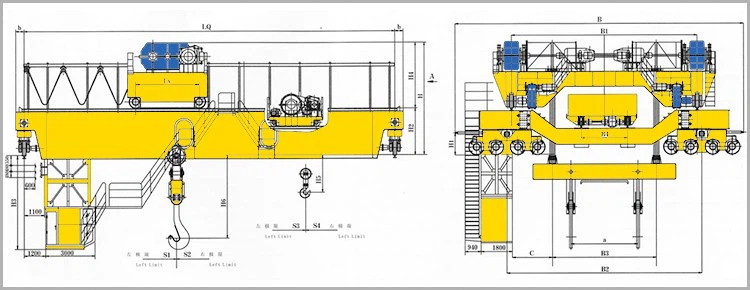
13. Sketch
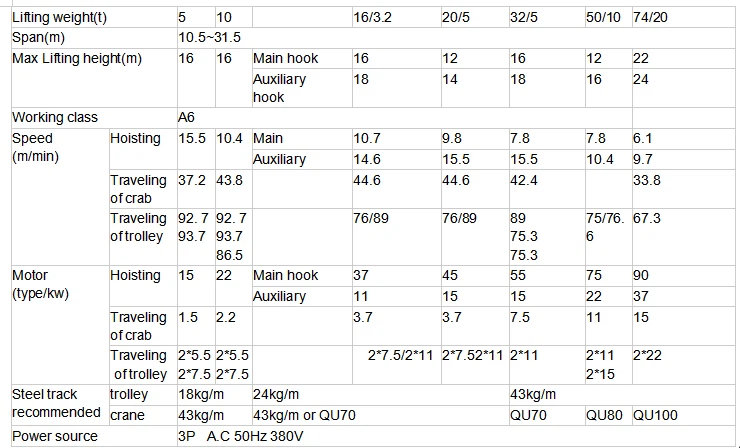
Main Technical Data
Advantages
Safety: These cranes are designed to handle dangerous materials such as molten metal, ensuring safety by keeping operators at a distance from hazardous areas.
Precision: Ladle overhead cranes offer high precision in positioning the ladle, which is vital when pouring molten metal or moving ladles between furnaces and casting areas.
Increased Productivity: With their efficient lifting and transportation capabilities, ladle overhead cranes can significantly speed up the production process in foundries and steel plants.
Heavy Load Handling: They are built to carry very heavy loads, often several tons, making them ideal for the demanding task of moving large ladles filled with molten metal.
Durability: These cranes are designed to withstand extreme heat, harsh operating environments, and heavy usage, ensuring long service life and reliability.
Customization: Ladle overhead cranes can be tailored to specific needs, including adjusting for different ladle sizes, lifting heights, and load capacities.
Reduced Manual Labor: These cranes automate the process of ladle handling, reducing the need for manual labor and minimizing the risk of worker injuries.
Operational Efficiency: They help streamline operations in steel mills and foundries, as they can handle complex tasks such as lifting, transporting, and pouring molten metal seamlessly.
Versatility: Besides transporting ladles, they can also be used for other heavy lifting tasks in the foundry or steel mill, adding versatility to the operation.
Energy Efficiency: Some ladle overhead cranes come with energy-efficient designs, optimizing power usage and lowering operational costs over time.
Application
Steel Plants: They are used to transport ladles containing molten steel from the furnace to the casting or refining stations. The crane helps to ensure the safety and efficiency of the steelmaking process by reducing manual handling.
Foundries: In foundries, ladle cranes move molten metal between melting furnaces and pouring stations. These cranes play a critical role in reducing risks associated with manually transporting hot metals.
Smelting Operations: Ladle cranes handle and transfer molten metal in smelting operations, assisting in the movement of the metal from the smelting furnace to molds for solidification.
Casting: These cranes are used to pour molten metal into molds during the casting process, ensuring precise control over the flow of material into the mold.
Maintenance and Repair: Ladle overhead cranes are also essential in maintenance operations, as they can transport ladles for cleaning, maintenance, or repair tasks, ensuring a continuous workflow in metalworking environments.
Load Handling in Steel Mills: They are crucial in moving heavy ladles filled with metal for refining, alloying, or further processing before the metal is sent for additional shaping or cooling.
Crane Production Procedure
1. Design & Engineering Phase
Requirement Analysis: Understanding customer needs, including load capacity, working environment, and operational requirements.
Structural Design: Creating detailed drawings for the main bridge, trolley, hoist, and ladle handling mechanism.
Electrical & Control System Design: Developing the control system (PLC, VFD, safety interlocks) and selecting electrical components.
Material Selection: Choosing high-strength steel, heat-resistant components, and other materials for extreme conditions.
2. Procurement of Raw Materials
Steel Plates & Profiles: Ordering high-quality steel for the crane structure.
Motors, Gearboxes & Electrical Parts: Sourcing motors, reducers, cables, sensors, and electrical cabinets.
Special Components: High-temperature-resistant parts, ladle hooks, and safety devices.
3. Fabrication & Welding
Main Girder & End Carriage Fabrication: Cutting, shaping, and welding steel beams to form the bridge structure.
Trolley & Hoist Assembly: Fabricating the trolley frame and integrating hoisting mechanisms.
Ladle Hook & Heat Shielding: Manufacturing ladle handling hooks and applying heat-resistant coatings.
Welding Quality Inspection: Ultrasonic and radiographic testing (UT, RT) to ensure weld integrity.
4. Machining & Surface Treatment
Precision Machining: Boring, drilling, and finishing critical mounting points.
Sandblasting & Painting: Surface treatment to prevent corrosion and enhance durability.
5. Electrical System Installation
Wiring & Control Panel Assembly: Installing cables, motors, sensors, and electrical enclosures.
Safety Features: Implementing limit switches, overload protection, and emergency stop systems.
6. Assembly & Pre-Testing
Mechanical Assembly: Integrating the bridge, trolley, hoist, and electrical systems.
Alignment & Calibration: Ensuring proper fit and alignment of all components.
Factory Testing: Conducting no-load and load testing, checking motor performance, and verifying safety features.
7. Transportation & On-Site Installation
Packing & Shipment: Disassembling and securely packaging for transport.
Installation at Customer Site: Assembling the crane on-site, connecting electricals, and performing final adjustments.
8. Commissioning & Final Testing
Load Testing: Testing at 100% and 125% rated load capacity.
Operational Test: Checking lifting, traversing, and control system functionality.
Safety Certification: Inspecting according to industry standards (ISO, FEM, CMAA, etc.).
9. Training & Handover
Operator Training: Providing user instructions for safe operation and maintenance.

Workshop View
The company has installed an intelligent equipment management platform, and has installed 310 sets (sets) of handling and welding robots. After the completion of the plan, there will be more than 500 sets (sets), and the equipment networking rate will reach 95%. 32 welding lines have been put into use, 50 are planned to be installed, and the automation rate of the entire product line has reached 85%.


Hot Tags: ladle overhead crane, China ladle overhead crane manufacturers, suppliers, factory, Ladle Foundry and Casting Steel Mill Overhead Crane, Casting Steel Overhead Crane, Rolling Mill Overhead Crane, Ladle Foundry Bridge Crane, Steel Factory Overhead Crane, Steel Mill Overhead Cranes
Previous
100 Ton Warehouse Overhead CraneYou Might Also Like


Send Inquiry