










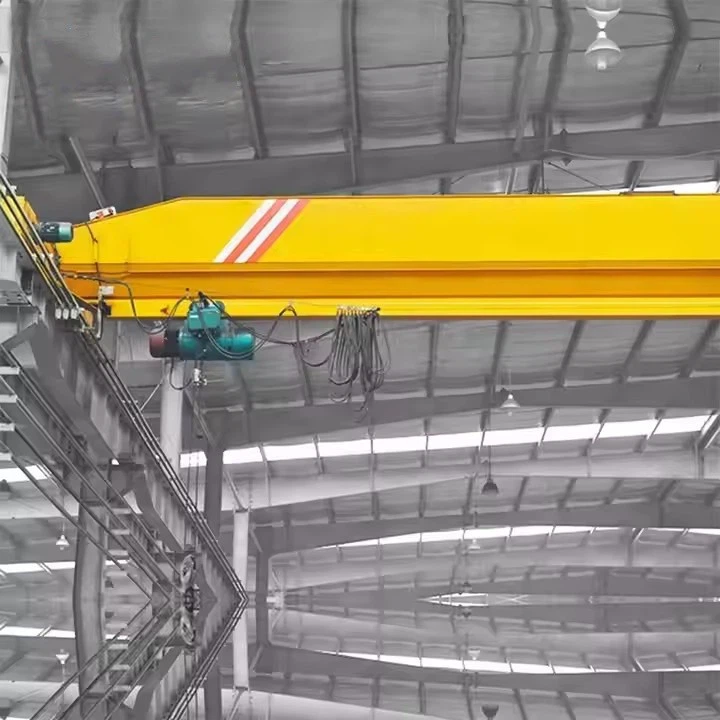

Small Single Beam Overhead Crane
Products Description
A Small Single Beam Overhead Crane is a lightweight lifting solution designed for workshops, warehouses, and manufacturing facilities. It features a single girder (beam) and is typically equipped with an electric hoist for efficient material handling. These cranes are ideal for lifting capacities ranging from 1 ton to 20 tons, with spans up to 31.5 meters.
Key Features & Specifications
Compact & Lightweight Design
Suitable for low-headroom applications, maximizing workspace efficiency.
The girder is a welded box structure for durability and reduced deflection.
Lifting Capacity & Span
Standard capacities: 1t, 2t, 3.2t, 5t, 10t, 16t, 20t.
Span range: 7.5m to 31.5m, adjustable based on workspace needs.
Hoisting Mechanism
Uses double-speed (6:1 ratio) or frequency-controlled lifting for precision.
Common hoist types: CD1 wire rope hoist or electric chain hoist.
Travel & Control
Travel speed: 3–30 m/min (crane), 2–20 m/min (hoist).
Control options: Pendant, remote, or cabin operation.
Power & Duty Class
Standard power: 380V/50Hz (adjustable to 460V/60Hz).
Duty classification: FEM 2m (A5), suitable for moderate industrial use.
Core Components: Gearbox, Motor, Gear
Place of Origin: Henan, China
Warranty: 1 Year
Weight (KG): 30000 kg
Video outgoing-inspection: Provided
Machinery Test Report: Provided
Selling Units: Single item
Single package size: 600X300X300 cm
Single gross weight: 200.000 kg
Comparison with Double-Girder Cranes
| Feature | Single Beam Crane | Double Girder Crane |
|---|---|---|
| Cost | Lower | Higher |
| Headroom | Minimal | More required |
| Capacity | Up to 20 tons | Up to 500+ tons |
| Span | Up to 31.5m | Up to 50m+ |
| Applications | Light/medium-duty | Heavy-duty industrial |

Pictures & Components
1. Main Girder (Single Beam)
The primary load-bearing structure, typically made of welded steel (box-type or I-beam design).
Designed for light to medium-duty lifting (1–20 tons).
Optimized for low headroom applications to save space.
 |
 |
2. End Trucks (End Carriages)
Located at both ends of the girder, equipped with wheels for movement along the runway rails.
Include drive motors for longitudinal travel (crane movement).
Can be single-girder or double-girder support type, depending on design.
 |
 |
3. Hoist & Trolley
Electric Hoist:
Wire rope hoist (CD1/MD1 type) – Common for heavier loads.
Chain hoist – Used for lighter loads (up to 5 tons).
Trolley Frame:
Moves horizontally along the girder.
Includes trolley wheels, motor, and gearbox for transverse travel.

4. Runway Beam & Rails
Supports the crane's movement along the workspace.
Made of steel I-beams or welded tracks.
Requires proper alignment to ensure smooth operation.

5. Electrical System
Control Panel: Manages power distribution and motor control.
Control Methods:
Pendant control (hanging push-button station).
Radio remote control (wireless operation).
Cabin control (for larger systems).
Limit Switches: Prevent over-travel of the hoist and trolley.

6. Power Supply System
Festoon System (Cable Reel): Supplies power to the crane via sliding cables.
Conductor Bars (Bus Bars): Alternative power delivery for long-span cranes.
7. Safety Devices
Overload Limiter: Prevents lifting beyond rated capacity.
Emergency Stop Button: For immediate shutdown.
Bumpers & Buffers: Absorb impact at travel limits.
Anti-Sway System (Optional): Reduces load swinging.
.
8. Braking System
Hoist Brake: Prevents load slippage when stopping.
Travel Brakes: Used on end truck motors for smooth stopping.
Additional Optional Components
Crane Scale: For weighing loads during lifting.
Explosion-Proof Features: For hazardous environments.
Variable Frequency Drive (VFD): For smoother speed control.


Sketch

Main technical

Advantages
Advantages of Small Single Beam Overhead Cranes
Cost-Effective
Lower initial cost compared to double-girder cranes.
Reduced installation and maintenance expenses.
Space-Saving Design
Compact structure with low headroom requirements, ideal for small workshops.
Maximizes vertical workspace without sacrificing lifting capacity.
Easy Installation & Mobility
Modular design allows quick assembly with bolt connections.
Can be mounted on existing support structures (columns or runway beams).
Energy Efficient
Uses standard electric hoists (wire rope or chain) with low power consumption.
Some models feature variable frequency drives (VFDs) for smoother operation.
Versatile Lifting Capacity
Handles loads from 1 ton to 20 tons, suitable for light to medium-duty tasks.
Adjustable span (typically 7.5m–31.5m) for different workspace layouts.
User-Friendly Operation
Simple controls (pendant, remote, or cabin-operated).
Optional anti-sway technology for precise load positioning.
Application:
Applications of Small Single Beam Overhead Cranes
1. Manufacturing & Workshops
Lifting machinery parts, molds, and assembly components.
Used in automotive, metalworking, and fabrication shops.
2. Warehousing & Logistics
Loading/unloading pallets, crates, and containers.
Efficient material handling in distribution centers.
3. Construction & Material Handling
Transporting steel beams, pipes, and construction materials.
Used in precast concrete production.
4. Ports & Shipyards
Handling small boats, engines, and marine equipment.
Light-duty lifting in dry docks and repair yards.
5. Mining & Energy Sectors
Moving generator parts, pumps, and mining equipment.
Suitable for power plants and oilfield maintenance.
6. Agriculture & Food Processing
Lifting feed bags, grain, and processing equipment.
Used in beverage and packaging industries.
Crane production procedure
1. Design & Engineering
Load Calculations – Structural analysis to determine girder dimensions, wheel loads, and deflection limits.
CAD Modeling – 3D design of the crane (main beam, end carriages, hoist trolley).
Standards Compliance – FEM 1.001, ISO 12485, or CMAA 70 specifications.
2. Material Procurement
Main Beam – Q235B/Q345B steel (cut to span length, typically 5–25m).
End Carriages – Fabricated from S355JR steel plates.
Wheels & Axles – 55Mn forged steel (hardened to HRC 50-55).
Electrical Components – Motors, brakes, and limit switches (CE/UL certified).
3. Main Girder Fabrication
A. Steel Plate Preparation
Laser/plasma cutting of steel plates.
Beveling edges for welding.
B. Welding & Assembly
Submerged Arc Welding (SAW) for longitudinal seams.
Box girder construction with internal stiffeners.
Post-weld heat treatment to relieve stress.
C. Machining
Drilling holes for trolley rails and connections.
Surface grinding for rail mounting area.
4. End Carriage Production
Frame Welding – Box-section design for rigidity.
Wheel Assembly –
Mounting forged steel wheels on shafts.
Installing spherical roller bearings (SKF/FAG).
Drive Unit Integration –
Motor, reducer, and brake coupling.
Alignment to ±0.5mm tolerance.
5. Hoist & Trolley Manufacturing
Trolley Frame – Welded steel with machined wheel paths.
Hoist Integration –
Mounting 10-ton electric wire rope/chain hoist.
Installing VFD for speed control.
Limit Switches – Upper/lower travel sensors.
6. Surface Treatment
Shot Blasting – Removes rust and scales.
Priming & Painting –
Epoxy primer (75μm).
Polyurethane topcoat (50μm, RAL color).
Anti-Corrosion Options – Hot-dip galvanizing (for harsh environments).
7. Electrical System Assembly
Control Panel – PLC, contactors, overload relays.
Wiring – Festoon system or conductor bars.
Safety Devices –
Emergency stop circuits.
Overload protection sensors.
8. Quality Testing
A. Dimensional Inspection
Beam straightness (±3mm over 10m).
Wheel alignment (±1mm).
B. Load Testing
Static Test – 125% SWL (12.5 tons) for 10 minutes.
Dynamic Test – 110% SWL (11 tons) with full travel.
C. Functional Checks
Brake performance (holds 150% load).
Limit switch activation accuracy.
9. Packaging & Shipping
Modular Disassembly – Main beam, end carriages, and electricals packed separately.
Protection – Waterproof wrapping for sea transport.
Documentation – Test reports, manuals, and certifications.
10. Installation & Commissioning
Runway Beam Alignment – Laser-leveled to ±2mm.
Crane Assembly – Bolt-up connection of modules.
Final Testing – Trial runs with actual loads.

Workshop view:
The company has installed an intelligent equipment management platform, and has installed 310 sets (sets) of handling and welding robots. After the completion of the plan, there will be more than 500 sets (sets), and the equipment networking rate will reach 95%. 32 welding lines have been put into use, 50 are planned to be installed, and the automation rate of the entire product line has reached 85%.


Hot Tags: small single beam overhead crane, China small single beam overhead crane manufacturers, suppliers, factory, Single Girder Overhead Crane, Single Girder Overhead Travelling Crane
You Might Also Like


Send Inquiry